
Italy Mass Notification System Market (2025-2030)

The Italy Mass Notification System Market was valued at $738.8 Million in 2025 and projected to reach to $855.5 Million by 2030, representing a compound annual growth rate of 9.0%. Italy's mass notification system market is experiencing steady growth at a 9% CAGR, significantly outpacing broader European trends as organizations prioritize emergency preparedness and regulatory compliance.


| Market Size in | USD 26.32 MN |
| Market Forecast in | |
| CAGR | |
| Forecast Period | |
| Units Considered | Value (USD MN) |
Italy Mass Notification System Market Trends and Insights
- Italy's market expansion is driven by increasing regulatory requirements for emergency communications, growing adoption of digital infrastructure across public and private sectors, and heightened awareness of business continuity management.
- The Italian market reflects steady demand from government agencies, enterprises, and critical infrastructure operators seeking reliable multi-channel notification solutions. In Italy, the mass notification system market benefits from the country's mature telecommunications infrastructure and regulatory frameworks mandating rapid public alert capabilities.
- Organizations across Italy are investing in integrated platforms that combine SMS, email, voice, and mobile app notifications to meet compliance standards and operational resilience requirements.
- The forecast period through 2030 indicates sustained growth as Italy continues to modernize emergency response systems and corporate communication protocols, positioning the country as a stable contributor to the broader European mass notification ecosystem..
Key Market Statistics
- CAGR (2025-2030) 9.0% CAGR
- Market Size, 2025 ~USD 738.8 Million
- Forecast, 2030 ~USD 855.5 Million
- Country Italy
Italy Mass Notification System Market Overview
Market Valuation :
Italy's mass notification system market is valued at USD 738.8 million in 2025, with projected growth to USD 855.5 million by 2030, reflecting steady market maturation and adoption across critical sectors.
Regulatory Compliance Drivers :
Increasing regulatory requirements for emergency communications in Italy are compelling organizations across public administration, healthcare, and utilities to implement robust mass notification solutions for citizen safety and operational continuity.
Digital Infrastructure Expansion :
Growing adoption of digital infrastructure across Italian public and private sectors is accelerating the deployment of integrated mass notification systems, particularly in smart city initiatives and enterprise risk management frameworks.
Emergency Preparedness Focus :
Heightened awareness of disaster management and emergency response capabilities in Italy is driving investment in multi-channel notification platforms that ensure rapid, reliable communication during critical incidents and natural disasters.
Italy Mass Notification System Market Dynamics
- The market benefits from Italy's stringent safety regulations, increasing digitalization of public services, and growing corporate focus on business continuity management.
- Key sectors including government agencies, healthcare institutions, and critical infrastructure operators are investing in advanced notification technologies to enhance operational resilience and public safety protocols. Looking ahead to 2030, Italy's market will be shaped by evolving EU directives on emergency communications, integration of AI-driven alert systems, and expansion of multi-channel notification capabilities.
- The convergence of IoT adoption, cloud-based solutions, and mobile-first communication strategies will create new growth opportunities.
- Organizations across Italy will increasingly demand integrated platforms that combine SMS, push notifications, voice alerts, and social media channels to ensure comprehensive audience reach during emergencies..
Market Ecosystem
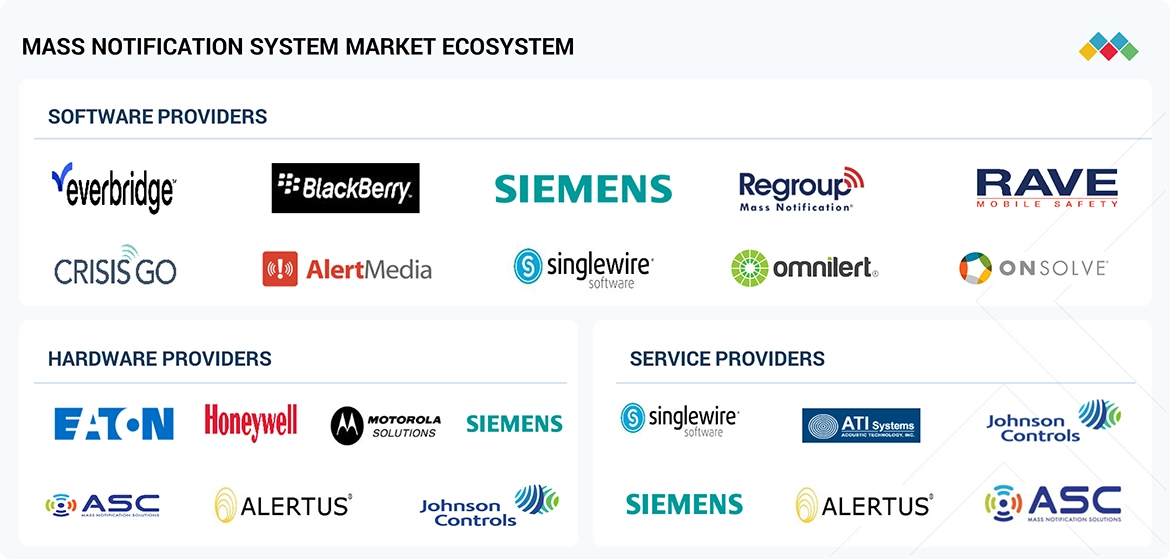
MASS NOTIFICATION SYSTEM MARKET: COMMERCIAL USE CASES ACROSS INDUSTRIES
| COMPANY | USE CASE DESCRIPTION | BENEFITS |
|---|---|---|
 |
Holland Hospital implemented the MNS solution InformaCast by Singlewire to strengthen staff safety and improve emergency communications across its main campus and 31 satellite locations. The platform replaced fragmented phone-based processes with a centralized system featuring a mobile panic button with user identification and location tracking, and integrated alerts across Cisco IP phones, overhead speakers, SMS, Microsoft Teams, email, and automated National Weather Service updates. | The platform improved response times and coordination for traveling and on-site staff. It enhanced cross-facility communication, strengthened situational awareness during emergencies and severe weather events, and ensured timely, multi-channel notifications for staff and patients. |
 |
Berenice International Airport deployed a centralized fire alarm and monitoring solution from Mircom (Flex-Net and Open Graphic Navigator) across its 37-building, 219,000 m² campus. The networked system connected control panels via 14 km of optical fiber and enabled centralized graphical monitoring and control through an integrated Fire Alarm Control Panel (FACP). | The solution delivered centralized, real-time visibility across airport facilities and strengthened emergency coordination. Its scalable network architecture and graphical troubleshooting tools improved operational oversight, system reliability, and long-term expansion flexibility. |
 |
The Minnesota Twins implemented the AlertMedia emergency communication and threat intelligence platform to enhance security at Target Field and during away games. The system provided real-time threat alerts and enabled rapid, multi-directional communication with staff across locations, improving coordination and situational awareness. | By centralizing threat intelligence within communication workflows, the organization improved its ability to identify and respond to potential risks. The solution enhanced personnel safety, strengthened event security operations, and ensured dependable crisis communication. |
Logos and trademarks shown above are the property of their respective owners. Their use here is for informational and illustrative purposes only.
Related Ecosystem
Cloud Computing
- Software as A Service (SaaS)
- Natural Language Processing (NLP)
- Platform as A Service (PaaS)
- Machine Learning
- Supply Chain Management
- International Business Machines Corporation
- MICROSOFT CORPORATION
- Oracle Corporation
- Amazon.com, Inc.
Digitalization And Iot
- Sensors
- Remote Monitoring
- Supply Chain Management
- Passenger Information System (PIS)
- Platform as A Service (PaaS)
- International Business Machines Corporation
- Cisco Systems, Inc.
- MICROSOFT CORPORATION
- Oracle Corporation
- HUAWEI TECHNOLOGIES CO LTD
Software And Services
- Natural Language Processing (NLP)
- Machine Learning
- Supply Chain Management
- Predictive Analytics
- Image Sensors
- International Business Machines Corporation
- MICROSOFT CORPORATION
- Oracle Corporation
- SAP SE
- Amazon.com, Inc.
Key Takeaways
- Italy's mass notification system market is valued at USD 738.8 million in 2025 and will reach USD 855.5 million by 2030 at a 9.0% CAGR.
- Italy's market growth is driven by regulatory compliance mandates and the need for robust emergency communication infrastructure across public and private sectors.
- Italian organizations are increasingly adopting multi-channel notification platforms to enhance business continuity and operational resilience.
- Italy's mature telecommunications landscape and regulatory environment position it as a stable, steady-growth market within the European mass notification sector.
Mass Notification System Market Report Scope
| Report Metric | Details |
|---|---|
| Base Year | 2025 |
| Fastest Growing Segment | SAFETY, RISK & THREAT INTELLIGENCE SOFTWARE (Software Type) |
| Forecast Period | 2025–2030 |
| Growth Rate | CAGR of 22.7% from 2025 to 2030 |
| Largest Segment | COMMERCIAL (End User) |
| Market Size Base Year (Billions) | ~USD 28.92 (2025) |
| Revenue Forecast (Billions) | ~USD 80.44 (2030) |
| Segments Covered | Offering, Software Type, Deployment Mode, Notification Device, Service, Communication Mode, Application, End User, Delivery Mode, Government & Public Sector End User, Commercial End User, Industrial End User |
Italy Mass Notification System Market Report Segmentation
12 segment dimensions are covered across the global market.
By Offering
- Notification Device
- Notification Devices
- Services
- Software
By Software Type
- Analytics, Reporting & Intelligence Software
- Incident & Event Management Software
- Mass Notification Platforms
- Operational & It Alerting Software
- Platform Enablement & Integration Software
- Safety, Risk & Threat Intelligence Software
By Deployment Mode
- Cloud
- On-Premises
By Notification Device
- Duress Buttons
- Electronic Messaging Displays
- Fire Alarm Systems
- Public Address Systems
- Sirens
- Visual Alert Devices
By Service
- Managed
- Managed Services
- Professional
- Professional Services
By Communication Mode
- Auditory
- Auditory Communication
- Multimodal
- Multimodal Communication
- Text-Based
- Text-Based Communication
By Application
- Awareness, Information, And Administrative Communication
- Business Continuity & Organizational Resilience
- Critical Event & Incident Management
- Emergency & Crisis Notification
- Operational & It Alerting
- Other Applications
- Preparedness, Training & Drills
- Preparedness, Training, And Drills
- Public Safety & Government Alerting
By End User
- Bfsi
- Commercial
- Construction & Large-Scale Infrastructure Projects
- Corporate Offices & Enterprise Campuses
- Courts, Civic, And Public Infrastructure
- Data Centers & Mission-Critical Facilities
- Educational Institutions
- Emergency Management & Civil Defense Authorities
- Energy & Utilities
- Federal, State, And Local Government Agencies
- Government & Public Sector
- Healthcare Providers
- Hospitality & Consumer-Facing Venues
- Industrial
- Logistics, Warehousing, And Distribution Centers
- Manufacturing Plants & Industrial Campuses
- Military & Defense
- Mining & Heavy Industry Sites
- Oil, Gas, And Chemical/Process Industries
- Public Safety & Law Enforcement Agencies
- Retail & E-Commerce Operators
- Transportation & Transit Operators
By Delivery Mode
- Auditory
- Multimodal
- Text-Based
By Government & Public Sector End User
- Courts, Civic & Public Infrastructure
- Courts, Civic, And Public Infrastructure
- Emergency Management & Civil Defense Authorities
- Federal, State & Local Government Agencies
- Federal, State, And Local Government Agencies
- Military & Defence
- Military & Defense
- Public Safety & Law Enforcement Agencies
By Commercial End User
- Bfsi
- Corporate Offices & Enterprise Campuses
- Data Centers & Mission-Critical Facilities
- Educational Institutions
- Healthcare Providers
- Hospitality & Consumer-Facing Venues
- Retail & E-Commerce Operators
- Transportation & Transit Operators
By Industrial End User
- Construction & Large-Scale Infrastructure Projects
- Energy & Utilities
- Logistics, Warehousing, And Distribution Centers
- Manufacturing Plants & Industrial Campuses
- Mining & Heavy Industry Sites
- Oil, Gas, And Chemical/Process Industries
ITALY: MASS NOTIFICATION SYSTEM MARKET, BY END USER, 2026–2031
| Segment | 2026 | 2027 | 2028 | 2029 | 2030 | 2031 | CAGR (%) |
|---|---|---|---|---|---|---|---|
| COMMERCIAL | 237.9 | 265.4 | 293.8 | 322 | 350.2 | 377.9 | 9.7 |
| GOVERNMENT & PUBLIC SECTOR | 195.1 | 214.1 | 233.2 | 251.5 | 269.1 | 285.6 | 7.9 |
| INDUSTRIAL | 123.9 | 137.5 | 151.5 | 165.3 | 178.9 | 192.1 | 9.2 |
| TOTAL | 557 | 617 | 678.6 | 738.8 | 798.2 | 855.5 | 9 |
Target Audience
- Italian Government & Public Administration : Government agencies and municipal authorities need this data to understand market trends, evaluate vendor solutions, and plan emergency communication infrastructure investments aligned with regulatory mandates and citizen safety requirements.
- Healthcare & Hospital Networks : Italian healthcare institutions require market insights to assess notification system capabilities for patient alerts, staff coordination, and emergency response protocols, ensuring compliance with healthcare-specific regulations.
- Critical Infrastructure Operators : Utilities, transportation, and energy sector organizations in Italy need market intelligence to evaluate mass notification solutions for operational continuity, incident response, and regulatory compliance in critical service delivery.
- Enterprise Risk & Business Continuity Managers : Corporate decision-makers across Italian organizations require market data to justify investments in mass notification systems, benchmark against industry standards, and select solutions that meet business continuity and crisis management objectives.
- Technology Vendors & Solution Providers : Mass notification system vendors and IT solution providers need Italy-specific market analysis to identify growth opportunities, understand local customer requirements, develop targeted go-to-market strategies, and assess competitive positioning.
Key Companies in the Italy Mass Notification System Market
| Company | HQ | Ownership | Strongest segments |
|---|---|---|---|
| AIRBUS GROUP SE | United States | Public Company | Public Warning & Emergency Alerting Software,Operational & IT Alerting Software,Fire Alarm Systems Hardware, |
| ENGHOUSE INTERACTIVE | United States | Private Company | Public Warning & Emergency Alerting Software,Operational & IT Alerting Software,Fire Alarm System Hardware, |
AIRBUS GROUP SE
Airbus Group SE is a publicly traded aerospace and defense company founded in 1998, headquartered in the United States. With 166,876 employees, it operates as a major global manufacturer of commercial aircraft, helicopters, and defense systems.
ENGHOUSE INTERACTIVE
Enghouse Interactive is a private software company founded in 1984 and based in the United States. With 243 employees, it provides interactive software solutions and services.
Reasons to Buy this Report
- Italy-Specific Market Sizing : Access precise market valuation data for Italy (USD 738.8M in 2025) with detailed forecasts through 2030, enabling accurate budget allocation and investment planning tailored to the Italian market landscape.
- Regulatory Landscape Intelligence : Understand Italy's unique regulatory requirements for emergency communications and compliance mandates that are driving market growth, helping organizations align their notification strategies with local legal frameworks.
- Sector-Specific Adoption Insights : Gain detailed analysis of mass notification adoption across Italian public administration, healthcare, utilities, and private enterprises, identifying high-growth segments and implementation best practices specific to Italy.
- Competitive Positioning Strategy : Benchmark your solutions against Italian market dynamics and competitor strategies, understanding local customer preferences, procurement patterns, and differentiation opportunities in the 9% CAGR growth environment.
- Investment and Expansion Planning : Make informed decisions about market entry, partnership development, or expansion in Italy with comprehensive data on market drivers, growth trajectories, and emerging opportunities through 2030.
Frequently asked questions
What is the current market size of mass notification systems in Italy?
Italy's mass notification system market is valued at USD 738.8 million in 2025.
What is the projected market size for mass notification systems in Italy by 2030?
Italy's mass notification system market is projected to reach USD 855.5 million by 2030.
What is the CAGR for Italy's mass notification system market?
Italy's mass notification system market is expected to grow at a compound annual growth rate (CAGR) of 9.0% from 2025 to 2030.
What are the primary drivers of growth in Italy's mass notification system market?
Key drivers include regulatory compliance requirements for emergency communications, digital infrastructure modernization, and increased focus on business continuity management across Italian organizations.
Which sectors are driving demand for mass notification systems in Italy?
Government agencies, critical infrastructure operators, and large enterprises in Italy are primary drivers of demand for integrated multi-channel notification solutions.
RESEARCH METHODOLOGY
The research methodology for the mass notification system market report involved extensive secondary sources and directories, as well as various reputable open-source databases, to identify and collect relevant information for this technical and market-oriented study. In-depth interviews were conducted with various primary respondents, including end users, high-level executives from multiple companies offering mass notification system software, notification devices & services, and industry consultants, to obtain and verify critical qualitative and quantitative information and assess market prospects and industry trends.
Secondary Research
During the secondary research process, various secondary sources were consulted to identify and collect information for the study. The secondary sources included annual reports, press releases, and investor presentations of companies; white papers; and certified publications.
Secondary research was used to gather key information on the industry’s value chain, the market’s monetary chain, the overall pool of key players, market classification, and segmentation based on industry trends, regional markets, and key developments from both market- and technology-oriented perspectives.
Primary Research
In the primary research process, a diverse range of stakeholders from both the supply and demand sides of the mass notification system ecosystem were interviewed to gather qualitative and quantitative insights specific to this market. From the supply side, key industry experts, such as chief executive officers (CEOs), vice presidents (VPs), marketing directors, technology & innovation directors, and technical leads from vendors offering mass notification system hardware, software & services, were consulted. Additionally, system integrators, service providers, and IT service firms that implement and support the mass notification system solutions were included in the study. On the demand side, input from IT decision-makers, infrastructure managers, and business heads from prominent industry verticals was collected to understand user perspectives and adoption challenges within the targeted industries.
The primary research ensured that all crucial parameters affecting the mass notification system market, including technological advancements and evolving use cases, as well as regulatory and compliance needs, were considered. Each factor was thoroughly analyzed, verified through primary research, and evaluated to obtain precise quantitative and qualitative data for this market.
Once the initial phase of market engineering was completed, which included detailed calculations for market statistics, segment-specific growth forecasts, and data triangulation, a second round of primary research was conducted. This step was crucial for refining and validating critical data points, such as mass notification system offerings (software, notification devices, & services), industry adoption trends, the competitive landscape, and key market dynamics like demand drivers (Growing IPAWS / WEA–equivalent compliance as a structural market requirement, embedding of MNS into regulated operational environments, expectation of immediate, area-wide alerting for life safety), challenges (limited end-to-end delivery confirmation in broadcast alerting, securing alert origination under heightened cyber and insider risk), and opportunities (managed alerting and compliance services, resilient edge-enabled notification capability, use of MNS for cyber and infrastructure incident communications), restraints (persistence of legacy, non-standard alerting assets, high consequence of erroneous alerting).
In the comprehensive market engineering process, the top-down and bottom-up approaches, along with several data triangulation methods, were extensively employed to estimate and forecast the overall market segments and subsegments listed in this report. Extensive qualitative and quantitative analysis was conducted across the complete market engineering process to capture critical information/insights throughout the report.
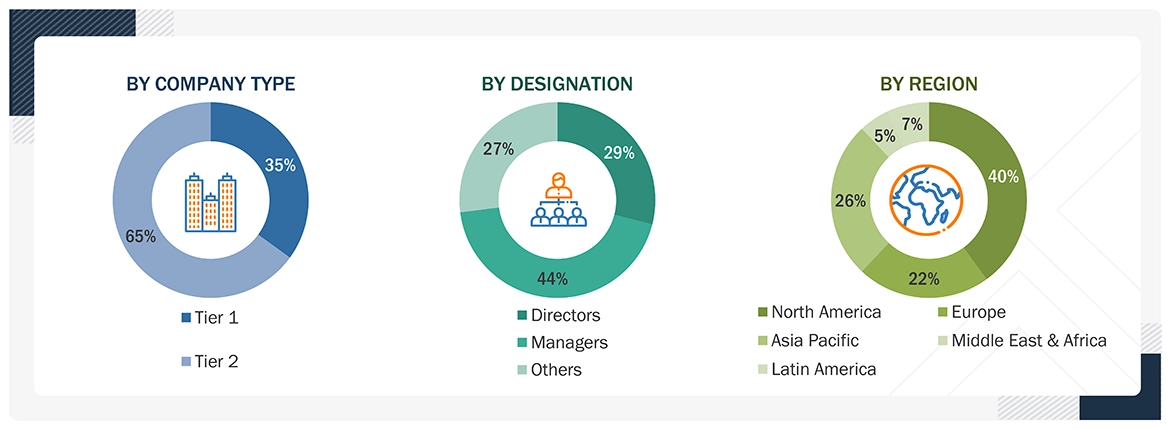
Note: Three tiers of companies are defined based on their total revenue as of 2025; tier 1 = revenue more than USD 100 million, tier 2 = revenue less than USD 100 million
Source: MarketsandMarkets Analysis
To know about the assumptions considered for the study, download the pdf brochure
Market Size Estimation
The top-down and bottom-up approaches were employed to estimate and forecast the mass notification system market, as well as its dependent submarkets. This multi-layered analysis was further reinforced through data triangulation, which incorporated primary and secondary research inputs. The market figures were also validated against the existing MarketsandMarkets repository for accuracy.
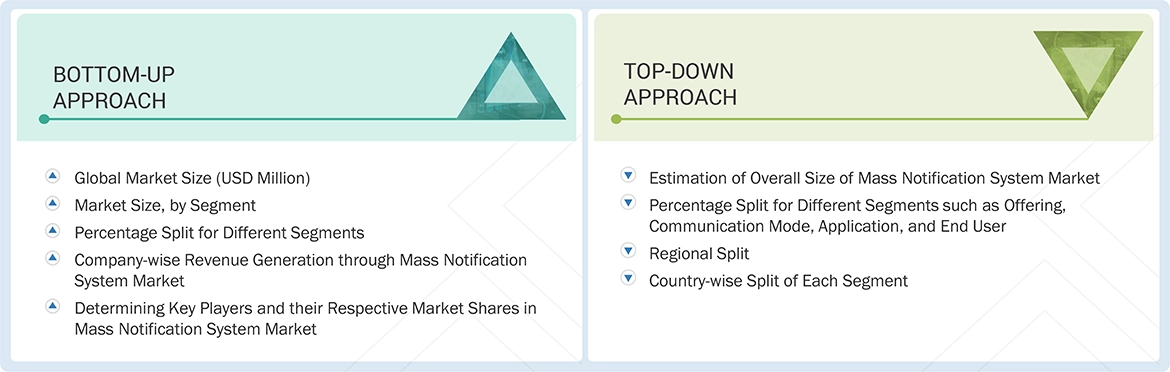
Data Triangulation
The market was divided into several segments and subsegments after determining the overall market size using the market size estimation processes described above. To complete the overall market engineering process and determine the exact statistics for each market segment and subsegment, data triangulation and market segmentation procedures were employed, wherever applicable. The overall market size was then used in the top-down approach to estimate the size of other individual markets by applying percentage splits to the market segmentation.
Market Definition
According to Everbridge, a mass notification system is a vital solution that enables prompt and precise delivery of notifications to individuals or groups, irrespective of their location. It is a comprehensive platform, swiftly disseminating emergency messages through various communication channels like voice calls, SMS, push notifications, desktop alerts, and social media. By utilizing visual intelligence and user-friendly interfaces, a mass notification system ensures that the right message reaches the intended recipients during critical events, regardless of their devices or physical whereabouts. This system plays a pivotal role in protecting people, securing operations, and safeguarding the reputation of organizations by facilitating timely and accurate communication.
Key Stakeholders
- Mass notification system vendors
- Mass notification software vendors
- Mass notification devices vendors
- Enterprise end-users
- Distributors and value-added resellers (VARs)
- Government agencies
- Independent software vendors (ISV)
- Managed service providers
- Support & maintenance service providers
- System integrators (SIs)/migration service providers
- Technology providers
- Academia & research institutions
- Investors & venture capital firms
- Market research and consulting firms
- Internet of Things (IoT) analytics vendors
Report Objectives
- To define, describe, and predict the mass notification system market by offering (software, notification devices, and services), communication mode, application, vertical, and region
- To provide detailed information related to major factors (drivers, restraints, opportunities, and industry-specific challenges) influencing market growth
- To analyze opportunities in the market and provide details of the competitive landscape for stakeholders and market leaders
- To forecast the market size of segments with respect to five main regions: North America, Europe, Asia Pacific, Middle East & Africa, and Latin America
- To analyze each submarket with respect to individual growth trends, prospects, and contributions to the overall mass notification system market
- To analyze competitive developments, such as partnerships, new product launches, mergers & acquisitions, in the mass notification system market
- To analyze the competitive developments, such as partnerships, product launches, mergers & acquisitions, in the mass notification system market
- To analyze the impact of macroeconomic factors on the mass Notification System market across all regions
Available customizations:
Using the provided market data, MarketsandMarkets offers customizations tailored to the company’s specific needs. The following customization options are available for the report.
Product analysis
- Product comparative analysis, which gives a detailed comparison of innovative products being offered by prominent vendors
Geographic analysis
- Further breakup of additional European countries by offering, communication mode, application, and end user
- Further breakup of additional Asia Pacific countries by offering, communication mode, application, and end user
- Further breakup of additional Middle East & African countries by offering, communication mode, application, and end user
- Further breakup of additional Latin American countries by offering, communication mode, application, and end user
Company information
- Detailed analysis and profiling of additional market players (up to five)
Get the Full Mass Notification System Market Report
Full forecast, segment splits, and company analysis for all Mass Notification System Market.
- Canada Mass Notification System Market
- US Mass Notification System Market
- UK Mass Notification System Market
- Germany Mass Notification System Market
- France Mass Notification System Market
- China Mass Notification System Market
- India Mass Notification System Market
- Japan Mass Notification System Market
- Saudi Arabia Mass Notification System Market
- UAE Mass Notification System Market
- Turkey Mass Notification System Market
- South Africa Mass Notification System Market
- Brazil Mass Notification System Market
- Mexico Mass Notification System Market
Need a Tailored Report?
Customize this report to your needs
Get 10% FREE Customization
Customize This Report
