
Europe Medical Electronics Market (2024-2029)

The Europe Medical Electronics Market was valued at $2902.2 Million in 2024 and projected to reach to $3876.6 Million by 2029, representing a compound annual growth rate of 6.0%. Europe's medical electronics market is positioned for sustained growth through 2029, supported by an aging population, increasing prevalence of chronic diseases, and rising healthcare expenditure across member states.


| Market Size in | USD 26.32 MN |
| Market Forecast in | |
| CAGR | |
| Forecast Period | |
| Units Considered | Value (USD MN) |
Europe Medical Electronics Market Trends and Insights
- This steady growth reflects Europe's strong healthcare infrastructure, regulatory frameworks, and increasing demand for advanced diagnostic and monitoring devices.
- Europe continues to lead in medical device innovation, driven by aging populations and rising healthcare expenditures across the region. The European medical electronics sector benefits from stringent quality standards and established manufacturing capabilities that support both domestic consumption and export markets.
- Between 2024 and 2029, Europe is expected to maintain its position as a key hub for medical electronics development, with particular strength in diagnostic imaging, patient monitoring systems, and surgical instruments.
- The region's commitment to digital health transformation and integration of IoT technologies in medical devices further accelerates market expansion throughout the forecast period..
Key Market Statistics
- CAGR (2024-2029) 6.0% CAGR
- Market Size, 2024 ~USD 2902.2 Million
- Forecast, 2029 ~USD 3876.6 Million
- Geography Europe
Europe Medical Electronics Market Overview
Market Leadership :
Europe commands a significant share of the global medical electronics market with a valuation of $2,902.2 million in 2024, driven by advanced healthcare infrastructure and stringent regulatory standards that ensure product quality and safety.
Steady Growth Trajectory :
The European market is projected to reach $3,876.6 million by 2029 at a CAGR of 6.0%, reflecting consistent demand for innovative diagnostic and monitoring devices across the region's mature healthcare systems.
Germany's Dominance :
Germany leads European medical electronics with a market size of $1,205.1 million, leveraging its strong manufacturing base, engineering expertise, and reputation for precision medical device innovation.
Regulatory Excellence :
Europe's robust CE marking and MDR compliance frameworks establish the region as a quality benchmark, attracting investment and fostering innovation in medical electronics development and commercialization.
Europe Medical Electronics Market Dynamics
- The region's commitment to digital health transformation and remote patient monitoring technologies is accelerating adoption of advanced medical devices.
- Germany, the UK, and France collectively represent over 70% of the European market, with strong innovation ecosystems and healthcare investment driving expansion.
- Regulatory harmonization under the Medical Device Regulation (MDR) continues to strengthen market standards while creating opportunities for compliant manufacturers..
Market Ecosystem
Related Ecosystem
Electronics System And Components
- Sensors
- Temperature Sensors
- Pressure Sensors
- Actuators
- Image Sensors
- Lenovo
- Samsung
- Texas Instruments Incorporated
- HONEYWELL INTERNATIONAL INC.
- Teledyne Technologies Incorporated
Sensors And Control
- Sensors
- Temperature Sensors
- Image Sensors
- Pressure Sensors
- Flow Sensors
- BAUMER ELECTRIC AG
- HONEYWELL INTERNATIONAL INC.
- Stmicroelectronics
- Lenovo
- Texas Instruments Incorporated
Key Takeaways
- Europe's medical electronics market will grow from $2,902.2M (2024) to $3,876.6M (2029) at a 6.0% CAGR.
- Europe maintains leadership in medical device innovation through advanced manufacturing and regulatory excellence.
- Aging demographics and digital health initiatives drive sustained demand for medical electronics across Europe.
- Europe's stringent quality standards and established infrastructure support both regional and export market growth.
Medical Electronics Market Report Scope
| Report Metric | Details |
|---|---|
| Base Year | 2024 |
| Fastest Growing Segment | OTHER MEDICAL FACILITIES (Medical Facility) |
| Forecast Period | 2024-2029 |
| Growth Rate | CAGR of 7.2% from 2024 to 2029 |
| Largest Segment | CLASS II (Medical Device Classification) |
| Market Size Base Year (Billions) | ~USD 11.09 (2024) |
| Revenue Forecast (Billions) | ~USD 15.7 (2029) |
| Segments Covered | Component, Type, Medical Equipment/Device Type, Medical Equipment/ Device Type, Medical Procedure, Medical Device Classification, Medical Facility |
Europe Medical Electronics Market Report Segmentation
7 segment dimensions are covered across the global market.
By Component
- Batteries
- Displays
- Memory Chips
- Mpus/Mcus
- Sensors
By Type
- Anesthesia Monitors
- Blood Gas Monitors
- Blood Glucose Monitors
- Blood Glucose Sensors
- Blood Oxygen Sensors
- Blood Pressure Monitors
- Cardiac Monitors
- Ct Scanners
- Digital Thermometers
- Doppler Monitors
- Ecg Sensors
- Electrocardiograph (Ecg)/ Electrocardiogram (Ekg) Monitors
- Endoscopes
- Flow Sensors
- Heart Rate Monitors
- Heart Rate Sensors
- Hemodynamic Monitors
- Image Sensors
- Ingestible Sensors
- Lithium-Ion (Li-Ion) Batteries
- Magnetic Resonance Imaging (Mri) Scanners
- Motion Sensors
- Multi-Parameter Monitoring Devices
- Neuromonitoring Devices
- Nuclear Imaging Systems
- Other Batteries
- Piezo Film Sensors
- Position Sensors
- Positron Emission Tomography (Pet) Scanners
- Pressure Sensors
- Pulse Oximeters
- Respiratory Monitors
- Single-Photon Emission Computed Tomography (Spect) Scanners
- Sleep Apnea Monitors
- Temperature Sensors
- Touch Sensors
- Ultrasound Scanners
- X-Ray Scanners
- Zinc Batteries
By Medical Equipment/Device Type
- Active Medical Implantable Devices
- Diagnostic And Imaging Devices
- Other Medical Equipment/Device Type
- Other Medical Equipment/Device Types
- Patient Monitoring Devices
- Surgical Robotic Systems
- Ventilators And Rgm Equipment
By Medical Equipment/ Device Type
- Active Medical Implantable Devices
- Diagnostic And Imaging Devices
- Other Medical Equipment/Device Types
- Patient Monitoring Devices
- Respiratory Care Devices
- Surgical Robotic Systems
By Medical Procedure
- Invasive
- Minimally Invasive
- Non-Invasive
By Medical Device Classification
- Class I
- Class Ii
- Class Iii
By Medical Facility
- Hospitals & Clinics
- Nursing Homes, Assisted Living Facilities, Long-Term Care Centers, And Home Care Settings
- Nursing Homes, Assisted Living Facilities, Long-Term Care Centers, And Home Health Care Settings
- Other Medical Facilities
Target Audience
- Medical Device Manufacturers : Manufacturers need Europe-specific market data to optimize product development, regulatory strategy, and market entry planning across diverse European healthcare systems and regulatory environments.
- Healthcare Investors & PE Firms : Investment professionals require detailed European market segmentation and growth forecasts to identify acquisition targets, assess portfolio company performance, and evaluate expansion opportunities.
- Healthcare Providers & Hospital Networks : Hospital administrators and procurement teams use market intelligence to benchmark equipment costs, evaluate supplier options, and plan capital equipment budgets across European facilities.
- Regulatory & Compliance Consultants : Consultants advising medical device companies need comprehensive European market context to guide clients through MDR compliance, market access strategies, and regional expansion planning.
- Market Research & Strategy Teams : Corporate strategists and business development teams require granular European market data to support competitive analysis, market positioning, and long-term strategic planning initiatives.
Countries within Europe - compare and drill down
| Country | 2025 size (native) |
|---|---|
| Germany | USD 1205.1 Million |
| UK | USD 701.2 Million |
| France | USD 798.3 Million |
| Italy | USD 395.3 Million |
| Rest Of Europe | USD 776.8 Million |
Country market size visualization
Reasons to Buy this Report
- Country-Level Market Segmentation : Access detailed market sizing for Germany ($1,205.1M), UK ($701.2M), France ($798.3M), Italy ($395.3M), and Rest of Europe, enabling precise market targeting and regional strategy development.
- Regulatory Compliance Insights : Understand Europe's stringent MDR and CE marking requirements, helping manufacturers navigate compliance pathways and identify market entry opportunities across different European jurisdictions.
- Competitive Landscape Analysis : Benchmark your position against regional leaders and identify growth opportunities in Europe's mature yet expanding medical electronics sector with detailed competitive dynamics.
- Investment Decision Support : Make informed capital allocation decisions with comprehensive market forecasts through 2029, identifying high-growth segments and geographic priorities within Europe's medical electronics ecosystem.
- Strategic Partnership Opportunities : Identify collaboration and acquisition targets across Europe's fragmented medical electronics landscape, leveraging country-specific market intelligence and growth projections.
Frequently asked questions
What is the current size of Europe's medical electronics market?
Europe's medical electronics market is valued at $2,902.2 million in 2024 and is expected to reach $3,876.6 million by 2029.
What is the projected growth rate for Europe's medical electronics market?
Europe's medical electronics market is projected to grow at a compound annual growth rate (CAGR) of 6.0% from 2024 to 2029.
What factors are driving growth in Europe's medical electronics sector?
Key drivers include aging populations, rising healthcare expenditures, digital health transformation, IoT integration, and Europe's strong regulatory and manufacturing infrastructure.
Which product categories dominate Europe's medical electronics market?
Europe shows particular strength in diagnostic imaging, patient monitoring systems, surgical instruments, and connected medical devices.
How does Europe's medical electronics market compare to global trends?
Europe's 6.0% CAGR is slightly below the global 7.2% CAGR, reflecting mature market dynamics and higher baseline valuations in the region.
RESEARCH METHODOLOGY
The study involved four major activities in estimating the current size of the medical electronics market—exhaustive secondary research collected information on the market, peer, and parent markets. The next step was to validate these findings, assumptions, and sizing with industry experts across the value chain through primary research. Both top-down and bottom-up approaches were employed to estimate the complete market size. After that, market breakdown and data triangulation were used to estimate the market size of segments and subsegments.
Secondary Research
Various secondary sources have been referred to in the secondary research process to identify and collect information important for this study. The secondary sources include annual reports, press releases, and investor presentations of companies; white papers; journals and certified publications; and articles from recognized authors, websites, directories, and databases. Secondary research has been conducted to obtain critical information about the industry’s supply chain, the market’s value chain, the total pool of key players, market segmentation according to the industry trends (to the bottom-most level), regional markets, and key developments from market- and technology-oriented perspectives. The secondary data has been collected and analyzed to determine the overall market size, further validated by primary research.
List of major secondary sources
|
Source |
Web Link |
|
Semiconductor Industry Association (SIA) |
|
|
AMA Association for Sensors and Measurement |
|
|
Global Semiconductor Alliance |
|
|
Taiwan Semiconductor Industry Association |
|
|
International Medical Device Manufacturers Association |
|
|
World Health Organization (WHO) |
|
|
Food and Drug Administration (FDA) |
|
|
Organization for Economic Co-operation and Development (OCED) |
|
|
European Confederation of Medical Devices Association (EUCOMED) |
Primary Research
Extensive primary research was conducted after gaining knowledge about the current scenario of the medical electronics market through secondary research. Several primary interviews were conducted with experts from the demand and supply sides across four major regions—North America, Europe, Asia Pacific, and RoW. This primary data was collected through questionnaires, emails, and telephonic interviews.
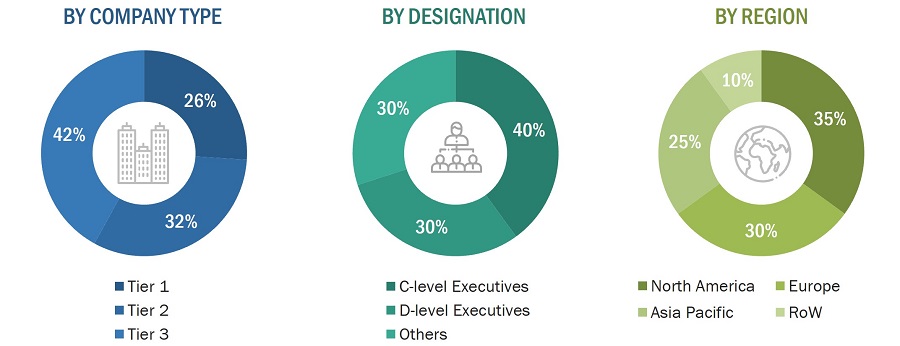
To know about the assumptions considered for the study, download the pdf brochure
Market Size Estimation
In the complete market engineering process, top-down and bottom-up approaches and several data triangulation methods have been used to estimate and forecast the overall market segments and subsegments listed in this report. Key players in the market have been identified through secondary research, and their market shares in the respective regions have been determined through primary and secondary research. This entire procedure includes the study of annual and financial reports of the top market players and extensive interviews for key insights (quantitative and qualitative) with industry experts (CEOs, VPs, directors, and marketing executives).
All percentage shares, splits, and breakdowns have been determined using secondary sources and verified through primary sources. All the parameters affecting the markets covered in this research study have been accounted for, viewed in detail, verified through primary research, and analyzed to obtain the final quantitative and qualitative data. This data has been consolidated and supplemented with detailed inputs and analysis from MarketsandMarkets and presented in this report. The following figure represents this study’s overall market size estimation process.
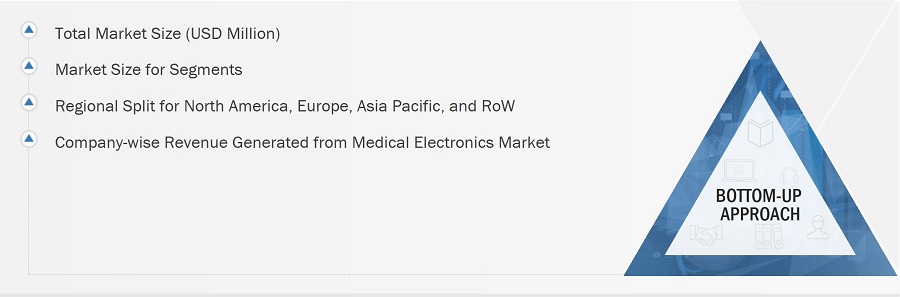
Bottom-Up Approach
The bottom-up approach was used to determine the overall size of the medical electronics market from the revenues of the key players and their shares in the market. The overall market size was calculated based on the revenues of the key players identified in the market.
- Identifying entities in the supply chain influencing the entire medical electronics industry
- Analyzing each entity, along with related major companies
- Identifying technology providers for deployment of components
- Estimating market for medical electronics end users
- Tracking ongoing and upcoming implementation of medical electronic components developments by various companies and forecasting market based on these developments and other critical parameters
- Arriving at market size by analyzing medical electronics companies based on their countries and combining it to obtain market estimates by region
- Verifying estimates and crosschecking them through a discussion with key opinion leaders, including chief experience officers (CXOs), directors, and operation managers
Top-Down Approach
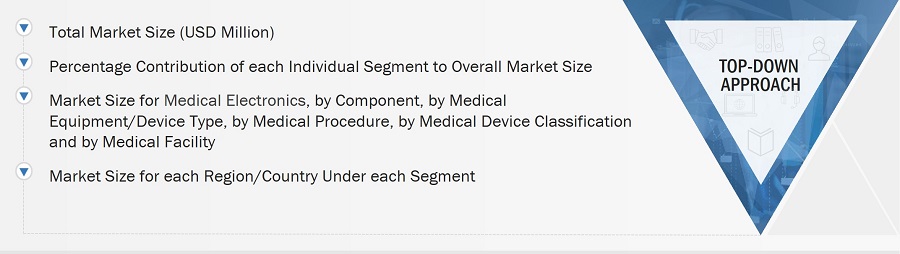
In the top-down approach, the overall market size has been used to estimate the size of individual markets (mentioned in the market segmentation) through percentage splits from secondary and primary research.
The most appropriate immediate parent market size has been used to implement the top-down approach to calculate the market size of specific segments. A top-down approach was implemented for the data extracted from the secondary research to validate the market size obtained.
Each company’s market share has been estimated to verify the revenue shares used earlier in the top-down approach. This study has determined and confirmed the overall parent market and individual market sizes by the data triangulation method and data validation through primaries. The data triangulation method in this study is explained in the next section.
- Focusing initially on topline investments by market players in the medical electronics ecosystem
- Calculating market size based on revenue generated by market players through sales of medical electronics
- Mapping the use of medical electronics in different equipment/ device types
- Building and developing information related to revenue generated by market players through key products
- Estimating geographic split using secondary sources considering factors such as number of players in a specific country and region, role of key players in developing innovative products, and adoption and penetration rates for various components and end uses in a particular country
Data Triangulation
After arriving at the overall market size from the above estimation process, the market has been split into several segments and subsegments. The data triangulation procedure has been employed wherever applicable to complete the overall market engineering process and arrive at the exact statistics for all segments and subsegments. The data has been triangulated by studying various factors and trends from both the demand and supply sides. Additionally, the market size has been validated using top-down and bottom-up approaches.
Market Definition
The term medical electronics refers to components such as sensors, memory devices, microcontrollers/microprocessors, batteries, and displays that are deployed in medical devices, and these components support multiple wireless and wired medical imaging, monitoring, and implantable devices.
Key Stakeholders
- Original equipment manufacturers (OEMs)
- Original device manufacturers (ODMs)
- Component suppliers
- Semiconductor component and device manufacturers
- Product manufacturers
- Component and device suppliers and distributors
- Medical technology providers
- Standardization and testing firms
- Government bodies such as regulatory authorities and policymakers
- Associations, organizations, forums, and alliances related to semiconductor, electronics, and medical equipment industries
- Research institutes and organizations
- Market research and consulting firms
- End Users
Report Objectives
- To describe and forecast the size of the medical electronics market, in terms of value, by component, medical equipment/device type, medical procedure, medical device classification, medical facility, and region
- To estimate the size of the medical electronics market, in terms of volume, by medical sensor type
- To forecast the market, in terms of value, for various segments with regard to four main regions: North America, Europe, Asia Pacific, and RoW
- To provide detailed information regarding the major factors, such as drivers, restraints, opportunities, and industry-specific challenges, influencing the growth of the medical electronics market
- To analyze the micromarkets1 with respect to individual growth trends, prospects, and contributions to the total market
- To study the complete supply chain and allied industry segments and perform a value chain analysis of the medical electronics landscape
- To strategically analyze the regulatory landscape, tariff, standards, patents, Porter's Five Forces, import and export scenarios, trade values, and case studies pertaining to the market under study
- To analyze the opportunities in the market for various stakeholders by identifying the high-growth segments of the medical electronics market
- To profile the key players and comprehensively analyze their market position in terms of ranking and core competencies2, along with detailing the competitive landscape for market leaders
- To analyze competitive developments, such as product launches, acquisitions strategies, partnerships, and expansions, in the medical electronics market
Available Customizations:
With the given market data, MarketsandMarkets offers customizations according to the specific requirements of companies. The following customization options are available for the report:
- Detailed analysis and profiling of additional market players (up to 5)
- Additional country-level analysis of the medical electronics market
Product Analysis
- Product matrix provides a detailed comparison of the product portfolio of each company in the medical electronics market.
Get the Full Medical Electronics Market Report
Full forecast, segment splits, and company analysis for all Medical Electronics Market.
- US Medical Electronics Market
- Canada Medical Electronics Market
- Mexico Medical Electronics Market
- Germany Medical Electronics Market
- UK Medical Electronics Market
- France Medical Electronics Market
- Italy Medical Electronics Market
- Rest Of Europe Medical Electronics Market
- China Medical Electronics Market
- Japan Medical Electronics Market
- India Medical Electronics Market
- South Korea Medical Electronics Market
- Rest Of Asia Pacific Medical Electronics Market
- GCC Medical Electronics Market
- Rest Of The Middle East Medical Electronics Market
Need a Tailored Report?
Customize this report to your needs
Get 10% FREE Customization
Customize This Report
