
Japan Medical Lasers Market (2023-2028)

The Japan Medical Lasers Market was valued at $249.1 Million in 2023 and projected to reach to $458.9 Million by 2028, representing a compound annual growth rate of 13.0%. Japan's medical lasers market is positioned for sustained expansion, with projections reaching USD 458.9 million by 2028.


| Market Size in | USD 26.32 MN |
| Market Forecast in | |
| CAGR | |
| Forecast Period | |
| Units Considered | Value (USD MN) |
Japan Medical Lasers Market Trends and Insights
- Japan is positioned as a key growth driver within the Asia Pacific region, leveraging advanced healthcare infrastructure and high adoption rates of minimally invasive surgical technologies.
- The market in Japan is projected to reach USD 458.9 million by 2028, representing a compound annual growth rate of 13.0%, outpacing global averages and reflecting Japan's commitment to cutting-edge medical device innovation. The acceleration in Japan's medical lasers market is driven by an aging population requiring advanced therapeutic solutions, increasing prevalence of chronic diseases, and substantial investments in healthcare modernization.
- Japan's regulatory environment and reimbursement frameworks continue to support adoption of laser-based treatments across dermatology, ophthalmology, oncology, and surgical specialties.
- Strong domestic manufacturing capabilities and partnerships with global medical device leaders further strengthen Japan's position as a significant market for medical laser technologies through the forecast period..
Key Market Statistics
- CAGR (2023-2028) 13.0% CAGR
- Market Size, 2023 ~USD 249.1 Million
- Forecast, 2028 ~USD 458.9 Million
- Country Japan
Japan Medical Lasers Market Overview
Market Valuation :
Japan's medical lasers market reached USD 249.1 million in 2023, establishing the country as a significant revenue contributor within the Asia Pacific healthcare technology sector.
Strong CAGR Performance :
Japan's market is expanding at a 13% CAGR from 2023-2028, outpacing the global growth rate of 11.5%, demonstrating accelerated adoption of laser-based medical technologies.
Advanced Healthcare Infrastructure :
Japan's sophisticated medical ecosystem and high penetration of minimally invasive surgical procedures drive consistent demand for cutting-edge laser technologies across hospitals and clinics.
Regional Growth Driver :
As a key growth engine within Asia Pacific, Japan's market expansion is fueled by aging demographics, rising healthcare expenditure, and strong physician adoption of advanced surgical solutions.
Japan Medical Lasers Market Dynamics
- The country's advanced healthcare infrastructure, coupled with high adoption rates of minimally invasive surgical technologies, creates a favorable environment for market growth.
- Japan's aging population and increasing prevalence of chronic conditions drive demand for precision laser-based treatments across dermatology, ophthalmology, and surgical specialties. The market outlook remains positive as Japanese healthcare providers continue investing in state-of-the-art laser systems to enhance patient outcomes and operational efficiency.
- Government support for healthcare innovation, combined with strong purchasing power of medical institutions, ensures sustained market momentum through 2028.
- Strategic partnerships between domestic and international laser manufacturers will further accelerate market penetration..
Market Ecosystem
Related Ecosystem
Medical Devices
- Polymerase Chain Reaction (PCR)
- Magnetic Resonance Imaging (MRI)
- Disposable Autoinjectors
- Pulse Oximeters
- Blood Pressure Monitors
- Medtronic plc
- Abbott Laboratories
- Stryker Corporation
- Becton, Dickinson and Company
- CONMED Corporation
Key Takeaways
- Japan's medical lasers market valued at USD 249.1 million in 2023 is expected to nearly double to USD 458.9 million by 2028.
- Japan's 13.0% CAGR significantly exceeds the global growth rate of 11.5%, positioning the country as a high-growth market within Asia Pacific.
- Aging demographics and chronic disease prevalence in Japan drive demand for minimally invasive laser-based surgical and therapeutic solutions.
- Japan's advanced healthcare infrastructure and favorable reimbursement policies accelerate adoption of medical laser technologies across multiple clinical specialties.
Medical Lasers Market Report Scope
| Report Metric | Details |
|---|---|
| Base Year | 2023 |
| Fastest Growing Segment | ND:YAG LASER SYSTEMS (Type) |
| Forecast Period | 2023-2028 |
| Growth Rate | CAGR of 11.5% from 2023 to 2028 |
| Largest Segment | HOSPITALS AND SURGICAL CENTERS (End User) |
| Market Size Base Year (Billions) | ~USD 4.82 (2023) |
| Revenue Forecast (Billions) | ~USD 8.3 (2028) |
| Segments Covered | Technology, Type, End User, Application |
Japan Medical Lasers Market Report Segmentation
4 segment dimensions are covered across the global market.
By Technology
- Diode Laser Systems
- Gas Laser Systems
- Other Technologies
- Pulsed Dye Laser Systems
- Solid-State Laser Systems
By Type
- Acne And Scar Removal
- Alexandrite Laser Systems
- Argon Laser Systems
- Co2 Laser Systems
- Er:Yag Laser Systems
- Excimer Laser Systems
- Hair Removal
- Ho:Yag Laser Systems
- Krypton Laser Systems
- Nd:Yag Laser Systems
- Other Aesthetic/ Cosmetic Applications
- Other Gas Laser Systems
- Other Solid-State Laser Systems
- Tattoo Removal
By End User
- Dermatology And Dental Clinics
- Home Use And Self-Care
- Hospitals And Surgical Centers
- Medical And Beauty Spas
- Other End Users
By Application
- Acne And Scar Removal
- Aesthetic/ Cosmetic
- Cardiovascular
- Cardiovascular Applications
- Dental
- Dental Applications
- Dermatology
- Dermatology Applications
- Hair Removal
- Ob/Gyn
- Ob/Gyn Applications
- Oncology
- Oncology Applications
- Ophthalmology
- Ophthalmology Applications
- Other Aesthetic Applications
- Other Applications
- Tattoo Removal
- Urology
- Urology Applications
Target Audience
- Medical Device Manufacturers : Manufacturers of laser systems need Japan-specific market data to assess market size, growth potential, and competitive landscape for strategic product launches and market expansion decisions.
- Healthcare Investors & PE Firms : Investment professionals require validated Japan market valuations and CAGR projections to evaluate acquisition targets, portfolio companies, and funding opportunities in the medical laser sector.
- Hospital & Clinic Administrators : Healthcare facility leaders need market insights to benchmark capital expenditure decisions, justify laser technology investments, and understand adoption trends among peer institutions in Japan.
- Market Research & Consulting Firms : Research organizations require Japan-specific market cutout data to support client advisory services, competitive analysis, and strategic recommendations for healthcare technology stakeholders.
- Government & Healthcare Policy Bodies : Regulatory and policy organizations need Japan market intelligence to inform healthcare technology regulations, reimbursement policies, and strategic healthcare infrastructure development initiatives.
Reasons to Buy this Report
- Market Size & Growth Validation : Obtain precise valuation data for Japan's medical lasers market (USD 249.1M in 2023) with verified 13% CAGR projections through 2028, enabling accurate financial forecasting and investment decisions.
- Competitive Positioning Intelligence : Understand Japan's market dynamics relative to global trends (11.5% CAGR) to identify competitive advantages, market gaps, and opportunities for product differentiation in this high-growth segment.
- Regional Market Insights : Access Japan-specific analysis of healthcare infrastructure, adoption patterns, and minimally invasive procedure trends to inform market entry strategies and localization approaches for medical laser solutions.
- Strategic Investment Guidance : Leverage detailed Japan market forecasts (USD 458.9M by 2028) to support capital allocation decisions, partnership evaluations, and expansion planning within Asia Pacific's most developed healthcare market.
- Stakeholder Communication Support : Utilize credible Japan market data and growth projections to strengthen investor presentations, board reports, and strategic planning documents with region-specific evidence and market validation.
Frequently asked questions
What is the current size of Japan's medical lasers market?
Japan's medical lasers market was valued at USD 249.1 million in 2023 and is projected to reach USD 458.9 million by 2028.
What is the growth rate for medical lasers in Japan?
Japan's medical lasers market is expected to grow at a compound annual growth rate (CAGR) of 13.0% from 2023 to 2028.
How does Japan's medical lasers market compare to global growth?
Japan's 13.0% CAGR outpaces the global medical lasers market CAGR of 11.5%, indicating stronger growth momentum in the Japanese market.
What factors are driving growth in Japan's medical lasers market?
Key drivers include Japan's aging population, rising prevalence of chronic diseases, advanced healthcare infrastructure, favorable reimbursement policies, and increasing adoption of minimally invasive procedures.
Which medical specialties utilize lasers most in Japan?
Medical lasers in Japan are widely used across dermatology, ophthalmology, oncology, and general surgery, with applications in both therapeutic and cosmetic procedures.
RESEARCH METHODOLOGY
The study involved four major activities in estimating the current size of the medical laser market. Exhaustive secondary research was done to collect information on the market, peer, and parent markets. The next step was to validate these findings, assumptions, and sizing with industry experts across the value chain through primary research. Both top-down and bottom-up approaches were employed to estimate the complete market size. After that, market breakdown and data triangulation were used to estimate the market size of segments and subsegments.
Secondary Research
The secondary research process involves the widespread use of secondary sources, directories, databases (such as Bloomberg Businessweek, Factiva, and D&B Hoovers), white papers, annual reports, company house documents, investor presentations, and SEC filings of companies. Secondary research was used to identify and collect information useful for the extensive, technical, market-oriented, and commercial medical lasers market study. It was also used to obtain important information about the key players and market classification & segmentation according to industry trends to the bottom-most level and key developments related to market and technology perspectives. A database of the key industry leaders was also prepared using secondary research.
Primary Research
In the primary research process, various supply and demand sources were interviewed to obtain qualitative and quantitative information for this report. The primary sources from the supply side include industry experts such as CEOs, vice presidents, marketing and sales directors, technology & innovation directors, and related key executives from various key companies and organizations in the medical lasers market. The primary sources from the demand side include medical OEMs, CDMOs, and service providers. Primary research was conducted to validate the market segmentation, identify key players, and gather insights on key industry trends & key market dynamics.
A breakdown of the primary respondents is provided below:
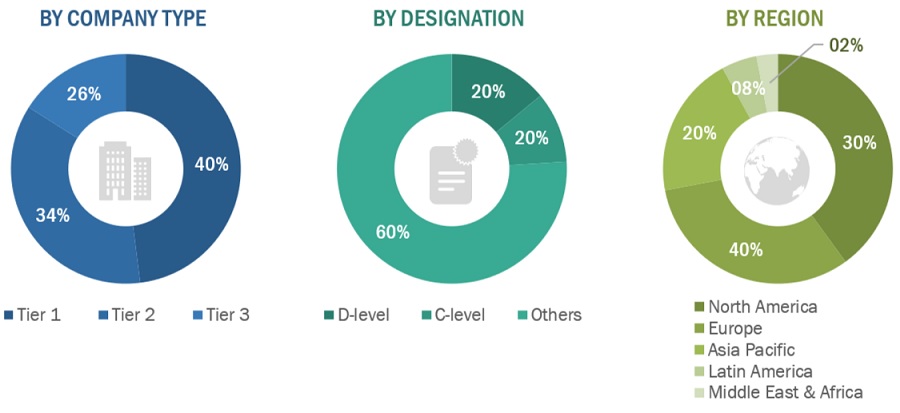
*Others include sales managers, marketing managers, business development managers, product managers, distributors, and suppliers.
Note: Companies are classified into tiers based on their total revenue. As of 2021, Tier 1 = >USD 1,000 million, Tier 2 = USD 500–1,000 million, and Tier 3 = <USD 500 million.
To know about the assumptions considered for the study, download the pdf brochure
Market Estimation Methodology
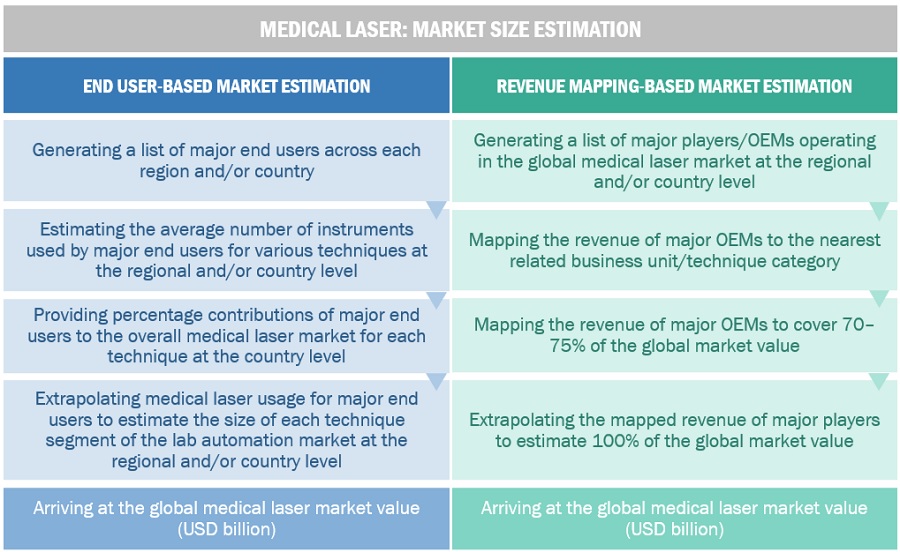
In this report, the size of the medical lasers market’s size was determined using the revenue share analysis of leading players. For this purpose, key players in the market were identified, and their revenues from the market business were determined through various insights gathered during the primary and secondary research phases. Secondary research included the study of the annual and financial reports of the top market players. In contrast, primary research included extensive interviews with key opinion leaders, such as CEOs, directors, and key marketing executives.
Segmental revenues were calculated based on the revenue mapping of major solution/service providers to calculate the global market value. This process involved the following steps:
- Generating a list of major global players operating in the medical lasers market.
- Mapping annual revenues generated by major global players from the product segment (or nearest reported business unit/category)
- Revenue mapping of major players to cover a major share of the global market share as of 2022
- Extrapolating the global value of the medical lasers market industry
Data Triangulation
After arriving at the overall market size from the market size estimation process explained above, the global medical lasers market was split into segments and subsegments. Data triangulation and market breakdown procedures were employed to complete the overall market engineering process and arrive at the exact statistics for all segments and subsegments. The data was triangulated by studying various factors and trends from both the demand and supply sides. Additionally, the medical lasers market was validated using top-down and bottom-up approaches.
Market Definition
The medical lasers market encompasses the global industry involved in the development, manufacturing, and distribution of laser-based technologies for diverse medical applications. These devices emit focused and intense beams of light with specific wavelengths, serving diagnostic, therapeutic, and surgical purposes in medical and healthcare settings. The market includes a variety of laser types, such as solid-state lasers (e.g., Nd: YAG lasers), gas lasers (e.g., CO2 lasers, argon lasers), diode lasers, and excimer lasers, each finding application in specialties like ophthalmology, dermatology, dentistry, cardiology, gynecology, urology, and surgery. As a result, medical lasers are widely employed in the formulation and production processes of various industries, including hospitals & surgical centers, dermatology clinics & dental clinics, medical& beauty spa.
Key Stakeholders
- Dermatology Clinics and Aesthetic Centers
- Hospitals and Surgical Centers
- Cosmetic Product Manufacturers
- Pharmaceutical Companies
- Medical Spas and Beauty Spas
- Cosmetologists and Plastic Surgeons
- Medical Aesthetics Device Distributors and Suppliers
- Dermatologists and Aesthetic Practitioners
- Urologists and Urological Surgeons
- Obstetricians and Gynecologists
- Nurses and Oncology Nurse Navigators
- Oncologists
- Cardiac Surgeons
- Regulatory Agencies
- Public Health Organizations
- Research and Development Organizations
- Medical Laser Manufacturers
Objectives of the Study
- To define, describe, and forecast the size of the medical lasers market based on technology, application, end user, and region
- To provide detailed information regarding the major factors influencing the growth potential of the global medical lasers market (drivers, restraints, opportunities, challenges, and trends)
- To analyze the micro markets with respect to individual growth trends, prospects, and contributions to the global medical lasers market.
- To analyze key growth opportunities in the global medical lasers market for key stakeholders and provide details of the competitive landscape for market leaders
- To forecast the size of market segments and/or subsegments with respect to five major regions, namely, North America (US and Canada), Europe (Germany, France, the UK, Spain, Italy, and the RoE), Asia Pacific (Japan, China, India, Australia, South Korea, Indonesia, Thailand and the RoAPAC), Latin America (Brazil, Mexico, RoLA), and Middle East and Africa.
- To profile the key players in the medical lasers market and comprehensively analyze their market shares and core competencies
- To track and analyze the competitive developments undertaken in the global medical lasers market, such as product launches, agreements, expansions, and mergers & acquisitions.
Available Customizations
With the given market data, MarketsandMarkets offers customizations per the company’s specific needs. The following customization options are available for the present medical lasers market report:
Product Analysis
- Product matrix, which gives a detailed comparison of the product portfolios of the top five companies
Company Information
- Detailed analysis and profiling of additional market players (up to five)
Geographic Analysis
- Further breakdown of the Rest of Europe medical lasers market into Russia, Belgium, the Netherlands, Switzerland, Austria, Finland, Sweden, Poland, and Portugal, among others
- Further breakdown of the Rest of Asia Pacific diagnostic imaging market into Singapore, Taiwan, New Zealand, Philippines, Malaysia, and other APAC countries
Get the Full Medical Lasers Market Report
Full forecast, segment splits, and company analysis for all Medical Lasers Market.
- US Medical Lasers Market
- Canada Medical Lasers Market
- Germany Medical Lasers Market
- France Medical Lasers Market
- UK Medical Lasers Market
- Italy Medical Lasers Market
- Spain Medical Lasers Market
- China Medical Lasers Market
- India Medical Lasers Market
- Australia Medical Lasers Market
- South Korea Medical Lasers Market
- Brazil Medical Lasers Market
- Mexico Medical Lasers Market
- Rest Of Europe Medical Lasers Market
- Rest Of Asia Pacific Medical Lasers Market
- Rest Of Latin America Medical Lasers Market
Need a Tailored Report?
Customize this report to your needs
Get 10% FREE Customization
Customize This Report
