
South Korea Medical Lasers Market (2023-2028)

The South Korea Medical Lasers Market was valued at $156.7 Million in 2023 and projected to reach to $318.4 Million by 2028, representing a compound annual growth rate of CAGR 15.2%. South Korea's medical lasers market is poised for accelerated growth through 2028, driven by increasing healthcare expenditure, aging population demographics, and widespread adoption of laser-based treatments in cosmetic and therapeutic applications.


| Market Size in | USD 26.32 MN |
| Market Forecast in | |
| CAGR | |
| Forecast Period | |
| Units Considered | Value (USD MN) |
South Korea Medical Lasers Market Trends and Insights
- South Korea is positioned as a key growth hub within the Asia Pacific region, driven by advanced healthcare infrastructure, rising demand for minimally invasive procedures, and significant investment in medical technology innovation.
- By 2028, South Korea's market is projected to nearly double, reaching USD 318.4 million, reflecting a compound annual growth rate of 15.2%. The expansion of South Korea's medical lasers market is underpinned by increasing adoption across dermatology, ophthalmology, and surgical applications.
- South Korea's aging population and growing healthcare expenditure are accelerating demand for laser-based treatments, while the country's strong manufacturing capabilities and export orientation support market competitiveness.
- South Korea continues to attract both domestic and international medical device manufacturers, reinforcing its status as a regional innovation and distribution center for advanced laser technologies..
Key Market Statistics
- CAGR (2023-2028) CAGR 15.2%
- Market Size, 2023 ~USD 156.7 Million
- Forecast, 2028 ~USD 318.4 Million
- Country South Korea
South Korea Medical Lasers Market Overview
Market Valuation Growth :
South Korea's medical lasers market reached USD 156.7 million in 2023 and is projected to grow to USD 318.4 million by 2028, representing a robust 15.2% CAGR, significantly outpacing the global average of 11.5%.
Advanced Healthcare Infrastructure :
South Korea's state-of-the-art medical facilities and high adoption rates of cutting-edge technologies position it as a leading market for medical laser applications across dermatology, ophthalmology, and surgical specialties.
Minimally Invasive Procedure Demand :
Rising patient preference for minimally invasive treatments and faster recovery times is driving substantial demand for medical laser systems across South Korean healthcare institutions and private clinics.
Medical Technology Innovation Hub :
South Korea's significant investment in medical technology R&D and strong domestic manufacturing capabilities create a dynamic ecosystem for medical laser innovation and market expansion.
South Korea Medical Lasers Market Dynamics
- The country's reputation as a global leader in medical aesthetics and advanced surgical techniques continues to fuel demand for premium laser systems.
- Government support for healthcare modernization and private sector investment in medical device manufacturing further strengthen market fundamentals.
- By 2028, South Korea is expected to maintain its position as a high-growth market within Asia Pacific, with expanding applications in ophthalmology, oncology, and dermatology driving sustained revenue growth and attracting international medical device manufacturers..
Market Ecosystem
Related Ecosystem
Medical Devices
- Polymerase Chain Reaction (PCR)
- Magnetic Resonance Imaging (MRI)
- Disposable Autoinjectors
- Pulse Oximeters
- Blood Pressure Monitors
- Medtronic plc
- Abbott Laboratories
- Stryker Corporation
- Becton, Dickinson and Company
- CONMED Corporation
Key Takeaways
- South Korea's medical lasers market is valued at USD 156.7 million in 2023 and is projected to reach USD 318.4 million by 2028, representing a 15.2% CAGR.
- South Korea's advanced healthcare infrastructure and high adoption of minimally invasive procedures are primary growth catalysts for the medical lasers sector.
- South Korea's aging demographic and rising healthcare spending are driving increased demand for laser-based dermatological, ophthalmological, and surgical treatments.
- South Korea's strong manufacturing base and export capabilities position the country as a regional hub for medical laser innovation and distribution in Asia Pacific.
Medical Lasers Market Report Scope
| Report Metric | Details |
|---|---|
| Base Year | 2023 |
| Fastest Growing Segment | ND:YAG LASER SYSTEMS (Type) |
| Forecast Period | 2023-2028 |
| Growth Rate | CAGR of 11.5% from 2023 to 2028 |
| Largest Segment | HOSPITALS AND SURGICAL CENTERS (End User) |
| Market Size Base Year (Billions) | ~USD 4.82 (2023) |
| Revenue Forecast (Billions) | ~USD 8.3 (2028) |
| Segments Covered | Technology, Type, End User, Application |
South Korea Medical Lasers Market Report Segmentation
4 segment dimensions are covered across the global market.
By Technology
- Diode Laser Systems
- Gas Laser Systems
- Other Technologies
- Pulsed Dye Laser Systems
- Solid-State Laser Systems
By Type
- Acne And Scar Removal
- Alexandrite Laser Systems
- Argon Laser Systems
- Co2 Laser Systems
- Er:Yag Laser Systems
- Excimer Laser Systems
- Hair Removal
- Ho:Yag Laser Systems
- Krypton Laser Systems
- Nd:Yag Laser Systems
- Other Aesthetic/ Cosmetic Applications
- Other Gas Laser Systems
- Other Solid-State Laser Systems
- Tattoo Removal
By End User
- Dermatology And Dental Clinics
- Home Use And Self-Care
- Hospitals And Surgical Centers
- Medical And Beauty Spas
- Other End Users
By Application
- Acne And Scar Removal
- Aesthetic/ Cosmetic
- Cardiovascular
- Cardiovascular Applications
- Dental
- Dental Applications
- Dermatology
- Dermatology Applications
- Hair Removal
- Ob/Gyn
- Ob/Gyn Applications
- Oncology
- Oncology Applications
- Ophthalmology
- Ophthalmology Applications
- Other Aesthetic Applications
- Other Applications
- Tattoo Removal
- Urology
- Urology Applications
Target Audience
- Medical Device Manufacturers : Manufacturers seeking to expand into South Korea's high-growth medical lasers market need detailed market sizing, competitive positioning, and regulatory requirements to develop effective market entry strategies.
- Healthcare Investors & PE Firms : Investment professionals evaluating opportunities in South Korea's medical technology sector require comprehensive market data, growth projections, and risk assessments to make informed capital allocation decisions.
- Hospital & Clinic Administrators : Healthcare facility leaders planning capital equipment investments need market intelligence on available laser technologies, pricing trends, and clinical applications to optimize procurement decisions.
- Market Consultants & Analysts : Consulting firms and research professionals require country-specific market data and forecasts to support client advisory services, competitive analysis, and strategic planning in South Korea's medical device sector.
- Distributors & Channel Partners : Medical device distributors and resellers need detailed market insights, demand forecasts, and competitive intelligence specific to South Korea to develop effective sales strategies and partnership models.
Reasons to Buy this Report
- Market-Specific Growth Projections : Access detailed forecasts showing South Korea's medical lasers market expanding from USD 156.7M to USD 318.4M by 2028, enabling precise investment and expansion planning tailored to this high-growth market.
- Competitive Landscape Analysis : Understand South Korea's unique competitive dynamics, local market leaders, and opportunities for market entry or partnership within Asia's most advanced healthcare ecosystem.
- Application-Specific Insights : Gain detailed intelligence on demand drivers across South Korean medical specialties including cosmetic dermatology, ophthalmology, and surgical oncology to identify high-potential segments.
- Regulatory & Reimbursement Framework : Obtain comprehensive analysis of South Korea's medical device regulations, healthcare reimbursement policies, and approval pathways specific to laser systems for strategic market navigation.
- Investment & Partnership Opportunities : Identify key stakeholders, distribution channels, and collaboration opportunities with South Korean healthcare providers, hospitals, and medical device manufacturers for market penetration.
Frequently asked questions
What is the current size of South Korea's medical lasers market?
South Korea's medical lasers market was valued at USD 156.7 million in 2023 and is expected to grow to USD 318.4 million by 2028.
What is the projected growth rate for South Korea's medical lasers market?
South Korea's medical lasers market is projected to grow at a compound annual growth rate (CAGR) of 15.2% from 2023 to 2028.
What are the main applications driving South Korea's medical lasers market?
South Korea's medical lasers market is primarily driven by applications in dermatology, ophthalmology, and surgical procedures, supported by increasing adoption of minimally invasive treatments.
Why is South Korea's medical lasers market growing faster than the global average?
South Korea's 15.2% CAGR outpaces the global 11.5% rate due to advanced healthcare infrastructure, an aging population, rising healthcare expenditure, and strong domestic manufacturing capabilities.
What role does South Korea play in the Asia Pacific medical lasers market?
South Korea serves as a key regional hub in Asia Pacific, leveraging its advanced healthcare system, manufacturing expertise, and innovation capabilities to drive market growth and support regional distribution.
RESEARCH METHODOLOGY
The study involved four major activities in estimating the current size of the medical laser market. Exhaustive secondary research was done to collect information on the market, peer, and parent markets. The next step was to validate these findings, assumptions, and sizing with industry experts across the value chain through primary research. Both top-down and bottom-up approaches were employed to estimate the complete market size. After that, market breakdown and data triangulation were used to estimate the market size of segments and subsegments.
Secondary Research
The secondary research process involves the widespread use of secondary sources, directories, databases (such as Bloomberg Businessweek, Factiva, and D&B Hoovers), white papers, annual reports, company house documents, investor presentations, and SEC filings of companies. Secondary research was used to identify and collect information useful for the extensive, technical, market-oriented, and commercial medical lasers market study. It was also used to obtain important information about the key players and market classification & segmentation according to industry trends to the bottom-most level and key developments related to market and technology perspectives. A database of the key industry leaders was also prepared using secondary research.
Primary Research
In the primary research process, various supply and demand sources were interviewed to obtain qualitative and quantitative information for this report. The primary sources from the supply side include industry experts such as CEOs, vice presidents, marketing and sales directors, technology & innovation directors, and related key executives from various key companies and organizations in the medical lasers market. The primary sources from the demand side include medical OEMs, CDMOs, and service providers. Primary research was conducted to validate the market segmentation, identify key players, and gather insights on key industry trends & key market dynamics.
A breakdown of the primary respondents is provided below:
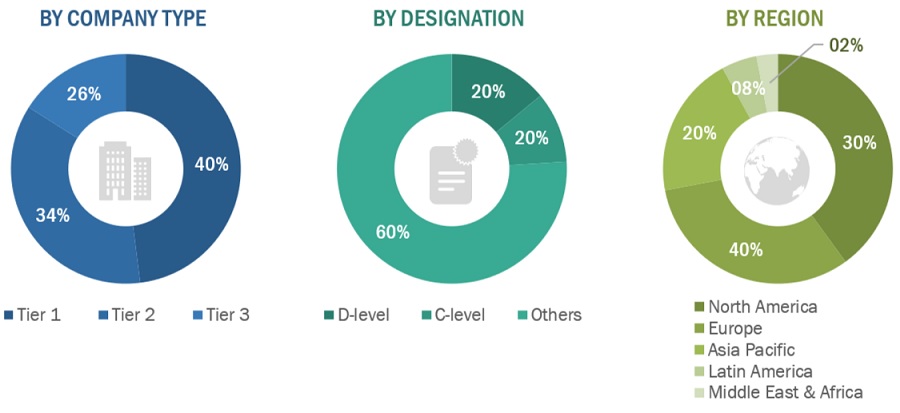
*Others include sales managers, marketing managers, business development managers, product managers, distributors, and suppliers.
Note: Companies are classified into tiers based on their total revenue. As of 2021, Tier 1 = >USD 1,000 million, Tier 2 = USD 500–1,000 million, and Tier 3 = <USD 500 million.
To know about the assumptions considered for the study, download the pdf brochure
Market Estimation Methodology
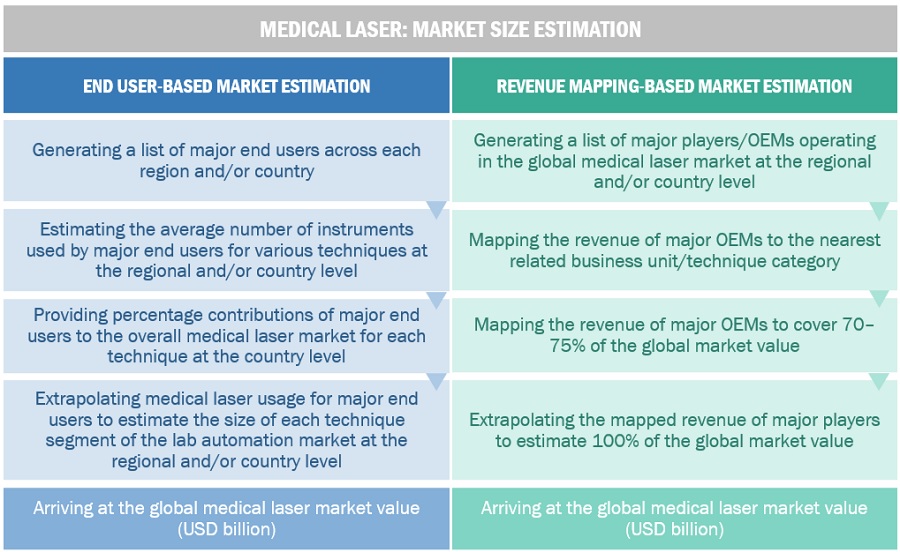
In this report, the size of the medical lasers market’s size was determined using the revenue share analysis of leading players. For this purpose, key players in the market were identified, and their revenues from the market business were determined through various insights gathered during the primary and secondary research phases. Secondary research included the study of the annual and financial reports of the top market players. In contrast, primary research included extensive interviews with key opinion leaders, such as CEOs, directors, and key marketing executives.
Segmental revenues were calculated based on the revenue mapping of major solution/service providers to calculate the global market value. This process involved the following steps:
- Generating a list of major global players operating in the medical lasers market.
- Mapping annual revenues generated by major global players from the product segment (or nearest reported business unit/category)
- Revenue mapping of major players to cover a major share of the global market share as of 2022
- Extrapolating the global value of the medical lasers market industry
Data Triangulation
After arriving at the overall market size from the market size estimation process explained above, the global medical lasers market was split into segments and subsegments. Data triangulation and market breakdown procedures were employed to complete the overall market engineering process and arrive at the exact statistics for all segments and subsegments. The data was triangulated by studying various factors and trends from both the demand and supply sides. Additionally, the medical lasers market was validated using top-down and bottom-up approaches.
Market Definition
The medical lasers market encompasses the global industry involved in the development, manufacturing, and distribution of laser-based technologies for diverse medical applications. These devices emit focused and intense beams of light with specific wavelengths, serving diagnostic, therapeutic, and surgical purposes in medical and healthcare settings. The market includes a variety of laser types, such as solid-state lasers (e.g., Nd: YAG lasers), gas lasers (e.g., CO2 lasers, argon lasers), diode lasers, and excimer lasers, each finding application in specialties like ophthalmology, dermatology, dentistry, cardiology, gynecology, urology, and surgery. As a result, medical lasers are widely employed in the formulation and production processes of various industries, including hospitals & surgical centers, dermatology clinics & dental clinics, medical& beauty spa.
Key Stakeholders
- Dermatology Clinics and Aesthetic Centers
- Hospitals and Surgical Centers
- Cosmetic Product Manufacturers
- Pharmaceutical Companies
- Medical Spas and Beauty Spas
- Cosmetologists and Plastic Surgeons
- Medical Aesthetics Device Distributors and Suppliers
- Dermatologists and Aesthetic Practitioners
- Urologists and Urological Surgeons
- Obstetricians and Gynecologists
- Nurses and Oncology Nurse Navigators
- Oncologists
- Cardiac Surgeons
- Regulatory Agencies
- Public Health Organizations
- Research and Development Organizations
- Medical Laser Manufacturers
Objectives of the Study
- To define, describe, and forecast the size of the medical lasers market based on technology, application, end user, and region
- To provide detailed information regarding the major factors influencing the growth potential of the global medical lasers market (drivers, restraints, opportunities, challenges, and trends)
- To analyze the micro markets with respect to individual growth trends, prospects, and contributions to the global medical lasers market.
- To analyze key growth opportunities in the global medical lasers market for key stakeholders and provide details of the competitive landscape for market leaders
- To forecast the size of market segments and/or subsegments with respect to five major regions, namely, North America (US and Canada), Europe (Germany, France, the UK, Spain, Italy, and the RoE), Asia Pacific (Japan, China, India, Australia, South Korea, Indonesia, Thailand and the RoAPAC), Latin America (Brazil, Mexico, RoLA), and Middle East and Africa.
- To profile the key players in the medical lasers market and comprehensively analyze their market shares and core competencies
- To track and analyze the competitive developments undertaken in the global medical lasers market, such as product launches, agreements, expansions, and mergers & acquisitions.
Available Customizations
With the given market data, MarketsandMarkets offers customizations per the company’s specific needs. The following customization options are available for the present medical lasers market report:
Product Analysis
- Product matrix, which gives a detailed comparison of the product portfolios of the top five companies
Company Information
- Detailed analysis and profiling of additional market players (up to five)
Geographic Analysis
- Further breakdown of the Rest of Europe medical lasers market into Russia, Belgium, the Netherlands, Switzerland, Austria, Finland, Sweden, Poland, and Portugal, among others
- Further breakdown of the Rest of Asia Pacific diagnostic imaging market into Singapore, Taiwan, New Zealand, Philippines, Malaysia, and other APAC countries
Get the Full Medical Lasers Market Report
Full forecast, segment splits, and company analysis for all Medical Lasers Market.
- US Medical Lasers Market
- Canada Medical Lasers Market
- Germany Medical Lasers Market
- France Medical Lasers Market
- UK Medical Lasers Market
- Italy Medical Lasers Market
- Spain Medical Lasers Market
- Japan Medical Lasers Market
- China Medical Lasers Market
- India Medical Lasers Market
- Australia Medical Lasers Market
- Brazil Medical Lasers Market
- Mexico Medical Lasers Market
- Rest Of Europe Medical Lasers Market
- Rest Of Asia Pacific Medical Lasers Market
- Rest Of Latin America Medical Lasers Market
Need a Tailored Report?
Customize this report to your needs
Get 10% FREE Customization
Customize This Report
