
Europe Medical Plastics Market (2026-2031)

The Europe Medical Plastics Market was valued at $8346 Million in 2026 and projected to reach to $11608.1 Million by 2031, representing a compound annual growth rate of 6.8%. Europe's medical plastics market is poised for steady expansion through 2031, driven by aging demographics, rising chronic disease prevalence, and continuous innovation in minimally invasive surgical devices.


| Market Size in | USD 26.32 MN |
| Market Forecast in | |
| CAGR | |
| Forecast Period | |
| Units Considered | Value (USD MN) |
Europe Medical Plastics Market Trends and Insights
- Europe maintains a significant share of the global medical plastics sector, driven by stringent regulatory frameworks, advanced healthcare infrastructure, and high demand for innovative medical devices.
- The region's emphasis on biocompatibility, sterilization capabilities, and sustainability standards positions Europe as a leader in premium medical plastic applications. Throughout the forecast period from 2026 to 2031, Europe's medical plastics market will benefit from increasing adoption of minimally invasive surgical procedures, aging demographics, and rising healthcare expenditures across member states.
- Europe's commitment to circular economy principles and regulatory compliance with ISO and EU standards continues to shape material selection and manufacturing processes.
- Key end-use sectors in Europe include diagnostic devices, drug delivery systems, surgical instruments, and patient monitoring equipment, all contributing to steady market expansion..
Key Market Statistics
- CAGR (2026-2031) 6.8% CAGR
- Market Size, 2026 ~USD 8346 Million
- Forecast, 2031 ~USD 11608.1 Million
- Geography Europe
Europe Medical Plastics Market Overview
Regulatory Leadership :
Europe's stringent regulatory frameworks, including CE marking and MDR compliance, drive demand for high-quality medical plastics and position the region as a quality benchmark for global medical device manufacturers.
Advanced Healthcare Infrastructure :
Well-established healthcare systems across Western Europe support consistent demand for innovative medical devices and specialized plastic components used in diagnostics, surgical instruments, and patient care applications.
Strong Market Valuation :
Europe's medical plastics market is valued at $8,346 million in 2026, with projected growth to $11,608.1 million by 2031, reflecting robust investment in healthcare innovation and medical device manufacturing.
Sustainable Material Adoption :
European manufacturers increasingly prioritize biocompatible and eco-friendly plastic materials, driven by EU environmental regulations and growing healthcare provider preference for sustainable medical device solutions.
Europe Medical Plastics Market Dynamics
- The region's commitment to regulatory excellence and sustainability standards creates competitive advantages for manufacturers meeting stringent quality requirements.
- Investment in advanced polymer technologies and biocompatible materials will support market growth across diagnostic devices, drug delivery systems, and surgical applications.
- Healthcare digitalization and personalized medicine initiatives further enhance demand for specialized plastic components in European medical device manufacturing..
Market Ecosystem
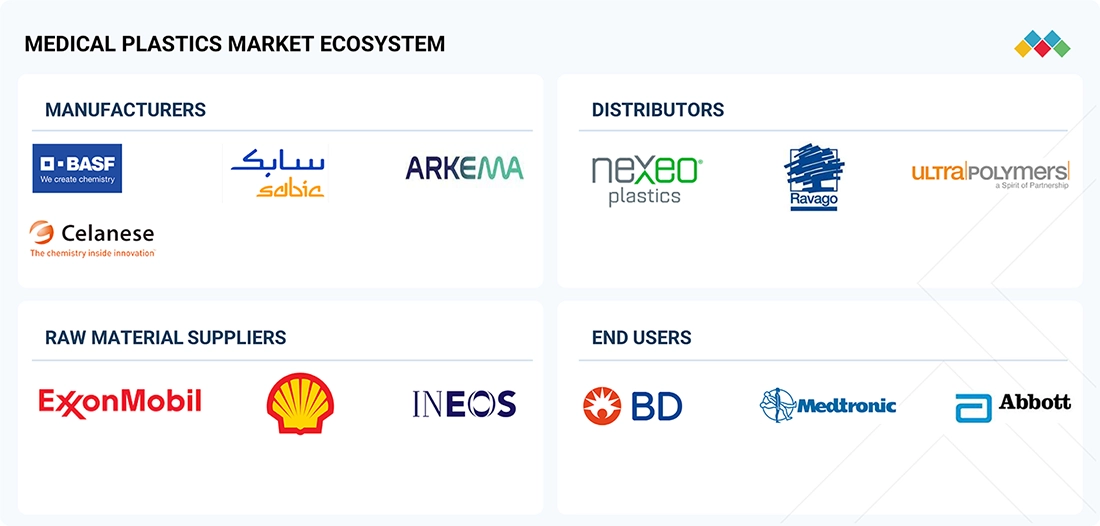
MEDICAL PLASTICS MARKET: COMMERCIAL USE CASES ACROSS INDUSTRIES
| COMPANY | USE CASE DESCRIPTION | BENEFITS |
|---|---|---|
 |
Lubrizol develops medical-grade thermoplastic polyurethanes (TPUs), specialty polymers, and engineered materials for catheters, wearable medical devices, drug delivery systems, wound care products, prosthetics, and other high-performance medical components. | Outstanding flexibility | Biocompatibility | Abrasion resistance | Chemical resistance | Sterilization compatibility while enabling miniaturization, patient comfort, and long-term device durability in demanding healthcare applications |
 |
Celanese manufactures high-performance medical polymers including acetal (POM), thermoplastic elastomers (TPEs), engineered nylons, and specialty compounds used in surgical instruments, inhalers, insulin pens, diagnostic equipment, implant components, and reusable medical devices. | Excellent mechanical strength | Dimensional stability | Wear resistance | Low friction | Sterilization compatibility, enabling lightweight, durable, and precision-engineered medical products with long service life |
 |
SABIC supplies medical-grade polycarbonate (PC), polypropylene (PP), polyethylene (PE), and specialty copolymers for medical disposables, diagnostic equipment, pharmaceutical packaging, respiratory devices, laboratory consumables, and healthcare electronics. | High impact strength | Optical clarity | Chemical resistance | Gamma and EtO sterilization compatibility | Excellent processability | Comprehensive regulatory documentation, making them ideal for high-volume medical manufacturing |
 |
Covestro provides Makrolon® polycarbonate, thermoplastic polyurethane (TPU), and other specialty medical polymers for medical device housings, diagnostic equipment, infusion systems, surgical instruments, wearable healthcare devices, and pharmaceutical packaging. | Exceptional toughness | Transparency | Design flexibility | Repeated sterilization capability | Biocompatibility while supporting lightweight, durable, and sustainable medical product development |
Logos and trademarks shown above are the property of their respective owners. Their use here is for informational and illustrative purposes only.
Related Ecosystem
Resins And Polymers
- Polycarbonate
- Acrylonitrile Butadiene Styrene (ABS)
- Epoxy Resin
- Light Commercial Vehicles (LCVs)
- Polypropylene (PP)
- Basf se
- DOW CHEMICAL COMPANY
- Solvay sa
- Saudi arabia basic industries corporation (sabic)
- DuPont de Nemours, Inc.
Medical Devices
- Polymerase Chain Reaction (PCR)
- Magnetic Resonance Imaging (MRI)
- Disposable Autoinjectors
- Pulse Oximeters
- Blood Pressure Monitors
- Medtronic plc
- Abbott Laboratories
- Stryker Corporation
- Becton, Dickinson and Company
- CONMED Corporation
Key Takeaways
- Europe's medical plastics market will grow from $8,346M (2026) to $11,608.1M (2031) at a 6.8% CAGR.
- Europe leads in regulatory compliance and biocompatible material innovation within the global medical plastics sector.
- Aging populations and minimally invasive procedures drive sustained demand for advanced medical plastic devices across Europe.
- Europe's circular economy focus and sustainability standards differentiate its market from other regions through 2031.
Medical Plastics Market Report Scope
| Report Metric | Details |
|---|---|
| Base Year | 2026 |
| Fastest Growing Segment | PP (Type) |
| Forecast Period | 2026-2031 |
| Growth Rate | CAGR of 7% from 2026 to 2031 |
| Largest Segment | OTHER MEDICAL PLASTICS (Type) |
| Market Size Base Year (Billions) | ~USD 34.77 (2026) |
| Revenue Forecast (Billions) | ~USD 48.77 (2031) |
| Segments Covered | Type, Application |
Europe Medical Plastics Market Report Segmentation
2 segment dimensions are covered across the global market.
By Type
- Engineering And High Performance Plastics
- Other Medical Plastics
- Pe
- Pmma
- Pp
- Ps
- Pvc
- -Abs
- -Others
- -Pa
- -Pc
- -Peek
- -Ppsu
- -Psu
By Application
- Drug Delivery
- Medical Disposables
- Medical Instruments & Devices
- Medical Packaging
- Other Applications
- Prosthetics & Implants
Target Audience
- Medical Device Manufacturers : Manufacturers need Europe-specific market data to optimize product portfolios, identify regulatory requirements, and allocate resources to high-growth European markets with strong healthcare spending.
- Plastic Material Suppliers : Suppliers require detailed insights into European demand for biocompatible, sterilizable, and sustainable plastics to align production capacity, develop compliant materials, and secure contracts with device makers.
- Healthcare Investment Firms : Investors need comprehensive European market analysis to evaluate acquisition targets, assess growth potential in regional medical device companies, and identify emerging opportunities in plastic innovation.
- Regulatory & Quality Consultants : Consultants leverage Europe-specific market intelligence to advise clients on compliance strategies, material selection, and market entry approaches aligned with EU regulatory frameworks and standards.
- Strategic Business Planners : Business strategists use regional forecasts and country-level data to develop market expansion plans, competitive strategies, and investment decisions for European medical plastics operations.
Countries within Europe - compare and drill down
| Country | 2025 size (native) |
|---|---|
| Germany | USD 2907.8 Million |
| France | USD 2014 Million |
| UK | USD 2228.8 Million |
| Italy | USD 1509.1 Million |
| Spain | USD 1137.6 Million |
| Rest Of Europe | USD 1810.9 Million |
Country market size visualization
Reasons to Buy this Report
- Country-Level Market Breakdown : Access detailed market sizing for Germany, France, UK, Italy, Spain, and other European nations to identify high-growth opportunities and regional demand patterns specific to your target markets.
- Regulatory Compliance Insights : Understand Europe's unique regulatory landscape including MDR, CE marking, and biocompatibility standards that directly impact material selection, manufacturing processes, and market entry strategies.
- Competitive Positioning : Benchmark your products and strategies against European market leaders and identify gaps in the $8.3B market to capture share in high-demand segments like surgical devices and diagnostics.
- Growth Trajectory Analysis : Leverage 6.8% CAGR projections and segment-specific forecasts to prioritize R&D investments, manufacturing capacity expansion, and market entry timing across European regions.
- Sustainability & Innovation Trends : Gain actionable intelligence on European demand for eco-friendly and advanced biocompatible plastics, enabling product development aligned with regulatory requirements and customer preferences.
Frequently asked questions
What is the projected size of Europe's medical plastics market in 2031?
Europe's medical plastics market is projected to reach $11,608.1 million by 2031, up from $8,346 million in 2026.
What is the CAGR for Europe's medical plastics market from 2026 to 2031?
Europe's medical plastics market is expected to grow at a compound annual growth rate of 6.8% during the forecast period.
Which factors are driving growth in Europe's medical plastics market?
Key drivers include aging demographics, increased adoption of minimally invasive procedures, stringent regulatory standards, and rising healthcare expenditures across European member states.
What regulatory standards govern medical plastics in Europe?
Europe's medical plastics market is shaped by ISO standards, EU directives, biocompatibility requirements, and sterilization protocols that ensure product safety and efficacy.
What are the primary end-use applications for medical plastics in Europe?
Key applications in Europe include diagnostic devices, drug delivery systems, surgical instruments, patient monitoring equipment, and minimally invasive surgical devices.
RESEARCH METHODOLOGY
The study involved four major activities to estimate the current size of the global medical plastics market. Exhaustive secondary research was carried out to collect information on the market, the peer product market, and the parent product group market. The next step was to validate these findings, assumptions, and sizes with the industry experts across the value chain of medical plastics through primary research. The top-down and bottom-up approaches were employed to estimate the overall size of the market. After that, market breakdown and data triangulation procedures were used to determine the size of different segments and sub-segments of the market.
Secondary Research
The market for companies offering medical plastics was derived from secondary data available through paid and unpaid sources, by analyzing the product portfolios of the major companies in the ecosystem, and by rating the companies based on their performance and quality. Various secondary sources, such as Business Standard, Bloomberg, World Bank, and Factiva, were referred to for identifying and collecting information for this study on the medical plastics market. In the secondary research process, various secondary sources were referred to for identifying and collecting information related to the study. Secondary sources included annual reports, press releases, and investor presentations of door vendors, forums, certified publications, and whitepapers. The secondary research was used to obtain critical information on the industry’s value chain, the total pool of key players, market classification, and segmentation from the market and technology-oriented perspectives.
Primary Research
In the primary research process, various primary sources from the supply and demand sides were interviewed to obtain qualitative and quantitative information for this report. The primary sources from the supply side included industry experts, such as Chief Executive Officers (CEOs), Vice Presidents (VPs), marketing directors, technology and innovation directors, and related key executives from several key companies and organizations operating in the medical plastics market. After the complete market engineering (calculations for market statistics, market breakdown, market size estimations, market forecasting, and data triangulation), extensive primary research was conducted to gather information and verify and validate the critical numbers arrived at.
Primary research was also conducted to identify the segmentation, industry trends, competitive landscape of medical plastics offered by various market players, and key market dynamics, such as drivers, restraints, opportunities, challenges, trends, and key player strategies. In the complete market engineering process, the top-down and bottom-up approaches and several data triangulation methods were extensively used to perform the market estimation and market forecasting for the overall market segments and subsegments listed in this report. Extensive qualitative and quantitative analysis was performed on the complete market engineering process to list the key information/insights throughout the report.
The following is the breakdown of primary respondents:
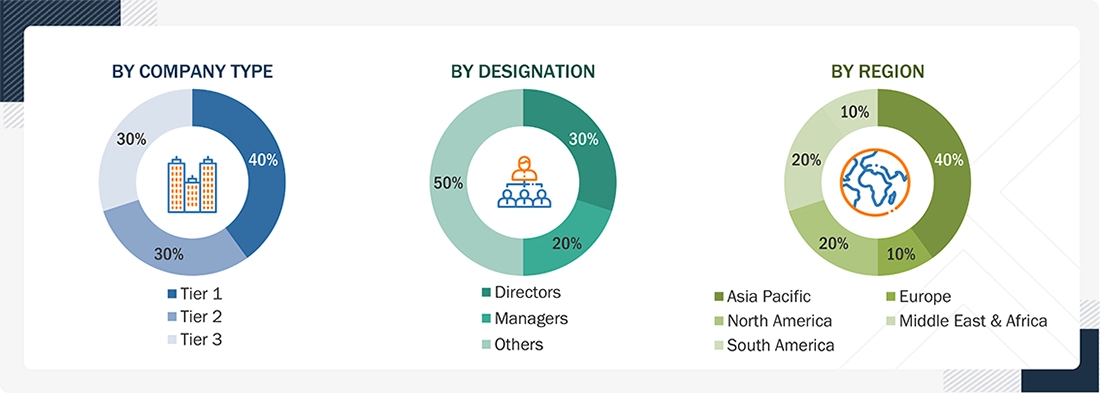
Notes: Other designations include sales, marketing, and product managers.
Tier 1: >USD 1 Billion; Tier 2: USD 500 million–1 Billion; and Tier 3: <USD 500 million.
To know about the assumptions considered for the study, download the pdf brochure
Market Size Estimation
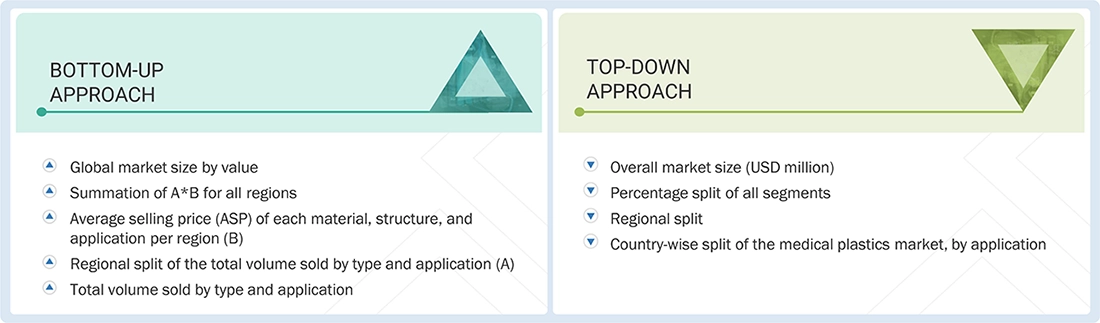
The top-down and bottom-up approaches were used to estimate and validate the size of the global medical plastics market. These approaches were also used extensively to estimate the size of various dependent market segments. The research methodology used to estimate the market size included the following:
Medical Plastics Market : Top-Down and Bottom-Up Approach
Data Triangulation
After arriving at the overall market size using the market size estimation processes, the market was split into several segments and subsegments. The data triangulation and market breakup procedures were employed, wherever applicable, to complete the overall market engineering process and arrive at the exact statistics of each market segment and subsegment. The data was triangulated by studying various factors and trends from the demand and supply sides.
Market Definition
Medical plastics refer to polymer materials that are designed specifically for use in medical and life science applications where certain performance parameters such as procedure compatibility, mechanical properties, sterilization, and compliance with regulations are of utmost importance. These materials are widely used to make medical devices such as medical disposables, medical instruments, implants, and drug delivery systems. Generally used plastics are classified as basic plastics, engineering plastics, high-performance plastics, and silicone plastics, and the appropriate plastic type is chosen on the basis of the functional performance required for a particular application. Medical plastics are manufactured with the use of sophisticated processes that include but are not limited to injection molding, extrusion, blow molding, thermoforming, compression molding, and additive manufacturing.
Key Stakeholders
- Medical plastics manufacturers
- Medical-grade polymer and resin suppliers
- Medical device manufacturers
- Pharmaceutical and biotechnology companies
- Healthcare providers (hospitals, clinics, and ambulatory surgical centers)
- Regulatory bodies and industry associations
- Research institutes and diagnostic laboratories
Report Objectives
- To describe and forecast the size of the global medical plastics market, by type and application, in terms of value and volume
- To forecast the market size of segments and subsegments for five regions: North America, Europe, Asia Pacific, South America, and the Middle East & Africa, in terms of value
- To provide detailed information on the significant drivers, restraints, opportunities, and challenges influencing the market
- To strategically analyze micro-markets concerning individual growth trends, prospects, and their contribution to the market
- To assess the growth opportunities in the market for stakeholders and provide details on the competitive landscape for market leaders
- To strategically profile key players and comprehensively analyze their market shares and core competencies
- To analyze competitive developments such as product launches, acquisitions, expansions, partnerships, and agreements in the market
- To analyze the impact of AI on the market
Available customizations:
With the given market data, MarketsandMarkets offers customizations according to client-specific needs.
The following customization options are available for the medical plastics market report:
Product analysis
-
A product matrix that gives a detailed comparison of the product portfolio of each company
Geographic analysis
-
A further breakdown of the medical plastics market for additional countries
Company information
- Detailed analysis and profiling of additional market players (up to five)
Get the Full Medical Plastics Market Report
Full forecast, segment splits, and company analysis for all Medical Plastics Market.
- US Medical Plastics Market
- Canada Medical Plastics Market
- Mexico Medical Plastics Market
- Germany Medical Plastics Market
- France Medical Plastics Market
- Spain Medical Plastics Market
- UK Medical Plastics Market
- Italy Medical Plastics Market
- China Medical Plastics Market
- Japan Medical Plastics Market
- India Medical Plastics Market
- South Korea Medical Plastics Market
- South Africa Medical Plastics Market
- Brazil Medical Plastics Market
- Argentina Medical Plastics Market
- Rest Of Europe Medical Plastics Market
- Rest Of Asia Pacific Medical Plastics Market
- GCC Medical Plastics Market
- -Rest Of GCC Medical Plastics Market
- Rest Of South America Medical Plastics Market
Need a Tailored Report?
Customize this report to your needs
Get 10% FREE Customization
Customize This Report
