
Germany Methanol Market (2025-2030)

The Germany Methanol Market was valued at $1651.4 Million in 2025 and projected to reach to $1972.9 Million by 2030, representing a compound annual growth rate of 3.6%. Germany's methanol market is poised for steady growth through 2030, driven by the country's commitment to sustainable chemical production and renewable energy integration.


| Market Size in | USD 26.32 MN |
| Market Forecast in | |
| CAGR | |
| Forecast Period | |
| Units Considered | Value (USD MN) |
Germany Methanol Market Trends and Insights
- Germany maintains a significant position in the European methanol sector, driven by its robust chemical manufacturing base and increasing demand for sustainable fuel alternatives.
- The market in Germany reflects broader European trends toward decarbonization and circular economy principles, with methanol gaining traction as a key feedstock for chemical synthesis and emerging fuel applications. Germany's methanol market growth is supported by the country's strong industrial infrastructure and commitment to green chemistry initiatives.
- Between 2025 and 2030, Germany is expected to see steady expansion as manufacturers invest in methanol-based processes and renewable methanol production technologies.
- Germany's strategic position within the EU and its advanced regulatory framework continue to shape market dynamics, positioning the country as a critical hub for methanol innovation and application development in Europe..
Key Market Statistics
- CAGR (2025-2030) 3.6% CAGR
- Market Size, 2025 ~USD 1651.4 Million
- Forecast, 2030 ~USD 1972.9 Million
- Country Germany
Germany Methanol Market Overview
Market Size & Growth :
Germany's methanol market is valued at USD 1,651.4 million in 2025, with projected growth to USD 1,972.9 million by 2030, representing a steady CAGR of 3.6%.
Chemical Manufacturing Hub :
Germany's strong chemical manufacturing base and advanced industrial infrastructure position it as a key methanol consumer in Europe, supporting diverse applications across multiple sectors.
Sustainable Fuel Transition :
Increasing demand for sustainable fuel alternatives and green chemistry solutions is driving methanol adoption in Germany, aligned with EU environmental regulations and decarbonization goals.
European Market Leadership :
Germany maintains a significant position in the European methanol sector, leveraging its technical expertise, established supply chains, and commitment to circular economy principles.
Germany Methanol Market Dynamics
- The market benefits from strong demand in automotive, chemical synthesis, and energy sectors, supported by Germany's advanced manufacturing capabilities and stringent environmental standards that favor methanol as a cleaner alternative fuel. The outlook remains positive as German industries increasingly adopt methanol for formaldehyde production, acetic acid synthesis, and as a fuel additive.
- Government initiatives promoting green chemistry and the transition away from fossil fuels will continue to support market expansion, though growth rates remain moderate compared to global averages due to market maturity and regulatory constraints..
Market Ecosystem
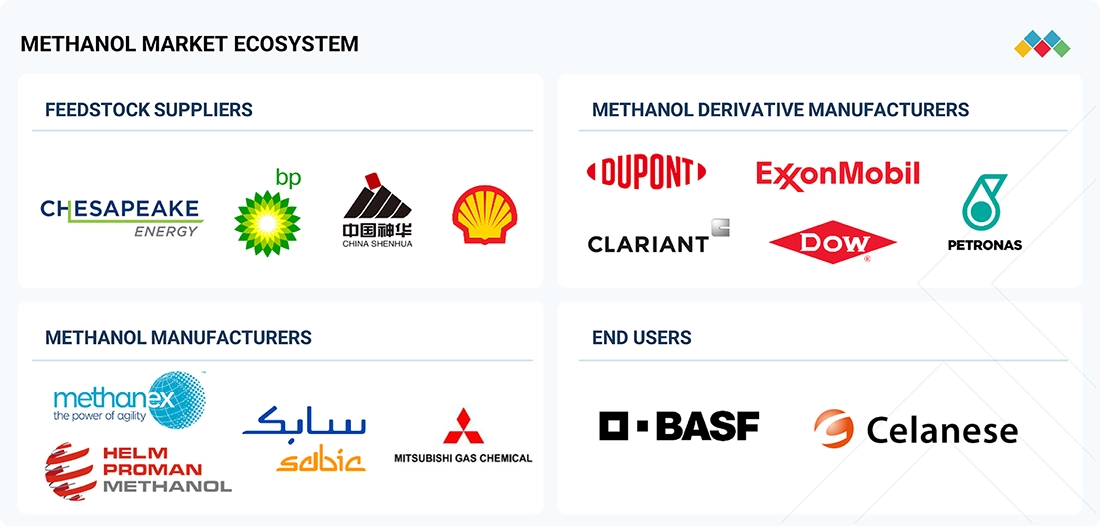
Methanol Market: COMMERCIAL USE CASES ACROSS INDUSTRIES
| COMPANY | USE CASE DESCRIPTION | BENEFITS |
|---|---|---|
 |
Use of methanol-to-olefins (MTO) technology to produce ethylene and propylene for plastics and packaging industries. | Diversifies raw material sources, reduces dependence on crude oil, and supports circular economy in plastics production. |
 |
Supply of low-carbon methanol for marine fuel applications under partnerships with major shipping firms. | Reduction in maritime CO2 emissions, compliance with IMO 2030 standards, and contribution to cleaner global logistics. |
 |
Development of methanol-to-gasoline (MTG) technology for cleaner automotive fuel alternatives. | Reduces vehicle emissions, promotes energy security, and enables use of existing fuel infrastructure. |
 |
Use of methanol in hydrogen and syngas generation for fertilizers and specialty chemicals. | Enhances production flexibility, improves yield, and supports transition to low-carbon industrial chemistry. |
 |
Development of methanol-based solutions for clean cooking fuels and distributed energy applications in rural areas. | Expands energy access, reduces biomass dependency, and lowers particulate emissions in developing regions. |
Logos and trademarks shown above are the property of their respective owners. Their use here is for informational and illustrative purposes only.
Related Ecosystem
Logistics And Transportation
- Internal Combustion Engine (ICE)
- Crawler Excavator
- Fuel Cell
- Light Commercial Vehicles (LCVs)
- Sensors
- Siemens ag
- Alstom s.a.
- Hitachi, Ltd.
- Godrej Industries Limited
- Toshiba Corporation
Bulk Chemicals And Inorganics
- Corrosion Inhibitors
- Glycol Ethers
- Acetic Acid
- Acetone
- Ammonium Nitrate
- Basf se
- DOW CHEMICAL COMPANY
- Exxon Mobil Corporation
- AZELIS HOLDINGS SA
- Sinopec limited
Key Takeaways
- Germany's methanol market is valued at USD 1,651.4 million in 2025 and will reach USD 1,972.9 million by 2030.
- Germany is experiencing a 3.6% CAGR, reflecting steady growth driven by chemical manufacturing and sustainable fuel demand.
- Germany's advanced regulatory framework and industrial infrastructure position it as a European leader in methanol innovation.
- Renewable methanol production and circular economy initiatives are key growth drivers for Germany's market expansion through 2030.
Methanol Market Report Scope
| Report Metric | Details |
|---|---|
| Base Year | 2025 |
| Fastest Growing Segment | FUEL (Application) |
| Forecast Period | 2025–2030 |
| Growth Rate | CAGR of 4.1% from 2025 to 2030 |
| Largest Segment | NATURAL GAS (Feedstock) |
| Market Size Base Year (Billions) | ~USD 45.64 (2025) |
| Revenue Forecast (Billions) | ~USD 55.8 (2030) |
| Segments Covered | Feedstock, Derivative, End-Use Industry, Subderivative, Application |
Germany Methanol Market Report Segmentation
5 segment dimensions are covered across the global market.
By Feedstock
- Coal
- Natural Gas
- Other Feedstocks
By Derivative
- Acetic Acid
- Biodiesel
- Dme
- Formaldehyde
- Gasoline
- Mma
- Mtbe
- Mto/Mtp
- Other Derivatives
By End-Use Industry
- Appliances
- Automotive
- Construction
- Electronics
- Insulation
- Other End-Use Industries
- Packaging
- Paints & Coatings
- Pharmaceuticals
- Solvents
By Subderivative
- Acetate Esters
- Acetic Anhydride
- Fuels
- Gasoline Additives
- Mdi
- Olefins
- Other Subderivatives
- Polyacetals
- Pta
- Uf/Pf Resins
- Vam
By Application
- Chemical Feedstock
- Fuel
GERMANY: METHANOL MARKET, BY END-USE INDUSTRY, 2025–2030
| Segment | 2025 | 2026 | 2027 | 2028 | 2029 | 2030 | CAGR (%) |
|---|---|---|---|---|---|---|---|
| APPLIANCES | 168.9 | 173.7 | 179.8 | 186.1 | 192.9 | 200.1 | 3.4 |
| AUTOMOTIVE | 410.3 | 423.2 | 439.1 | 455.6 | 473.6 | 492.3 | 3.7 |
| CONSTRUCTION | 336.8 | 346.9 | 359.5 | 372.5 | 386.7 | 401.4 | 3.6 |
| ELECTRONICS | 211.7 | 218.5 | 226.9 | 235.6 | 245 | 254.9 | 3.8 |
| INSULATION | 94 | 97 | 100.6 | 104.4 | 108.5 | 112.8 | 3.7 |
| OTHER END-USE INDUSTRIES | 39.2 | 40 | 41.1 | 42.1 | 43.3 | 44.5 | 2.6 |
| PACKAGING | 70.1 | 72.3 | 75 | 77.8 | 80.9 | 84 | 3.7 |
| PAINTS & COATINGS | 179.9 | 185.5 | 192.4 | 199.5 | 207.3 | 215.4 | 3.7 |
| PHARMACEUTICALS | 81.2 | 83.5 | 86.3 | 89.3 | 92.5 | 95.9 | 3.4 |
| SOLVENTS | 59.3 | 61.2 | 63.6 | 66 | 68.7 | 71.4 | 3.8 |
| TOTAL | 1651.4 | 1701.9 | 1764.3 | 1828.9 | 1899.6 | 1972.9 | 3.6 |
Target Audience
- Chemical Manufacturers : German and European chemical producers need market intelligence to optimize methanol sourcing, production planning, and competitive positioning in formaldehyde and acetic acid synthesis.
- Energy & Fuel Companies : Fuel producers and energy firms require Germany-specific data to assess methanol's viability as a sustainable fuel alternative and plan renewable methanol investments.
- Investment & Strategy Teams : Corporate strategists and investors need accurate market sizing and growth forecasts for Germany to evaluate M&A opportunities, capital allocation, and portfolio decisions.
- Government & Policy Makers : German regulatory bodies and policy officials use market data to inform environmental regulations, green chemistry incentives, and sustainable fuel transition strategies.
- Supply Chain & Procurement : Procurement professionals and supply chain managers need Germany market insights to negotiate contracts, identify suppliers, and manage methanol sourcing efficiently.
Key Companies in the Germany Methanol Market
| Company | HQ | Ownership | Strongest segments |
|---|---|---|---|
| SOJITZ CORPORATION | Japan | ||
| PETROBRAS | Brazil | ||
| SHELL PLC | United Kingdom | Public Company | Natural-gas-based methanol (merchant and integrated),MTBE and gasoline blending components,Formaldehyde and downstream resins, |
| METHANEX CORPORATION | Canada | Public Company | Natural-gas-based methanol (merchant),Coal-based methanol (sourced/traded),Formaldehyde chain, |
| SABIC | Saudi Arabia | Public Company | Merchant methanol (natural gas feedstock),MTBE and gasoline blending components,Formaldehyde and downstream resins, |
| YANKUANG ENERGY GROUP COMPANY LIMITED | China | Public Company | Methanol (merchant),Acetic acid and derivatives (incl. ethyl acetate),Other coal-chemical derivatives (DME, MTBE, etc.), |
| CELANESE CORPORATION | United States | Public Company | Acetic acid and acetyl derivatives (methanol-based),Formaldehyde and related resins,EVA resins, compounds, and redispersible powders, |
| BASF SE | Germany | ||
| MITSUBISHI GAS CHEMICAL COMPANY INC. | Japan | ||
| MITSUI & CO., LTD. | Japan | Public Company | Natural-gas-based methanol (merchant and integrated),Coal-based methanol and MTO/MTP chain exposure,Formaldehyde and construction-linked derivatives, |
| SIPCHEM | Saudi Arabia | Public Company | Methanol (merchant and captive),Acetic Acid and Acetyls (including VAM, ethyl/butyl acetate, acetic anhydride),Formaldehyde and Derivatives (including resins and construction uses), |
| METAFRAX CHEMICALS | Russia | Private Company | Merchant Methanol,Formaldehyde and Low-Methanol Formalin,Urea Formaldehyde Concentrate and Resins, |
SOJITZ CORPORATION
Sojitz Corporation is a Japanese trading and investment company operating across multiple sectors including energy, metals, machinery, and chemicals.
PETROBRAS
Petrobras is a Brazilian multinational energy company engaged in oil and gas exploration, production, refining, and distribution.
SHELL PLC
Shell PLC is a British-Dutch multinational energy company founded in 1897 with 84,000 employees, operating as a public company in oil, gas, and renewable energy sectors.
METHANEX CORPORATION
Methanex Corporation is a Canadian public company founded in 1968 with 1,649 employees, specializing in methanol production and marketing.
SABIC
SABIC is a Saudi Arabian public company founded in 1976 with 35,000 employees, a leading global petrochemical manufacturer.
YANKUANG ENERGY GROUP COMPANY LIMITED
Yankuang Energy Group Company Limited is a Chinese public company founded in 1997 with 77,957 employees, engaged in coal mining and energy production.
CELANESE CORPORATION
Celanese Corporation is a United States-based public company founded in 1912 with 11,434 employees, producing specialty chemicals and advanced materials.
BASF SE
BASF SE is a German multinational chemical company engaged in the production of chemicals, plastics, performance products, and agricultural solutions.
MITSUBISHI GAS CHEMICAL COMPANY INC.
Mitsubishi Gas Chemical Company Inc. is a Japanese chemical manufacturer producing industrial chemicals, specialty materials, and related products.
MITSUI & CO., LTD.
Mitsui & Co., Ltd. is a Japanese public company founded in 1947 with 55,463 employees, operating as a diversified trading and investment corporation.
SIPCHEM
SIPCHEM is a Saudi Arabian public company founded in 1999 with 1,011 employees, producing specialty chemicals and petrochemical products.
METAFRAX CHEMICALS
Metafrax Chemicals is a Russian private company founded in 1955 engaged in chemical manufacturing and production.
Reasons to Buy this Report
- Market-Specific Sizing & Forecasts : Access precise valuation data for Germany's methanol market with detailed projections through 2030, enabling accurate financial planning and investment decisions specific to this key European market.
- Competitive Landscape Intelligence : Understand Germany's unique market dynamics, local player strategies, and competitive positioning within the broader European methanol sector to identify growth opportunities.
- Regulatory & Sustainability Insights : Gain insights into Germany's stringent environmental regulations, green chemistry initiatives, and sustainable fuel policies that shape methanol demand and market opportunities.
- Sector-Specific Application Analysis : Identify high-growth applications in German chemical manufacturing, automotive, and energy sectors to target the most promising customer segments and use cases.
- Strategic Market Entry Planning : Leverage Germany-focused data to develop market entry strategies, partnership opportunities, and expansion plans in Europe's largest chemical manufacturing economy.
Frequently asked questions
What is the current size of Germany's methanol market?
Germany's methanol market is estimated at USD 1,651.4 million in 2025, making it a significant segment within the European chemicals industry.
What is the projected growth rate for Germany's methanol market?
Germany's methanol market is projected to grow at a CAGR of 3.6% from 2025 to 2030, reaching USD 1,972.9 million by the forecast year.
What are the main drivers of growth in Germany's methanol market?
Key drivers include Germany's robust chemical manufacturing sector, increasing demand for sustainable fuel alternatives, renewable methanol production technologies, and EU regulatory support for green chemistry.
How does Germany's methanol market compare to other European markets?
Germany maintains a leading position in Europe's methanol sector due to its advanced industrial infrastructure, strong regulatory framework, and commitment to decarbonization and circular economy principles.
What applications drive methanol demand in Germany?
Primary applications in Germany include chemical synthesis, formaldehyde production, fuel blending, and emerging uses in renewable energy and sustainable transportation solutions.
RESEARCH METHODOLOGY
The research encompassed four primary actions in assessing the present market size of methanol. Comprehensive secondary research was conducted to gather information on the overall, peer, and parent markets. The subsequent stage involved corroborating these findings, assumptions, and dimensions with industry specialists throughout the methanol value chain via primary research. The total market size is ascertained using both top-down and bottom-up methodologies. Subsequently, market segmentation analysis and data triangulation were employed to determine the dimensions of the market segments and subsegments.
Secondary Research
The research approach employed to assess and project the access control market is initiated by collecting revenue data from prominent suppliers using secondary research. During the secondary research, many secondary sources, such as Hoovers, Bloomberg BusinessWeek, Factiva, the World Bank, and industry magazines, were utilized to identify and compile information for this study. The secondary sources comprised annual reports, press releases, and investor presentations from corporations; white papers; accredited periodicals; writings by esteemed authors; announcements from regulatory agencies; trade directories; and databases. Vendor offerings have been considered to ascertain market segmentation.
Primary Research
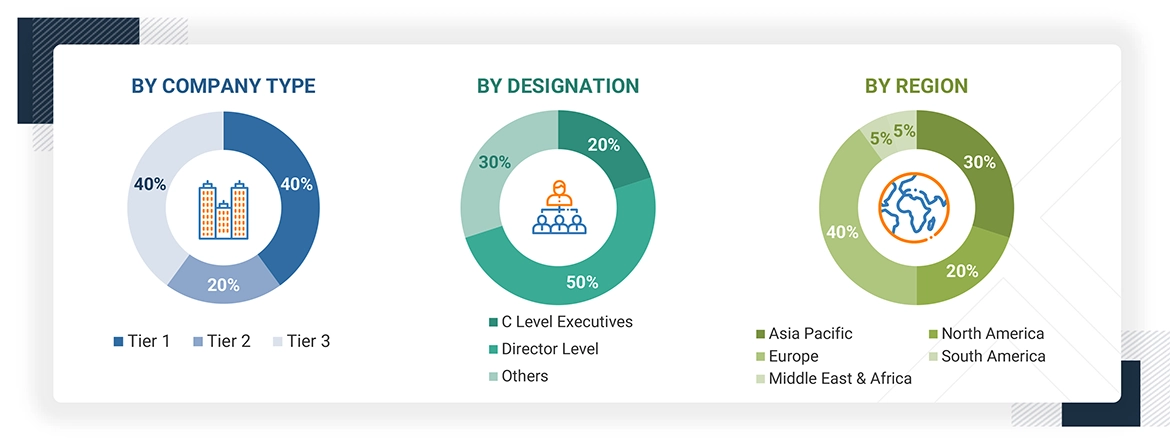
The methanol market comprises several stakeholders in the supply chain, such as manufacturers, suppliers, traders, associations, and regulatory organizations. The demand side of this market is characterized by the development of construction, automotive, electronics, appliances, paints and coatings, insulation, pharmaceuticals, packaging, solvents, and other applications. Advancements in technology characterize the supply side. Various primary sources from the supply and demand sides of the market were interviewed to obtain qualitative and quantitative information.
Following is the breakdown of the primary respondents:
To know about the assumptions considered for the study, download the pdf brochure
Market Size Estimation
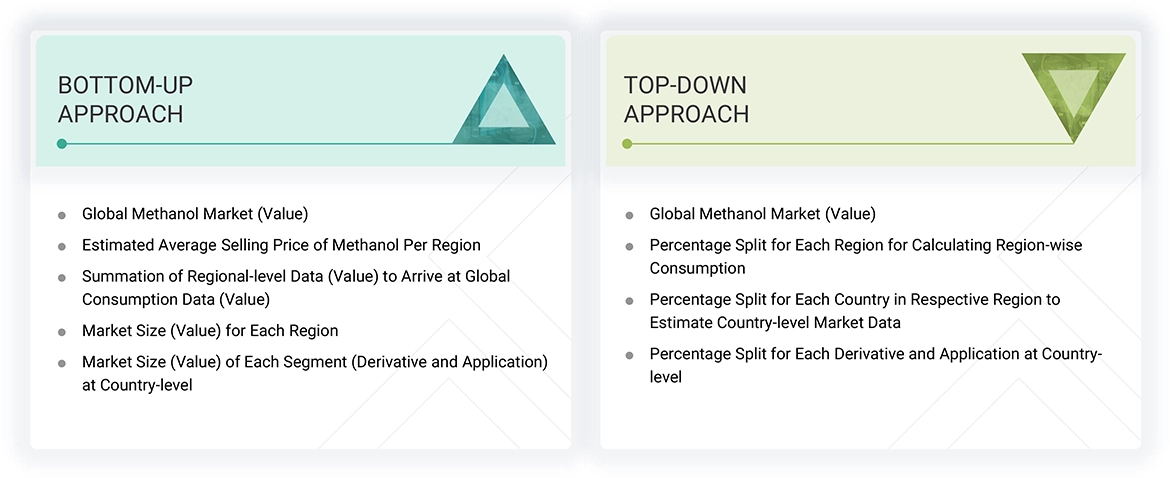
Both the top-down and bottom-up approaches were used to estimate and validate the total size of the methanol market. These methods were also used extensively to determine the size of various sub-segments in the market. The research methodology used to estimate the market size included the following:
- The key players were identified through extensive primary and secondary research.
- The value chain and market size of the methanol market, in terms of value, were determined through primary and secondary research.
- All percentage shares, splits, and breakdowns were determined using secondary sources and verified through primary sources.
- All possible parameters that affect the market covered in this research study were accounted for, viewed in extensive detail, verified through primary research, and analyzed to obtain the final quantitative and qualitative data.
- The research included the study of reports, reviews, and newsletters of top market players, along with extensive interviews for opinions from key leaders, such as CEOs, directors, and marketing executives.
Global Methanol Market Size: Bottom-Up and Top-Down Approach
Data Triangulation
After arriving at the overall market size using the market size estimation processes as explained above, the market was split into several segments and subsegments. Data triangulation and market breakdown procedures were employed to complete the overall market engineering process and arrive at the exact statistics of each market segment and subsegment. The market size was calculated globally by summing up the country-level and regional-level data.
Market Definition
Methanol is known as methyl liquor or wood liquor. It is the most common of alcohols, comprising of a methyl gather joined to a hydroxyl bunch. Methanol is widely used in several industries, such as the marine, automotive, electronics, and construction sectors. Methanol is used in several blends and offers derivatives such as formaldehyde, acidic corrosive, gasoline, biodiesel, methanol to olefins (MTO), methanol to propylene (MTP), and methyl methacrylate (MMA).
Stakeholders
- Raw material manufacturers
- Methanol manufacturers
- Methanol traders, distributors, and suppliers
- Manufacturers of methanol and other related products that use methanol as an integral raw material
- Associations and industrial bodies such as the United States Environment Protection Agency (EPA), the World Health Organization (WHO), the Department of Energy, the Methanol Institute, the European Investment Bank
- Contract manufacturing organizations (CMOs)
- NGOs, governments, investment banks, venture capitalists, and private equity firms
Report Objectives
- To define, describe, and forecast the size of the global methanol market in terms of volume and value
- To provide detailed information regarding the key factors, such as drivers, restraints, opportunities, and industry-specific challenges, influencing the growth of the global methanol market
- To analyze and forecast the size of various segments (derivative and application) of the methanol market based on five major regions—North America, the Asia Pacific, Europe, South America, and the Middle East & Africa—along with key countries in each of these regions
- To analyze recent developments and competitive strategies, such as expansions, new product developments, agreements, and acquisitions, to draw the competitive landscape of the market To strategically profile the key players in the market and comprehensively analyze their core competencies
Get the Full Methanol Market Report
Full forecast, segment splits, and company analysis for all Methanol Market.
- US Methanol Market
- Rest Of Europe Methanol Market
- Rest Of GCC Countries Methanol Market
- Rest Of South America Methanol Market
- China Methanol Market
- Japan Methanol Market
- India Methanol Market
- South Korea Methanol Market
- Indonesia Methanol Market
- UK Methanol Market
- France Methanol Market
- Russia Methanol Market
- Turkey Methanol Market
- Canada Methanol Market
- Mexico Methanol Market
- Saudi Arabia Methanol Market
- UAE Methanol Market
- South Africa Methanol Market
- Brazil Methanol Market
- Argentina Methanol Market
Need a Tailored Report?
Customize this report to your needs
Get 10% FREE Customization
Customize This Report
