
South Korea Microbiology Testing Market (2025-2030)

The South Korea Microbiology Testing Market was valued at $11.2 Million in 2025 and projected to reach to $14.2 Million by 2030, representing a compound annual growth rate of 4.2%. South Korea's microbiology testing market is poised for moderate but sustainable growth through 2030, driven by increasing prevalence of infectious diseases, rising healthcare awareness, and investments in diagnostic infrastructure.


| Market Size in | USD 26.32 MN |
| Market Forecast in | |
| CAGR | |
| Forecast Period | |
| Units Considered | Value (USD MN) |
South Korea Microbiology Testing Market Trends and Insights
- South Korea's advanced healthcare infrastructure and strong diagnostic capabilities position the country as a key player in the Asia Pacific microbiology testing sector.
- The market in South Korea is driven by increasing demand for rapid diagnostic solutions, rising prevalence of infectious diseases, and growing adoption of automated testing systems across clinical laboratories and hospitals. South Korea's regulatory environment and emphasis on precision medicine continue to support market expansion through 2030.
- South Korea benefits from high healthcare spending and a well-established network of diagnostic centers that prioritize quality microbiology testing services.
- The forecast period reflects South Korea's commitment to modernizing laboratory infrastructure and integrating advanced microbiology technologies to meet evolving clinical and public health needs..
Key Market Statistics
- CAGR (2025-2030) 4.2% CAGR
- Market Size, 2025 ~USD 11.2 Million
- Forecast, 2030 ~USD 14.2 Million
- Country South Korea
South Korea Microbiology Testing Market Overview
Market Valuation :
South Korea's microbiology testing market is valued at USD 11.2 million in 2025, with projections reaching USD 14.2 million by 2030, representing steady growth in the region's diagnostic sector.
Growth Rate :
The market expands at a CAGR of 4.2% through 2030, outpacing several regional competitors while remaining below the global average of 5.3%, indicating selective but consistent market development.
Healthcare Infrastructure :
South Korea's advanced healthcare infrastructure and cutting-edge diagnostic capabilities establish the country as a pivotal player in Asia Pacific microbiology testing, supported by high healthcare spending and technological adoption.
Regional Position :
As a developed economy with strong pharmaceutical and medical device sectors, South Korea benefits from robust regulatory frameworks and increasing demand for rapid, accurate microbiology diagnostics across clinical and industrial applications.
South Korea Microbiology Testing Market Dynamics
- The country's aging population and emphasis on preventive healthcare create consistent demand for microbiology testing services across hospitals, diagnostic laboratories, and research institutions. Key growth catalysts include technological advancements in automated testing systems, expansion of point-of-care diagnostics, and strengthening regulatory standards for food and pharmaceutical safety.
- South Korea's competitive advantage in medical technology innovation positions it well to capture emerging opportunities in rapid diagnostics and personalized medicine applications within the microbiology testing sector..
Related Ecosystem
Medical Devices
- Polymerase Chain Reaction (PCR)
- Magnetic Resonance Imaging (MRI)
- Disposable Autoinjectors
- Pulse Oximeters
- Blood Pressure Monitors
- Medtronic plc
- Abbott Laboratories
- Stryker Corporation
- Becton, Dickinson and Company
- CONMED Corporation
Key Takeaways
- South Korea's microbiology testing market is valued at USD 11.2 million in 2025 with a projected value of USD 14.2 million by 2030.
- South Korea is experiencing steady growth at a 4.2% CAGR, driven by advanced healthcare infrastructure and diagnostic innovation.
- South Korea's market is supported by high healthcare expenditure and widespread adoption of automated laboratory systems.
- South Korea's regulatory framework and precision medicine initiatives are key growth catalysts through the forecast period.
Microbiology Testing Market Report Scope
| Report Metric | Details |
|---|---|
| Base Year | 2025 |
| Fastest Growing Segment | VIRAL (Pathogen Type) |
| Forecast Period | 2025–2030 |
| Growth Rate | CAGR of 5.3% from 2025 to 2030 |
| Largest Segment | TRADITIONAL MICROBIOLOGY METHODS (TMM) (Technology Type) |
| Market Size Base Year (Billions) | ~USD 7.4 (2025) |
| Revenue Forecast (Billions) | ~USD 9.58 (2030) |
| Segments Covered | Product, Type, Technology Type, Pathogen Type, End User, Technology, End Users |
South Korea Microbiology Testing Market Report Segmentation
7 segment dimensions are covered across the global market.
By Product
- Consumables
- Instruments
- Reagents & Kits
By Type
- Automated Culture Systems
- Cellular Component-Based Rapid Microbiology Testing
- Colony Counters
- Culture Methods
- Growth-Based Rapid Microbiology Testing
- Incubators
- Manual Counting Methods
- Mass Spectrometers
- Microscopes
- Microscopy Methods
- Nucleic Acid-Based Rapid Microbiology Testing
- Other Instruments
- Other Traditional Microbiology Methods
- Staining Techniques
- Viability-Based Rapid Microbiology Testing
By Technology Type
- Rapid Microbiology Methods (Rmm)
- Traditional Microbiology Methods (Tmm)
By Pathogen Type
- Bacterial
- Fungal
- Other Pathogens
- Viral
By End User
- Cosmetics & Personal Care Companies
- Environmental & Water Testing
- Food & Beverage Companies
- Other End Users
- Pharmaceutical & Biotech Companies
By Technology
- Rapid Microbiology Methods (Rmm)
- Traditional Microbiology Methods (Tmm)
By End Users
- Cosmetics & Personal Care Companies
- Environmental & Water Testing
- Food & Beverage Companies
- Other End Users
- Pharmaceutical & Biotech Companies
Target Audience
- Diagnostic Equipment Manufacturers : Manufacturers need South Korea-specific market data to assess demand for microbiology testing equipment, identify local distribution partners, and tailor product offerings to meet advanced healthcare standards and regulatory requirements.
- Clinical Laboratory Operators : Laboratory managers require market insights to benchmark performance, understand competitive positioning, plan capacity expansion, and identify emerging testing services with growth potential in South Korea's healthcare system.
- Healthcare Investment Firms : Investors evaluating opportunities in South Korea's diagnostic sector need detailed market sizing, growth projections, and competitive analysis to make informed decisions on acquisitions, partnerships, and capital allocation.
- Pharmaceutical & Biotech Companies : Companies developing diagnostic solutions and antimicrobial products need South Korea market data to understand testing demand, regulatory pathways, reimbursement landscapes, and commercialization strategies.
- Healthcare Policy & Government Agencies : Government health officials and policy makers require market intelligence to inform healthcare infrastructure planning, diagnostic standards development, and resource allocation for infectious disease management in South Korea.
Key Companies in the South Korea Microbiology Testing Market
| Company | HQ | Ownership | Strongest segments |
|---|---|---|---|
| BIOMÉRIEUX | France | Public Company | Syndromic and low-plex PCR (BIOFIRE, BIOFIRE SPOTFIRE, ARGENE),Microbiology ID/AST and blood culture (VITEK 2, VITEK MS, VITEK REVEAL, BACT/ALERT, ETEST, API),Immunoassays and sepsis markers (VIDAS, Hybiome CLIA), |
| THERMO FISHER SCIENTIFIC INC. | United States | Public Company | Life Sciences Solutions,Analytical Instruments,Specialty Diagnostics, |
| MERCK KGAA | Germany | Public Company | Life Science (lab and bioprocessing),Healthcare (prescription drugs and biopharmaceuticals),Electronics (semiconductor and display materials), |
| NEOGEN CORPORATION | United States | Public Company | Food Safety diagnostics, media, and sanitation,Animal Safety reagents, instruments, and animal care products,Genomics services for livestock and companion animals, |
| QIAGEN | Netherlands | Public Company | Sample technology consumables and instruments,Immune response (TB and transplant/viral load assays),Oncology and sexual/reproductive health assays, |
| BIO-RAD LABORATORIES, INC. | United States | Public Company | Life Science instruments and systems,Life Science reagents and consumables,Clinical diagnostic test systems and informatics, |
| BRUKER | United States | Public Company | NMR/EPR and Preclinical Imaging (BSI BioSpin),Mass Spectrometry, Molecular Diagnostics, and CALID Solutions,X-ray, AFM, and Nano-Analysis (BSI Nano), |
| SHIMADZU CORPORATION | Japan | Public Company | Analytical and Measuring Instruments,Medical Systems,Industrial and Vacuum Machinery, |
| CHARLES RIVER LABORATORIES | United States | Public Company | Research Models and Services,Discovery and Safety Assessment,Manufacturing Solutions, |
| EUROFINS SCIENTIFIC | Luxembourg | Public Company | Food and Feed Testing, Assurance and Certification,Environment Testing (water, air, soil, waste, maritime),Biopharma Services and Clinical Diagnostics, |
| IDEXX | United States | Public Company | Companion Animal Group (in-clinic analyzers, SNAP tests, reference labs, telemedicine, software),Water Quality Products,Livestock, Poultry and Dairy plus Human Diagnostics, |
BIOMÉRIEUX
bioMérieux is a French public company founded in 1963 that employs 14,894 people. The company operates in the life sciences and diagnostics sector.
THERMO FISHER SCIENTIFIC INC.
Thermo Fisher Scientific Inc. is a United States-based public company founded in 1956 with 125,000 employees. It is a major player in the life sciences and laboratory services industry.
MERCK KGAA
Merck KGaA is a German public company with roots dating back to 1668 and currently employs 59,077 people. The company operates across pharmaceuticals, life sciences, and specialty chemicals.
NEOGEN CORPORATION
Neogen Corporation is a United States-based public company founded in 1981 with 2,974 employees. The company provides food and animal safety solutions.
QIAGEN
QIAGEN is a Netherlands-based public company founded in 1984 with 5,500 employees. The company specializes in molecular diagnostics and life sciences technologies.
BIO-RAD LABORATORIES, INC.
Bio-Rad Laboratories, Inc. is a United States-based public company founded in 1952 with 7,450 employees. The company manufactures and distributes life science research and clinical diagnostics products.
BRUKER
Bruker is a United States-based public company founded in 1960 with 11,085 employees. The company develops scientific instruments and analytical solutions for research and diagnostics.
SHIMADZU CORPORATION
Shimadzu Corporation is a Japanese public company founded in 1875 with 14,649 employees. The company manufactures analytical and measuring instruments, medical devices, and industrial equipment.
CHARLES RIVER LABORATORIES
Charles River Laboratories is a United States-based public company founded in 1947 with 19,000 employees. The company provides preclinical and clinical laboratory services for drug development.
EUROFINS SCIENTIFIC
Eurofins Scientific is a Luxembourg-based public company founded in 1987 with 65,694 employees. The company operates a network of laboratories providing testing and analytical services across multiple industries.
IDEXX
IDEXX is a United States-based public company founded in 1983 with 11,000 employees. The company develops and manufactures diagnostics and software for veterinary and water testing markets.
Reasons to Buy this Report
- Market-Specific Sizing Data : Access precise valuation figures for South Korea's microbiology testing market (USD 11.2M in 2025) with detailed 5-year forecasts, enabling accurate budget allocation and investment planning specific to this developed Asian market.
- Competitive Landscape Intelligence : Understand South Korea's unique competitive dynamics, including local diagnostic leaders, technology adoption rates, and market consolidation trends that differ significantly from global patterns.
- Regulatory & Infrastructure Insights : Gain detailed knowledge of South Korea's advanced healthcare regulations, certification requirements, and diagnostic infrastructure that directly impact market entry strategies and product positioning.
- Growth Driver Analysis : Identify South Korea-specific growth catalysts including aging demographics, healthcare spending patterns, infectious disease prevalence, and technological adoption rates driving the 4.2% CAGR.
- Strategic Market Entry Planning : Develop targeted go-to-market strategies for South Korea with localized insights on customer preferences, distribution channels, pricing dynamics, and partnership opportunities in this high-income healthcare market.
Frequently asked questions
What is the current size of South Korea's microbiology testing market?
South Korea's microbiology testing market is valued at USD 11.2 million in 2025.
What is the projected market size for South Korea by 2030?
South Korea's microbiology testing market is projected to reach USD 14.2 million by 2030.
What is the CAGR for South Korea's microbiology testing market?
South Korea's microbiology testing market is expected to grow at a CAGR of 4.2% from 2025 to 2030.
What factors are driving growth in South Korea's microbiology testing market?
Growth in South Korea is driven by advanced healthcare infrastructure, rising infectious disease prevalence, increasing demand for rapid diagnostics, and widespread adoption of automated laboratory systems.
How does South Korea's market compare to the global microbiology testing market?
South Korea's CAGR of 4.2% is slightly lower than the global CAGR of 5.3%, reflecting the country's mature healthcare system and established diagnostic infrastructure.
RESEARCH METHODOLOGY
The objective of the study is to analyze the key market dynamics of the microbiology testing sector, including drivers, opportunities, restraints, challenges, and key player strategies. It aims to monitor developments across leading players, including acquisitions, product launches, expansions, agreements, and partnerships. The competitive landscape is evaluated to assess market players across various parameters within the broad categories of business and product strategy. The market size is estimated using top-down and bottom-up approaches, while market breakdown and data triangulation methods are employed to determine segment and subsegment sizes.
Secondary Research
In the secondary research process, various secondary sources such as annual reports, press releases & investor presentations of companies, white papers, certified publications, articles by recognized authors, gold-standard & silver-standard websites, regulatory bodies, and databases (D&B Hoovers, Bloomberg Business, and Factiva) were referred to identify and collect information for this study.
Primary Research
In the primary research process, various sources from the supply and demand sides were interviewed to obtain qualitative and quantitative information for this report. Primary sources included industry experts from core and related industries, as well as preferred suppliers, manufacturers, distributors, service providers, technology developers, researchers, and organizations related to all segments of the industry’s value chain. In-depth interviews were conducted with various primary respondents, including key industry participants, subject-matter experts, C-level executives of key market players, and industry consultants, to obtain and verify critical qualitative and quantitative information as well as assess prospects.
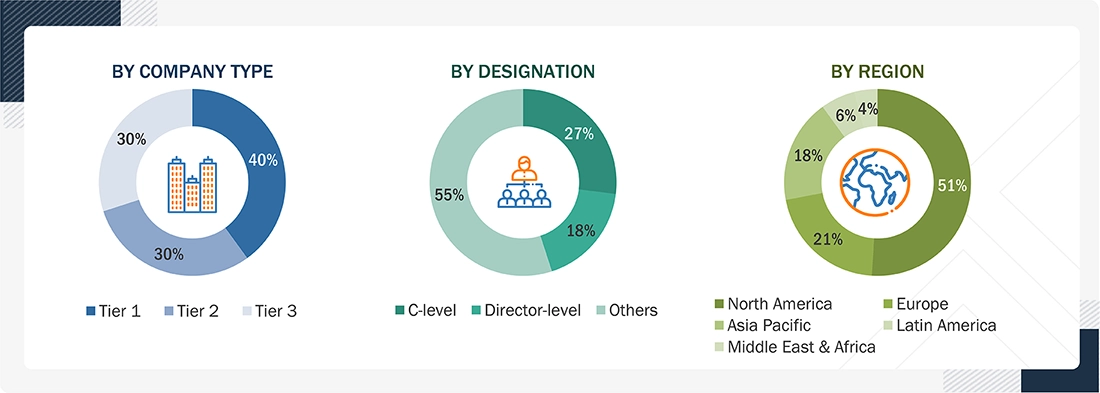
Note 1: Others include sales managers, marketing managers, and product managers.
Note 2: Companies are classified into tiers based on their total revenues. As of 2025, Tier 1 = >USD 100 million, Tier 2 = USD 10 million to USD 100 million, and Tier 3 = <USD 10 million.
To know about the assumptions considered for the study, download the pdf brochure
Market Size Estimation
Both the top-down and bottom-up approaches have been used to estimate and validate the size of the small satellite market.
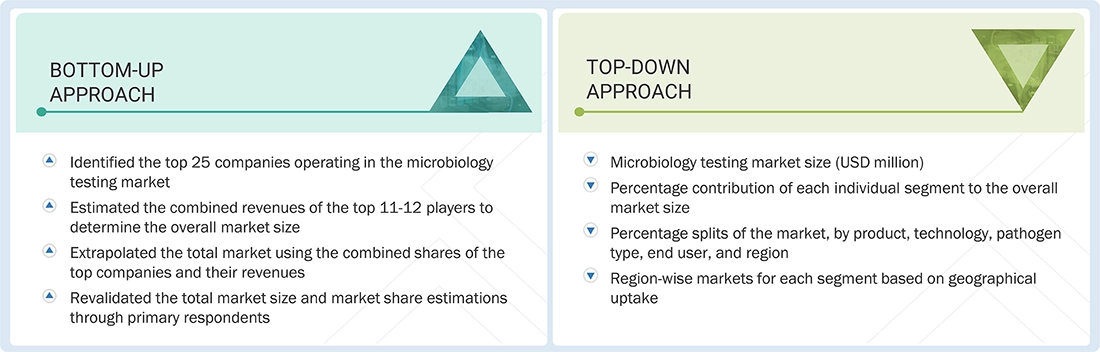
The top-down and bottom-up approaches were used to estimate and validate the total size of the microbiology testing market. These methods were also widely used to estimate the sizes of various market segments. The research methodology used to estimate the market size includes the following:
- The key players in the industry have been identified through extensive secondary research.
- The revenues generated by leading players operating in the microbiology testing industry have been determined through primary and secondary research.
- All percentage shares, splits, and breakdowns have been determined using secondary sources and verified through primary sources.
Microbiology Testing Market : Top-Down and Bottom-Up Approach
Data Triangulation
After determining the overall market size using the above-mentioned process, the total market was divided into several segments and subsegments. To complete the overall market engineering process and obtain precise statistics for all segments and subsegments, data triangulation and market breakdown procedures were employed, as applicable. The data was triangulated by examining various factors and trends on both the demand and supply sides.
Market Definition
Microbiology testing involves the identification, quantification, and analysis of microorganisms, including bacteria, viruses, fungi, and protozoa, and plays a critical role in ensuring product safety, protecting public health, and preserving environmental integrity. These tests are widely used across pharmaceutical and biotech companies, food and beverage companies, environmental and water testing, cosmetics and personal-care companies, the agriculture and animal feed industry, and academic and research institutes, where they support quality control, regulatory compliance, contamination monitoring, and scientific research activities.
Key Stakeholders
- Manufacturers & distributors of microbiology testing solutions
- Food & beverage companies
- Environmental and water testing organizations
- Pharmaceutical & biotechnology companies
- Cosmetics & personal care companies
- Agriculture & animal feed industry
- Contract testing laboratories
- Academic & research institutes
- Government and regulatory bodies
- Market research & consulting firms
- Venture capitalists & investors
Report Objectives
- To define, segment, and forecast the global microbiology testing market by product, technology, pathogen type, end user, and region
- To provide detailed information regarding the major factors influencing market growth (such as drivers, restraints, opportunities, and challenges)
- To analyze micromarkets with respect to individual growth trends, prospects, and contributions to the overall microbiology testing market
- To analyze market opportunities for stakeholders and provide details of the competitive landscape for key players
- To forecast the size of the market segments with respect to six regions, namely, North America, Europe, the Asia Pacific, Latin America, and the Middle East & Africa
- To profile the key players and comprehensively analyze their product portfolios, market positions, and core competencies
- To track and analyze company developments such as product launches & approvals, partnerships, acquisitions, agreements, and other developments
- To benchmark players within the microbiology testing market using the company evaluation matrix framework, which analyzes market players on various parameters within the broad categories of business strategy, market share, and product offerings
Available customizations:
MarketsandMarkets offers the following customizations for this market report.
Company Profiles
- An additional five company profiles of players operating in microbiology testing.
Regional Analysis
- Further breakdown of the market segments at the country level
Country Information
- Additional country-level analysis of microbiology testing
Get the Full Microbiology Testing Market Report
Full forecast, segment splits, and company analysis for all Microbiology Testing Market.
- North America Microbiology Testing Market
- Europe Microbiology Testing Market
- Asia Pacific Microbiology Testing Market
- Latin America Microbiology Testing Market
- North America Clinical Microbiology Market
- Europe Clinical Microbiology Market
- Asia Pacific Clinical Microbiology Market
- Latin America Clinical Microbiology Market
- Canada Microbiology Testing Market
- US Microbiology Testing Market
- Germany Microbiology Testing Market
- UK Microbiology Testing Market
- France Microbiology Testing Market
- Italy Microbiology Testing Market
- Spain Microbiology Testing Market
- China Microbiology Testing Market
- Japan Microbiology Testing Market
- India Microbiology Testing Market
- Australia Microbiology Testing Market
- Brazil Microbiology Testing Market
- Mexico Microbiology Testing Market
- Rest Of Europe Microbiology Testing Market
- Rest Of Asia Pacific Microbiology Testing Market
- Rest Of Latin America Microbiology Testing Market
- Canada Clinical Microbiology Market
- US Clinical Microbiology Market
- Germany Clinical Microbiology Market
- France Clinical Microbiology Market
- UK Clinical Microbiology Market
- Italy Clinical Microbiology Market
- Spain Clinical Microbiology Market
- China Clinical Microbiology Market
- Japan Clinical Microbiology Market
- India Clinical Microbiology Market
- Australia Clinical Microbiology Market
- Brazil Clinical Microbiology Market
- Mexico Clinical Microbiology Market
- Rest Of Europe Clinical Microbiology Market
- Rest Of Asia Pacific Clinical Microbiology Market
- Rest Of Latin America Clinical Microbiology Market
- Ksa Clinical Microbiology Market
- UAE Clinical Microbiology Market
Need a Tailored Report?
Customize this report to your needs
Get 10% FREE Customization
Customize This Report