
Canada Military Radar Market (2024-2029)

The Canada Military Radar Market was valued at $490.1 Million in 2024 and projected to reach to $671.3 Million by 2029, representing a compound annual growth rate of 6.5%. Canada's military radar market is positioned for robust growth through 2029, supported by government commitments to modernize defence capabilities and strengthen continental security.


| Market Size in | USD 26.32 MN |
| Market Forecast in | |
| CAGR | |
| Forecast Period | |
| Units Considered | Value (USD MN) |
Canada Military Radar Market Trends and Insights
- This growth trajectory reflects Canada's strategic investments in modernizing its defence infrastructure and enhancing surveillance capabilities across air, sea, and land domains.
- Canada's commitment to NATO obligations and regional security partnerships is driving demand for advanced radar systems that support early warning, air defence, and maritime patrol operations. The Canadian military radar sector benefits from sustained government defence spending and collaboration with allied nations on next-generation radar technologies.
- Canada's geographic position and Arctic security priorities are catalyzing procurement of sophisticated radar platforms capable of operating in challenging environmental conditions.
- Between 2024 and 2029, Canada's market expansion will be supported by ongoing platform upgrades, integration of digital technologies, and development of multi-function radar systems that enhance operational effectiveness across the Canadian Armed Forces..
Key Market Statistics
- CAGR (2024-2029) 6.5% CAGR
- Market Size, 2024 ~USD 490.1 Million
- Forecast, 2029 ~USD 671.3 Million
- Country Canada
Canada Military Radar Market Overview
Strong CAGR Growth :
Canada's military radar market is expanding at 6.5% CAGR from 2024-2029, outpacing the global growth rate of 5.4%, driven by increased defence modernization initiatives.
NATO Strategic Commitments :
Canada's obligations to NATO and North American defence partnerships are accelerating investments in advanced radar systems for air, sea, and land domain awareness.
Multi-Domain Surveillance Focus :
Canadian defence priorities emphasize integrated radar capabilities across maritime surveillance, air defence, and ground-based systems to address evolving security threats.
Domestic Defence Spending :
Increased federal budget allocations for defence infrastructure modernization are creating sustained demand for next-generation radar technologies and system upgrades.
Canada Military Radar Market Dynamics
- The market expansion reflects Canada's strategic focus on upgrading aging radar infrastructure and integrating advanced surveillance systems across the Canadian Armed Forces.
- Key drivers include NATO interoperability requirements, Arctic surveillance priorities, and investments in integrated air defence systems.
- The projected growth from USD 490.1 million to USD 671.3 million demonstrates sustained confidence in Canada's defence modernization agenda and the critical role of radar technology in national security operations..
Market Ecosystem
Related Ecosystem
Cns Systems
- C-Band
- Ka-Band
- Antennas
- Unmanned Ground Vehicles (UGV)
- Rotary Wing Aircraft
- L3Harris Technologies, Inc.
- Thales group
- HONEYWELL INTERNATIONAL INC.
- Northrop Grumman Corporation
- LOCKHEED MARTIN CORPORATION
Defence Platforms And Systems
- Sensors
- Unmanned Ground Vehicles (UGV)
- Fighter Aircraft
- Special Mission Aircraft
- Antennas
- BAE Systems plc
- Thales group
- LOCKHEED MARTIN CORPORATION
- Northrop Grumman Corporation
- L3Harris Technologies, Inc.
Key Takeaways
- Canada's military radar market is valued at USD 490.1 million in 2024 and will grow to USD 671.3 million by 2029 at a 6.5% CAGR.
- Canada's Arctic security priorities and NATO commitments are primary drivers of radar modernization and procurement initiatives.
- Canada is investing in multi-function radar systems and digital integration to enhance surveillance across air, maritime, and land domains.
- Sustained government defence spending and allied partnerships position Canada as a stable growth market for advanced radar technologies through 2029.
Military Radar Market Report Scope
| Report Metric | Details |
|---|---|
| Base Year | 2024 |
| Fastest Growing Segment | QUANTUM RADARS (Technology) |
| Forecast Period | 2024-2029 |
| Growth Rate | CAGR of 5.4% from 2024 to 2029 |
| Largest Segment | NEW INSTALLATION (Service) |
| Market Size Base Year (Billions) | ~USD 14.15 (2024) |
| Revenue Forecast (Billions) | ~USD 18.4 (2029) |
| Segments Covered | Component, Platform, End User, Waveform, Technology, Frequency Band, Product Type, Dimension, Service, Range, Frequency |
Canada Military Radar Market Report Segmentation
11 segment dimensions are covered across the global market.
By Component
- Antennas
- Digital Signal Processors
- Duplexers
- Graphical User Interfaces
- Other Components
- Power Amplifiers
- Receivers
- Stabilization Systems
- Transmitters
By Platform
- Airborne
- Land
- Naval
- Space
By End User
- Air Force
- Army
- Navy
- Space
By Waveform
- Doppler
- Frequency-Modulated Continuous Wave (Fmcw)
By Technology
- Conventional Radars
- Quantum Radars
- Software-Defined Radars
By Frequency Band
- C-Band
- Hf/Vhf/Uhf-Band
- Ka-Band
- Ku-Band
- L-Band
- Multi-Band
- S-Band
- X-Band
By Product Type
- Air Traffic Control Radars
- Airborne Moving Target Indicator (Mti) Radars
- Airborne Moving-Target Indicator (Mti) Radars
- Aircraft Bird Strike Avoidance Radars
- Counter-Drone Radar
- Counter-Drone Radars
- Ground Penetrating Radars
- Multifunction Radars
- Other Components
- Other Products
- Surveillance & Early Airborne Warning Radars
- Tracking & Fire Control Radars
- Weapon Locating & C-Ram Radars
- Weapon Locating Radar & C-Ram Radar
- Weapon Locating Radar & C-Ram Radars
- Weather Radars
By Dimension
- 2D
- 3D
- 4D
By Service
- New Installation
- Support & Maintenance
- Training & Consulting
By Range
- Long Range
- Medium Range
- Short Range
- Very Long Range
- Very Short Range
By Frequency
- C-Band
- Hf/Vhf/Uhf-Band
- Ka-Band
- Ku-Band
- L-Band
- Multi-Band
- S-Band
- X-Band
Target Audience
- Defence Contractors & OEMs : Radar manufacturers and systems integrators need Canada-specific market data to develop localized offerings, navigate procurement processes, and capitalize on modernization contracts.
- Government & Military Procurement : Canadian Department of National Defence and military procurement officials require market intelligence to benchmark spending, evaluate vendor capabilities, and plan acquisition strategies.
- Investment & Private Equity Firms : Investors targeting aerospace & defence sectors need Canada market insights to identify acquisition targets, assess growth potential, and evaluate portfolio companies in the radar space.
- Technology & Systems Integrators : Companies providing radar components, software, and integration services require Canada-specific demand forecasts to align R&D investments and production capacity planning.
- Strategic Consultants & Analysts : Management consulting firms and research organizations need granular Canada data to support client advisory work on defence modernization, market entry, and competitive positioning.
Reasons to Buy this Report
- Market Size & Growth Data : Access precise valuation metrics for Canada's military radar market with verified 2024 baseline (USD 490.1M) and 2029 forecasts, enabling accurate budget planning and investment decisions.
- Competitive Landscape Intelligence : Understand Canada-specific supplier dynamics, procurement patterns, and competitive positioning to identify partnership opportunities and market entry strategies in this growing defence sector.
- NATO & Policy Insights : Gain clarity on how Canadian NATO commitments, Arctic security priorities, and federal defence spending translate into radar system demand and technology requirements.
- Procurement Cycle Analysis : Identify upcoming modernization programs, defence budget cycles, and acquisition timelines specific to Canadian military branches to align sales and development strategies.
- Regional Growth Drivers : Leverage Canada-specific growth catalysts including continental defence integration, multi-domain surveillance expansion, and domestic industrial capacity development for strategic planning.
Frequently asked questions
What is the current size of Canada's military radar market?
Canada's military radar market is valued at USD 490.1 million in 2024 and is expected to reach USD 671.3 million by 2029.
What is the projected growth rate for Canada's military radar market?
Canada's military radar market is projected to grow at a compound annual growth rate (CAGR) of 6.5% from 2024 to 2029.
What factors are driving growth in Canada's military radar sector?
Key drivers include Canada's Arctic security priorities, NATO commitments, modernization of defence infrastructure, and investments in multi-function radar systems for enhanced surveillance capabilities.
Which military domains are prioritized for radar investment in Canada?
Canada is prioritizing radar investments across air defence, maritime patrol, and land-based surveillance domains to support comprehensive operational coverage.
How does Canada's market compare to global military radar trends?
Canada's 6.5% CAGR outpaces the global military radar market CAGR of 5.4%, reflecting stronger regional demand driven by Arctic security and allied defence partnerships.
RESEARCH METHODOLOGY
The study involved four major activities in estimating the current size of the Military Radar Market. Exhaustive secondary research was done to collect information on the Military Radar Market, its adjacent markets, and its parent market. The next step was to validate these findings, assumptions, and sizing with industry experts across the value chain through primary research. Demand-side analyses were carried out to estimate the overall size of the market. After that, market breakdown and data triangulation procedures were used to estimate the sizes of different segments and subsegments of the Military Radar Market.
Secondary Research
In the secondary research process, various sources were referred to for identifying and collecting information for this study. The secondary sources included government sources, such as SIPRI; corporate filings such as annual reports, press releases, and investor presentations of companies; white papers, journals, and certified publications; and articles from recognized authors, directories, and databases.
Primary Research
Extensive primary research was conducted after acquiring information regarding the Military Radar Market scenario through secondary research. Several primary interviews were conducted with market experts from both the demand and supply sides across major countries of North America, Europe, Asia Pacific, the Middle East, and the Rest of the World, which includes Africa and Latin America. Primary data was collected through questionnaires, emails, and telephonic interviews.
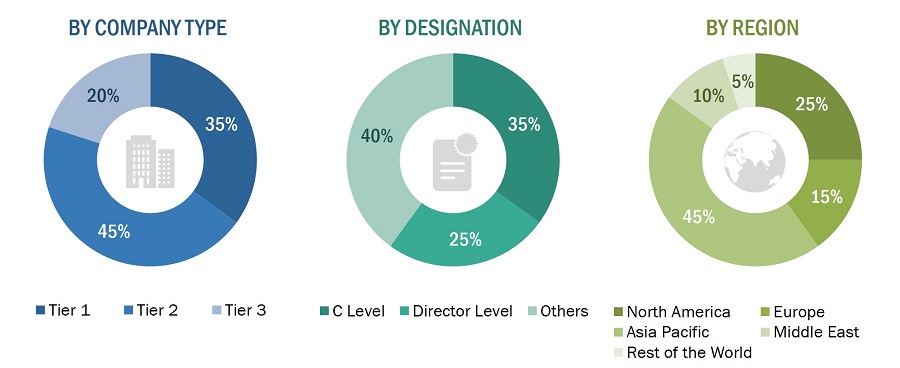
To know about the assumptions considered for the study, download the pdf brochure
Market Size Estimation
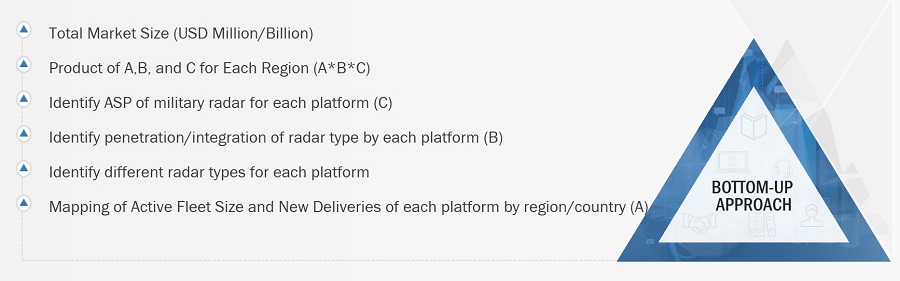
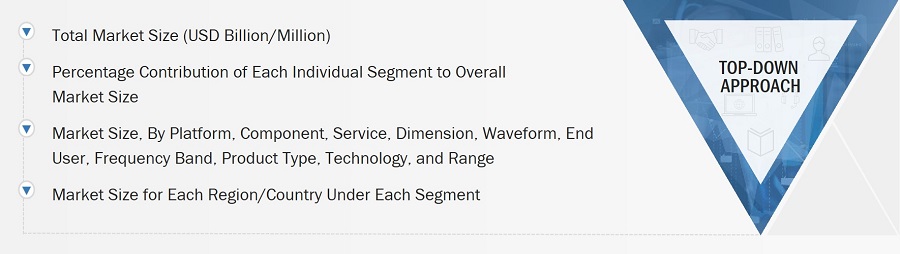
The top-down and bottom-up approaches were used to estimate and validate the size of the Military Radar Market. The research methodology used to estimate the size of the market includes the following details.
Key players in the Military Radar Market were identified through secondary research, and their market share was determined through primary and secondary research. This included a study of the annual and financial reports of the top market players and extensive interviews with leaders such as directors, engineers, marketing executives, and other stakeholders of leading companies operating in the Military Radar Market .
All percentage shares, splits, and breakdowns were determined using secondary sources and verified through primary sources. All possible parameters that affect the markets covered in this research study were accounted for, viewed in extensive detail, verified through primary research, and analyzed to obtain the final quantitative and qualitative data on the Military Radar Market. This data was consolidated, enhanced with detailed inputs, analyzed by MarketsandMarkets, and presented in this report.
Military Radar Market Market Size: Bottom-up Approach
Military Radar Market Market Size: Top-Down Approach
Data Triangulation
After arriving at the overall market size, the total market was split into several segments and subsegments. The data triangulation and market breakdown procedures explained below were implemented, wherever applicable, to complete the overall market engineering process and arrive at the estimated market numbers for the market segments and subsegments. The data was triangulated by studying various factors and trends from the demand and supply sides. Along with this, the market size was validated using the top-down and bottom-up approaches.
Market Definition
The military radar market is dedicated to the design, production, and deployment of specialized radar systems for defense and military applications. These systems are essential for enhancing the capabilities of armed forces and defense agencies in critical areas such as situational awareness, target detection, tracking, surveillance, and reconnaissance. The market encompasses a wide range of applications, including airspace monitoring, air and missile defense, weapon guidance, ground surveillance, airborne mapping, maritime patrolling, and search and rescue operations, spanning land, airborne, naval, and space-based platforms. It incorporates various radar technologies across 2D, 3D, and 4D dimensions and frequency bands including HF/UHF/VHF, L-band, S-band, C-band, X-band, Ku-band, Ka-band, and multi-band. Market growth is driven by technological advancements such as AESA and GaN technologies, increased defense spending due to rising global security threats, and the urgent need to modernize outdated radar systems. Key players in this sector include Lockheed Martin, Northrop Grumman, Raytheon Technologies, BAE Systems, and Thales Group, whose innovations are significantly propelling market expansion.
Key Stakeholders
- Airlines
- System Integrators
- Military Radar Solution Providers
- Military Radar Platform Providers
- Military Radar System Providers
- Technology Providers
- Armed Forces
- Military Radar Product Manufacturers
- Component Manufacturers
- Distributors and Suppliers
- Aerospace and Defense Industries
- Component Manufacturers
- Distributors and Suppliers
- Universities, Research Organizations, Forums, Alliances, and Associations
- Ministries of Defense
- Original Equipment Manufacturers (OEMs)
- Regulatory Bodies
- R&D Companies
Report Objectives
- To define, describe, and forecast the military radar market size based on application, component, platform, end-user, waveform, technology, product type, frequency band, range, dimension, services, and Region.
- To forecast the size of different segments of the market with respect to five major regions: North America, Europe, Asia Pacific, the Middle East, and the Rest of the World, along with their respective key countries
- To identify and analyze key drivers, restraints, opportunities, and challenges influencing the market’s growth
- To identify industry trends and technology trends currently prevailing in the market
- To analyze micromarkets1 with respect to their individual growth trends, prospects, and contribution to the overall market
- To profile companies operating in the market based on their product portfolios, market share, and key growth strategies
- To analyze the degree of competition among players in the market by identifying and analyzing their business revenues, products offered, and recent developments and ranking them based on these parameters
- To analyze competitive developments such as deals, new product launches/developments, and partnerships/acquisitions undertaken by key market players
- To strategically profile key players and comprehensively analyze their share and core competencies in the market
Available Customizations:
MarketsandMarkets offers the following customizations for this market report:
- Additional country-level analysis of the Military Radar Market
- Profiling of other market players (up to 5)
Product Analysis
- Product matrix, which provides a detailed comparison of the product portfolio of each company in the Military Radar Market
Get the Full Military Radar Market Report
Full forecast, segment splits, and company analysis for all Military Radar Market.
- US Military Radar Market
- UK Military Radar Market
- Germany Military Radar Market
- France Military Radar Market
- Italy Military Radar Market
- India Military Radar Market
- Japan Military Radar Market
- South Korea Military Radar Market
- Australia Military Radar Market
- Saudi Arabia Military Radar Market
- UAE Military Radar Market
- Rest Of Europe Military Radar Market
- Rest Of Asia Pacific Military Radar Market
- Rest Of Middle East Military Radar Market
Need a Tailored Report?
Customize this report to your needs
Get 10% FREE Customization
Customize This Report
