
Asia Pacific Modified Starch Market (2022-2027)

The Asia Pacific Modified Starch Market was valued at $4484.53 Million in 2022 and projected to reach to $5286.67 Million by 2027, representing a compound annual growth rate of CAGR 3.3%. The Asia Pacific modified starch market is poised for steady growth through 2027, driven by rapid industrialization, expanding food processing infrastructure, and shifting consumer preferences toward convenience foods.


| Market Size in | USD 26.32 MN |
| Market Forecast in | |
| CAGR | |
| Forecast Period | |
| Units Considered | Value (USD MN) |
Asia Pacific Modified Starch Market Trends and Insights
- Asia Pacific represents a significant portion of global demand, driven by rapid industrialization, growing food processing sectors, and increasing consumer preference for convenience foods across the region.
- The market in Asia Pacific is supported by rising applications in bakery, confectionery, dairy, and beverage industries, where modified starches serve as thickeners, stabilizers, and texture enhancers. Asia Pacific's modified starch market growth is fueled by expanding middle-class populations and urbanization trends that drive packaged food consumption.
- Between 2022 and 2027, Asia Pacific is expected to maintain steady momentum as manufacturers invest in product innovation and clean-label formulations.
- The region's competitive landscape features both multinational corporations and regional players adapting to local regulatory requirements and consumer preferences, positioning Asia Pacific as a critical growth market within the global modified starch industry..
Key Market Statistics
- CAGR (2022-2027) CAGR 3.3%
- Market Size, 2022 ~USD 4484.53 Million
- Forecast, 2027 ~USD 5286.67 Million
- Geography Asia Pacific
Asia Pacific Modified Starch Market Overview
Market Valuation & Growth :
Asia Pacific modified starch market valued at $4,484.53 million in 2022, projected to reach $5,286.67 million by 2027, representing a robust 3.3% CAGR over the forecast period.
China's Market Dominance :
China leads the Asia Pacific region with a market size of $4,449.64 million, accounting for the majority of regional demand and driving innovation in modified starch applications.
Rapid Industrialization & Food Processing :
Accelerating food processing sectors across Asia Pacific, coupled with rising urbanization and middle-class expansion, are fueling demand for modified starch in convenience foods and industrial applications.
Emerging Market Opportunities :
India ($820.79M) and Japan ($1,762.91M) present significant growth opportunities, with increasing adoption of processed foods and functional ingredients driving market expansion in these key economies.
Asia Pacific Modified Starch Market Dynamics
- China remains the dominant market force, while emerging economies like India and Southeast Asian nations present substantial untapped potential.
- The region's growing middle-class population and increasing disposable incomes are accelerating demand for processed and packaged food products that rely on modified starch as a key ingredient. Key growth drivers include technological advancements in starch modification, rising demand from the pharmaceutical and cosmetics sectors, and regulatory support for food innovation across the region.
- However, market growth may be tempered by fluctuating raw material costs and competition from alternative thickening and stabilizing agents.
- Strategic investments in production capacity and R&D will be critical for market players to capitalize on Asia Pacific's expanding opportunities..
Market Ecosystem
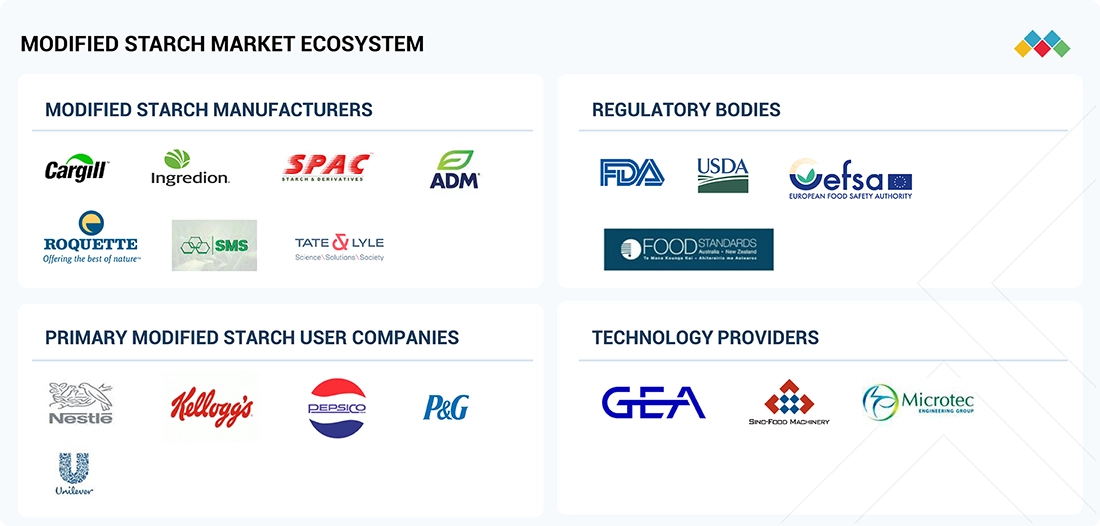
modified-starch-market: COMMERCIAL USE CASES ACROSS INDUSTRIES
| COMPANY | USE CASE DESCRIPTION | BENEFITS |
|---|---|---|
 |
Focus on clean-label and specialty starches derived from various sources for dairy, bakery, and beverages | Innovation in functional ingredients | Ability to meet the rising demand for healthier food formulations |
 |
Development of modified starches for food applications (thickeners, stabilizers, texturizers) | Delivering the viscosity, texture, and stability of traditional cook-up starches without the need for cooking |
 |
Food-grade and nutrition-focused starch derivatives | Provides unique technical and texture properties suited to sauces that require stability under challenging conditions |
Logos and trademarks shown above are the property of their respective owners. Their use here is for informational and illustrative purposes only.
Related Ecosystem
Fandb Ingredients
- Dairy Products
- Bakery Products
- Microorganism
- Polydextrose
- Carbohydrates
- AZELIS HOLDINGS SA
- Archer-Daniels-Midland Company
- Kerry Group plc
- Amway
- DSM FIRMMENICH
Key Takeaways
- Asia Pacific modified starch market is valued at $4,484.53 million in 2022 with projected growth to $5,286.67 million by 2027.
- The region demonstrates a 3.3% CAGR, reflecting steady demand from food processing and beverage industries across Asia Pacific.
- Urbanization and rising middle-class consumption in Asia Pacific are primary drivers of modified starch market expansion through 2027.
- Asia Pacific manufacturers are increasingly focusing on clean-label and sustainable modified starch solutions to meet evolving consumer preferences.
Modified Starch Market Report Scope
| Report Metric | Details |
|---|---|
| Base Year | 2022 |
| Fastest Growing Segment | CASSAVA (Raw Material) |
| Forecast Period | 2022–2027 |
| Growth Rate | CAGR of 3.1% from 2022 to 2027 |
| Largest Segment | DRY (Form) |
| Market Size Base Year (Billions) | ~USD 13.65 (2022) |
| Revenue Forecast (Billions) | ~USD 15.9 (2027) |
| Segments Covered | Raw Material, Application, Sub-Application, Type, Form |
Asia Pacific Modified Starch Market Report Segmentation
5 segment dimensions are covered across the global market.
By Raw Material
- Cassava
- Corn
- Other Raw Materials
- Potato
- Wheat
By Application
- Feed
- Food & Beverages
- Industrial
By Sub-Application
- Bakery & Confectionery
- Beverages
- Cosmetics
- Medicines & Pharmaceuticals
- Other Food Applications
- Other Industrial Applications
- Papermaking
- Processed Foods
- Weaving & Textiles
By Type
- Other Feed Applications
- Poultry Feed
- Ruminant Feed
- Swine Feed
By Form
- Dry
- Liquid
Target Audience
- Food & Beverage Manufacturers : Manufacturers operating in Asia Pacific need market data to optimize product formulations, identify sourcing opportunities, and align production strategies with regional demand for modified starch in processed foods.
- Starch Producers & Suppliers : Starch producers require detailed market insights to assess regional demand, evaluate expansion opportunities in high-growth markets like India, and develop competitive strategies against established players.
- Investment & Private Equity Firms : Investors evaluating M&A opportunities and market entry strategies in Asia Pacific's food ingredients sector need comprehensive market sizing, growth forecasts, and competitive landscape analysis.
- Food Ingredient Distributors : Distributors and traders require country-level market data to optimize inventory management, identify emerging demand centers, and develop targeted sales strategies across Asia Pacific regions.
- Regulatory & Industry Consultants : Consultants advising clients on market expansion, regulatory compliance, and competitive positioning in Asia Pacific need detailed regional insights and country-specific market dynamics.
Key Companies in the Asia Pacific Modified Starch Market
| Company | HQ | Ownership | Strongest segments |
|---|---|---|---|
| BUNGE LIMITED | United States | Public Company | Soybean Processing and Refining,Softseed Processing and Refining,Other Oilseeds Processing and Refining, |
| SENSUS, INC | United States | Public Company | SRT-100 base systems,SRT-100 Vision and SRT-100+,Sentinel service program, |
| AMWAY | Malaysia | Public Company | Nutrition and weight management (NUTRILITE, bodykey, XS),Beauty and personal care (ARTISTRY, G&H, GLISTER, SATINIQUE),Home and living (eSpring, ATMOSPHERE, Amway Home), |
| ROYAL COSUN | Netherlands | Private Company | Beet sugar and co-products,Potato products and specialties,Functional ingredients (inulin, starch, fibers), |
| ARCHER DANIELS MIDLAND COMPANY | United States | Public Company | Ag Services and Oilseeds,Carbohydrate Solutions,Nutrition, |
| CARGILL | United States | Private Company | Grains and oilseeds origination, trading, and processing,Animal nutrition and feed (including aquaculture),Meat and poultry products, |
| INGREDION INCORPORATED | United States | Public Company | Sweeteners (HFCS, glucose syrups, dextrose, polyols),Food starches and texture systems,Industrial and specialty industrial starches, |
| TATE & LYLE | United Kingdom | Public Company | Sweeteners (bulk and specialty),Fibres,Starches, proteins, and functional flours, |
| AVEBE U.A. | Netherlands | Private Company | Food-grade potato starch and systems (Solvitose, Perfectasol, Etenia, Eliane, Paselli, Perfectamyl, Puramyl, Farinex),Potato protein and feed co-products (Solanic, Protamylasse, Protamyl, Protastar),Industrial starches for paper, construction, adhesives, inks, textiles (Casucol, Perfectafilm, Amylofax, Perfectacote, Avedex, Solvicol), |
| AGRANA | Austria | Public Company | Food and Beverage Solutions,ACS-Starch,ACS-Sugar, |
| GLOBAL BIO-CHEM TECHNOLOGY GROUP COMPANY LIMITED | Hong Kong | Public Company | Upstream corn refined products,Amino acids,Corn sweeteners and modified starches, |
| TEREOS | France | Private Company | Sugar and sweetening ingredients,Starches and plant-based ingredients,Alcohol and ethanol, |
BUNGE LIMITED
Bunge Limited is a publicly traded American company founded in 1818 with 34,000 employees, operating as a global agribusiness and food ingredient producer.
SENSUS, INC
Sensus, Inc. is a small publicly traded American company founded in 2010 with 60 employees.
AMWAY
Amway is a publicly traded company based in Malaysia, founded in 1976 with 308 employees.
ROYAL COSUN
Royal Cosun is a private Dutch company with 4,528 employees operating in the agricultural and food processing sectors.
ARCHER DANIELS MIDLAND COMPANY
Archer Daniels Midland Company is a publicly traded American agribusiness corporation founded in 1902 with 41,147 employees.
CARGILL
Cargill is a privately held American company founded in 1865 with 155,000 employees, operating as one of the world's largest agricultural processors and commodity traders.
INGREDION INCORPORATED
Ingredion Incorporated is a publicly traded American company founded in 1906 with 11,200 employees, specializing in ingredient solutions for food and industrial applications.
TATE & LYLE
Tate & Lyle is a publicly traded British company founded in 1903 with 4,840 employees, producing specialty food ingredients and sweeteners.
AVEBE U.A.
Avebe U.A. is a private Dutch company founded in 1919 with 1,155 employees, producing potato starch and starch-based products.
AGRANA
Agrana is a publicly traded Austrian company founded in 1988 with 8,353 employees, operating in sugar, fruit, and starch production.
GLOBAL BIO-CHEM TECHNOLOGY GROUP COMPANY LIMITED
Global Bio-Chem Technology Group Company Limited is a publicly traded Hong Kong company founded in 1994 with 1,890 employees, operating in biochemical and agricultural processing.
TEREOS
Tereos is a private French company founded in 1996 with 10,241 employees, operating in sugar, starch, and bioethanol production.
Countries within Asia Pacific - compare and drill down
| Country | 2025 size (native) |
|---|---|
| China | USD 4449.64 Million |
| Japan | USD 1762.91 Million |
| India | USD 820.79 Million |
| South Korea | USD 316.31 Million |
| Thailand | USD 257.51 Million |
| Rest Of Asia Pacific | USD 1556.2 Million |
Country market size visualization
Reasons to Buy this Report
- Regional Market Intelligence : Gain comprehensive insights into Asia Pacific's $4.48 billion modified starch market with country-level breakdowns, competitive dynamics, and growth drivers specific to the region's unique food processing landscape.
- China & Japan Market Analysis : Access detailed market data for China ($4.45B) and Japan ($1.76B), the region's largest markets, including consumer trends, regulatory environment, and competitive positioning of key players.
- Emerging Market Opportunities : Identify high-growth opportunities in India, Thailand, South Korea, and Rest of Asia Pacific markets with tailored insights on market entry strategies and localization requirements.
- Forecast & Strategic Planning : Leverage 5-year forecasts (2022-2027) at 3.3% CAGR to inform product development, capacity planning, and market expansion strategies aligned with Asia Pacific's growth trajectory.
- Competitive Benchmarking : Understand competitive positioning across Asia Pacific's fragmented market, identify white-space opportunities, and benchmark performance against regional and global competitors.
Frequently asked questions
What is the market size of modified starch in Asia Pacific?
The Asia Pacific modified starch market was valued at $4,484.53 million in 2022 and is expected to reach $5,286.67 million by 2027.
What is the growth rate of the modified starch market in Asia Pacific?
Asia Pacific's modified starch market is growing at a CAGR of 3.3% from 2022 to 2027.
Which industries drive demand for modified starch in Asia Pacific?
Key industries in Asia Pacific include bakery, confectionery, dairy, and beverage sectors, where modified starches function as thickeners, stabilizers, and texture enhancers.
What factors are driving growth in Asia Pacific's modified starch market?
Growth in Asia Pacific is driven by urbanization, expanding middle-class populations, increased packaged food consumption, and rising demand for convenience foods.
What trends are shaping the Asia Pacific modified starch market through 2027?
Key trends in Asia Pacific include product innovation, clean-label formulations, sustainability initiatives, and adaptation to regional regulatory requirements.
RESEARCH METHODOLOGY
This study employed two primary approaches to estimate the current size of the modified starch market. Exhaustive secondary research was done to collect information on the type, application, source, form, and functions (qualitative) segments of the market. The next step involved validating these findings, assumptions, and sizing with industry experts across the value chain through primary research. The top-down and bottom-up approaches were employed to estimate the complete market size. Thereafter, data triangulation was used to estimate the market size of segments and subsegments.
Secondary Research
This research study used extensive secondary sources—directories and databases such as Bloomberg Businessweek and Factiva—to identify and collect information for a technical, market-oriented, and commercial market study. In the secondary research process, sources such as annual reports, press releases & investor presentations of companies, white papers, pet food journals, certified publications, articles from recognized authors, directories, and databases were referred to identify and collect information. Secondary research was mainly used to obtain key information about the industry’s supply chain, the pool of key players, and market classification and segmentation based on the industry trends to the bottom-most level, regional markets, and key developments from market- and technology-oriented perspectives.
Primary Research
Extensive primary research was conducted after obtaining information regarding the modified starch market scenario through secondary research. Several primary interviews were conducted with market experts from the demand and supply sides across major countries of North America, Europe, Asia Pacific, South America, and the Rest of the World. Primary data was collected through questionnaires, emails, and telephonic interviews. The primary sources from the supply side included various industry experts, such as Chief Experience Officers (CXOs), vice presidents (VPs), directors from business development, marketing, research, and development teams, and related key executives from distributors and key opinion leaders.
Primary interviews were conducted to gather insights, including market statistics, revenue data from products and services, market breakdowns, market size estimations, market forecasting, and data triangulation. Primary research also helped to understand the various trends related to type, application, form, and functions (qualitative), and region.
Stakeholders from the demand side, including distributors, importers, exporters, and end-use sectors such as food and dietary supplement manufacturers, were interviewed to understand the buyers’ perspective on suppliers, products, and the outlook for their business, which will impact the overall market.
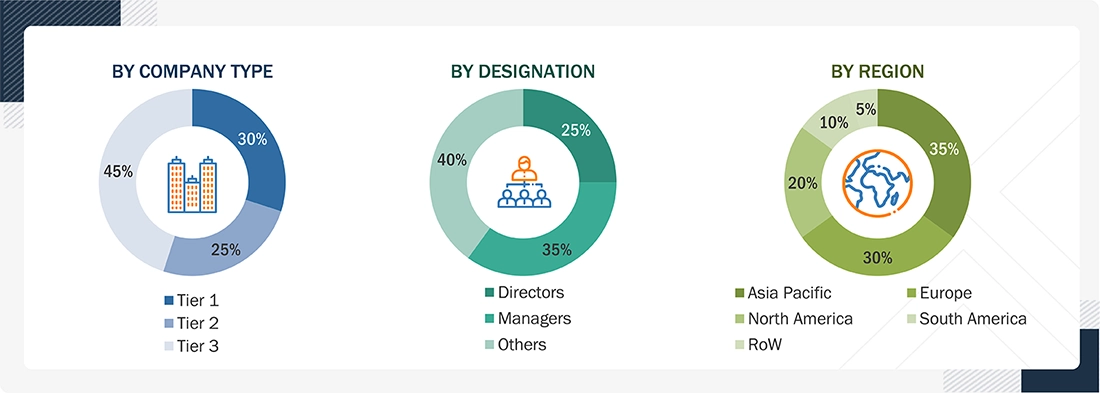
Note: The three tiers of the companies are defined based on their total revenues in 2023 or 2024, based on the availability of financial data: Tier 1: Revenue > USD 1 billion; Tier 2: USD 100 million ≤ revenue ≤ USD 1 billion; Tier 3: Revenue < USD 100 million. RoW includes Africa and the Middle East.
To know about the assumptions considered for the study, download the pdf brochure
|
COMPANY NAME |
DESIGNATION |
|
Cargill, Incorporated (US) |
Product Development Manager |
|
Ingredion (US) |
Sales Manager |
|
Roquette (France) |
Marketing Head |
|
ADM (US) |
Marketing Head |
|
SMS Corporation (Thailand) |
Senior Sales Manager |
|
SPAC Industries India Pvt. Ltd. (India) |
Business Development Manager |
Market Size Estimation
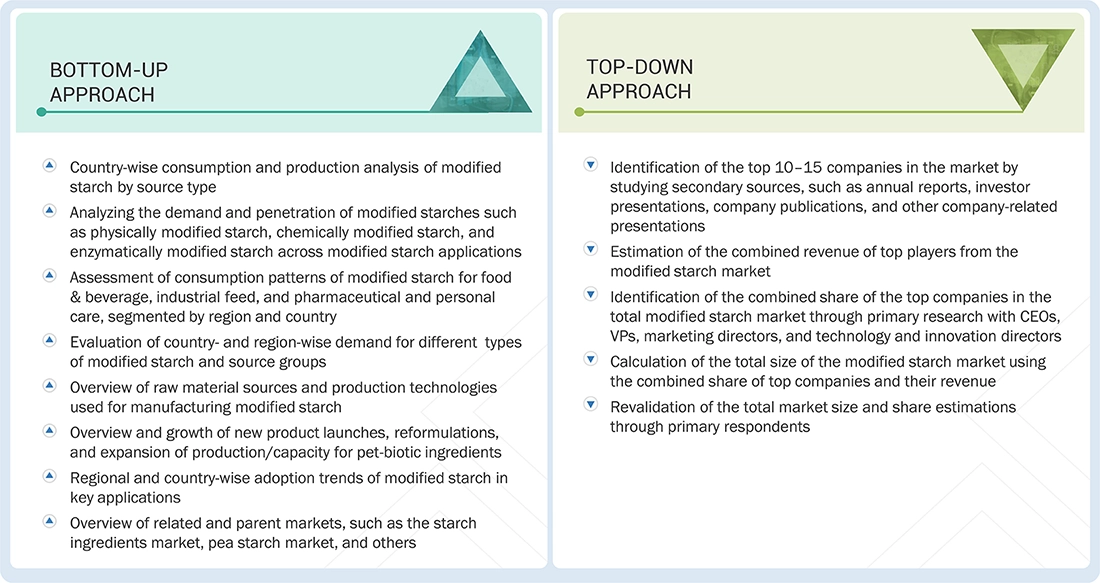
The top-down and bottom-up approaches were used to estimate and validate the total size of the modified starch market. These approaches were also used extensively to determine the size of various subsegments in the market. The research methodology used to estimate the market size includes the following details:
- The key players in the industry and the overall markets were identified through extensive secondary research.
- All shares, splits, and breakdowns were determined using secondary sources and verified through primary sources.
- All possible parameters that affect the market covered in this research study were accounted for, viewed in extensive detail, verified through primary research, and analyzed to obtain final quantitative and qualitative data.
- The research included the study of reports, reviews, and newsletters of top market players, along with extensive interviews for opinions from leaders, such as CEOs, directors, and marketing executives.
Modified Starch Market : Top-Down and Bottom-Up Approach
Data Triangulation
After determining the overall market size from the estimation process explained above, the total market was split into several segments and subsegments. The data triangulation procedure was employed, wherever applicable, to estimate the overall modified starch market and obtain precise statistics for all segments and subsegments. The data was triangulated by studying various factors and trends from the demand and supply sides. The market size was also validated using the top-down and bottom-up approaches.
Market Definition
Modified starches are derived from native starches through various processing techniques, including physical, enzymatic, wet and dry chemical treatments, drum drying, and extrusion. These methods alter the properties of native starch such as freeze–thaw stability, resistance to acids or alkalis, and tolerance to shear to create products that meet diverse industrial and functional requirements. Modified starches serve multiple purposes, including thickening, stabilizing, binding, and emulsifying. In addition to their widespread use in food products, they are also utilized across numerous non-food industries and in the animal feed sector due to their enhanced performance characteristics.
Key Stakeholders
Modified starch and native starch manufacturers and processors
- Intermediate suppliers, such as traders and distributors of modified starch
- Manufacturers of food & beverage ingredients, processed food manufacturers, and livestock feed manufacturers
- Other manufacturing industries, such as the personal care, pharmaceutical, and papermaking industries
- Government and research organizations
-
Associations, regulatory bodies, and other industry-related bodies:
- Starch Europe
- The Food and Agriculture Organization (FAO)
- Food and Drug Administration (FDA)
- US Department of Agriculture (USDA)
- European Food Safety Agency (EFSA)
- Agriculture and Agri-Food Canada
- National Corn Grower Association – World of Corn
- The International Food Additives Council (IFAC)
- Food Processing Suppliers Association (FPSA)
Report Objectives
- To determine and project the size of the modified starch market based on type, application, source, form, and functions (qualitative), and region, over five years, ranging from 2025 to 2030
- To identify the attractive opportunities in the market by determining the largest and fastest-growing segments across regions
- To provide detailed information about the key factors influencing market growth (drivers, restraints, opportunities, and challenges)
- To analyze the opportunities in the market for stakeholders and provide details of the competitive landscape for market leaders
- To analyze the micromarkets with respect to individual growth trends, prospects, and their contribution to the total market
- To identify and profile the key players in the market
- To understand the competitive landscape and identify the major growth strategies adopted by players across the key regions
Customization Options:
With the given market data, MarketsandMarkets offers customizations according to company-specific scientific needs. The following customization options are available for the report:
Product Analysis
- Product matrix, which gives a detailed comparison of the product portfolio of each company.
Geographic Analysis
With the given market data, MarketsandMarkets offers customizations according to company-specific scientific needs.
- Further breakdown of the Rest of Europe modified starch market into key countries
- Further breakdown of the Rest of Asia Pacific modified starch market into key countries
- Further breakdown of the Rest of South America modified starch market into key countries
Company Information
- Detailed analyses and profiling of additional market players (up to five)
Get the Full Modified Starch Market Report
Full forecast, segment splits, and company analysis for all Modified Starch Market.
- US Modified Starch Market
- Canada Modified Starch Market
- Mexico Modified Starch Market
- Germany Modified Starch Market
- France Modified Starch Market
- UK Modified Starch Market
- Spain Modified Starch Market
- Italy Modified Starch Market
- China Modified Starch Market
- Japan Modified Starch Market
- India Modified Starch Market
- South Korea Modified Starch Market
- Thailand Modified Starch Market
- Brazil Modified Starch Market
- Argentina Modified Starch Market
- Rest Of Europe Modified Starch Market
- Rest Of Asia Pacific Modified Starch Market
- Rest Of South America Modified Starch Market
Need a Tailored Report?
Customize this report to your needs
Get 10% FREE Customization
Customize This Report
