
India Nematicide Market (2025-2030)

The India Nematicide Market was valued at $182.3 Million in 2025 and projected to reach to $294.6 Million by 2030, representing a compound annual growth rate of 10.1%. India's nematicide market is poised for sustained expansion as agricultural intensification and rising crop productivity demands drive nematode management investments.


| Market Size in | USD 26.32 MN |
| Market Forecast in | |
| CAGR | |
| Forecast Period | |
| Units Considered | Value (USD MN) |
India Nematicide Market Trends and Insights
- India's agricultural sector faces significant challenges from root-knot and cyst nematodes, which damage high-value crops including cotton, sugarcane, and vegetables, driving demand for effective nematode management solutions.
- The expansion of India's nematicide market is fueled by increasing awareness among farmers, rising adoption of integrated pest management practices, and government initiatives promoting sustainable agriculture. India's nematicide market growth is supported by the country's large agricultural base and the critical need to protect yields in a competitive global market.
- Between 2025 and 2030, India is expected to see accelerated adoption of both chemical and biological nematicides as farmers seek cost-effective solutions to combat soil-borne pests.
- The market's trajectory reflects India's commitment to enhancing crop productivity while addressing environmental concerns through modern pest management technologies..
Key Market Statistics
- CAGR (2025-2030) 10.1% CAGR
- Market Size, 2025 ~USD 182.3 Million
- Forecast, 2030 ~USD 294.6 Million
- Country India
India Nematicide Market Overview
Market Valuation :
India's nematicide market is valued at USD 182.3 million in 2025, with strong growth trajectory driven by increasing awareness of nematode-related crop losses in high-value agricultural segments.
Crop Vulnerability :
Root-knot and cyst nematodes pose significant threats to India's major crops including cotton, sugarcane, and vegetables, creating sustained demand for effective nematicide solutions across diverse agro-climatic zones.
Growth Momentum :
India's nematicide market is expanding at a CAGR of 10.1% from 2025 to 2030, outpacing many regional markets and reflecting rising adoption of chemical and biological nematode management practices.
Future Projection :
The market is forecasted to reach USD 294.6 million by 2030, representing a 61.5% increase over five years, driven by intensified agricultural practices and growing farmer awareness of nematode management.
India Nematicide Market Dynamics
- The sector benefits from India's large farming population, diverse cropping patterns, and increasing adoption of integrated pest management practices.
- Government initiatives promoting sustainable agriculture and farmer education on soil health are accelerating nematicide uptake across cotton-growing regions, sugarcane belts, and vegetable cultivation zones. The forecast period through 2030 will witness growing preference for both synthetic and bio-nematicides, with regional variations reflecting crop-specific vulnerabilities.
- Rising input costs and yield pressures are compelling farmers to invest in preventive nematode control measures.
- Market expansion will be supported by improved distribution networks, farmer cooperatives, and digital agricultural advisory services that enhance product accessibility and awareness across India's diverse agricultural landscape..
Market Ecosystem
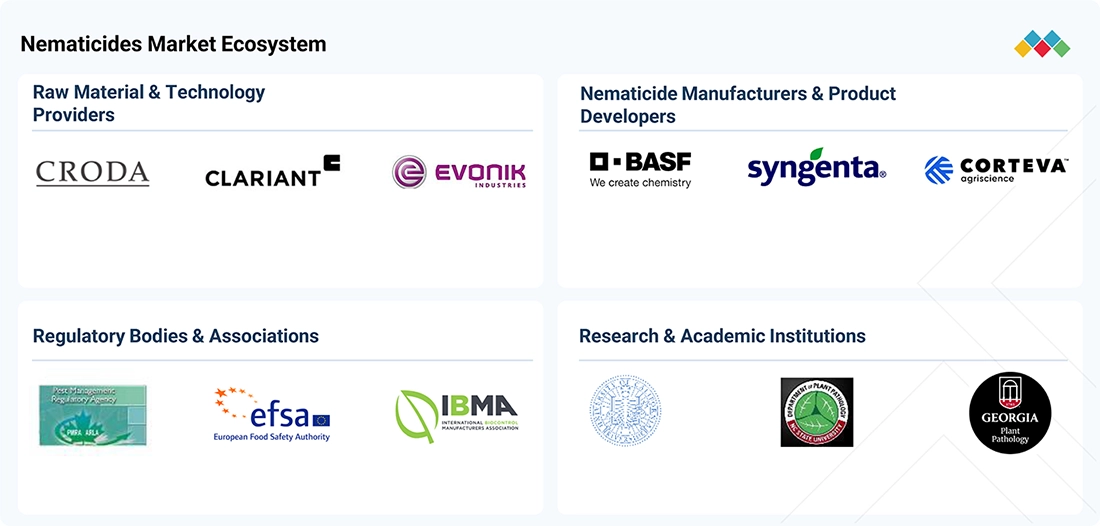
NEMATICIDE MARKET: COMMERCIAL USE CASES ACROSS INDUSTRIES
| COMPANY | USE CASE DESCRIPTION | BENEFITS |
|---|---|---|
 |
Application of chemical nematicides for root-knot nematode control in vegetables and row crops | Provides rapid and effective nematode suppression, improving yield |
 |
Bio-nematicide solutions for sustainable nematode management in high-value crops | Eco-friendly approach reduces chemical residues while maintaining crop protection |
 |
Soil-applied granular nematicides for cereals and oilseeds | Offers long-lasting residual activity and ease of application |
 |
Seed treatment nematicides for vegetables and pulses | Protects seedlings during early growth, enhancing crop establishment |
Logos and trademarks shown above are the property of their respective owners. Their use here is for informational and illustrative purposes only.
Related Ecosystem
Agrochemicals
- Phosphatic Fertilizers
- Potassic Fertilizers
- Fungicides
- Ammonium Nitrate
- Anticoagulant Rodenticides
- AZELIS HOLDINGS SA
- Basf se
- Origin Enterprises plc
- MITSUI AGRO BUSINESS SACO
- Mitsui & Co., Ltd.
Key Takeaways
- India's nematicide market is valued at USD 182.3 million in 2025 and is forecast to reach USD 294.6 million by 2030, growing at a 10.1% CAGR.
- India's agricultural sector relies heavily on nematicide solutions to protect high-value crops such as cotton, sugarcane, and vegetables from soil-borne nematode damage.
- India is witnessing increased farmer awareness and adoption of integrated pest management practices, which are key drivers of nematicide market expansion.
- India's nematicide market growth is supported by government initiatives promoting sustainable agriculture and modern pest management technologies.
Nematicide Market Report Scope
| Report Metric | Details |
|---|---|
| Base Year | 2025 |
| Fastest Growing Segment | BIOLOGICAL (Type) |
| Forecast Period | 2025–2030 |
| Growth Rate | CAGR of 10.7% from 2025 to 2030 |
| Largest Segment | LIQUID (Formulation) |
| Market Size Base Year (Billions) | ~USD 3.06 (2025) |
| Revenue Forecast (Billions) | ~USD 5.09 (2030) |
| Segments Covered | Type, Nematode Type, Crop Type, Formulation, Mode Of Application, Crop Sub-Type |
India Nematicide Market Report Segmentation
6 segment dimensions are covered across the global market.
By Type
- 1-3-Dichloropropene
- Abamectin
- Berries
- Biochemicals
- Biological
- Carbamate
- Chemical
- Citrus Fruits
- Cyclobutrifluram
- Fluopyram
- Fumigant
- Fumigants
- Leafy Vegetables
- Metam Sodium
- Methyl Bromide
- Microbials
- Non-Fumigants
- Organophosphate
- Other Fruits & Vegetables
- Other Fumigant Types
- Other Non-Fumigants
- Pome Fruits
- Roots & Tuber Vegetables
- Sdhi
By Nematode Type
- Cyst Nematodes
- Lesion Nematodes
- Other Nematode Types
- Root-Knot Nematodes
By Crop Type
- Cereals & Grains
- Fruits & Vegetables
- Oilseeds & Pulses
- Oilseeds And Pulses
- Other Crop Types
By Formulation
- Granular
- Liquid
By Mode Of Application
- Drenching
- Drenching/Chemigation
- Fumigation
- Other Modes Of Application
- Seed Treatment
- Soil Dressing
By Crop Sub-Type
- Berries
- Citrus Fruits
- Corn
- Leafy Vegetables
- Other Cereals & Grains
- Other Fruits & Vegetables
- Other Oilseeds & Pulses
- Pome Fruits
- Rice
- Roots & Tuber Vegetables
- Soybean
- Sunflower
- Wheat
Target Audience
- Agrochemical Manufacturers : Evaluate India's nematicide market opportunity to guide product development, registration strategies, and commercial expansion plans in one of Asia's largest agricultural markets with high nematode pressure.
- Agricultural Input Distributors : Understand India-specific demand patterns, regional crop vulnerabilities, and growth forecasts to optimize inventory management, channel partnerships, and sales strategies across diverse farming communities.
- Crop Protection Companies : Access market sizing and growth projections for India to inform portfolio decisions, competitive positioning, and investment priorities in the country's expanding nematicide and integrated pest management segments.
- Agricultural Investment Firms : Utilize India market data and CAGR analysis to evaluate investment opportunities in agritech, biotech nematicide solutions, and distribution infrastructure serving India's high-value crop sectors.
- Government & Policy Bodies : Leverage market intelligence on India's nematicide sector to inform agricultural policy, subsidy programs, and sustainable farming initiatives that address soil health and crop productivity challenges.
Key Companies in the India Nematicide Market
| Company | HQ | Ownership | Strongest segments |
|---|---|---|---|
| STEPAN COMPANY | United States | Public Company | Surfactants,Polymers,Specialty Products, |
| BUNGE LIMITED | United States | Public Company | Soybean Processing and Refining,Softseed Processing and Refining,Other Oilseeds Processing and Refining, |
| OCI COMPANY LTD. | Netherlands | Public Company | Nitrogen fertilizers (urea, UAN, CAN, ammonium nitrate + sulphur, ammonium sulphate),Ammonia (anhydrous, renewable and lower carbon, storage services),Methanol and derivatives, |
| SYNTHOS S.A | Poland | Private Company | Styrene-butadiene and butadiene rubbers (KER, KRALEX, SYNTECA, NBR),EPS/XPS and polystyrene (InSphere, Inpacto, Silver, Synthos XPS PRIME, SYNTHOS PS),Dispersions, latex, adhesives (Osakryl, Synexil, WOODMAX, PAPERMAX), |
| SIPCAM-OXON GROUP | Italy | Private Company | Formulated plant protection products,Active ingredients and chemical intermediates,Biological products and special fertilizers, |
| ORIGIN ENTERPRISES PLC | Ireland | Public Company | Integrated agronomy services and advisory,Fertilizer blending and crop nutrition products,Seed, crop protection, and biologicals, |
| PRAYON S.A. | Belgium | Private Company | Feed-grade phosphates (mono/dicalcium and blends),Food and pharma-grade phosphates,Industrial and fertilizer phosphates, |
| MITSUI & CO., LTD. | Japan | Public Company | Energy (LNG, oil, fuels, carbon solutions),Mobility, Digital & Infrastructure,Chemicals (gas, basic chemicals, performance monomers), |
| MITSUI AGRISCIENCE INTERNATIONAL | Belgium | Private Company | Proprietary insecticides for high-value horticulture,Proprietary fungicides for fruits and vegetables,Other crop protection and formulation services, |
| BOREALIS AG | Austria | Private Company | Virgin polyolefins (PE/PP),Recycled polyolefin solutions,Base chemicals (olefins, phenol, aromatics), |
| BASF SE | Germany | Public Company | Chemicals (petrochemicals and intermediates),Materials (isocyanates, polyamides, inorganic basics, specialties),Industrial Solutions (dispersions, resins, additives, catalysts, electronic materials), |
| SYNGENTA | Switzerland | Private Company | Chemical crop protection (herbicides, fungicides, insecticides),Seeds and seed treatments,Biological crop protection, |
| CORTEVA | United States | Public Company | Seed,Crop Protection, |
| UPL | India | Public Company | Crop Protection (herbicides, fungicides, insecticides, acaricides, seed treatment, adjuvants, bio-solutions, public health, fumigants),Seeds (Advanta, Alta Seeds, Pacific Seeds, Hannaford),Non-Agro & Specialty (industrial/specialty chemicals, post-harvest, environmental electronics, apiculture, other services), |
| BAYER AG | Germany | Public Company | Crop Science,Pharmaceuticals,Consumer Health, |
| FMC CORPORATION | United States | Public Company | Insecticides,Herbicides,Fungicides, |
| SUMITOMO CHEMICAL CO., LTD. | Japan | Public Company | Essential & Green Materials,Agro & Life Solutions,Sumitomo Pharma, |
| NUFARM | Australia | Public Company | Herbicides,Insecticides,Fungicides, |
| AMERICAN VANGUARD CORPORATION | United States | Public Company | Conventional insecticides and miticides,Herbicides and soil fumigants,Biologicals and biorationals (including microbial products and soil health), |
| BIOCERES CROP SOLUTIONS | Argentina | Public Company | Crop Nutrition (inoculants, bio-inductors, biological and microgranulated fertilizers),Crop Protection (Rizoderma, adjuvants, herbicides, insecticides, fungicides, baits),Seed and Integrated Products (seed traits, germplasms, seed treatment packs, HB4), |
STEPAN COMPANY
Stepan Company is a United States-based public company founded in 1932 with 2,328 employees. The company operates as a manufacturer of specialty chemicals and surfactants.
BUNGE LIMITED
Bunge Limited is a United States-based public company founded in 1818 with 34,000 employees. The company is a global agribusiness and food company engaged in the production, processing, and distribution of agricultural commodities.
OCI COMPANY LTD.
OCI Company Ltd. is a Netherlands-based public company founded in 2013 with 761 employees. The company operates in the chemical and fertilizer industries.
SYNTHOS S.A
Synthos S.A. is a Poland-based private company founded in 1945 with 2,975 employees. The company is a chemical manufacturer specializing in synthetic rubber and chemical products.
SIPCAM-OXON GROUP
Sipcam-Oxon Group is an Italy-based private company founded in 1946. The company operates in the agrochemical and crop protection sector.
ORIGIN ENTERPRISES PLC
Origin Enterprises PLC is an Ireland-based public company founded in 2006 with 2,997 employees. The company provides crop protection products, seeds, and agricultural services.
PRAYON S.A.
Prayon S.A. is a Belgium-based private company founded in 1882 with 1,139 employees. The company is a chemical manufacturer specializing in phosphate-based products.
MITSUI & CO., LTD.
Mitsui & Co., Ltd. is a Japan-based public company founded in 1947 with 55,463 employees. The company is a diversified trading and investment corporation with operations across multiple industries.
MITSUI AGRISCIENCE INTERNATIONAL
Mitsui Agriscience International is a Belgium-based private company founded in 2001 with 15 employees. The company operates in the agrochemical sector.
BOREALIS AG
Borealis AG is an Austria-based private company founded in 1994 with 5,887 employees. The company is a chemical manufacturer specializing in polyolefins and base chemicals.
BASF SE
BASF SE is a Germany-based public company founded in 1865 with 94,910 employees. The company is a global leader in the chemical industry producing a wide range of products including chemicals, plastics, and agricultural solutions.
SYNGENTA
Syngenta is a Switzerland-based private company founded in 1999 with 28,000 employees. The company is a global agrochemical and seeds company specializing in crop protection and seeds.
CORTEVA
Corteva is a United States-based public company founded in 1802 with 21,500 employees. The company is a global provider of seeds, crop protection products, and digital agricultural solutions.
UPL
UPL is an India-based public company founded in 1969 with 12,000 employees. The company is a global agrochemical company specializing in crop protection products and solutions.
BAYER AG
Bayer AG is a Germany-based public company founded in 1863 with 87,757 employees. The company is a multinational pharmaceutical and agrochemical corporation with operations in healthcare, crop science, and consumer health.
FMC CORPORATION
FMC Corporation is a United States-based public company founded in 1883 with 5,500 employees. The company is a global chemical manufacturer specializing in agricultural sciences and specialty chemicals.
SUMITOMO CHEMICAL CO., LTD.
Sumitomo Chemical Co., Ltd. is a Japan-based public company founded in 1913 with 27,491 employees. The company is a diversified chemical manufacturer with operations in petrochemicals, agrochemicals, and pharmaceuticals.
NUFARM
Nufarm is an Australia-based public company founded in 1916 with 3,046 employees. The company is a global agrochemical company specializing in crop protection products and seeds.
AMERICAN VANGUARD CORPORATION
American Vanguard Corporation is a United States-based public company founded in 1969 with 739 employees. The company manufactures and distributes agrochemical products for crop protection.
BIOCERES CROP SOLUTIONS
Bioceres Crop Solutions is an Argentina-based public company founded in 2001 with 751 employees. The company develops and commercializes crop biotechnology and agrochemical products.
Reasons to Buy this Report
- India-Specific Market Sizing : Access precise valuation data for India's nematicide market with country-level forecasts through 2030, enabling accurate investment planning and resource allocation for India-focused agricultural businesses.
- Crop-Specific Demand Insights : Understand nematode pressure patterns across India's key crops—cotton, sugarcane, and vegetables—with regional vulnerability assessments to identify high-opportunity market segments and product positioning strategies.
- Growth Trajectory Analysis : Leverage India's 10.1% CAGR data to benchmark market expansion against global trends (10.7%), identify competitive advantages, and develop targeted go-to-market strategies for the Indian agricultural sector.
- Regional Market Dynamics : Gain insights into India's agro-climatic variations, farmer adoption patterns, and distribution challenges specific to different states and crop zones to optimize product development and market penetration strategies.
- Strategic Decision Support : Make informed decisions on market entry, product portfolio expansion, and partnership opportunities in India's growing nematicide sector with comprehensive country-level competitive and regulatory intelligence.
Frequently asked questions
What is the current size of India's nematicide market?
India's nematicide market is valued at USD 182.3 million in 2025 and is expected to grow to USD 294.6 million by 2030.
What is the projected growth rate for India's nematicide market?
India's nematicide market is projected to grow at a compound annual growth rate (CAGR) of 10.1% from 2025 to 2030.
Which crops in India are most affected by nematodes?
High-value crops in India such as cotton, sugarcane, and vegetables are particularly vulnerable to root-knot and cyst nematodes, driving demand for nematicide solutions.
What factors are driving growth in India's nematicide market?
India's nematicide market growth is driven by increasing farmer awareness, rising adoption of integrated pest management practices, and government initiatives promoting sustainable agriculture.
What types of nematicides are used in India?
India's nematicide market includes both chemical and biological nematicides, with farmers increasingly adopting these solutions to combat soil-borne pests cost-effectively.
RESEARCH METHODOLOGY
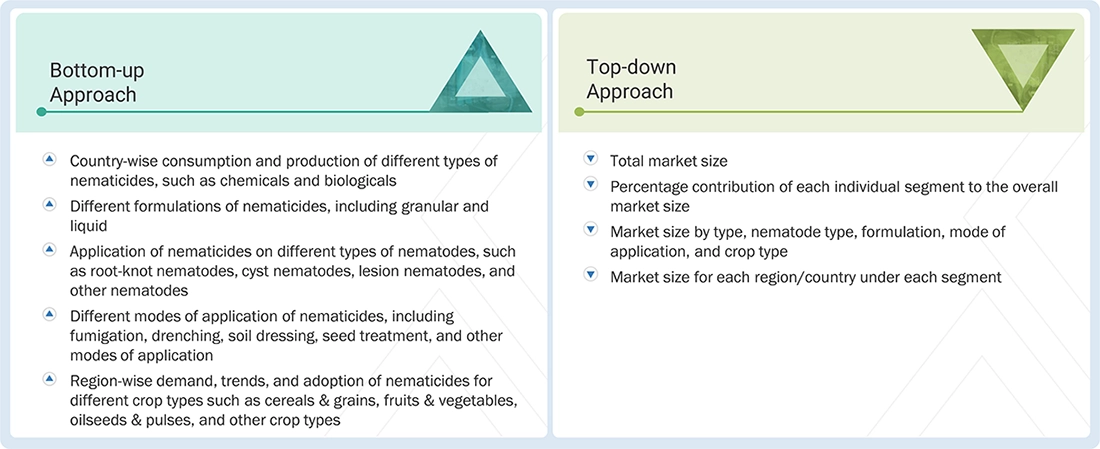
This study involved two major approaches in estimating the current size of the nematicides market. Exhaustive secondary research was conducted to collect information on the current, peer, and parent markets. The next step involved validating these findings, assumptions, and sizing with industry experts across the value chain through primary research. Top-down and bottom-up approaches were employed to estimate the complete market size. Thereafter, market breakdown and data triangulation were used to estimate the market size of segments and subsegments.
Secondary Research
This research study involved the extensive use of secondary sources—directories and databases such as Bloomberg Businessweek and Factiva—to identify and collect information useful for a technical, market-oriented, and commercial study of the market.
In the secondary research process, various sources, such as company annual reports, press releases, investor presentations, white papers, food journals, certified publications, articles from recognized authors, directories, and databases, were used to identify and collect information.
Secondary research was mainly used to obtain key information about the industry’s supply chain, the total pool of key players, and market classification and segmentation based on industry trends to the bottom-most level, regional markets, and key developments from market- and technology-oriented perspectives.
Primary Research
Extensive primary research was conducted after obtaining information regarding the nematicides market through secondary research. Several primary interviews were conducted with market experts from the demand and supply sides across major countries in North America, Europe, Asia Pacific, South America, and the Rest of the World. Primary data was collected through questionnaires, emails, and telephonic interviews.
The primary sources from the supply side included various industry experts, such as Chief X Officers (CXOs), Vice Presidents (VPs), and Directors from business development, marketing, research, and development teams, as well as related key executives from distributors and key opinion leaders. Primary interviews were conducted to gather insights such as market statistics, data on revenue collected from the products and services, market breakdowns, market size estimations, market forecasting, and data triangulation.
Primary research also helped in understanding the various trends related to the nematicides market based on type, nematode type, formulation, mode of application, crop type, and region. Stakeholders from the demand side, including agricultural cooperatives and distributors, agri-input retailers and dealers, and farmers and growers, were interviewed to gain insights into their perspectives on suppliers, products, and their current usage of the nematicides market. This understanding helped in assessing the overall market outlook and its impact on business trends.
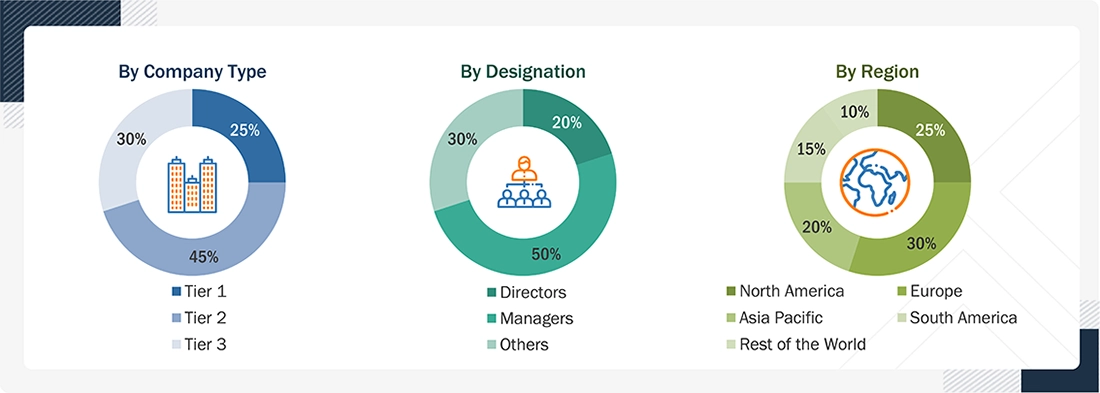
Note: The three tiers of the companies are defined based on their total revenues in 2024 or 2025, as per the availability of financial data: Tier 1: Revenue > USD 1 billion; Tier 2: USD 100 million ≤ Revenue ≤ USD 1 billion; Tier 3: Revenue < USD 100 million.
|
COMPANY NAME |
DESIGNATION |
|
BASF SE (Germany) |
Sales Manager |
|
Syngenta (Switzerland) |
Territory Sales Manager |
|
Bayer AG (Germany) |
Regional Marketing Manager |
|
Corteva (US) |
Operation Manager |
|
UPL (India) |
Marketing Manager |
To know about the assumptions considered for the study, download the pdf brochure
Market Size Estimation
The top-down and bottom-up approaches were used to estimate and validate the total size of the nematicides market. These approaches were also used extensively to determine the size of various subsegments in the market. The research methodology used to estimate the market size includes the following details.
- The key players in the industry and the overall market were identified through extensive secondary research.
- All shares, splits, and breakdowns were determined using secondary sources and verified through primary sources.
- All possible parameters that affect the market covered in this research study were accounted for, viewed in extensive detail, verified through primary research, and analyzed to obtain final quantitative and qualitative data.
- The research included the study of reports, reviews, and newsletters of top market players, along with extensive interviews for opinions from leaders, such as CEOs, directors, and marketing executives.
Nematicides Market: Bottom-up & Top-down Approaches
Data Triangulation
After determining the overall market size from the estimation process explained above, the total market was split into several segments and subsegments. The data triangulation and market breakdown procedures were employed, wherever applicable, to estimate the overall nematicides market and arrive at the exact statistics for all segments and subsegments. The data were triangulated by studying various factors and trends from the demand and supply sides. The market size was also validated using the top-down and bottom-up approaches.
Market Definition
According to the EPA definition, nematicides are chemical agents used to control parasitic worms such as plant-parasitic nematodes. They are applied to crops for protection from nematodes, resulting in enhanced yield and crop quality. Nematodes are tiny parasites, such as microscopic roundworms, found in large quantities in soil, water, and inside other plants and animals.
Key Stakeholders
- Agriculture pesticide manufacturers & suppliers
- Associations and industry bodies
- Nematicide manufacturers & suppliers
- Nematicide traders, retailers, and distributors
- Commercial research & development (R&D) institutions
- Venture capitalists and investors
- Regulatory bodies and research organizations
- Public hygiene organizations, government regulatory institutions, and food safety agencies
Associations and industry bodies:
- Food and Agriculture Organization (FAO)
- European Food Safety Authority (EFSA)
- British Pest Control Association (BPCA)
- National Pest Management Association (NPMA)
- National Pest Technicians Association
- Confederation of European Pest Management Association (CEPA)
- Organization for Economic Co-operation and Development (OECD)
Report Objectives
- To determine and project the size of the nematicides market based on type, formulation, nematode type, mode of application, crop type, and region in terms of value over five years, ranging from 2026 to 2031
- To identify the attractive opportunities in the market by determining the largest and fastest-growing segments across regions
- To provide detailed information about the key factors influencing market growth (drivers, restraints, opportunities, and challenges)
- To analyze the opportunities in the market for stakeholders and provide details of the competitive landscape for market leaders
- To analyze the micromarkets concerning individual growth trends, prospects, and their contribution to the total market
- To identify and profile the key players in the market
- To understand the competitive landscape and identify the major growth strategies adopted by market players across the key regions.
Available customizations:
With the given market data, MarketsandMarkets offers customizations according to company-specific scientific needs.
The following customization options are available for the report:
PRODUCT ANALYSIS
- Product matrix, which gives a detailed comparison of the product portfolio of each company.
GEOGRAPHIC ANALYSIS
With the given market data, MarketsandMarkets offers customizations according to company-specific scientific needs.
- Further breakdown of the Rest of Europe nematicides market into key countries
- Further breakdown of the Rest of Asia Pacific nematicides market into key countries
- Further breakdown of the Rest of South America nematicides market into key countries
COMPANY INFORMATION
- Detailed analyses and profiling of additional market players (up to five)
Get the Full Nematicide Market Report
Full forecast, segment splits, and company analysis for all Nematicide Market.
- Canada Nematicide Market
- Mexico Nematicide Market
- US Nematicide Market
- France Nematicide Market
- Germany Nematicide Market
- Italy Nematicide Market
- Spain Nematicide Market
- UK Nematicide Market
- China Nematicide Market
- Japan Nematicide Market
- Argentina Nematicide Market
- Brazil Nematicide Market
- Rest Of Europe Nematicide Market
Need a Tailored Report?
Customize this report to your needs
Get 10% FREE Customization
Customize This Report
