
Japan Occupant Classification System (OCS) Market (2025-2030)

The Japan Occupant Classification System (OCS) Market was valued at $6807 Million in 2025 and projected to reach to $7622 Million by 2030, representing a compound annual growth rate of 1.6%. Japan's Occupant Classification System market demonstrates resilience with moderate growth prospects through 2030.


| Market Size in | USD 26.32 MN |
| Market Forecast in | |
| CAGR | |
| Forecast Period | |
| Units Considered | Value (USD MN) |
Japan Occupant Classification System (OCS) Market Trends and Insights
- Japan's automotive sector, renowned for its advanced safety technologies and regulatory compliance, continues to drive steady demand for OCS solutions across passenger vehicles and commercial applications.
- The market in Japan benefits from stringent safety regulations, high vehicle production volumes, and consumer preference for premium safety features that enhance occupant protection. Japan's OCS market growth is supported by the country's leadership in automotive innovation and the integration of advanced sensor technologies in vehicle design.
- Japanese manufacturers prioritize occupant safety systems as a competitive differentiator, particularly in premium and mid-segment vehicles.
- The forecast period through 2030 reflects Japan's commitment to evolving safety standards and the gradual adoption of next-generation classification systems that improve airbag deployment accuracy and overall vehicle safety performance..
Key Market Statistics
- CAGR (2025-2030) 1.6% CAGR
- Market Size, 2025 ~USD 6807 Million
- Forecast, 2030 ~USD 7622 Million
- Country Japan
Japan Occupant Classification System (OCS) Market Overview
Steady Growth Trajectory :
Japan's OCS market is projected to grow from USD 6,807 million in 2025 to USD 7,622 million by 2030, representing a CAGR of 1.6%, driven by stringent safety regulations and consumer demand for advanced occupant protection systems.
Advanced Safety Technology Leadership :
Japanese automotive manufacturers leverage cutting-edge OCS technology to maintain competitive advantage, with integrated sensor systems and AI-driven classification becoming standard across premium and mid-range vehicle segments.
Regulatory Compliance Focus :
Japan's strict automotive safety standards and government mandates for occupant protection systems ensure consistent market demand, with OEM compliance requirements driving sustained investment in OCS solutions.
Commercial Vehicle Expansion :
Growing adoption of OCS in commercial vehicles and fleet applications across Japan's logistics and transportation sectors presents emerging growth opportunities beyond traditional passenger vehicle markets.
Japan Occupant Classification System (OCS) Market Dynamics
- The nation's automotive industry, characterized by technological innovation and rigorous safety standards, continues to integrate advanced OCS solutions across vehicle portfolios.
- Domestic manufacturers' commitment to occupant safety and regulatory compliance sustains steady demand, while aftermarket opportunities expand as vehicle fleets modernize. The market outlook remains positive despite global headwinds, supported by Japan's aging vehicle fleet requiring safety upgrades and increasing adoption of OCS in commercial transportation.
- Strategic partnerships between OEMs and technology providers, combined with government safety initiatives, will drive incremental market expansion.
- However, market growth remains moderate compared to emerging markets, reflecting Japan's mature automotive landscape and already-high baseline safety technology penetration..
Market Ecosystem
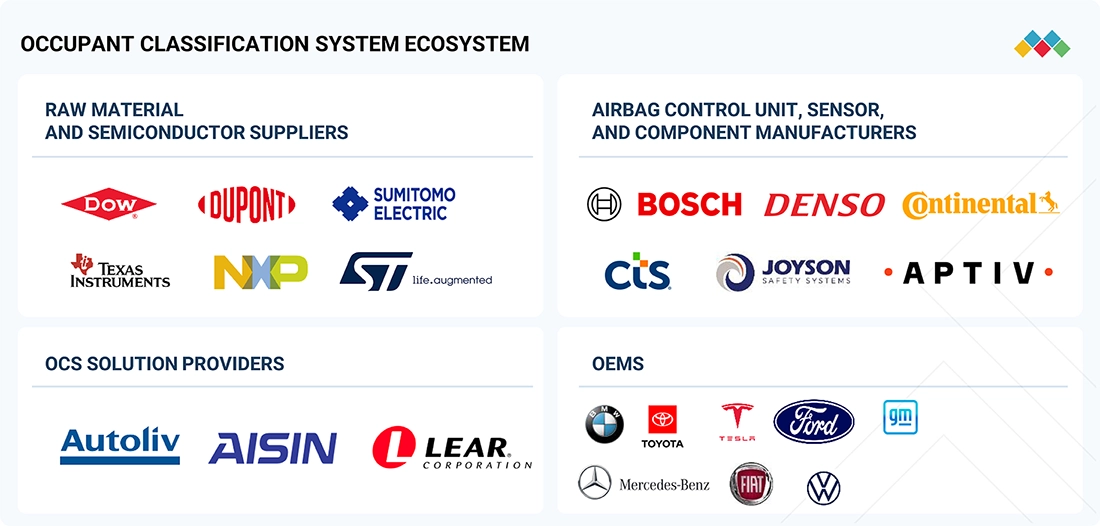
Occupant Classification System (OCS) Market: COMMERCIAL USE CASES ACROSS INDUSTRIES
| COMPANY | USE CASE DESCRIPTION | BENEFITS |
|---|---|---|
 |
AI interior sensing, child presence detection, pose recognition | Compliance with EU/US rules, improved crash safety, personalization. |
 |
Driver status monitor, posture and distraction detection | Prevents accidents via early warning, adds safety rating value |
 |
Child presence detection with UWB, cabin sensing for living vs. objects | Meets child safety mandates, reduces fatalities, fewer false alarms |
 |
Adaptive restraints with occupant digital twin, active seat belt tensioner | Smarter airbag and belt response, reduced injury risk, better crash outcomes |
 |
Body sensing, child detection, seat belt reminders | Reliable airbag suppression, child protection, regulation compliance |
Logos and trademarks shown above are the property of their respective owners. Their use here is for informational and illustrative purposes only.
Related Ecosystem
Automotive Advance Technologies
- Battery Electric Vehicle (BEV)
- Light Commercial Vehicles (LCVs)
- Fuel Cell Electric Vehicle (FCEV)
- Hybrid Electric Vehicle (HEV)
- Internal Combustion Engine (ICE)
- BOSCH LIMITED
- Continental ag
- Visteon Corporation
- DENSO Corporation
- ZF FRIEDRICHSHAFEN AG
Body Exterior Interior
- Battery Electric Vehicle (BEV)
- Fuel Cell Electric Vehicle (FCEV)
- Light Commercial Vehicles (LCVs)
- Hybrid Electric Vehicle (HEV)
- Agricultural Tractors
- AISIN CORPORATION
- Magna International Inc.
- GORKOVSKY AVTOMOBILNY ZAVOD
- BOCAR
- Continental ag
Electric Hybrid Vehicles
- Battery Electric Vehicle (BEV)
- Fuel Cell Electric Vehicle (FCEV)
- Light Commercial Vehicles (LCVs)
- Hybrid Electric Vehicle (HEV)
- Agricultural Tractors
- Visteon Corporation
- BOSCH LIMITED
- Byd company ltd.
- Tesla, Inc.
- FORD MOTOR COMPANY
Key Takeaways
- Japan's OCS market is valued at USD 6,807 million in 2025 and will reach USD 7,622 million by 2030, representing steady growth at 1.6% CAGR.
- Japan's stringent automotive safety regulations and high vehicle production volumes drive consistent demand for advanced occupant classification technologies.
- Japanese manufacturers leverage OCS as a key safety differentiator in premium and mid-segment vehicle segments to enhance occupant protection.
- The forecast period reflects Japan's commitment to next-generation classification systems that improve airbag deployment accuracy and vehicle safety performance.
Occupant Classification System (OCS) Market Report Scope
| Report Metric | Details |
|---|---|
| Base Year | 2025 |
| Fastest Growing Segment | FUEL CELL ELECTRIC VEHICLE (Electric Vehicle) |
| Forecast Period | 2025–2030 |
| Growth Rate | CAGR of -0.2% from 2025 to 2030 |
| Largest Segment | ICE (Propulsion) |
| Market Size Base Year (Billions) | ~USD 4.01 (2025) |
| Revenue Forecast (Billions) | ~USD 3.97 (2030) |
| Segments Covered | Vehicle Class, Component Type, Sensor Type, Electric Vehicle, Propulsion |
Japan Occupant Classification System (OCS) Market Report Segmentation
5 segment dimensions are covered across the global market.
By Vehicle Class
- Economy Car
- Luxury Car
- Mid-Size Car
By Component Type
- Airbag Control Unit
- Sensor
By Sensor Type
- Belt Tension Sensor
- Pressure Sensor
By Electric Vehicle
- Battery Electric Vehicle
- Fuel Cell Electric Vehicle
- Plug-In Hybrid Electric Vehicle
By Propulsion
- Electric
- ICE
Target Audience
- Japanese Automotive OEMs : Major manufacturers require detailed market insights to optimize OCS integration strategies, assess competitive positioning, and align product development with regulatory requirements and consumer safety expectations in Japan.
- Tier-1 & Tier-2 Suppliers : Component manufacturers and system integrators need Japan-specific demand forecasts and market sizing to plan production capacity, negotiate contracts with OEMs, and identify growth opportunities in the domestic supply chain.
- International Market Entrants : Foreign automotive companies and technology providers seeking to enter or expand in Japan's market require localized intelligence on regulatory compliance, competitive dynamics, and customer preferences to develop effective market strategies.
- Investment & Private Equity Firms : Investors evaluating opportunities in Japan's automotive safety technology sector need comprehensive market data, growth projections, and competitive analysis to assess investment viability and portfolio company performance.
- Automotive Consultants & Analysts : Industry consultants and research professionals require Japan-specific OCS market data to support client advisory services, competitive benchmarking, and strategic recommendations for automotive stakeholders.
Key Companies in the Japan Occupant Classification System (OCS) Market
| Company | HQ | Ownership | Strongest segments |
|---|---|---|---|
| FAURECIA S.A. | France | Public Company | Seating,Interiors,Clean Mobility, |
| TOYODA GOSEI CO., LTD | Japan | Public Company | Weatherstrips & Sealing Systems,Functional Components (fuel tank, battery, engine, chassis/drivetrain),Interior & Exterior Plastics (grilles, filler pipes, turbo ducts), |
| ROBERT BOSCH GMBH | India | ||
| DENSO CORPORATION | Japan | ||
| CONTINENTAL AG | Germany | ||
| APTIV | Ireland | ||
| AISIN CORPORATION | Japan | ||
| TE CONNECTIVITY | Switzerland | ||
| CTS CORPORATION | United States | Public Company | Sensing and controls (sensors, switches, pedals, transducers),Connectivity and signal integrity (EMI/RFI filters, capacitors, resistors, RF filters, frequency control),Motion control (piezo microactuators, rotary actuators), |
| JOYSON SAFETY SYSTEMS | United States | Private Company | Airbags (frontal, side, curtain, knee),Seatbelts and restraint systems,Steering wheels, |
FAURECIA S.A.
Faurecia S.A. is a French automotive supplier founded in 1914 that operates as a public company with 103,434 employees. The company specializes in providing components and systems for the automotive industry.
TOYODA GOSEI CO., LTD
Toyoda Gosei Co., Ltd. is a Japanese public company established in 1949 with 41,304 employees. The company manufactures automotive components and related products.
ROBERT BOSCH GMBH
Robert Bosch GmbH is a multinational engineering and technology company based in India. The company operates across multiple industrial sectors including automotive, industrial, and consumer goods.
DENSO CORPORATION
Denso Corporation is a Japanese automotive supplier specializing in components and systems for vehicles. The company is a major global provider of thermal and powertrain technologies.
CONTINENTAL AG
Continental AG is a German multinational automotive supplier and tire manufacturer. The company operates across multiple divisions including automotive systems, tires, and industrial solutions.
APTIV
Aptiv is an automotive technology company based in Ireland. The company develops and manufactures advanced electrical and electronic systems for vehicles.
AISIN CORPORATION
Aisin Corporation is a Japanese automotive supplier providing drivetrain and chassis components. The company is a major global manufacturer of transmission systems and related technologies.
TE CONNECTIVITY
TE Connectivity is a Switzerland-based company specializing in connectivity and sensor solutions. The company serves multiple industries including automotive, industrial, and communications.
CTS CORPORATION
CTS Corporation is a United States-based public company founded in 1896 with 3,492 employees. The company manufactures sensors, actuators, and electronic components for various industries.
JOYSON SAFETY SYSTEMS
Joyson Safety Systems is a United States-based private company founded in 1986 with 16,300 employees. The company specializes in automotive safety systems and components.
Reasons to Buy this Report
- Japan-Specific Market Sizing : Access precise valuation data for Japan's OCS market with verified 2025 baseline (USD 6,807M) and 2030 forecasts, enabling accurate budgeting and investment decisions tailored to the Japanese automotive landscape.
- Regulatory Landscape Intelligence : Understand Japan's unique safety compliance requirements and government mandates driving OCS adoption, critical for manufacturers and suppliers navigating domestic market entry or expansion strategies.
- Competitive Positioning Analysis : Benchmark against Japanese OEM strategies and technology adoption patterns to identify market gaps, competitive advantages, and opportunities for differentiation in Japan's advanced automotive sector.
- Segment-Specific Growth Opportunities : Identify high-potential segments including commercial vehicles and fleet applications in Japan, with detailed insights into adoption rates and expansion prospects beyond traditional passenger vehicle markets.
- Strategic Planning & Forecasting : Leverage Japan-focused CAGR analysis (1.6%) and 5-year projections to develop informed go-to-market strategies, resource allocation plans, and long-term business development initiatives in this mature market.
Frequently asked questions
What is the current market size of OCS in Japan?
Japan's Occupant Classification System market is valued at USD 6,807 million in 2025.
What is the projected market size for OCS in Japan by 2030?
Japan's OCS market is forecast to reach USD 7,622 million by 2030.
What is the CAGR for Japan's OCS market?
Japan's OCS market is expected to grow at a compound annual growth rate of 1.6% from 2025 to 2030.
What factors drive OCS market growth in Japan?
Japan's OCS market growth is driven by stringent safety regulations, high vehicle production volumes, advanced sensor technology integration, and consumer demand for premium safety features.
How do Japanese manufacturers use OCS technology?
Japanese manufacturers integrate OCS as a competitive safety differentiator in premium and mid-segment vehicles to enhance occupant protection and improve airbag deployment accuracy.
RESEARCH METHODOLOGY
The research study involves extensive use of secondary sources, such as company annual reports/presentations, industry association publications, magazine articles, directories, technical handbooks, World Economic Outlook, trade websites, technical articles, and databases, to identify and collect information on the occupant classification system (OCS) market. Primary sources, such as experts from related industries, OEMs, and suppliers, have been interviewed to obtain and verify critical information and assess the growth prospects and market estimations.
Secondary Research
Secondary sources for this research study include corporate filings, such as annual reports, investor presentations, and financial statements; trade, business, and professional associations; whitepapers and OCS & regulator-related journals; certified publications; articles by recognized authors; directories; and databases. Secondary data has been collected and analyzed to determine the overall market size, further validated by primary research.
Primary Research
After understanding the occupant classification system market scenario through secondary research, extensive primary research has been conducted. Primary interviews have been conducted with market experts from both demand and supply sides across North America, Europe, Asia Pacific, and the Rest of the World. Approximately 27% of interviews have been conducted from the demand side, while 73% have been conducted from the supply side. The primary data has been collected through questionnaires, emails, and telephone interviews.
In the canvassing of primaries, various departments within organizations, such as sales and operations, have been covered to provide a holistic viewpoint in this report. Primary sources from the supply side include various industry experts, such as CXOs, vice presidents, directors from business development, marketing, product development/innovation teams, and related key executives from various key companies. Various system integrators, industry associations, independent consultants/industry veterans, and key opinion leaders have also been interviewed.
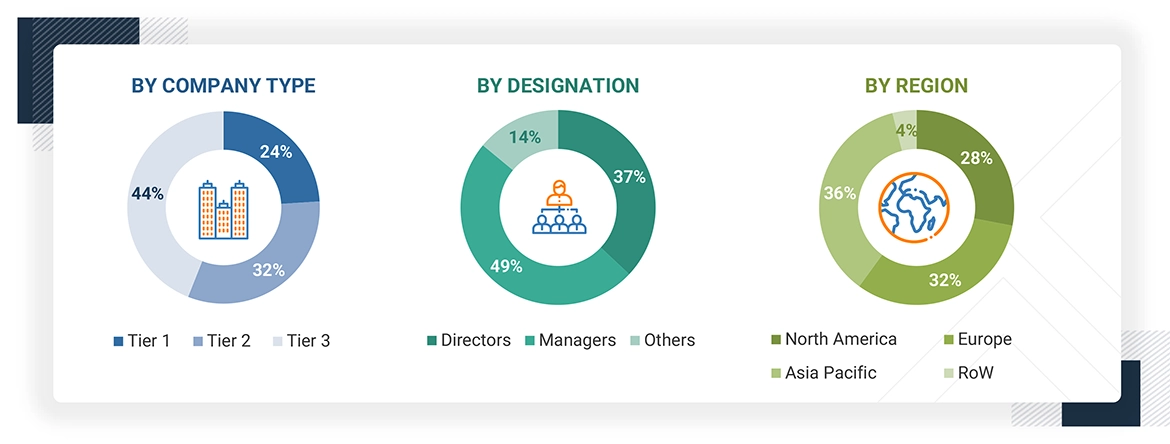
Notes: Others include sales managers and product managers.
Company tiers are based on the value chain; revenue from the company is not considered.
To know about the assumptions considered for the study, download the pdf brochure
Market Size Estimation
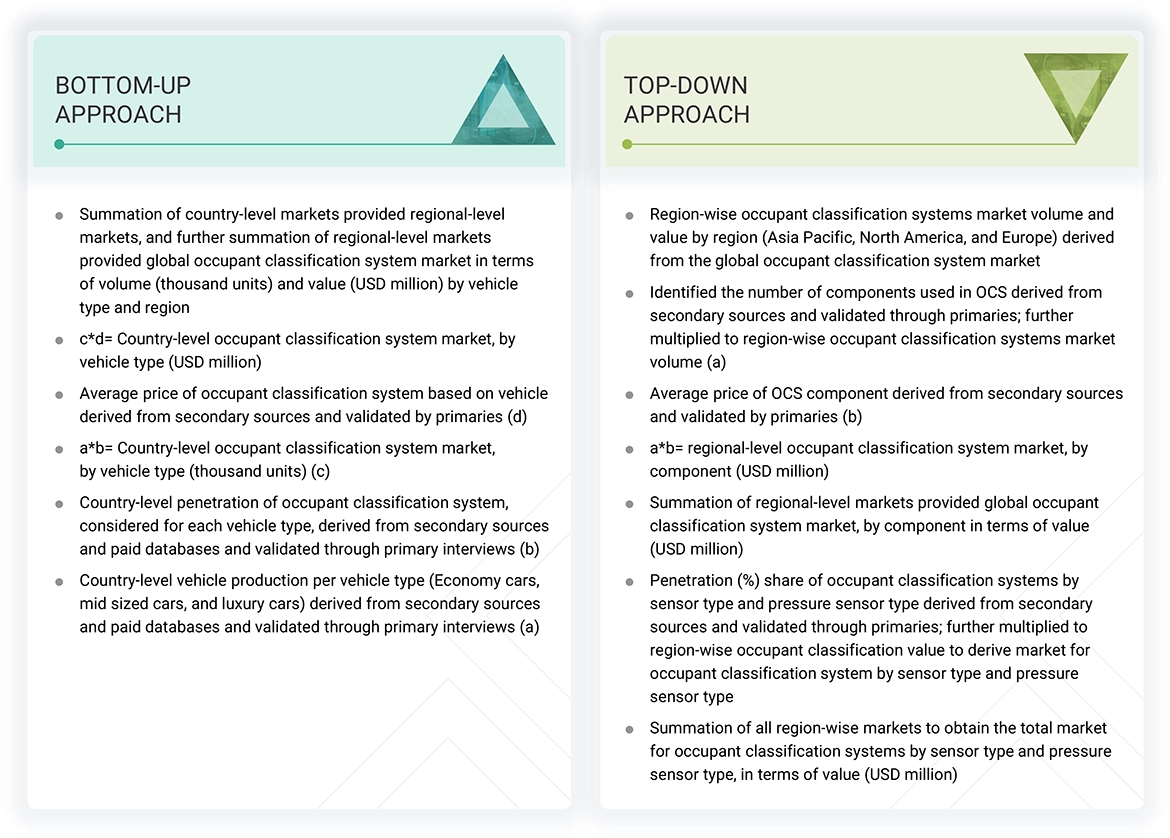
Both top-down and bottom-up approaches have been used to estimate and validate the total size of the occupant classification system market. These methods have also been used extensively to estimate the size of various subsegments in the market. The research methodology used to estimate the market size includes the following:
Occupant Classification System (OCS) Market : Top-Down and Bottom-Up Approach
Data Triangulation
All percentage shares, splits, and breakdowns have been determined using secondary sources and verified by primary sources. All parameters that affect the markets covered in this research study have been accounted for, viewed in extensive detail, and analyzed to obtain the final quantitative and qualitative data. This data has been consolidated and enhanced with detailed inputs and analysis from MarketsandMarkets and presented in the report. The following figure is an illustrative representation of the overall market size estimation process employed for this study.
Market Definition
An OCS encompasses a safety system that uses sensors to detect and classify front-seat passengers, determining whether the airbag should be enabled or disabled. It enhances vehicle safety by preventing airbag deployment when a non-living object or improperly seated passenger is detected. According to Volvo, an OCS works in conjunction with seat sensors to ensure airbags deploy based on occupant classification.
Stakeholders
- Airbag Control Unit Manufacturers
- Automakers
- Automotive Industry Associations, Government Authorities, and Research Organizations
- Automotive Parts Distributors
- Automotive Pressure Sensor Manufacturers
- Country-specific Automotive Associations
- European Automobile Manufacturers Association (ACEA)
- Government and Research Organizations
- National Highway Traffic Safety Administration (NHTSA)
- Occupant Classification System Providers
- Repair and Service Centers
- Transport Authorities
- Vehicle Safety Regulatory Bodies
Report Objectives
- To analyze and forecast the occupant classification system market in terms of volume (thousand units) and value (USD million) from 2025 to 2032
-
To segment the market by vehicle class, component type, sensor type, electric vehicle, propulsion, and region
- To segment and forecast the market by vehicle class (economy car, mid-size car, and luxury car)
- To segment and forecast the market by component type (airbag control unit, sensor, and others)
- To segment and forecast the market by sensor type (pressure sensor and belt tension sensor)
- To segment and forecast the market by electric vehicle (battery electric vehicle, plug-in hybrid vehicle, and fuel cell electric vehicle)
- To segment and forecast the market by propulsion (ICE and electric)
- To forecast the market by region [North America, Europe, Asia Pacific, and the Rest of the World]
- To identify and analyze key drivers, challenges, restraints, and opportunities influencing market growth
- To strategically analyze the market for individual growth trends, prospects, and contributions to the total market
-
To study the following with respect to the market
- Case study analysis
- Ecosystem Analysis
- Trade analysis
- Key conferences and events
- Key stakeholders and buying criteria
- Patent analysis
- Regulatory landscape
- Supply chain analysis
- Technology analysis
- Pricing Analysis
- To strategically profile the key players and comprehensively analyze their market share and core competencies
- To analyze the impact of AI/Generative AI (GenAI) on the market
- To analyze the impact of US tariffs on the market
- To track and analyze competitive developments such as deals, product launches/developments, expansions, and other activities undertaken by the key industry participants
Available Customizations
With the given market data, MarketsandMarkets offers customizations:
- Additional Company Profiles (Up to 5)
- Global Occupant Classification System Market, By Propulsion, at Country Level
- Global Occupant Classification System Market, By Electric Vehicle, at Country Level
Get the Full Occupant Classification System (OCS) Market Report
Full forecast, segment splits, and company analysis for all Occupant Classification System (OCS) Market.
- China Occupant Classification System (OCS) Market
- India Occupant Classification System (OCS) Market
- South Korea Occupant Classification System (OCS) Market
- Thailand Occupant Classification System (OCS) Market
- Germany Occupant Classification System (OCS) Market
- France Occupant Classification System (OCS) Market
- UK Occupant Classification System (OCS) Market
- Spain Occupant Classification System (OCS) Market
- Italy Occupant Classification System (OCS) Market
- Russia Occupant Classification System (OCS) Market
- Turkey Occupant Classification System (OCS) Market
- Canada Occupant Classification System (OCS) Market
- Mexico Occupant Classification System (OCS) Market
- US Occupant Classification System (OCS) Market
- Rest Of Europe Occupant Classification System (OCS) Market
- Rest Of Asia Pacific Occupant Classification System (OCS) Market
Need a Tailored Report?
Customize this report to your needs
Get 10% FREE Customization
Customize This Report
