
Brazil Optical Imaging Market (2022-2027)

The Brazil Optical Imaging Market was valued at $16.5 Million in 2022 and projected to reach to $28.2 Million by 2027, representing a compound annual growth rate of 11.3%. Brazil's optical imaging market is positioned for sustained expansion through 2027, supported by increasing healthcare expenditure and modernization initiatives across public and private medical facilities.


| Market Size in | USD 26.32 MN |
| Market Forecast in | |
| CAGR | |
| Forecast Period | |
| Units Considered | Value (USD MN) |
Brazil Optical Imaging Market Trends and Insights
- This 11.3% compound annual growth rate reflects Brazil's increasing adoption of advanced diagnostic and surgical imaging technologies across healthcare institutions.
- Brazil's market expansion is driven by rising healthcare investments, growing demand for minimally invasive procedures, and improving healthcare infrastructure in urban and emerging regions. The optical imaging sector in Brazil is benefiting from enhanced access to diagnostic equipment and growing awareness among healthcare providers regarding precision medicine applications.
- Between 2022 and 2027, Brazil is expected to see accelerated deployment of optical imaging systems in hospitals, diagnostic centers, and research facilities.
- Brazil's position as Latin America's largest healthcare market positions it as a critical growth hub for optical imaging technologies, with increasing participation from both multinational and regional medical device manufacturers..
Key Market Statistics
- CAGR (2022-2027) 11.3% CAGR
- Market Size, 2022 ~USD 16.5 Million
- Forecast, 2027 ~USD 28.2 Million
- Country Brazil
Brazil Optical Imaging Market Overview
Market Valuation Growth :
Brazil's optical imaging market reached $16.5 million in 2022 and is projected to grow to $28.2 million by 2027, representing a robust 71% increase over the five-year forecast period.
Strong CAGR Performance :
With an 11.3% compound annual growth rate, Brazil's optical imaging market outpaces many emerging markets, driven by modernization of healthcare infrastructure and increased diagnostic demand.
Healthcare Investment Surge :
Rising government and private sector healthcare investments in Brazil are accelerating adoption of advanced diagnostic and surgical imaging technologies across major medical institutions and hospitals.
Technology Adoption Acceleration :
Brazilian healthcare providers are increasingly integrating optical imaging solutions for minimally invasive procedures, improving patient outcomes and operational efficiency in surgical and diagnostic applications.
Brazil Optical Imaging Market Dynamics
- The country's growing middle class and rising prevalence of chronic diseases are driving demand for advanced diagnostic capabilities.
- Healthcare providers are investing in state-of-the-art imaging technologies to enhance surgical precision and patient care quality. The market will benefit from improving reimbursement policies, expanding healthcare access in underserved regions, and partnerships between international medical device manufacturers and local distributors.
- As Brazil strengthens its healthcare infrastructure and regulatory frameworks, optical imaging adoption is expected to accelerate, particularly in major metropolitan areas and specialized medical centers..
Market Ecosystem
Related Ecosystem
Key Takeaways
- Brazil's optical imaging market is valued at $16.5 million in 2022 and is forecast to reach $28.2 million by 2027, representing a robust 11.3% CAGR.
- Brazil's healthcare infrastructure modernization and increased investment in diagnostic technologies are primary drivers of market expansion.
- Brazil's growing preference for minimally invasive surgical procedures is accelerating adoption of advanced optical imaging systems.
- Brazil's market represents a significant opportunity for medical device manufacturers targeting Latin America's largest healthcare economy.
Optical Imaging Market Report Scope
| Report Metric | Details |
|---|---|
| Base Year | 2022 |
| Fastest Growing Segment | SOFTWARE (Product) |
| Forecast Period | 2022–2027 |
| Growth Rate | CAGR of 13.5% from 2022 to 2027 |
| Largest Segment | OPTICAL COHERENCE TOMOGRAPHY (OCT) (Technique) |
| Market Size Base Year (Billions) | ~USD 1.54 (2022) |
| Revenue Forecast (Billions) | ~USD 2.9 (2027) |
| Segments Covered | Product, Type, Technique, Application, Therapeutic Area, End User |
Brazil Optical Imaging Market Report Segmentation
6 segment dimensions are covered across the global market.
By Product
- Cameras
- Illumination Systems
- Imaging Systems
- Lenses
- Other Products
- Software
By Type
- Optical Imaging Systems
- Spectral Imaging Systems
By Technique
- Hyperspectral Imaging (Hsi)
- Near-Infrared Spectroscopy (Nirs)
- Optical Coherence Tomography (Oct)
- Photoacoustic Tomography (Pat)
By Application
- Intra-Operative Imaging
- Pathological Imaging
By Therapeutic Area
- Cardiology
- Dermatology
- Neurology
- Oncology
- Ophthalmology
- Other Products
- Other Therapeutic Areas
By End User
- Hospitals & Clinics
- Pharmaceutical & Biotechnology Companies
- Research Laboratories
BRAZIL: OPTICAL IMAGING MARKET, BY END USER, 2020–2027
| Segment | 2020 | 2021 | 2022 | 2023 | 2024 | 2025 | 2026 | 2027 | CAGR (%) |
|---|---|---|---|---|---|---|---|---|---|
| HOSPITALS & CLINICS | 15.7 | 18.4 | 16.2 | 17.6 | 19.5 | 21.9 | 24.8 | 28.3 | 11.8 |
| PHARMACEUTICAL & BIOTECHNOLOGY COMPANIES | 6.6 | 7.3 | 6.1 | 6.3 | 6.6 | 7 | 7.5 | 8.1 | 5.9 |
| RESEARCH LABORATORIES | 8.9 | 10.2 | 8.8 | 9.4 | 10.3 | 11.4 | 12.7 | 14.3 | 10.1 |
| TOTAL | 31.2 | 35.9 | 31.1 | 33.3 | 36.4 | 40.3 | 45 | 50.7 | 10.3 |
Target Audience
- Medical Device Manufacturers : Manufacturers need Brazil-specific market data to develop localized product strategies, identify distribution channels, and optimize pricing for competitive positioning in this 11.3% CAGR growth market.
- Healthcare Investors & PE Firms : Investment professionals require detailed Brazil market analysis to evaluate acquisition targets, assess portfolio company growth potential, and identify high-return opportunities in optical imaging healthcare technology.
- Hospital & Healthcare Administrators : Healthcare facility leaders need market insights to benchmark capital equipment spending, justify technology investments to boards, and align procurement strategies with industry growth trends in Brazil.
- Distributors & Channel Partners : Regional distributors and resellers require Brazil market intelligence to forecast demand, optimize inventory, identify emerging customer segments, and develop effective go-to-market strategies.
- Market Research & Consulting Firms : Research organizations need comprehensive Brazil optical imaging data to support client advisory services, validate market models, and provide evidence-based strategic recommendations for healthcare stakeholders.
Key Companies in the Brazil Optical Imaging Market
| Company | HQ | Ownership | Strongest segments |
|---|---|---|---|
| HOYA CORPORATION | Japan | Public Company | Eyeglasses and ophthalmic lenses,Contact lenses and Eyecity retail,Medical endoscopes and surgical instruments, |
| BRUKER CORPORATION | United States | Public Company | NMR/EPR and preclinical imaging (BSI BioSpin),Mass spectrometry, molecular diagnostics, and CALID solutions,Nano analysis, X-ray, AFM, and semiconductor metrology, |
| VARIAN MEDICAL SYSTEMS, INC | United States | Private Company | Oncology Systems – Linacs and Treatment Delivery Hardware,Oncology Systems – Software, Informatics, and QA,Proton Solutions, |
| XILINX, INC. | United States | Private Company | High-end FPGAs and adaptive compute platforms,Mid/low-range PLDs and configuration devices,SoC platforms, development boards, and kits, |
| CARL ZEISS MEDITEC AG | Germany | Public Company | Ophthalmology – diagnostics and imaging,Ophthalmology – surgical (cataract, refractive, IOLs, consumables),Microsurgery – neurosurgery and spine visualization, |
| TOPCON CORPORATION | Japan | Private Company | Eye Care (OCT, retinal imaging, refraction, ophthalmic software),Positioning – Surveying instruments (total stations, GNSS, laser products),Positioning – IT construction systems, |
| CANON INC. | Japan | Public Company | Printing Business Unit,Medical Business Unit,Imaging Business Unit, |
| ABBOTT LABORATORIES INC. | United States | Public Company | Diagnostic Products,Medical Devices,Nutritional Products, |
| KONINKLIJKE PHILIPS N.V. | Netherlands | Public Company | Diagnostic Imaging (MR, CT, X-ray, Ultrasound),Image Guided Therapy Systems and Devices,Monitoring and Enterprise Informatics, |
| PERKINELMER, INC. | United States | Public Company | Diagnostics screening (prenatal, neonatal, infectious disease),Life science reagents and assays (BioLegend, AlphaLISA, Dharmacon, etc.),Instruments, imaging, and detection platforms, |
| AGFA-GEVAERT N.V. | Belgium | Public Company | Healthcare enterprise imaging and diagnostic imaging (incl. SmartXR),Analog X-ray film, hardcopy film, and chemicals,Sign and display, packaging printing (printers, inks, software), |
| HAMAMATSU PHOTONICS K.K. | Japan | Public Company | Electron Tube (incl. photomultiplier tubes, X-ray sensors),Opto-Semiconductor (photodiodes, APDs, SPADs, sensors),Imaging and Measurement Instruments (cameras, systems, software), |
| OPTOS | United Kingdom | Private Company | Standalone UWF retinal imaging (optomap, Daytona, California),OCT-integrated platforms (Silverstone, Monaco, Monacopro),Service, software, and support (viewing, reference resources, self-help), |
HOYA CORPORATION
HOYA Corporation is a Japanese public company founded in 1941 that employs 37,752 people. The company operates as a diversified manufacturer with significant global operations.
BRUKER CORPORATION
Bruker Corporation is a United States-based public company founded in 1960 with 11,085 employees. The company specializes in scientific instruments and analytical solutions.
VARIAN MEDICAL SYSTEMS, INC
Varian Medical Systems, Inc. is a United States-based private company founded in 1948 with approximately 10,000 employees. The company operates in the medical technology sector.
XILINX, INC.
Xilinx, Inc. is a United States-based private company founded in 1984 with 4,890 employees. The company operates in the semiconductor and technology industry.
CARL ZEISS MEDITEC AG
Carl Zeiss Meditec AG is a German public company founded in 1846 with 5,798 employees. The company specializes in medical technology and optical solutions.
TOPCON CORPORATION
Topcon Corporation is a Japanese private company founded in 1932 with 5,327 employees. The company operates in the optical and precision instruments industry.
CANON INC.
Canon Inc. is a Japanese public company founded in 1933 with 165,547 employees. The company is a diversified manufacturer of imaging and optical products.
ABBOTT LABORATORIES INC.
Abbott Laboratories Inc. is a United States-based public company founded in 1888 with 115,000 employees. The company operates in the healthcare and pharmaceutical sectors.
KONINKLIJKE PHILIPS N.V.
Koninklijke Philips N.V. is a Netherlands-based public company founded in 1891 with 64,317 employees. The company is a diversified technology and healthcare conglomerate.
PERKINELMER, INC.
PerkinElmer, Inc. is a United States-based public company founded in 1937 with 11,000 employees. The company provides scientific instruments and diagnostic solutions.
AGFA-GEVAERT N.V.
Agfa-Gevaert N.V. is a Belgian public company founded in 1867 with 4,211 employees. The company operates in imaging and printing technology sectors.
HAMAMATSU PHOTONICS K.K.
Hamamatsu Photonics K.K. is a Japanese public company founded in 1953 with 6,601 employees. The company specializes in photonics and optical sensor technologies.
OPTOS
Optos is a United Kingdom-based private company founded in 1992 with 302 employees. The company operates in the optical or imaging technology industry.
Reasons to Buy this Report
- Market Size & Growth Validation : Obtain precise valuation data for Brazil's optical imaging market with verified 11.3% CAGR projections through 2027, enabling accurate financial forecasting and investment planning for regional expansion.
- Competitive Landscape Intelligence : Understand market dynamics specific to Brazil, including key players, market share distribution, and competitive positioning to identify partnership and acquisition opportunities in this high-growth emerging market.
- Regulatory & Reimbursement Insights : Access Brazil-specific regulatory requirements, healthcare reimbursement policies, and compliance frameworks essential for successful market entry and product commercialization strategies.
- Customer Segmentation Analysis : Identify and profile Brazil's primary healthcare buyer segments—hospitals, surgical centers, diagnostic clinics—with purchasing patterns, budget allocation, and technology adoption preferences.
- Strategic Growth Opportunities : Discover untapped market segments, geographic expansion potential, and emerging applications driving optical imaging adoption across Brazil's healthcare institutions and underserved regions.
Frequently asked questions
What is the current size of Brazil's optical imaging market?
Brazil's optical imaging market was valued at $16.5 million in 2022 and is projected to grow to $28.2 million by 2027.
What is the expected growth rate for optical imaging in Brazil?
Brazil's optical imaging market is expected to grow at a compound annual growth rate (CAGR) of 11.3% from 2022 to 2027.
What factors are driving growth in Brazil's optical imaging market?
Key drivers include healthcare infrastructure modernization, increased healthcare spending, rising demand for minimally invasive procedures, and growing adoption of precision diagnostic technologies in Brazil.
Which healthcare segments in Brazil are adopting optical imaging technologies?
Brazil's hospitals, diagnostic imaging centers, surgical facilities, and research institutions are increasingly adopting optical imaging systems for diagnostic and therapeutic applications.
How does Brazil's optical imaging market compare to other Latin American countries?
Brazil represents the largest optical imaging market in Latin America due to its advanced healthcare infrastructure, large patient population, and significant healthcare investments.
RESEARCH METHODOLOGY
This study involved four major approaches in estimating the current optical imaging market size. Extensive research was conducted to collect information on the market as well as its peer and parent markets. The next step was to validate these findings, assumptions, and sizing with industry experts across the value chain through primary research. Both top-down and bottom-up approaches were employed to estimate the value market. After that, market breakdown and data triangulation procedures were used to estimate the market size of segments and subsegments.
Secondary Research
The secondary research process involves the widespread use of secondary sources, directories, databases (such as Bloomberg Business, Factiva, and D&B Hoovers), white papers, annual reports, companies house documents, investor presentations, and SEC filings of companies. Secondary research was used to identify and collect information useful for the extensive, technical, market-oriented, and commercial study of the optical imaging market. It was also used to obtain important information about the key players and market classification & segmentation according to industry trends to the bottom-most level, and key developments related to market and technology perspectives. A database of the key industry leaders was also prepared using secondary research.
Some of the key secondary resources referred to in this study include:
- The United States Department of Health & Human Services (HHS)
- Center for Drug Evaluation and Research (CDER)
- Center for Disease Control and Prevention
- National Institute of Biomedical Imaging and Bioengineering (NIBIB)
- Center for Devices & Radiological Health
- World Health Organisation
- American Hospital Association
- U.S. Bureau of Labor Statistics
Primary Research
In the primary research process, various sources from both the supply and demand sides were interviewed to obtain qualitative and quantitative information for this report. Primary sources from the supply side include CEOs, consultants, subject-matter experts, directors, general managers, developers, and other key opinion leaders of the various companies that offer optical imaging products. Primary sources from the demand side include industry experts such as hospital directors, research professionals, pharmaceutical company research and development head, and other medical professionals.
Primary research was conducted to identify segmentation types; industry trends; technology trends; key players; and key market dynamics such as drivers, restraints, opportunities, challenges, and key player strategies.
Market Size Estimation
The total size of the optical imaging market was arrived at after data triangulation from four different approaches, as mentioned below.
Bottom-up Approach: Revenues of individual companies were gathered from public sources and databases. Shares of the medical device cleaning businesses of leading players were gathered from secondary sources to the extent available. In certain cases, the share of the business unit was ascertained after a detailed analysis of various parameters, including product portfolio, market positioning, selling price, and geographic reach and strength. Individual shares or revenue estimates were validated through expert interviews.
Country level Analysis: The size of the global market was obtained from the annual presentations of leading players and secondary data available in the public domain. The share of optical imaging products in the overall market was obtained from secondary data and validated by primary participants to arrive at the total market. Primary participants further validated the numbers.
Primary Interviews: As a part of the primary research process, individual respondent insights on the market size and growth were taken during the interview (regional and global, as applicable). All the responses were collated, and a weighted average was taken to derive a probabilistic estimate of the market size and growth rate.
Geographic market assessment (by region & country): The geographic assessment was done using the following approaches:
Approach 1: Geographic revenue contributions/splits of leading players in the market (wherever available) and respective growth trends
Approach 2: Geographic adoption trends for individual product segments by end users and growth prospects for each of the segments (assumptions and indicative estimates validated from primary interviews)
At each point, the assumptions and approaches were validated through industry experts contacted during primary research. Considering the limitations of data available from secondary research, revenue estimates for individual companies (for the overall optical imaging market and geographic market assessment) were ascertained based on a detailed analysis of their respective product offerings, geographic reach/strength (direct or through distributors or suppliers), and the shares of the leading players in a particular region or country.
After complete market engineering with calculations for market statistics, market size estimations, market forecasting, market breakdown, and data triangulation, extensive primary research was conducted to gather information and verify and validate the critical numbers arrived at. In the complete market engineering process, both top-down and bottom-up approaches were extensively used, along with several data triangulation methods to perform market estimation and market forecasting for the overall market segments and subsegments listed in this report. Extensive qualitative and further quantitative analysis was also done from all the numbers arrived at in the complete market engineering process to list key information throughout the report.
Breakdown of Primary Interviews (Supply Side): By End-User Type, Designation, and Region
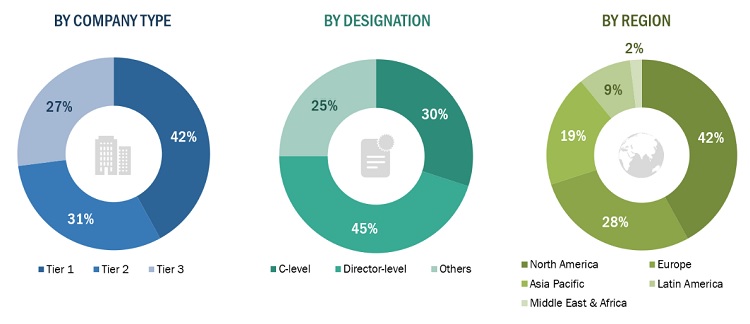
* Others include sales managers, marketing managers, and product managers
Note: Tiers of companies are defined by their total revenues; as of 2020, Tier 1>= USD 500 million, Tier 2 = USD 200 million to USD 500 million, and Tier 3<= USD 200 million
To know about the assumptions considered for the study, download the pdf brochure
Breakdown of Primary Interviews (Demand Side): By End-User Type, Designation, and Region
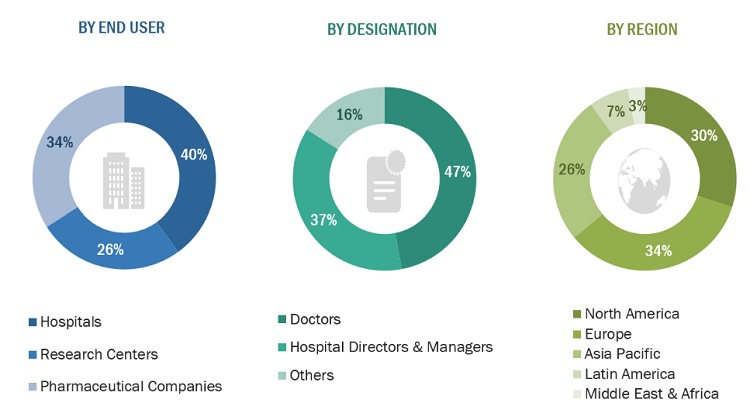
Note: Other designation includes type-c executives of hospitals and clinics.
Data Triangulation
After arriving at the market size, the total market was divided into several segments and subsegments. To complete the overall market engineering process and arrive at the exact statistics for all segments and subsegments, data triangulation and market breakdown procedures were employed wherever applicable.
Approach to derive the market size and estimate market growth
The market rankings for leading players were ascertained after a detailed assessment of their revenues from the optical imaging business using secondary data available through paid and unpaid sources. Owing to data limitations, in certain cases, the revenue share was arrived at after a detailed assessment of the product portfolios of major companies and their respective sales performance. At each point, this data was validated through primary interviews with industry experts.
Objectives of the Study
- To define, describe, and forecast the optical imaging market by product, application, end user, therapeutic area, techniques, and region.
- To provide detailed information about the major factors influencing the market growth (such as drivers, restraints, opportunities, and challenges)
- To strategically analyze micromarkets with respect to individual growth trends, prospects, and contributions to the overall market
- To analyze market opportunities for stakeholders and provide details of the competitive landscape for key players
- To forecast the size of the global market with respect to five major regions, namely, North America, Europe, Asia Pacific, Latin America, and the Middle East & Africa
- To profile the key players and comprehensively analyze their market shares and core competencies in the global market
- To track and analyze competitive developments such as partnerships, agreements, acquisitions, product launches, and expansions in the global market
Available Customizations
With the given market data, MarketsandMarkets offers customizations as per the company’s specific needs. The following customization options are available for the report:
Company Information
- Detailed analysis and profiling of additional market players
Geographic Analysis
- Further breakdown of the Rest of Asia Pacific optical imaging market into Thailand, New Zealand, and other countries.
Get the Full Optical Imaging Market Report
Full forecast, segment splits, and company analysis for all Optical Imaging Market.
- Canada Optical Imaging Market
- US Optical Imaging Market
- France Optical Imaging Market
- Germany Optical Imaging Market
- Italy Optical Imaging Market
- Spain Optical Imaging Market
- UK Optical Imaging Market
- Australia Optical Imaging Market
- China Optical Imaging Market
- India Optical Imaging Market
- Japan Optical Imaging Market
- South Korea Optical Imaging Market
Need a Tailored Report?
Customize this report to your needs
Get 10% FREE Customization
Customize This Report
