
US Patient Registry Software Market (2025-2030)

The US Patient Registry Software Market was valued at $1012.1 Million in 2025 and projected to reach to $1626.2 Million by 2030, representing a compound annual growth rate of 9.9%. The US Patient Registry Software Market is positioned for sustained growth through 2030, driven by ongoing digital transformation initiatives within American healthcare systems and increasing regulatory requirements for patient data management.


| Market Size in | USD 26.32 MN |
| Market Forecast in | |
| CAGR | |
| Forecast Period | |
| Units Considered | Value (USD MN) |
US Patient Registry Software Market Trends and Insights
- This expansion reflects the US healthcare system's increasing adoption of digital health infrastructure and regulatory mandates requiring comprehensive patient data management.
- The US market is driven by the need for interoperable systems that enable healthcare providers to maintain accurate, accessible patient records across multiple care settings. In the US, patient registry software solutions are becoming essential for disease management, clinical research, and population health initiatives.
- The 9.9% compound annual growth rate through 2030 underscores strong demand from US hospitals, specialty clinics, and health systems seeking to improve care coordination and outcomes.
- The US market benefits from significant healthcare IT investments, favorable reimbursement policies, and the growing emphasis on value-based care models that depend on robust patient data analytics and registry capabilities..
Key Market Statistics
- CAGR (2025-2030) 9.9% CAGR
- Market Size, 2025 ~USD 1012.1 Million
- Forecast, 2030 ~USD 1626.2 Million
- Country US
US Patient Registry Software Market Overview
Market Valuation Growth :
The US Patient Registry Software Market is valued at $1,012.1 million in 2025 and is projected to reach $1,626.2 million by 2030, representing a robust 9.9% CAGR driven by digital health adoption across American healthcare systems.
Regulatory Compliance Drivers :
US healthcare regulations and mandates for comprehensive patient data management are accelerating the adoption of patient registry solutions among hospitals, clinics, and healthcare networks nationwide.
Interoperability Focus :
The US market is increasingly prioritizing interoperable systems that enable seamless data exchange across healthcare providers, addressing the critical need for integrated patient information across fragmented healthcare networks.
Digital Health Infrastructure Expansion :
Growing investment in digital health infrastructure across US healthcare institutions is fueling demand for advanced patient registry software solutions that support clinical operations and data analytics.
US Patient Registry Software Market Dynamics
- Healthcare providers are investing heavily in interoperable registry solutions to improve care coordination, enhance clinical outcomes, and meet compliance standards.
- The market will continue to benefit from the shift toward value-based care models and the need for comprehensive patient data analytics.
- Additionally, the integration of artificial intelligence and advanced analytics capabilities into registry platforms is expected to create new growth opportunities for vendors serving the US market..
Market Ecosystem
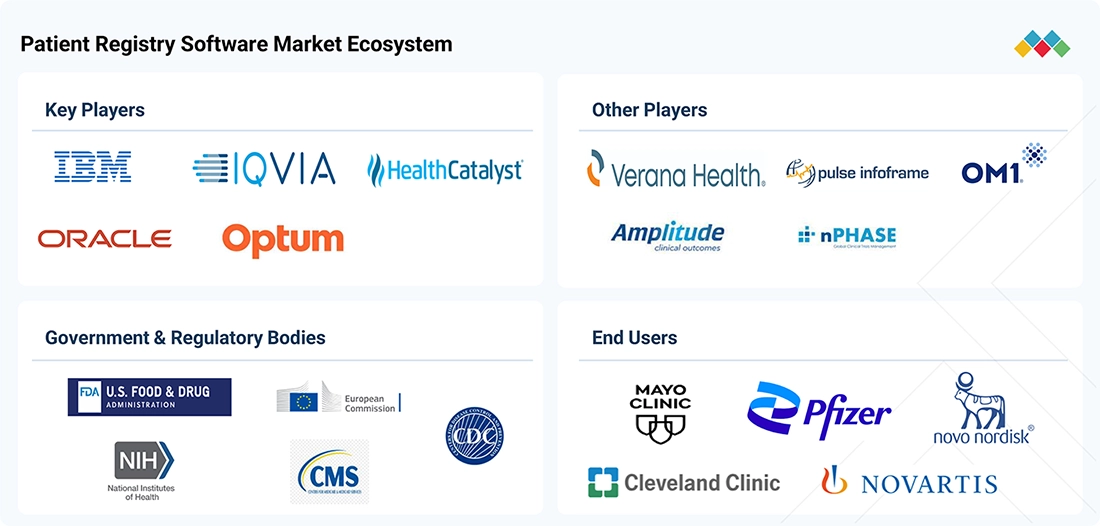
PATIENT REGISTRY SOFTWARE MARKET: COMMERCIAL USE CASES ACROSS INDUSTRIES
| COMPANY | USE CASE DESCRIPTION | BENEFITS |
|---|---|---|
 |
Healthcare master data management supporting patient identity resolution, deduplication, longitudinal patient records, and integration of patient data across healthcare applications | InfoSphere MDM for Patient supports patient registries and health information exchange environments. | Improves patient data accuracy and consistency, reduces duplicate records, strengthens patient identity management, and supports interoperability and reliable registry data management. |
 |
Patient registry solutions supporting disease-specific, product, safety, and quality-improvement registries | The Clinical Insight Registry Platform collects research-ready real-world data from clinicians and patients across multiple sites and geographies. | Streamlines longitudinal patient data collection, supports patient-reported and clinician-reported data, enables clinical research and real-world evidence generation, and facilitates quality improvement and patient outcome analysis. |
 |
ARMUS clinical registry software supporting registry development, data abstraction, validation, management, submission, and analytics for hospitals, healthcare systems, and medical societies. | Reduces manual data abstraction effort, improves data quality and registry submission efficiency, supports standardized reporting and benchmarking, and enables analysis of clinical outcomes across providers and facilities. |
 |
Healthcare applications supporting patient registration and data management, alongside public-health capabilities such as immunization registry reporting and immunization management. | Streamlines patient registration and healthcare workflows, supports public-health reporting and immunization data management, and facilitates access to consistent patient information across clinical and administrative processes. |
 |
Healthcare data and analytics solutions supporting patient registries, patient cohort identification, longitudinal data management, and population health analysis through integration of electronic medical records and other healthcare data sources. | Supports patient identification and stratification, enables longitudinal monitoring and outcomes analysis, improves population health management, and helps healthcare organizations use clinical and administrative data for informed care decisions. |
Logos and trademarks shown above are the property of their respective owners. Their use here is for informational and illustrative purposes only.
Related Ecosystem
Key Takeaways
- The US Patient Registry Software Market is valued at $1,012.1 million in 2025 and will reach $1,626.2 million by 2030, representing a 9.9% CAGR.
- US healthcare providers are increasingly adopting registry software to comply with regulatory requirements and improve patient outcomes through better data management.
- The US market is driven by the shift toward value-based care models that require comprehensive patient data analytics and interoperable systems.
- Strong healthcare IT investments and favorable reimbursement policies in the US support sustained market expansion through 2030.
Patient Registry Software Market Report Scope
| Report Metric | Details |
|---|---|
| Base Year | 2025 |
| Fastest Growing Segment | CLOUD-BASED MODELS (Deployment) |
| Forecast Period | 2025-2030 |
| Growth Rate | CAGR of 9.9% from 2025 to 2030 |
| Largest Segment | DISEASE REGISTRIES (Registry Type) |
| Market Size Base Year (Billions) | ~USD 2.25 (2025) |
| Revenue Forecast (Billions) | ~USD 3.61 (2030) |
| Segments Covered | Registry Type, Type, Product, Use Case, Deployment, End User |
US Patient Registry Software Market Report Segmentation
6 segment dimensions are covered across the global market.
By Registry Type
- Disease Registries
- Product Registries
By Type
- Asthma Registries
- Birth Defect Registries
- Cancer Registries
- Cardiovascular Registries
- Chronic Kidney Registries
- Clinics & Outpatient Settings
- Diabetes Registries
- Drug Registries
- Healthcare Payers
- Healthcare Providers
- Hospitals
- Immunization Registries
- Medical Device Registries
- Medical Specialty Societies
- Orthopedic Registries
- Other Disease Registries
- Other Healthcare Providers
- Patient Organizations
- Pharmaceutical, Biotechnology, And Medtech Companies
- Rare Disease Registries
By Product
- Direct-To-Patient (Patient-Recorded) Registries
- Site-Based/Clinical Data (Provider-Recorded) Registries
By Use Case
- Medical Research & Clinical Studies
- Other Use Cases
- Patient Care Management
- Patient Engagement
- Patient Self-Care
- Point-Of-Care Support
- Population Health
- Public Health Surveillance
- Quality Improvement
By Deployment
- Cloud-Based Models
- On-Premise Models
By End User
- For-Profit Registries
- Government & Third-Party Administrators
- Nonprofit Registries
- Other End Users
US: PATIENT REGISTRY SOFTWARE MARKET, BY END USER, 2023–2030
| Segment | 2023 | 2024 | 2025 | 2026 | 2027 | 2028 | 2029 | 2030 | CAGR (%) |
|---|---|---|---|---|---|---|---|---|---|
| FOR-PROFIT REGISTRIES | 452.8 | 496 | 544.2 | 598.8 | 659.4 | 728.2 | 805.7 | 892.1 | 10.4 |
| GOVERNMENT & THIRD-PARTY ADMINISTRATORS | 107.1 | 115.8 | 125.4 | 136.2 | 148 | 161.3 | 176.2 | 192.5 | 9 |
| NONPROFIT REGISTRIES | 252.5 | 274.9 | 299.9 | 328 | 359 | 394.1 | 433.4 | 477 | 9.7 |
| OTHER END USERS | 36.4 | 39.4 | 42.6 | 46.2 | 50.1 | 54.5 | 59.3 | 64.5 | 8.7 |
| TOTAL | 848.9 | 926 | 1012.1 | 1109.1 | 1216.6 | 1338.1 | 1474.5 | 1626.2 | 9.9 |
Target Audience
- Healthcare IT Vendors : Patient registry software providers need US market intelligence to benchmark competitive positioning, identify growth opportunities, and develop solutions aligned with American healthcare provider requirements and regulatory standards.
- Hospital & Health System Executives : C-suite leaders and IT directors require market data to justify patient registry investments, evaluate vendor options, and plan digital health infrastructure upgrades that improve care coordination and operational efficiency.
- Healthcare Consultants & Advisors : Management consultants and healthcare IT advisors need comprehensive US market analysis to guide client technology selection, assess market trends, and develop implementation strategies for patient registry solutions.
- Private Equity & Investment Firms : Investment professionals evaluating healthcare IT opportunities need detailed US market forecasts, growth drivers, and competitive dynamics to assess acquisition targets and portfolio company growth potential.
- Healthcare Policy & Regulatory Bodies : Government agencies and healthcare policy organizations require market insights to understand digital health adoption trends, assess regulatory impact on patient registry adoption, and inform healthcare IT policy development.
Reasons to Buy this Report
- Market Size & Growth Validation : Gain precise US market valuation data ($1,012.1M in 2025) and verified 9.9% CAGR projections through 2030, enabling accurate financial forecasting and investment decision-making for US healthcare IT initiatives.
- Regulatory Landscape Insights : Understand US-specific regulatory mandates and compliance requirements driving patient registry adoption, helping healthcare organizations align technology investments with federal and state healthcare regulations.
- Competitive Positioning Strategy : Identify market dynamics specific to the US healthcare ecosystem, including interoperability standards and provider adoption patterns, to develop targeted go-to-market strategies for patient registry solutions.
- Investment & Expansion Planning : Leverage detailed US market forecasts and growth drivers to support capital allocation decisions, vendor selection, and strategic expansion plans within the American healthcare market through 2030.
- Technology Integration Roadmap : Understand US healthcare provider priorities for digital health infrastructure and data management, informing product development and feature prioritization for patient registry software solutions.
Frequently asked questions
What is the current size of the US Patient Registry Software Market?
The US Patient Registry Software Market is valued at $1,012.1 million in 2025 and is projected to grow to $1,626.2 million by 2030.
What is the expected growth rate for the US market through 2030?
The US Patient Registry Software Market is expected to grow at a compound annual growth rate (CAGR) of 9.9% from 2025 to 2030.
What are the primary drivers of growth in the US Patient Registry Software Market?
Key drivers include regulatory compliance requirements, the shift to value-based care models, increasing healthcare IT investments, and the need for interoperable patient data systems across US health systems.
Which US healthcare organizations are adopting patient registry software?
US hospitals, specialty clinics, health systems, and research institutions are adopting patient registry software to improve care coordination, disease management, and clinical research capabilities.
How does the US market compare to global trends?
The US Patient Registry Software Market is a significant portion of the global market, with strong growth driven by advanced healthcare infrastructure, regulatory mandates, and substantial IT spending in the US healthcare sector.
RESEARCH METHODOLOGY
The study involved several key activities to estimate the current size of the patient registry software market. Extensive secondary research was conducted to gather information on this market. Next, we validated the findings, assumptions, and size estimates through primary research by consulting industry experts across the value chain. We used top-down and bottom-up approaches to estimate the overall market size. Next, we used market segmentation and data triangulation to determine the size of specific segments and subsegments within the patient registry software market.
Secondary Research
This research study relied heavily on secondary sources, including directories and databases such as Dun & Bradstreet, Bloomberg Businessweek, and Factiva; white papers, annual reports, and companies’ house documents; investor presentations; and companies' SEC filings. Secondary research was used to identify and collect information useful for an extensive, technical, market-oriented, and commercial study of the patient registry software market. It was also used to obtain key information on the key players, market classification & segmentation by industry trends to the most granular level, and key developments from market and technology perspectives. The study also prepared a database of key industry leaders using secondary research.
Some of the key secondary sources referred to for this study include:
- Food and Drug Administration (FDA)
- European Medicines Agency (EMA)
- National Institutes of Health (NIH)
- Agency for Healthcare Research and Quality (AHRQ)
- Centers for Disease Control and Prevention (CDC)
- Centers for Medicare & Medicaid Services (CMS)
- World Health Organization (WHO)
- International Council for Harmonisation of Technical Requirements for Pharmaceuticals for Human Use (ICH)
- Health Level Seven International (HL7)
- European Commission (EU)
- International Organization for Standardization (ISO)
- International Society for Pharmacoeconomics and Outcomes Research (ISPOR)
- Investor Presentations, SEC Filings, and Company Annual Reports
- White Papers, Scientific Journals/Magazines, and News Articles
- Paid Databases, such as Factiva, D&B Hoovers, and Bloomberg
Primary Research
In the primary research process, various sources from both the supply and demand sides were interviewed to obtain qualitative and quantitative information for this report. Primary sources mainly included industry experts from core and related industries, as well as preferred suppliers, manufacturers, distributors, technology developers, researchers, and organizations across all segments of the industry’s value chain. We conducted in-depth interviews with primary respondents, including key industry participants, subject-matter experts (SMEs), C-level executives of key market players, and industry consultants, among others, to gather and verify critical qualitative and quantitative information and assess prospects.
Primary research was conducted to identify segmentation types, industry trends, key players, and key market dynamics such as drivers, restraints, opportunities, challenges, and strategies adopted by key players.
Breakdown of primary respondents:
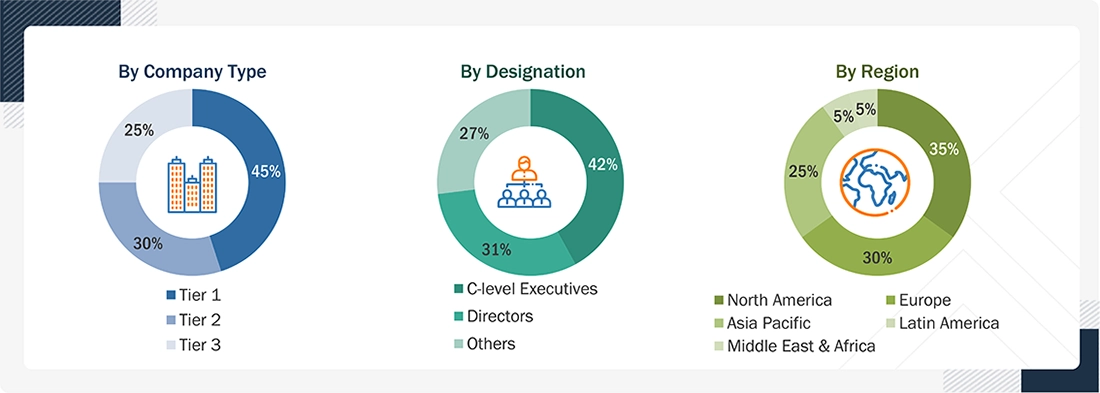
Note 1: Others include sales, marketing, and product managers.
Note 2: Tiers are defined based on a company’s total revenue. As of 2025: Tier 1 = >USD 1 billion, Tier 2 = USD 500 million to USD 1 billion, and Tier 3 = <USD 500 million.
To know about the assumptions considered for the study, download the pdf brochure
Market Size Estimation
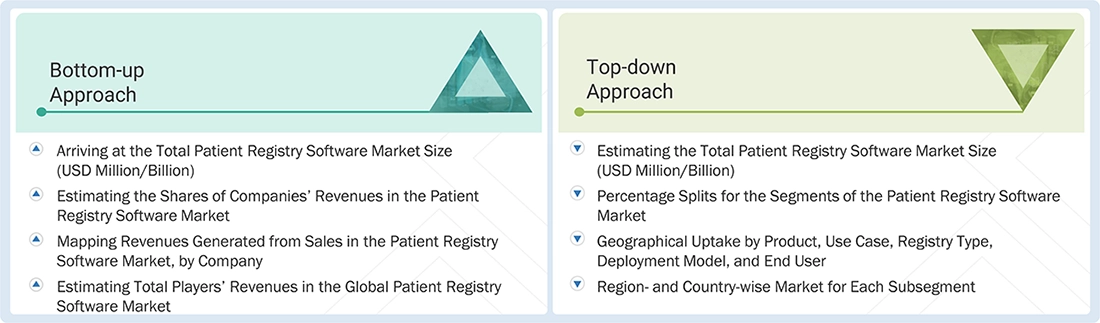
This study's market size estimates and forecasts are derived from a mix of bottom-up (revenue share analysis of leading players) and top-down approaches (assessment of utilization/adoption/penetration trends by product, use case, registry type, deployment model, end user, and region).
Patient Registry Software Market : Top-Down and Bottom-Up Approach
Data Triangulation
After arriving at the overall market size, the market was split into several segments and subsegments using market size estimation processes. To complete the overall market engineering process and arrive at the exact statistics of each market segment and subsegment, the data triangulation and market breakdown procedures were employed, wherever applicable. The data was triangulated by analyzing factors and trends from both the demand and supply sides of the patient registry software market.
Market Definition
Patient registry software is a digital tool that systematically collects, stores, manages, and analyzes patient data on specific diseases, conditions, treatments, or outcomes, enabling real-world evidence generation, research support, and improved clinical decision-making. It facilitates longitudinal tracking of patient outcomes, enhances population health management, and supports regulatory compliance and quality improvement initiatives.
Key Stakeholders
- Patient Registry Software Vendors
- Government Bodies
- Healthcare Providers
- Clinical/Physician Centers
- Healthcare Professionals
- Health IT Service Providers
- Healthcare Associations/Institutes
- Venture Capitalists
- Distributors & Resellers
- Maintenance & Support Service Providers
- Integration Service Providers
- Healthcare Payers
- Advocacy Groups
- Investors & Financial Institutions
- Industry Associations & Trade Groups
Report Objectives
- To define, describe, and forecast the global patient registry software market based on product, use case, registry type, deployment model, end user, and region
- To provide detailed information regarding the major factors influencing the growth of the market (drivers, restraints, opportunities, and challenges)
- To strategically analyze micromarkets with respect to individual growth trends, prospects, and contributions to the overall market
- To analyze the opportunities in the market for stakeholders and provide details of the competitive landscape for market leaders
- To forecast the size of the market segments with respect to five main regions, namely, North America, Europe, Asia, Latin America, and the Middle East & Africa
- To profile key market players and comprehensively analyze their product portfolios, market positions, and core competencies
- To track and analyze competitive developments such as product launches & upgrades; expansions; agreements, partnerships, and acquisitions; and R&D activities in the patient registry software market
Available customizations:
Based on the market data provided, MarketsandMarkets offers customizations to meet your company’s specific needs. The following customization options are available for the report:
Company Information
- Detailed analysis and profiling of additional market players (up to 5)
Geographic Analysis
- Further breakdown of the Rest of Europe patient registry software market into Denmark, Norway, and others
- Further breakdown of the Rest of Asia Pacific patient registry software market into Vietnam, New Zealand, Australia, South Korea, and others
Get the Full Patient Registry Software Market Report
Full forecast, segment splits, and company analysis for all Patient Registry Software Market.
- Canada Patient Registry Software Market
- UK Patient Registry Software Market
- Germany Patient Registry Software Market
- France Patient Registry Software Market
- Italy Patient Registry Software Market
- Spain Patient Registry Software Market
- Japan Patient Registry Software Market
- China Patient Registry Software Market
- India Patient Registry Software Market
- Brazil Patient Registry Software Market
- Mexico Patient Registry Software Market
- Rest Of Europe Patient Registry Software Market
- Rest Of Asia Pacific Patient Registry Software Market
- Rest Of Latin America Patient Registry Software Market
Need a Tailored Report?
Customize this report to your needs
Get 10% FREE Customization
Customize This Report
