
South Korea Peptide Synthesis Market (2024-2029)

The South Korea Peptide Synthesis Market was valued at $15.9 Million in 2024 and projected to reach to $24.7 Million by 2029, representing a compound annual growth rate of 9.3%. South Korea's peptide synthesis market is poised for sustained expansion driven by increasing investments in drug discovery infrastructure and a growing pipeline of peptide-based therapeutics.


| Market Size in | USD 26.32 MN |
| Market Forecast in | |
| CAGR | |
| Forecast Period | |
| Units Considered | Value (USD MN) |
South Korea Peptide Synthesis Market Trends and Insights
- This expansion reflects South Korea's strengthening position in the Asia Pacific biopharmaceutical sector, driven by increasing investments in drug discovery and development infrastructure.
- South Korea's advanced research capabilities and government support for biotechnology innovation are positioning the country as a key hub for peptide-based therapeutics. The 9.3% compound annual growth rate (CAGR) in South Korea outpaces the global average, underscoring the region's accelerating demand for peptide synthesis services.
- South Korea's pharmaceutical companies and contract research organizations are increasingly adopting peptide synthesis technologies to develop novel therapeutics for oncology, metabolic disorders, and immunology.
- Between 2024 and 2029, South Korea is expected to capture growing market share as domestic manufacturers enhance production capabilities and expand their service offerings to international clients..
Key Market Statistics
- CAGR (2024-2029) 9.3% CAGR
- Market Size, 2024 ~USD 15.9 Million
- Forecast, 2029 ~USD 24.7 Million
- Country South Korea
South Korea Peptide Synthesis Market Overview
Market Valuation Growth :
South Korea's peptide synthesis market is valued at USD 15.9 million in 2024, with a projected CAGR of 9.3% through 2029, reaching USD 24.7 million. This outpaces the global CAGR of 8.7%, positioning South Korea as a high-growth market in the Asia Pacific region.
Government Support & Investment :
South Korea's government has prioritized biopharmaceutical development through substantial R&D funding and regulatory incentives. These initiatives have strengthened the country's peptide synthesis infrastructure and attracted both domestic and international pharmaceutical companies to establish operations.
Advanced Research Capabilities :
South Korea hosts world-class research institutions and biotech companies with expertise in peptide drug development. The country's strong academic-industry collaboration ecosystem accelerates innovation in therapeutic peptide synthesis and manufacturing technologies.
Strategic Asia Pacific Hub :
South Korea's strategic location, skilled workforce, and regulatory framework position it as a key hub for peptide synthesis in Asia Pacific. The country serves as a manufacturing and innovation center for regional pharmaceutical companies and multinational enterprises.
South Korea Peptide Synthesis Market Dynamics
- The country's commitment to biopharmaceutical innovation, coupled with government support for life sciences research, creates favorable conditions for market growth.
- South Korea's advanced manufacturing capabilities and skilled scientific workforce enable competitive peptide synthesis services for both domestic and regional markets. Looking ahead, South Korea is expected to strengthen its position as a regional leader in peptide synthesis through continued technological advancement and strategic partnerships.
- The market will benefit from rising demand for personalized medicine, increased outsourcing of peptide manufacturing, and expansion of contract research organizations (CROs) specializing in peptide development.
- These factors collectively support the projected growth trajectory through 2029..
Market Ecosystem
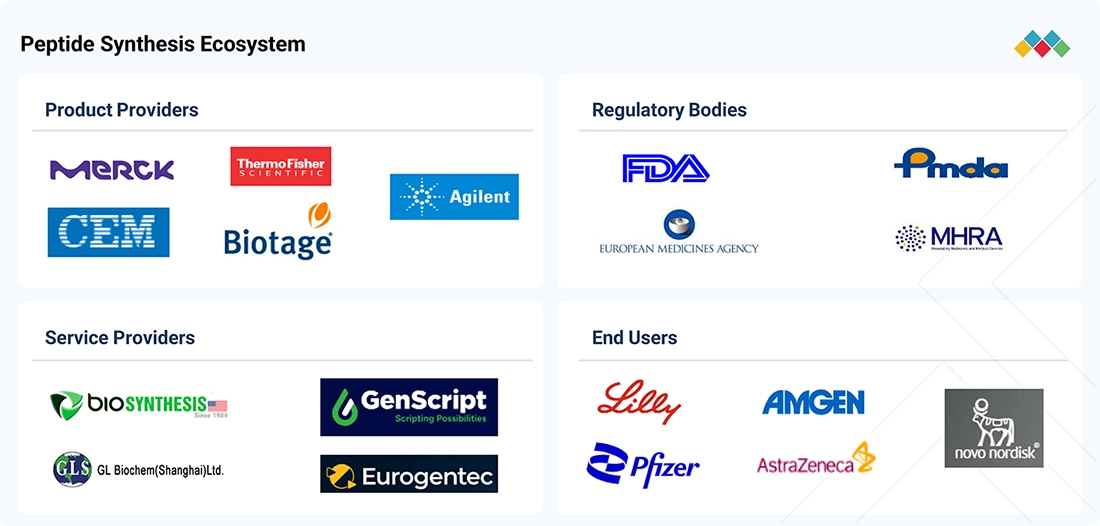
PEPTIDE SYNTHESIS MARKET: COMMERCIAL USE CASES ACROSS INDUSTRIES
| COMPANY | USE CASE DESCRIPTION | BENEFITS |
|---|---|---|
 |
Has worked with GenScript Biotech Corporation (China) to generate thousands of peptides used to study T-cell receptor recognition and identify novel targets for solid-tumor therapeutics. | Enabled large-scale generation of diverse peptide libraries required for target discovery, supporting identification of tumor-specific targets and development of potentially safer and more effective T-cell receptor therapies. |
 |
Uses Biotage AB (Sweden) peptide synthesis and downstream processing technologies, including Syro automated peptide synthesizers, Initiator+ microwave systems, Isolera purification systems, and V-10 evaporation systems, within its peptide drug-discovery workflows. | Parallel synthesis increased peptide throughput, while heated synthesis shortened coupling times for certain reactions from around one hour to about 10 minutes. The integrated workflow also supports difficult sequences, faster purification, and expansion of peptide discovery programs. |
Logos and trademarks shown above are the property of their respective owners. Their use here is for informational and illustrative purposes only.
Related Ecosystem
Biotechnology
- Reagents
- Polymerase Chain Reaction (PCR)
- Stem Cells
- Assay Kits
- Flow Cytometers
- Thermo Fisher Scientific Inc.
- Merck KGaA
- Danaher Corporation
- Agilent Technologies, Inc.
- Bio-Rad Laboratories, Inc.
Key Takeaways
- South Korea's peptide synthesis market is valued at USD 15.9 million in 2024, with projected growth to USD 24.7 million by 2029.
- South Korea's 9.3% CAGR exceeds the global average of 8.7%, reflecting accelerating regional demand and investment.
- South Korea's government support and advanced research infrastructure are driving adoption of peptide synthesis technologies across pharmaceutical and biotech sectors.
- South Korea's contract research organizations and domestic manufacturers are expanding capabilities to serve both local and international markets through 2029.
Peptide Synthesis Market Report Scope
| Report Metric | Details |
|---|---|
| Base Year | 2024 |
| Fastest Growing Segment | CANCER (Indication) |
| Forecast Period | 2024–2029 |
| Growth Rate | CAGR of 8.7% from 2024 to 2029 |
| Largest Segment | CHEMICAL METHODS (Technique) |
| Market Size Base Year (Billions) | ~USD 0.93 (2024) |
| Revenue Forecast (Billions) | ~USD 1.41 (2029) |
| Segments Covered | Offering, Type, Technique, Application, Indication |
South Korea Peptide Synthesis Market Report Segmentation
5 segment dimensions are covered across the global market.
By Offering
- Products
- Services
By Type
- Amino Acids
- Automated Peptide Synthesizers
- Chromatography Systems
- Cleavage Reagents
- Consumables
- Coupling Reagents
- Deprotection Reagents
- Dyes & Fluorescent Labeling Reagents
- Enzymatic Synthesis
- Instruments
- Liquid-Phase Peptide Synthesis
- Lyophilizers
- Manual Peptide Synthesizers
- Other Chemical Methods
- Other Consumables
- Other Instruments
- Other Reagents
- Peptide Synthesizers
- Reagents
- Recombinant Dna Technology
- Resins
- Solid-Phase Peptide Synthesis
By Technique
- Biological Methods
- Chemical Methods
By Application
- Diagnostic Applications
- Discovery & Development Applications
- Therapeutic Applications
By Indication
- Autoimmune Diseases
- Cancer
- Diabetes
- Obesity
- Other Diseases
Target Audience
- Pharmaceutical Companies : Pharmaceutical firms seeking to establish or expand peptide synthesis operations in South Korea need market intelligence on growth potential, regulatory requirements, and competitive dynamics to inform investment decisions.
- Contract Research Organizations (CROs) : CROs and contract manufacturing organizations require detailed market data on South Korea's peptide synthesis demand, client base, and service opportunities to develop business strategies and capacity planning.
- Biotech Investors & Venture Capital : Investors evaluating opportunities in South Korea's biopharmaceutical sector need market forecasts, growth drivers, and competitive analysis to assess investment returns and portfolio allocation decisions.
- Government & Policy Makers : South Korean government agencies and policy makers require market insights to evaluate the effectiveness of biopharmaceutical support programs and inform future R&D funding and regulatory strategies.
- Equipment & Technology Suppliers : Suppliers of peptide synthesis equipment and technologies need market data on South Korea's growth trajectory and customer base to identify sales opportunities and develop region-specific product strategies.
Key Companies in the South Korea Peptide Synthesis Market
| Company | HQ | Ownership | Strongest segments |
|---|---|---|---|
| FLUOR CORPORATION | United States | Public Company | Energy Solutions (oil, gas, chemicals, LNG, power, energy transition),Urban Solutions (advanced technologies, life sciences, mining, infrastructure, staffing, maintenance),Mission Solutions (government nuclear, remediation, security, logistics, O&M), |
| MERCK KGAA | Germany | Public Company | Life Science (tools, consumables, CDMO, bioprocessing),Healthcare (prescription drugs and biopharmaceuticals),Electronics (semiconductor and display materials, gases, equipment), |
| AGILENT TECHNOLOGIES, INC. | United States | Public Company | Life Sciences and Diagnostics Markets,Agilent CrossLab,Applied Markets, |
| GENSCRIPT | Hong Kong | Public Company | Life Science Services and Products,Biologics Development Services,Industrial Synthetic Biology Products, |
| BACHEM | Switzerland | Public Company | Peptide NCE APIs (clinical and commercial),Generic peptide APIs,Oligonucleotide NCE APIs, |
| SYNGENE INTERNATIONAL LIMITED | India | Public Company | Discovery chemistry,Discovery biology and DMPK,Development services (chemical, formulation, analytical, clinical), |
| BIOTAGE | Sweden | Private Company | Flash chromatography systems and consumables,Sample preparation and SPE workflows,Biomolecule purification (antibody, plasmid, AAV, tagged proteins), |
| CEM CORPORATION | Mexico | Public Company | Gray ordinary Portland cement,White and blended cement, masonry products,Ready-mix concrete (standard and specialty), |
FLUOR CORPORATION
Fluor Corporation is a publicly traded engineering and construction company founded in 1912 and headquartered in the United States. With approximately 23,000 employees, the company provides design, engineering, procurement, and construction services across multiple industries.
MERCK KGAA
Merck KGaA is a German publicly traded pharmaceutical, chemical, and life sciences company with roots dating back to 1668. The company employs approximately 59,000 people and operates globally across healthcare, life sciences, and performance materials sectors.
AGILENT TECHNOLOGIES, INC.
Agilent Technologies, Inc. is a publicly traded American company founded in 1999 that specializes in life sciences, diagnostics, and applied chemical markets. With approximately 18,000 employees, Agilent provides instruments, software, services, and consumables for laboratory and clinical settings.
GENSCRIPT
GenScript is a Hong Kong-based publicly traded biotechnology company founded in 2002 with approximately 6,165 employees. The company provides gene synthesis, protein production, and drug discovery services to support research and development globally.
BACHEM
Bachem is a Swiss publicly traded company founded in 1971 with approximately 2,725 employees specializing in the production of biochemical compounds. The company serves the pharmaceutical, biotechnology, and diagnostics industries with custom synthesis and manufacturing services.
SYNGENE INTERNATIONAL LIMITED
Syngene International Limited is an Indian publicly traded company founded in 1993 with approximately 6,692 employees providing integrated drug discovery and development services. The company offers preclinical, clinical, and manufacturing services to pharmaceutical and biotechnology clients worldwide.
BIOTAGE
Biotage is a Swedish private company founded in 1969 with approximately 622 employees specializing in laboratory chemistry and sample preparation solutions. The company develops and manufactures instruments and consumables for pharmaceutical, chemical, and environmental analysis.
CEM CORPORATION
CEM Corporation is a publicly traded company founded in 1906 and headquartered in Mexico with approximately 38,495 employees. The company operates across multiple industrial and commercial sectors providing manufacturing and related services.
Reasons to Buy this Report
- Market-Specific Growth Intelligence : Gain detailed insights into South Korea's peptide synthesis market dynamics, including country-specific growth drivers, regulatory landscape, and competitive positioning that differ from global market trends.
- Investment & Expansion Strategy : Identify high-potential opportunities for market entry, partnership development, and facility expansion in South Korea's biopharmaceutical sector with data-driven market sizing and forecasts through 2029.
- Competitive Landscape Analysis : Understand South Korea's unique competitive environment, including local players, multinational presence, and emerging biotech companies to inform strategic positioning and differentiation strategies.
- Government Support & Incentives : Access comprehensive information on South Korean government initiatives, R&D funding programs, and regulatory incentives that impact peptide synthesis market development and business operations.
- Regional Hub Opportunity Assessment : Evaluate South Korea's role as an Asia Pacific manufacturing and innovation hub for peptide synthesis, including supply chain advantages and regional market access potential.
Frequently asked questions
What is the current size of South Korea's peptide synthesis market?
South Korea's peptide synthesis market was valued at USD 15.9 million in 2024 and is expected to grow to USD 24.7 million by 2029.
What is the growth rate for South Korea's peptide synthesis market?
South Korea's peptide synthesis market is projected to grow at a compound annual growth rate (CAGR) of 9.3% from 2024 to 2029.
Why is South Korea's peptide synthesis market growing faster than the global average?
South Korea's 9.3% CAGR outpaces the global 8.7% average due to strong government support for biotechnology, advanced research infrastructure, and increasing pharmaceutical R&D investments.
What are the main drivers of growth in South Korea's peptide synthesis market?
Key drivers include rising demand for peptide-based therapeutics, expansion of contract research organizations, government biotechnology initiatives, and growing pharmaceutical innovation in South Korea.
Which therapeutic areas are driving demand in South Korea's peptide synthesis market?
South Korea's peptide synthesis market is driven by demand in oncology, metabolic disorders, immunology, and other therapeutic areas requiring novel peptide-based drug development.
RESEARCH METHODOLOGY
This research study relied extensively on secondary sources, directories, and databases to identify and collect valuable information for the analysis of the global peptide synthesis market. In-depth interviews were conducted with various primary respondents, including key industry participants, subject-matter experts (SMEs), C-level executives at major market players, and industry consultants, to gather and validate critical qualitative and quantitative information and assess the market's growth prospects. The global market size estimated through secondary research was then triangulated with primary research inputs to arrive at the final market size.
Secondary Research
Secondary research was used mainly to identify and collect information for the extensive, technical, market-oriented, and commercial study of the peptide synthesis market. The secondary sources used for this study include US Food and Drug Administration (FDA), European Medicines Agency (EMA), National Institutes of Health (NIH), European Directorate for the Quality of Medicines & HealthCare (EDQM), Japan Pharmaceuticals and Medical Devices Agency (PMDA), World Health Organization (WHO), US Pharmacopeia (USP), ClinicalTrials.gov, Journal of Peptide Science, International Journal of Peptide Research and Therapeutics, Peptide Science, American Peptide Society (APS), European Peptide Society (EPS), Chemical & Engineering News (C&EN), Genetic Engineering & Biotechnology News (GEN), and BioPharm International; corporate filings such as annual reports, SEC filings, investor presentations, and financial statements; press releases; and trade, business, professional associations, among others. These sources were also used to obtain key information on major players, market classification and segmentation aligned with industry trends, regional/country-level markets, market developments, and technology perspectives.
Primary Research
In-depth interviews were conducted with various primary respondents, including key industry participants, subject-matter experts (SMEs), C-level executives of key market players, and industry consultants, among others, to obtain and verify critical qualitative and quantitative information and to assess the market's future prospects. Various primary sources from both the supply and demand sides of the market were interviewed to obtain qualitative and quantitative information. The following is a breakdown of the primary respondents:
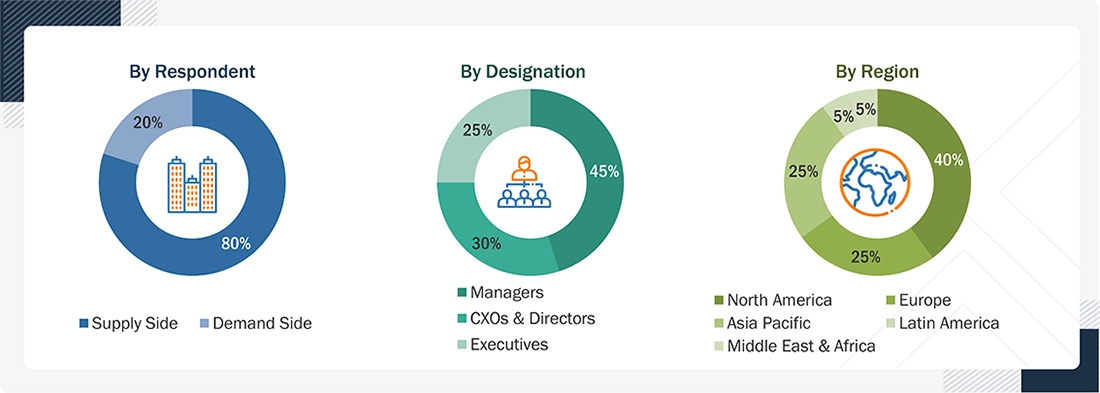
To know about the assumptions considered for the study, download the pdf brochure
Market Size Estimation
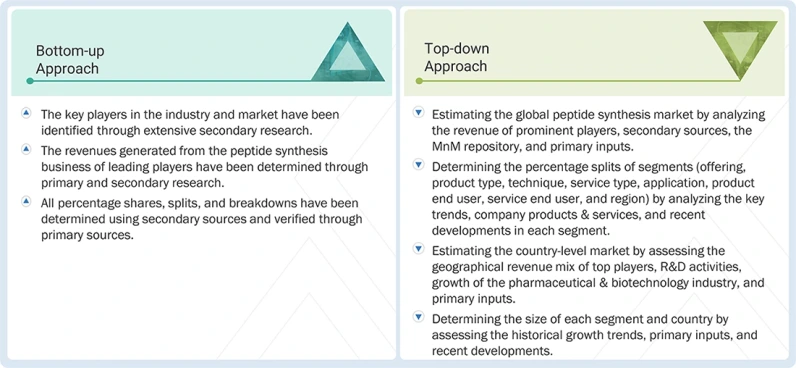
Both top-down and bottom-up approaches were used to estimate and validate the total size of the peptide synthesis market. These methods were also used extensively to estimate the size of various subsegments in the market. The research methodology used to estimate the market size includes the following.
Peptide Synthesis Market : Top-Down and Bottom-Up Approach
Data Triangulation
After arriving at the market size from the market size estimation process explained above, the total market was divided into several segments and subsegments. To complete the overall market engineering process and obtain the exact statistics for all segments and subsegments, data triangulation and market breakdown procedures were employed wherever applicable. The data was triangulated by studying various factors and trends from both the demand and supply sides.
Market Definition
Peptide synthesis is the process of producing peptides through the controlled assembly of amino acids into specific sequences using chemical, biological, or hybrid manufacturing approaches.
The peptide synthesis market comprises the global commercial market for products and services used to chemically or biologically synthesize, modify, purify, and characterize peptides for research, drug discovery and development, diagnostics, therapeutics, and other life science applications. The market includes peptide synthesis instruments and systems, synthesis reagents and building blocks, purification and analytical instruments, synthesis-related consumables, and custom peptide synthesis services. Services covered include custom peptide synthesis, peptide engineering and modification, peptide labeling and conjugation, peptide purification, and peptide-specific analytical and characterization services provided by CROs, CDMOs and specialized peptide service providers.
Key Stakeholders
- Peptide synthesis instrument manufacturers
- Peptide synthesis reagent and consumable suppliers
- Custom peptide synthesis and specialized peptide service providers
- Pharmaceutical & biotechnology companies
- Contract research organizations (CROs) & contract development and manufacturing organizations (CDMOs)
- Academic & research institutes
- Medical device companies
- Clinical & diagnostic laboratories
- Market research & consulting firms
- Regulatory bodies
Report Objectives
- To define, describe, and forecast the global peptide synthesis market based on offering, product type, technique, service type, application, product end user, service end user, and region
- To provide detailed information regarding the major factors influencing the growth of the market (such as drivers, restraints, opportunities, and challenges)
- To strategically analyze micromarkets with respect to individual growth trends, future prospects, and contributions to the overall peptide synthesis market
- To analyze opportunities in the market for stakeholders and provide details of the competitive landscape for market leaders
- To forecast the size of the market segments with respect to six main regions, namely, North America, Europe, Asia Pacific, Latin America, the Middle East, and Africa
- To strategically profile the key players and comprehensively analyze their product & service portfolios, market positions, and core competencies
- To track and analyze competitive developments such as acquisitions, product & service launches, expansions, and R&D activities in the peptide synthesis market
- To analyze and provide funding & investment activities, brand/product/service comparative analysis, and vendor valuation & financial metrics of the peptide synthesis market
Available customizations:
Based on the given market data, MarketsandMarkets offers customization to meet the company’s specific needs. The following customization options are available for this report:
Portfolio Assessment
- Product Matrix, which gives a detailed comparison of the product portfolios of the top four companies.
Company Information
-
Detailed analysis and profiling of additional market players (up to five).
Geographical Analysis
- A further breakdown of the Rest of Europe peptide synthesis market, by country
- A further breakdown of the Rest of Asia Pacific peptide synthesis market, by country
- A further breakdown of the Rest of Latin America peptide synthesis market, by country
Get the Full Peptide Synthesis Market Report
Full forecast, segment splits, and company analysis for all Peptide Synthesis Market.
- Canada Peptide Synthesis Market
- US Peptide Synthesis Market
- Germany Peptide Synthesis Market
- UK Peptide Synthesis Market
- France Peptide Synthesis Market
- Italy Peptide Synthesis Market
- Spain Peptide Synthesis Market
- China Peptide Synthesis Market
- Japan Peptide Synthesis Market
- India Peptide Synthesis Market
- Australia Peptide Synthesis Market
- Brazil Peptide Synthesis Market
- Mexico Peptide Synthesis Market
- Saudi Arabia Peptide Synthesis Market
- UAE Peptide Synthesis Market
- Rest Of Europe Peptide Synthesis Market
- Rest Of Asia Pacific Peptide Synthesis Market
- Rest Of Latin America Peptide Synthesis Market
- Rest Of GCC Countries Peptide Synthesis Market
Need a Tailored Report?
Customize this report to your needs
Get 10% FREE Customization
Customize This Report
