
GCC Permanent Magnet Motor Market (2025-2030)

The GCC Permanent Magnet Motor Market was valued at $1874.9 Million in 2025 and projected to reach to $2930.9 Million by 2030, representing a compound annual growth rate of 9.3%. The GCC permanent magnet motor market is poised for sustained expansion through 2030, driven by aggressive energy efficiency standards and industrial digitalization initiatives across member states.


| Market Size in | USD 26.32 MN |
| Market Forecast in | |
| CAGR | |
| Forecast Period | |
| Units Considered | Value (USD MN) |
GCC Permanent Magnet Motor Market Trends and Insights
- This 9.3% compound annual growth rate reflects GCC's strategic pivot toward energy efficiency and industrial modernization across the region.
- GCC nations are increasingly adopting permanent magnet motors in manufacturing, HVAC systems, and renewable energy applications, driven by government sustainability initiatives and rising electricity costs. GCC's diversified economy and substantial capital investment in infrastructure development are key catalysts for market expansion through 2030.
- The region's focus on reducing energy consumption in industrial operations has positioned permanent magnet motors as a critical technology for GCC enterprises seeking competitive advantage.
- Additionally, GCC's growing renewable energy sector, particularly solar and wind installations, is creating incremental demand for high-efficiency motor solutions that permanent magnet technology uniquely provides..
Key Market Statistics
- CAGR (2025-2030) 9.3% CAGR
- Market Size, 2025 ~USD 1874.9 Million
- Forecast, 2030 ~USD 2930.9 Million
- Country GCC
GCC Permanent Magnet Motor Market Overview
Market Valuation Growth :
GCC permanent magnet motor market valued at USD 1,874.9 million in 2025, expanding to USD 2,930.9 million by 2030, representing a strong 9.3% CAGR driven by regional energy efficiency mandates.
Energy Efficiency Adoption :
GCC nations prioritizing industrial modernization with permanent magnet motors in manufacturing, HVAC systems, and renewable energy applications, aligning with Vision 2030 sustainability goals across Saudi Arabia, UAE, and Qatar.
Industrial Sector Momentum :
Manufacturing and petrochemical industries in GCC driving demand for high-efficiency motors to reduce operational costs and carbon footprint, supported by government incentives and regulatory frameworks.
Regional Competitive Advantage :
GCC's 9.3% CAGR slightly below global 9.8% rate, yet positioned as key growth market due to oil-to-renewables transition and increased investment in smart industrial infrastructure across the region.
GCC Permanent Magnet Motor Market Dynamics
- Saudi Arabia, UAE, and Qatar are leading adoption through manufacturing modernization and HVAC system upgrades, supported by Vision 2030 sustainability commitments.
- Government policies promoting renewable energy integration and reduced energy consumption are accelerating permanent magnet motor deployment in industrial facilities and commercial buildings. Regional economic diversification away from oil dependency is catalyzing investment in advanced manufacturing technologies and smart infrastructure.
- The market will benefit from increased foreign direct investment in industrial zones, growing demand for energy-efficient cooling systems in harsh climates, and expanding petrochemical sector modernization.
- Strategic partnerships between local distributors and global motor manufacturers will enhance market penetration, while rising electricity costs incentivize end-users to adopt high-efficiency permanent magnet solutions..
Market Ecosystem
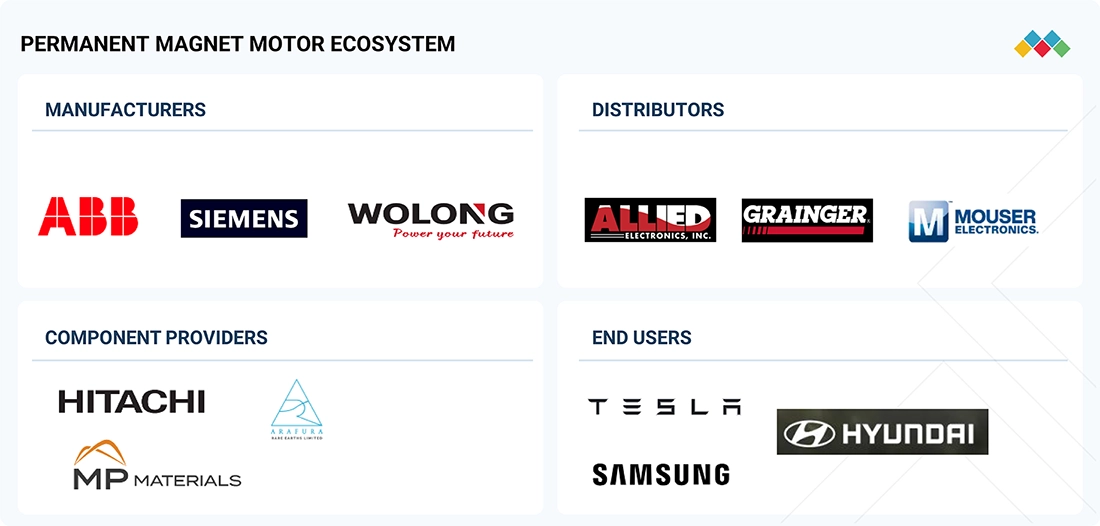
Permanent Magnet Motor Market: COMMERCIAL USE CASES ACROSS INDUSTRIES
| COMPANY | USE CASE DESCRIPTION | BENEFITS |
|---|---|---|
 |
Utilized permanent magnet motors in Model 3 and Model Y vehicles to enhance powertrain efficiency and performance while reducing overall motor size and weight | Improved driving range by up to 15%, reduced energy consumption, and optimized thermal management for sustained performance |
 |
Integrated high-efficiency permanent magnet synchronous motors (PMSMs) in its IONIQ electric lineup to deliver compact design and superior torque output | Increased torque density, enhanced acceleration response, and lowered system losses for greater energy efficiency |
 |
Applied permanent magnet motors in compressor systems for home appliances and HVAC units to achieve quieter and more energy-efficient operation | Reduced power consumption by 20%, minimized vibration and noise, and extended product lifespan through lower heat generation |
Logos and trademarks shown above are the property of their respective owners. Their use here is for informational and illustrative purposes only.
Related Ecosystem
Industrial Equipment
- HVAC System
- Fiberglass
- Actuators
- Cartridge Filters
- Electrostatic Precipitators
- Siemens ag
- ABB India Limited
- GRUNDFOS GROUP
- SCHNEIDER ELECTRIC SE
- Emerson Electric Co.
Variable Speed Drives
- Brushed DC Motors
- HVAC System
- High Power Drives
- Low Power Drives
- Medium Power Drives
- ABB India Limited
- Siemens ag
- Rockwell Automation, Inc.
- SCHNEIDER ELECTRIC SE
- Weg sa
Key Takeaways
- GCC permanent magnet motor market grows from $1,874.9M (2025) to $2,930.9M (2030) at 9.3% CAGR
- GCC's energy efficiency mandates and industrial modernization drive adoption of permanent magnet motor technology
- GCC's renewable energy expansion creates sustained demand for high-efficiency motor solutions through 2030
- GCC's capital-intensive infrastructure projects position the region as a high-growth market for permanent magnet motors
Permanent Magnet Motor Market Report Scope
| Report Metric | Details |
|---|---|
| Base Year | 2025 |
| Fastest Growing Segment | ROBOTICS (Industrial End User) |
| Forecast Period | 2025-2030 |
| Growth Rate | CAGR of 9.8% from 2025 to 2030 |
| Largest Segment | UP TO 25 KW (Power Rating) |
| Market Size Base Year (Billions) | ~USD 58.74 (2025) |
| Revenue Forecast (Billions) | ~USD 93.75 (2030) |
| Segments Covered | Type, Power Rating, End User, Industrial End User, Commercial & Residential End User, Commercial End User, Industria End User |
GCC Permanent Magnet Motor Market Report Segmentation
7 segment dimensions are covered across the global market.
By Type
- Brushless Dc Motor
- Brushless Dc Motors
- Permanent Magnet Ac Motor
- Permanent Magnet Ac Motors
- Permanent Magnet Dc Motor
- Permanent Magnet Dc Motors
By Power Rating
- 101-300 Kw
- 101-300 Kw
- 26-100 Kw
- 26-100 Kw
- Above 300 Kw
- Up To 25 Kw
By End User
- Commercial & Residential
- Commercial And Residential
- Industrial
- Other End Users
By Industrial End User
- Aerospace & Aviation
- Automotive
- Chemical & Petrochemical
- Chemicals & Petrochemicals
- Electronics
- Food & Beverage
- Food & Beverages
- Other End Users
- Other Industrial End Users
- Pulp & Paper
- Robotics
- Textile
- Textiles
By Commercial & Residential End User
- Commercial
- Residential
By Commercial End User
- Banks
- Healthcare
- Malls
- Offices
- Other Commercial End Users
By Industria End User
- Aerospace & Aviation
- Automotive
- Chemicals & Petrochemicals
- Electronics
- Food & Beverages
- Other Industrial End Users
- Pulp & Paper
- Robotics
- Textiles
REST OF GCC: PERMANENT MAGNET MOTOR MARKET, BY END USER, 2025–2030
| Segment | 2025 | 2026 | 2027 | 2028 | 2029 | 2030 | CAGR (%) |
|---|---|---|---|---|---|---|---|
| COMMERCIAL & RESIDENTIAL | 132 | 144.6 | 158.5 | 173.9 | 191.1 | 210.1 | 9.7 |
| INDUSTRIAL | 140.7 | 154.3 | 169.3 | 186 | 204.5 | 225.1 | 9.9 |
| OTHER END USERS | 45.8 | 49.1 | 52.6 | 56.4 | 60.6 | 65 | 7.2 |
| TOTAL | 318.6 | 348 | 380.4 | 416.3 | 456.1 | 500.3 | 9.4 |
GCC: PERMANENT MAGNET MOTOR MARKET, BY END USER, 2025–2030
| Segment | 2025 | 2026 | 2027 | 2028 | 2029 | 2030 | CAGR (%) |
|---|---|---|---|---|---|---|---|
| COMMERCIAL AND RESIDENTIAL | 716.8 | 784.1 | 858.7 | 941.4 | 1033.1 | 1136.3 | 9.7 |
| INDUSTRIAL | 870.4 | 952 | 1042.4 | 1142.6 | 1253.8 | 1376.7 | 9.6 |
| OTHER END USERS | 287.7 | 309.6 | 333.4 | 359.4 | 387.7 | 417.9 | 7.8 |
| TOTAL | 1874.9 | 2045.7 | 2234.5 | 2443.3 | 2674.6 | 2930.9 | 9.3 |
Target Audience
- Industrial Equipment Manufacturers : Manufacturers need GCC market data to develop region-specific permanent magnet motor products, understand local regulatory requirements, and identify partnership opportunities with regional distributors and OEMs.
- Energy & Utilities Companies : GCC utilities and energy providers require market insights to assess permanent magnet motor adoption rates, evaluate energy savings potential, and plan infrastructure modernization investments aligned with sustainability goals.
- HVAC & Building Systems Integrators : HVAC contractors and building automation firms need GCC-specific data to quantify market demand for efficient cooling systems, understand customer preferences, and develop competitive offerings for commercial and industrial segments.
- Investment & Strategy Consultants : Consultants advising on GCC industrial investments require detailed market analysis to support client decision-making, identify growth opportunities, and assess competitive positioning in the permanent magnet motor sector.
- Government & Policy Makers : GCC government agencies and policy bodies need market intelligence to evaluate energy efficiency program effectiveness, benchmark regional progress against global standards, and refine industrial modernization policies.
Reasons to Buy this Report
- Market-Specific Growth Projections : Access precise GCC market sizing (USD 1,874.9M in 2025 to USD 2,930.9M in 2030) with country-level CAGR analysis to inform investment decisions and market entry strategies tailored to regional dynamics.
- Regulatory & Policy Insights : Understand GCC-specific energy efficiency mandates, Vision 2030 sustainability frameworks, and government incentives driving permanent magnet motor adoption across Saudi Arabia, UAE, Qatar, and other member states.
- Competitive Landscape Analysis : Identify key GCC market players, distribution channels, and competitive positioning within the region's industrial and HVAC sectors to optimize go-to-market strategies and partnership opportunities.
- Sector-Specific Demand Drivers : Gain detailed insights into GCC manufacturing, petrochemical, and renewable energy sectors driving permanent magnet motor demand, enabling targeted product development and customer acquisition strategies.
- Risk & Opportunity Assessment : Evaluate GCC-specific market risks, supply chain considerations, and emerging opportunities in smart industrial infrastructure to mitigate investment risks and capitalize on regional growth potential.
Frequently asked questions
What is the current size of the GCC permanent magnet motor market?
The GCC permanent magnet motor market is valued at USD 1,874.9 million in 2025, with verified data confirming this baseline for regional analysis.
What is the projected market size for GCC permanent magnet motors by 2030?
The GCC permanent magnet motor market is forecast to reach USD 2,930.9 million by 2030, representing significant expansion over the five-year period.
What is the CAGR for the GCC permanent magnet motor market?
The GCC permanent magnet motor market is expected to grow at a compound annual growth rate of 9.3% from 2025 to 2030.
Which industries in GCC are driving permanent magnet motor adoption?
GCC's manufacturing, HVAC, renewable energy, and industrial sectors are primary drivers of permanent magnet motor demand due to energy efficiency requirements and sustainability goals.
Why is GCC a strategic market for permanent magnet motor manufacturers?
GCC's high energy costs, government sustainability mandates, renewable energy investments, and capital-intensive infrastructure projects create favorable conditions for permanent magnet motor market growth.
RESEARCH METHODOLOGY
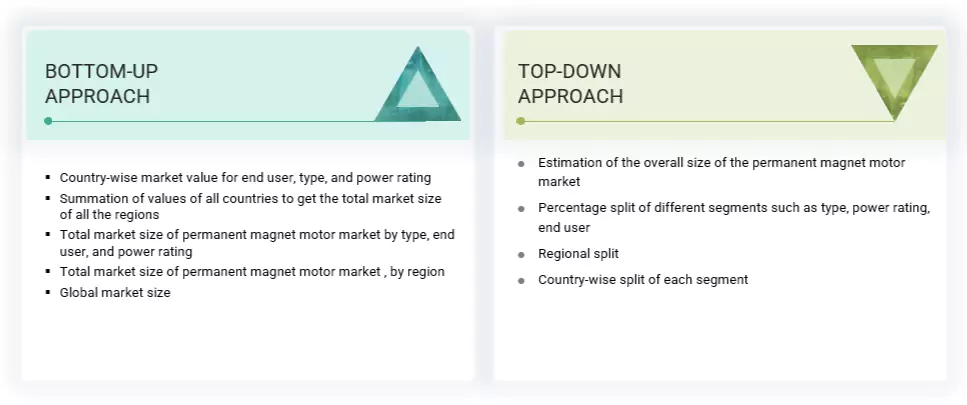
The study involved major activities in estimating the current size of the permanent magnet motor market. Exhaustive secondary research was done to collect information on the peer and parent markets. The next step was to validate these findings, assumptions, and sizing with industry experts across the value chain through primary research. Both top-down and bottom-up approaches were employed to estimate the complete market size. Thereafter, market breakdown and data triangulation were used to estimate the market size of the segments and subsegments.
Secondary Research
This research study on the permanent magnet motor market involved the use of extensive secondary sources, directories, and databases, such as Hoovers, Bloomberg, Businessweek, Factiva, International Energy Agency, and BP Statistical Review of World Energy, to identify and collect valuable information for a technical, market-oriented, and commercial study of the global permanent magnet motor market. Other secondary sources included annual reports, press releases, and investor presentations of companies, white papers, certified publications, articles by recognized authors, manufacturer associations, trade directories, and databases.
Primary Research
The permanent magnet motor market comprises stakeholders such as permanent magnet motor manufacturers, technology providers, and support providers in the supply chain. The demand side of this market is characterized by the rising demand for permanent magnet motors in nations due to their high energy efficiency, compact design, and superior performance. The supply side is characterized by the increasing demand for contracts from the distribution utilities, and mergers and acquisitions among big players. Various primary sources from the supply and demand sides of the market were interviewed to obtain qualitative and quantitative information. The following is the breakdown of primary respondents:
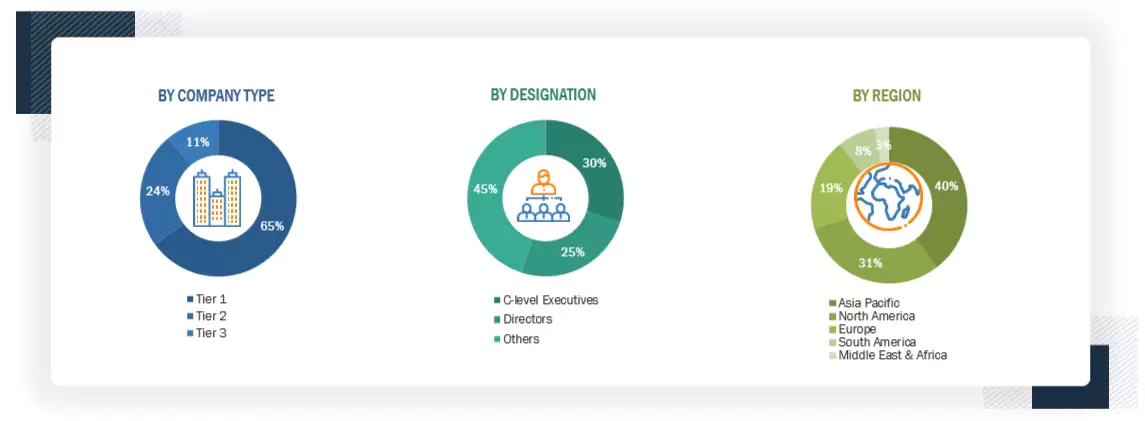
Note: Other designations include sales managers, engineers, and regional managers.
The tiers of the companies are defined based on their total revenue as of 2024: Tier 1: >USD 1 billion, Tier 2: USD 500 million–1
billion, and Tier 3:
To know about the assumptions considered for the study, download the pdf brochure
Market Size Estimation
Top-down and bottom-up approaches were used to estimate and validate the size of the permanent magnet motor market and its dependent submarkets. The key players in the market were identified through secondary research, and their market share in the respective regions was obtained through primary and secondary research. The research methodology includes studying top market players' annual and financial reports and interviews with industry experts, such as chief executive officers, vice presidents, directors, sales managers, and marketing executives, for key quantitative and qualitative insights related to the permanent magnet motor market.
Permanent Magnet Motor Market : Top-Down and Bottom-Up Approach
Data Triangulation
The total market was split into several segments and subsegments after arriving at the overall market size from the above estimation process. The data triangulation and market breakdown processes were employed to complete the overall market engineering process and arrive at the exact statistics for all the segments and subsegments, wherever applicable. The data was triangulated by studying various factors and trends from both the demand and supply sides. The market was also validated using both the top-down and bottom-up approaches.
Market Definition
The permanent magnet motor market encompasses the global electric motors industry that utilizes permanent magnets embedded in the rotor to generate a constant magnetic field. Unlike induction motors, which require an external power source to create rotor flux, permanent magnet motors achieve higher energy efficiency and performance through their inherent magnetic properties. This market includes the manufacturing, distribution, and application of these motors across diverse sectors, such as automotive, industrial automation, robotics, and consumer electronics. Growth in this market is primarily driven by increasing demand for energy-efficient solutions, advancements in electric vehicle technology, and broad industrial adoption for high-performance applications.
Stakeholders
- Permanent Magnet Motor Manufacturing Companies
- Permanent Magnet Motor Manufacturers Association
- Investment Banks
- Government & Research Organizations
- Institutional Investors
- Investors/Shareholders
- Permanent Magnet Motors Manufacturers, Dealers, and Suppliers
- Consulting Companies
- Automotive Manufacturers
- Electronic Equipment Manufacturers
- Companies Involved in Food & Beverages, Textiles, Pulp & Paper Industries
- Suppliers of Parts and Components for Motors
Report Objectives
- To define, describe, segment, and forecast the permanent magnet motor market, by type, power rating, end user, and region, in terms of value
- To forecast the market size for five regions, namely, North America, Europe, Asia Pacific, the Middle East & Africa, and South America, along with their key countries, in terms of value
- To forecast the market size, in terms of volume, by region and type
- To provide a detailed overview of the value chain, ecosystem analysis, case study analysis, patent analysis, trade analysis, technology analysis, average selling price (ASP) analysis, AI/gen AI impact analysis, 2025 US tariff impact analysis, Porter’s five forces analysis, and regulations about the permanent magnet motor market
- To provide detailed information about the key factors, including drivers, restraints, opportunities, and challenges, influencing the growth of the permanent magnet motor market
- To strategically analyze the subsegments with respect to individual growth trends, prospects, and contributions of each segment to the overall market size
- To analyze market opportunities for stakeholders and the details of the competitive landscape for market leaders
- To strategically profile the key players and comprehensively analyze their market shares and core competencies1.
- To analyze competitive developments, such as investments, agreements, acquisitions, partnerships, and expansions, in the permanent magnet motor market
Available Customizations
MarketsandMarkets offers customizations according to the specific needs of the companies using the given market data.
The following customization options are available for the report:
Product Analysis
- Product matrix, which gives a detailed comparison of the product portfolio of each company
Geographic Analysis as per Feasibility
- Further breakdown of the permanent magnet motor market, by country
Company Information
- Detailed analysis and profiling of additional market players (up to five)
Get the Full Permanent Magnet Motor Market Report
Full forecast, segment splits, and company analysis for all Permanent Magnet Motor Market.
- China Permanent Magnet Motor Market
- Japan Permanent Magnet Motor Market
- India Permanent Magnet Motor Market
- South Korea Permanent Magnet Motor Market
- Australia Permanent Magnet Motor Market
- Canada Permanent Magnet Motor Market
- Mexico Permanent Magnet Motor Market
- US Permanent Magnet Motor Market
- Germany Permanent Magnet Motor Market
- UK Permanent Magnet Motor Market
- France Permanent Magnet Motor Market
- Italy Permanent Magnet Motor Market
- Russia Permanent Magnet Motor Market
- Brazil Permanent Magnet Motor Market
- Argentina Permanent Magnet Motor Market
- Saudi Arabia Permanent Magnet Motor Market
- UAE Permanent Magnet Motor Market
- South Africa Permanent Magnet Motor Market
- Rest Of Europe Permanent Magnet Motor Market
- Rest Of Asia Pacific Permanent Magnet Motor Market
- Rest Of Middle East And Africa Permanent Magnet Motor Market
- Rest Of South America Permanent Magnet Motor Market
- Rest Of GCC Permanent Magnet Motor Market
Need a Tailored Report?
Customize this report to your needs
Get 10% FREE Customization
Customize This Report
