
Argentina Planting Equipment Market (2026-2031)

The Argentina Planting Equipment Market was valued at $553.9 Million in 2026 and projected to reach to $753.2 Million by 2031, representing a compound annual growth rate of 6.3%. Argentina's planting equipment market is positioned for steady growth through 2031, driven by the nation's strong agricultural heritage and increasing farmer investment in mechanization.


| Market Size in | USD 26.32 MN |
| Market Forecast in | |
| CAGR | |
| Forecast Period | |
| Units Considered | Value (USD MN) |
Argentina Planting Equipment Market Trends and Insights
- Argentina's agricultural sector, a cornerstone of the nation's economy, continues to drive demand for advanced planting technologies as farmers seek to optimize crop yields and operational efficiency.
- The market growth in Argentina reflects increasing mechanization adoption across both large-scale and mid-sized farming operations, supported by favorable commodity prices and government agricultural initiatives. During the forecast period from 2026 to 2031, Argentina is expected to experience steady market expansion driven by technological innovation in precision agriculture and rising investment in farm modernization.
- Argentina's competitive advantage in global grain production, particularly in soybean and corn cultivation, necessitates continuous equipment upgrades to maintain productivity.
- Market players in Argentina are increasingly focusing on sustainable and efficient planting solutions to meet both domestic demand and export-oriented production requirements..
Key Market Statistics
- CAGR (2026-2031) 6.3% CAGR
- Market Size, 2026 ~USD 553.9 Million
- Forecast, 2031 ~USD 753.2 Million
- Country Argentina
Argentina Planting Equipment Market Overview
Market Valuation Growth :
Argentina's planting equipment market is valued at USD 553.9 million in 2026 and is projected to reach USD 753.2 million by 2031, representing a robust 35.9% total growth over the five-year forecast period.
Consistent CAGR Performance :
The Argentine market is expanding at a steady compound annual growth rate of 6.3%, aligning with global market trends and reflecting sustained investment in agricultural modernization across the country's farming regions.
Agricultural Sector Drivers :
Argentina's economy relies heavily on agriculture, with farmers increasingly adopting advanced planting technologies to enhance crop yields, reduce operational costs, and improve sustainability practices in competitive global markets.
Technology Adoption Momentum :
Rising demand for precision agriculture solutions and mechanized planting equipment reflects Argentine farmers' commitment to operational efficiency and their ability to invest in modern farming infrastructure.
Argentina Planting Equipment Market Dynamics
- The country's vast arable land and export-oriented farming operations create sustained demand for efficient planting solutions that enhance productivity and reduce labor costs.
- Government support for agricultural modernization and access to international financing further bolster market expansion. The forecast period will likely see increased adoption of precision planting technologies, including GPS-guided systems and variable-rate seeders, as Argentine farmers compete in global commodity markets.
- Rising commodity prices and improved farm profitability will enable continued capital investment in equipment upgrades, while supply chain improvements and local manufacturing partnerships will enhance market accessibility across both large-scale and mid-sized farming operations..
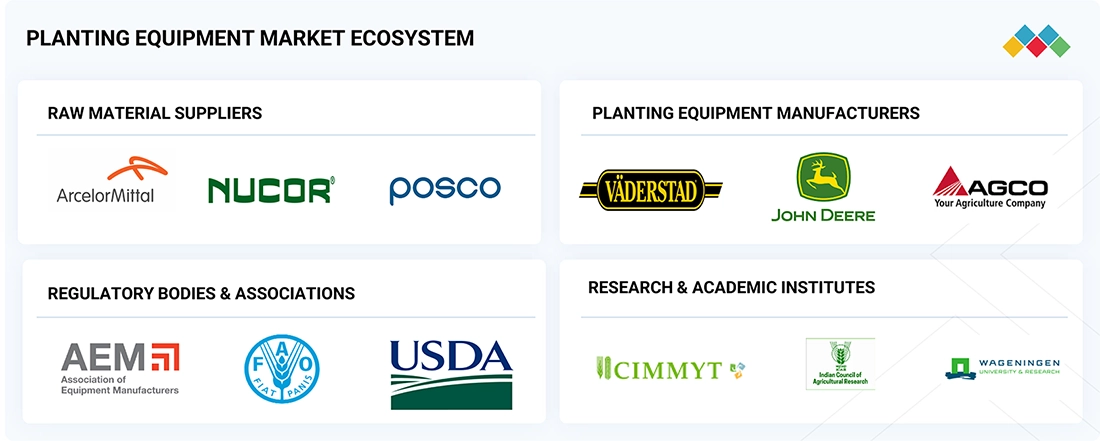
Market Ecosystem
PLANTING EQUIPMENT MARKET: COMMERCIAL USE CASES ACROSS INDUSTRIES
| COMPANY | USE CASE DESCRIPTION | BENEFITS |
|---|---|---|
 |
Deployment of GPS-guided precision planters in large-scale corn and soybean farming | Enhances seed placement accuracy, improves crop uniformity, and increases overall yield |
 |
Use of high-speed planters and variable rate seeding systems in commercial farming operations | Optimizes seed usage, reduces input costs, and improves operational efficiency |
 |
Integration of smart planting equipment with digital farm management platforms | Enables real-time monitoring, improves decision-making, and enhances productivity |
 |
Adoption of compact and automated planting equipment in small and medium-sized farms | Reduces labor dependency, ensures timely planting, and improves crop establishment |
Logos and trademarks shown above are the property of their respective owners. Their use here is for informational and illustrative purposes only.
Related Ecosystem
Farm Equipment And Irrigation
- Sensors
- Hydroponics
- Aeroponics
- Camera Systems
- Global Positioning System (GPS)
- MSK FARM MACHINERY CORPORATION
- MITSUBISHI AGRICULTURAL MACHINERY
- MITSUBISHI CHEMICAL AGRI DREAM
- RIVULIS IRRIGATION
- AGCO Corporation
Key Takeaways
- Argentina's planting equipment market reaches USD 553.9 million in 2026 with projected growth to USD 753.2 million by 2031.
- Argentina maintains a 6.3% CAGR throughout the forecast period, reflecting steady agricultural mechanization trends.
- Argentina's dominance in global soybean and corn production drives continuous demand for advanced planting technologies.
- Argentina's market expansion is supported by government initiatives and rising investment in farm modernization and precision agriculture.
Planting Equipment Market Report Scope
| Report Metric | Details |
|---|---|
| Base Year | 2026 |
| Fastest Growing Segment | FRUITS & VEGETABLES (Crop Type) |
| Forecast Period | 2026–2031 |
| Growth Rate | CAGR of 6.3% from 2026 to 2031 |
| Largest Segment | AUTOMATIC (Design) |
| Market Size Base Year (Billions) | ~USD 21.66 (2026) |
| Revenue Forecast (Billions) | ~USD 29.4 (2031) |
| Segments Covered | Type, Crop Type, Design, Type 2026–2031 |
Argentina Planting Equipment Market Report Segmentation
4 segment dimensions are covered across the global market.
By Type
- Air Seeders
- Other Types
- Planters
- Seed Drill
- Seed Drills
By Crop Type
- Cereals & Grains
- Fruits & Vegetables
- Oilseeds & Pulses
- Other Crop Types
By Design
- Automatic
- Mechanical
By Type 2026–2031
- Air Seeders
- Other Types
- Planters
- Seed Drills
Target Audience
- Agricultural Equipment Manufacturers : Manufacturers need Argentina-specific market data to assess production capacity requirements, localization strategies, and competitive positioning in South America's largest planting equipment market.
- Farm Equipment Distributors & Dealers : Distributors require detailed market insights to optimize inventory planning, identify high-growth product categories, and develop sales strategies aligned with Argentine farmer purchasing patterns and seasonal demand cycles.
- Agricultural Investment Firms : Investment professionals need comprehensive Argentina market analysis to evaluate funding opportunities, assess portfolio company growth potential, and benchmark returns against regional agricultural technology investments.
- Agritech Solution Providers : Technology companies need Argentina market intelligence to understand adoption rates for precision agriculture solutions, identify integration opportunities with local equipment manufacturers, and plan digital agriculture expansion.
- Government & Policy Organizations : Agricultural ministries and policy bodies require market data to inform subsidy programs, mechanization initiatives, and trade policies that support farmer access to modern planting equipment and technology adoption.
Key Companies in the Argentina Planting Equipment Market
| Company | HQ | Ownership | Strongest segments |
|---|---|---|---|
| CLAAS KGAA MBH | Germany | Private Company | Seed Drills,Planters,Air Seeders, |
| DEERE & COMPANY | United States | Public Company | Planters,Air Seeders,Seed Drills, |
| AGCO CORPORATION | United States | Public Company | Planters,Seed Drills,Air Seeders, |
| CNH INDUSTRIAL N.V. | United Kingdom | Public Company | Planters,Seed Drills,Air Seeders, |
| KUBOTA CORPORATION | Japan | Public Company | Seed Drills,Planters,Air Seeders, |
| YANMAR CO., LTD. | Japan | Private Company | Seed Drills,Planters,Air Seeders, |
CLAAS KGAA MBH
CLAAS KGAA MBH is a German private company founded in 1913 with 11,654 employees, specializing in agricultural machinery and equipment manufacturing.
DEERE & COMPANY
DEERE & COMPANY is a publicly traded American company founded in 1837 with 73,100 employees, a leading manufacturer of agricultural, construction, and forestry equipment.
AGCO CORPORATION
AGCO CORPORATION is a publicly traded American company founded in 1990 with 22,000 employees that manufactures and distributes agricultural equipment and solutions.
CNH INDUSTRIAL N.V.
CNH INDUSTRIAL N.V. is a publicly traded company founded in 1842 with 34,197 employees, headquartered in the United Kingdom and specializing in agricultural and construction equipment.
KUBOTA CORPORATION
KUBOTA CORPORATION is a publicly traded Japanese company founded in 1890 with 52,503 employees, a major manufacturer of agricultural machinery, engines, and industrial equipment.
YANMAR CO., LTD.
YANMAR CO., LTD. is a Japanese private company founded in 1912 specializing in the manufacture of diesel engines and agricultural machinery.
Reasons to Buy this Report
- Market Size & Growth Validation : Obtain precise valuation data for Argentina's planting equipment market with verified CAGR of 6.3%, enabling accurate financial forecasting and investment decision-making for the 2026-2031 period.
- Competitive Landscape Intelligence : Understand Argentina-specific market dynamics, local competitor positioning, and regional demand patterns to develop targeted go-to-market strategies and identify partnership opportunities with Argentine distributors and farmers.
- Investment & Expansion Planning : Leverage detailed market projections to evaluate Argentina as an expansion market, assess capital requirements, and benchmark performance against global planting equipment market trends at 6.3% CAGR.
- Customer Segmentation Insights : Access Argentina-focused buyer profiles, including large-scale commodity producers, mid-sized farms, and agricultural cooperatives, to tailor product offerings and marketing messaging for maximum market penetration.
- Risk Mitigation & Opportunity Identification : Identify growth drivers specific to Argentina's agricultural sector, regulatory environment, and technology adoption trends to mitigate market entry risks and capitalize on emerging opportunities in precision planting solutions.
Frequently asked questions
What is the current size of Argentina's planting equipment market?
Argentina's planting equipment market is valued at USD 553.9 million in 2026.
What is the projected market size for Argentina by 2031?
Argentina's planting equipment market is forecast to reach USD 753.2 million by 2031.
What is the growth rate for Argentina's planting equipment market?
Argentina's planting equipment market is expected to grow at a CAGR of 6.3% from 2026 to 2031.
What factors are driving growth in Argentina's planting equipment market?
Growth in Argentina is driven by increasing mechanization adoption, technological innovation in precision agriculture, rising farm modernization investments, and Argentina's competitive position in global grain production.
Which crops are most significant for Argentina's planting equipment demand?
Soybean and corn cultivation are the primary drivers of planting equipment demand in Argentina, given their importance to the nation's agricultural exports and economy.
RESEARCH METHODOLOGY
The study involved four major activities in estimating the current size of the planting equipment market. Exhaustive secondary research was done to collect information on the market, peer market, and parent market. The next step was to validate these findings, assumptions, and sizing with industry experts across the value chain through primary research. Both top-down and bottom-up approaches were employed to estimate the complete market size. After that, market breakdown and data triangulation were used to estimate the market size of segments and subsegments.
Secondary Research
This research study involved the extensive use of secondary sources—directories and databases such as Bloomberg Businessweek and Factiva—to identify and collect information useful for a technical, market-oriented, and commercial study of the planting equipment market.
In the secondary research process, various sources such as annual reports, press releases & investor presentations of companies, white papers, certified publications, articles from recognized authors, gold & silver standard websites, directories, and databases were referred to identify and collect information. This research study involved the extensive use of secondary sources—directories and databases such as Bloomberg Businessweek and Factiva—to identify and collect information useful for a technical, market-oriented, and commercial study of the planting equipment market.
Secondary research was mainly used to obtain key information about the industry’s supply chain, the total pool of key players, and market classification and segmentation as per the industry trends to the bottom-most level, regional markets, and key developments from both market- and technology-oriented perspectives.
Primary Research
Extensive primary research was carried out after gathering information about the planting equipment market through secondary research. Several interviews were conducted with industry experts from both the demand and supply sides across major countries in North America, Europe, Asia Pacific, South America, and RoW. Data was collected via questionnaires, emails, and phone calls. Supply-side sources included industry leaders such as CXOs, Vice Presidents (VPs), and directors from business development, marketing, research, and development teams, as well as key opinion leaders. These interviews aimed to gather insights on market statistics, revenue data from products and services, market segmentation, size estimates, forecasting, and data triangulation. The research also provided an understanding of trends related to planting equipment’s core material, shell material, methods, technology, and applications. Stakeholders from the demand side, including research institutions, universities, and third-party vendors, were interviewed to gain perspectives on their service needs, current use of encapsulation, and outlook for their businesses, which influence the overall market.
Note: The three tiers of the companies are defined based on their total revenues in 2023 or 2024, as per the availability of financial data: Tier 1: Revenue > USD 1 billion; Tier 2: USD 100 million ≤ Revenue ≤ USD 1 billion; Tier 3: Revenue < USD 100 million.
To know about the assumptions considered for the study, download the pdf brochure
|
COMPANY NAME |
DESIGNATION |
|
Deere & Company (United States) |
R&D Expert |
|
AGCO Corporation (United States) |
Sales Manager |
|
CNH Industrial N.V. (United Kingdom) |
Manager |
|
HORSCH Maschinen GmbH (Germany) |
Sales Manager |
|
KUHN Group (France) |
Marketing Manager |
Market Size Estimation
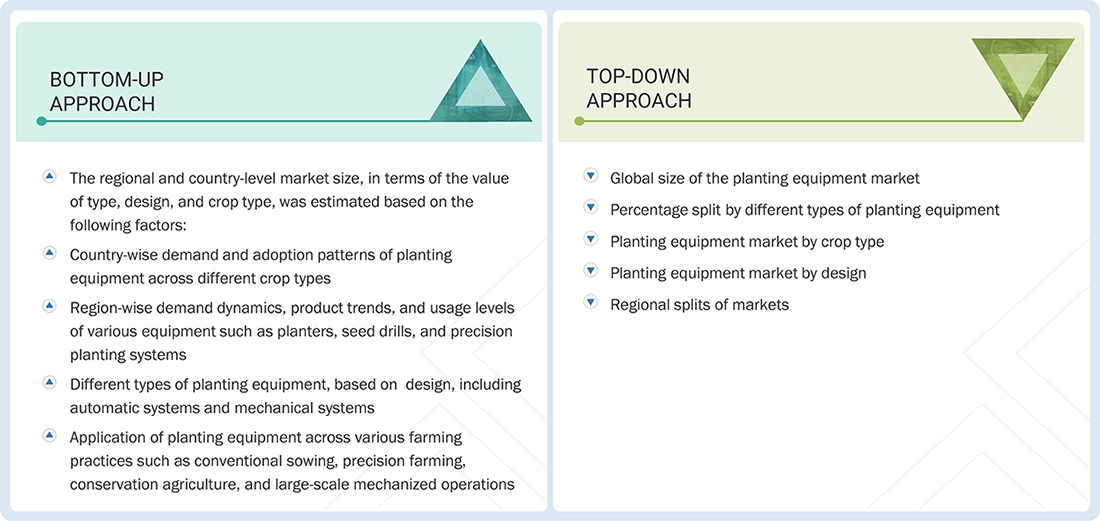
Both the top-down and bottom-up approaches were used to estimate and validate the total size of the planting equipment market. These approaches were also used extensively to determine the size of various subsegments in the market. The research methodology used to estimate the market size includes the following details:
- The key players in the industry and the overall markets were identified through extensive secondary research.
- All shares, splits, and breakdowns were determined using secondary sources and verified through primary sources.
- All possible parameters that affect the market covered in this research study were accounted for, viewed in extensive detail, verified through primary research, and analyzed to obtain final quantitative and qualitative data.
- The research included the study of reports, reviews, and newsletters of top market players, along with extensive interviews for opinions from leaders, such as CEOs, directors, and marketing executives.
Planting Equipment Market : Top-Down and Bottom-Up Approach
Data Triangulation
After arriving at the overall market size from the estimation process explained above, the total market was split into several segments and subsegments. Data triangulation and market breakdown procedures were employed, wherever applicable, to estimate the overall planting equipment market and arrive at the exact statistics for all segments and subsegments. The data was triangulated by studying various factors and trends from the demand and supply sides. Along with this, the market size was validated using both the top-down and bottom-up approaches.
Market Definition
Planting equipment refers to agricultural machinery used for sowing seeds in the soil at the correct depth, spacing, and rate to ensure optimal crop establishment throughout the growing season. These machines are essential for improving planting accuracy, reducing seed wastage, and increasing overall farm productivity. Planting equipment allows for timely operations and supports uniform germination, which directly leads to higher crop yields. It can be used across a variety of crops, including cereals, oilseeds, and horticultural crops, and is suitable for both small-scale and large-scale farming.
Planting equipment comprises various types, such as seed drills, planters, and precision planting systems. Seed drills are widely used for uniform seed distribution and proper soil coverage, while planters are designed for row crops with precise spacing and depth control. Advanced planting systems integrate technologies such as GPS guidance, sensors, and automation to improve efficiency and accuracy. These machines help farmers optimize input usage, reduce labor dependency, and ensure effective crop establishment under different farming conditions.
Key Stakeholders
- Raw material suppliers and manufacturers
- Key manufacturers of planting equipment and precision agriculture solutions
- Agricultural machinery dealers, distributors, and service providers
- Importers and exporters
- Regulatory bodies:
- The United States Department of Agriculture (USDA)
- Food and Agriculture Organization (FAO)
- European Commission (EC)
- Commercial research & development (R&D) institutions and financial institutions
- Agricultural engineering research institutes and agri-tech innovation centers
- Banks and financial institutions providing farm equipment, financing and leasing services
- Associations:
- Association of Equipment Manufacturers
- Agricultural Industry Electronics Foundation
- Organisation for Economic Co-operation and Development (OECD)
Report Objectives
MARKET INTELLIGENCE
- Determining and projecting the size of the planting equipment market with respect to type, crop type, and design
- Identifying the attractive opportunities in the market by determining the largest and fastest-growing segments
- Providing detailed information about the key factors influencing market growth (drivers, restraints, opportunities, and industry-specific challenges)
- Providing the regulatory framework and market entry process related to the planting equipment market
- Analyzing the micro markets with respect to individual growth trends, prospects, and their contribution to the total market
Available customizations:
With the given market data, MarketsandMarkets offers customizations according to company-specific scientific needs.
The following customization options are available for the report:
Product Analysis
- Products Matrix, which gives a detailed comparison of the service portfolio of each company.
Regional Analysis
With the given market data, MarketsandMarkets offers customizations according to company-specific scientific needs.
- Further breakdown of the Rest of Europe planting equipment market into key countries.
- Further breakdown of the Rest of Asia Pacific planting equipment market into key countries.
- Further breakdown of the Rest of South America planting equipment market into key countries.
Company Information
- Detailed analyses and profiling of additional market players (up to five)
Get the Full Planting Equipment Market Report
Full forecast, segment splits, and company analysis for all Planting Equipment Market.
- US Planting Equipment Market
- Canada Planting Equipment Market
- Mexico Planting Equipment Market
- Germany Planting Equipment Market
- France Planting Equipment Market
- Poland Planting Equipment Market
- UK Planting Equipment Market
- Italy Planting Equipment Market
- Spain Planting Equipment Market
- China Planting Equipment Market
- India Planting Equipment Market
- Japan Planting Equipment Market
- Brazil Planting Equipment Market
- Rest Of Europe Planting Equipment Market
- Rest Of Asia Pacific Planting Equipment Market
- Rest Of South America Planting Equipment Market
Need a Tailored Report?
Customize this report to your needs
Get 10% FREE Customization
Customize This Report
