
Rest Of Asia Pacific Polyimide Films & Tapes Market (2025-2030)

The Rest Of Asia Pacific Polyimide Films & Tapes Market was valued at $75.6 Million in 2025 and projected to reach to $107.1 Million by 2030, representing a compound annual growth rate of 7.2%. Rest Of Asia Pacific represents a critical growth corridor for the polyimide films and tapes market, driven by accelerating industrialization and expanding manufacturing capabilities across emerging economies.


| Market Size in | USD 26.32 MN |
| Market Forecast in | |
| CAGR | |
| Forecast Period | |
| Units Considered | Value (USD MN) |
Rest Of Asia Pacific Polyimide Films & Tapes Market Trends and Insights
- The region is projected to expand to $107.1 million by 2030, driven by increasing demand from electronics, automotive, and aerospace sectors across emerging economies.
- Rest Of Asia Pacific's growth trajectory reflects rising industrialization, expanding manufacturing capabilities, and growing adoption of high-performance materials in specialized applications. The polyimide films and tapes market in Rest Of Asia Pacific is characterized by accelerating demand for thermal and electrical insulation solutions in semiconductor and electronics manufacturing.
- Rest Of Asia Pacific's 7.2% compound annual growth rate outpaces many mature markets, supported by investments in electronics production and the region's role in global supply chains.
- Rest Of Asia Pacific's competitive landscape is increasingly dynamic, with both regional players and international manufacturers establishing production and distribution networks to capture emerging opportunities..
Key Market Statistics
- CAGR (2025-2030) 7.2% CAGR
- Market Size, 2025 ~USD 75.6 Million
- Forecast, 2030 ~USD 107.1 Million
- Country Rest Of Asia Pacific
Rest Of Asia Pacific Polyimide Films & Tapes Market Overview
Strong CAGR Growth :
Rest Of Asia Pacific polyimide films and tapes market is expanding at 7.2% CAGR from 2025 to 2030, outpacing many mature markets and reflecting robust regional industrialization.
Emerging Economy Demand :
Rising electronics manufacturing, automotive production, and aerospace expansion across emerging economies in the region are driving significant polyimide material adoption and consumption.
Market Valuation Growth :
Market size is projected to grow from $75.6 million in 2025 to $107.1 million by 2030, representing a 41.6% increase over the five-year forecast period.
Industrial Acceleration :
Rapid industrialization and infrastructure development across Rest Of Asia Pacific countries are creating new applications and end-user opportunities for polyimide films and tapes.
Rest Of Asia Pacific Polyimide Films & Tapes Market Dynamics
- The region's 7.2% CAGR reflects strong demand from electronics, automotive, and aerospace sectors, where polyimide materials are essential for high-performance applications.
- Growing investments in semiconductor production, electric vehicle manufacturing, and aerospace component fabrication are creating sustained demand for advanced polyimide solutions. The market's expansion to $107.1 million by 2030 underscores the region's increasing importance in the global polyimide supply chain.
- Rising technical expertise, improving infrastructure, and competitive manufacturing costs position Rest Of Asia Pacific as an attractive market for both established and emerging polyimide producers.
- Continued economic growth and sector-specific investments will sustain momentum through 2030..
Market Ecosystem
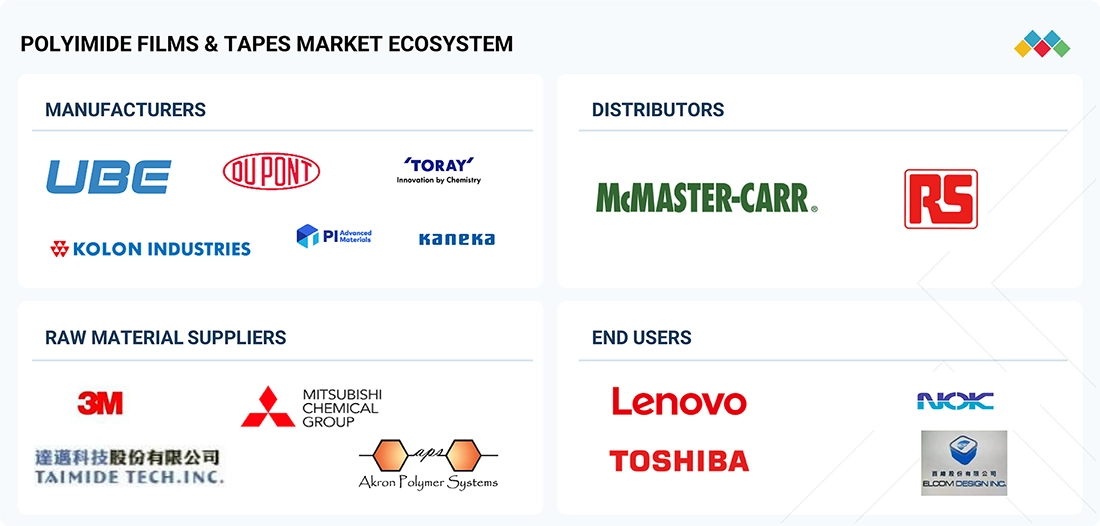
Polyimide Films and Tapes Market: COMMERCIAL USE CASES ACROSS INDUSTRIES
| COMPANY | USE CASE DESCRIPTION | BENEFITS |
|---|---|---|
 |
Supplies high-performance polyimide films and tapes used across electronics, aerospace, and industrial insulation applications. DuPont’s Kapton series delivers exceptional thermal stability and dielectric strength, enabling reliable performance in extreme environments. | Enhances product reliability, supports high-temperature operations, and ensures long-term stability in mission-critical electronic and mechanical systems. |
 |
Develops advanced polyimide films optimized for flexible printed circuits, displays, and automotive electronics. Its materials are engineered for excellent dimensional stability and low outgassing, suitable for high-precision manufacturing. | Improves device durability, ensures superior dimensional control, and reduces manufacturing defects in high-performance electronic assemblies. |
 |
Produces specialty polyimide materials designed for electrical insulation, sensor components, and optical applications. UBE’s focus on resin chemistry innovation enables enhanced heat resistance and mechanical strength. | Provides high thermal endurance, improves insulation reliability, and extends component lifespan under demanding operational conditions. |
 |
Specializes in advanced polyimide films designed for flexible printed circuits, display technologies, and electric vehicle batteries. The company utilizes proprietary polymer processing and coating techniques to ensure exceptional heat resistance, dimensional stability, and electrical insulation for high-reliability applications. | Enables superior heat resistance and mechanical strength in flexible electronics, enhances reliability in EV battery insulation, and supports high-yield manufacturing for next-generation electronic components. |
 |
Manufactures a wide range of polyimide films for electronics, aerospace, and industrial uses, emphasizing energy-efficient production and customizable material properties. | Offers versatile film solutions, enables cost-effective production, and supports sustainable performance with strong thermal and chemical resistance. |
Logos and trademarks shown above are the property of their respective owners. Their use here is for informational and illustrative purposes only.
Related Ecosystem
Ceramics And Glass
- Zirconia
- Alumina Ceramics
- Silicon Carbide
- Silicon Nitride
- Titanate Ceramics
- Saint-gobain
- 3M COMPANY
- Kyocera Corporation
- COORSTEK INCORPORATED
- CERAMTEC GMBH
Resins And Polymers
- Polycarbonate
- Acrylonitrile Butadiene Styrene (ABS)
- Epoxy Resin
- Light Commercial Vehicles (LCVs)
- Polypropylene (PP)
- Basf se
- DOW CHEMICAL COMPANY
- Solvay sa
- Saudi arabia basic industries corporation (sabic)
- DuPont de Nemours, Inc.
Key Takeaways
- Rest Of Asia Pacific polyimide films and tapes market is valued at $75.6 million in 2025 and expected to reach $107.1 million by 2030.
- Rest Of Asia Pacific is experiencing a 7.2% CAGR, reflecting strong demand from electronics, automotive, and aerospace industries.
- Rest Of Asia Pacific's growth is driven by rising industrialization, semiconductor manufacturing expansion, and increasing adoption of high-performance insulation materials.
- Rest Of Asia Pacific's competitive landscape is becoming increasingly dynamic with both regional and international manufacturers investing in production capabilities.
Polyimide Films & Tapes Market Report Scope
| Report Metric | Details |
|---|---|
| Base Year | 2025 |
| Fastest Growing Segment | FLEXIBLE PRINTED CIRCUITS (Application) |
| Forecast Period | 2025-2030 |
| Growth Rate | CAGR of 9% from 2025 to 2030 |
| Largest Segment | FLEXIBLE PRINTED CIRCUITS (Application) |
| Market Size Base Year (Billions) | ~USD 1.5 (2025) |
| Revenue Forecast (Billions) | ~USD 2.31 (2030) |
| Segments Covered | Application, End-Use Industry |
Rest Of Asia Pacific Polyimide Films & Tapes Market Report Segmentation
2 segment dimensions are covered across the global market.
By Application
- Flexible Displays
- Flexible Printed Circuit Boards
- Flexible Printed Circuits
- Flexible Solar Cells
- Lighting Equipment
- Motors & Generators
- Other Applications
- Pressure-Sensitive Tapes
- Specialty Fabricated Products
- Wires & Cables
By End-Use Industry
- Aerospace
- Automotive
- Electronics
- Labeling
- Other End-Use Industries
- Solar
Target Audience
- Polyimide Material Manufacturers : Producers need Rest Of Asia Pacific-specific market data to identify expansion opportunities, assess regional demand growth, and develop localized production and distribution strategies.
- Electronics & Semiconductor Companies : Electronics manufacturers require regional polyimide supply chain insights to optimize sourcing, evaluate supplier capabilities, and plan component sourcing across Rest Of Asia Pacific.
- Automotive & Aerospace OEMs : Original equipment manufacturers need regional market intelligence to identify polyimide material suppliers, assess regional manufacturing capabilities, and plan supply chain diversification.
- Investment & Private Equity Firms : Investors require detailed Rest Of Asia Pacific market analysis to evaluate acquisition targets, assess growth potential, and make informed capital allocation decisions in the region.
- Business Development & Strategy Teams : Corporate strategists need regional market forecasts and growth drivers to inform partnership decisions, market entry strategies, and competitive positioning in Rest Of Asia Pacific.
Reasons to Buy this Report
- Regional Market Sizing & Forecasts : Obtain precise market valuation data specific to Rest Of Asia Pacific with detailed 2025-2030 projections, enabling accurate regional business planning and investment decisions.
- Emerging Economy Opportunity Assessment : Identify high-growth emerging markets within Rest Of Asia Pacific with sector-specific demand drivers in electronics, automotive, and aerospace to prioritize market entry strategies.
- Competitive Landscape Intelligence : Understand regional competitive dynamics, local player positioning, and market consolidation trends specific to Rest Of Asia Pacific polyimide suppliers and manufacturers.
- Sector-Specific Demand Analysis : Access detailed insights into electronics, automotive, and aerospace sector demand patterns across Rest Of Asia Pacific to align product development and marketing strategies.
- Strategic Growth Planning : Leverage regional growth trajectory data and industrialization trends to develop targeted expansion strategies and resource allocation plans for Rest Of Asia Pacific operations.
Frequently asked questions
What is the market size of polyimide films and tapes in Rest Of Asia Pacific?
Rest Of Asia Pacific's polyimide films and tapes market is estimated at $75.6 million in 2025 and is projected to grow to $107.1 million by 2030.
What is the growth rate for polyimide films and tapes in Rest Of Asia Pacific?
Rest Of Asia Pacific is experiencing a compound annual growth rate (CAGR) of 7.2% from 2025 to 2030.
Which industries drive demand for polyimide films and tapes in Rest Of Asia Pacific?
Rest Of Asia Pacific's demand is primarily driven by electronics, semiconductor manufacturing, automotive, and aerospace sectors requiring high-performance thermal and electrical insulation solutions.
What factors are contributing to growth in Rest Of Asia Pacific's polyimide market?
Rest Of Asia Pacific's growth is supported by rising industrialization, expanding electronics manufacturing, semiconductor production growth, and increasing adoption of advanced insulation materials in specialized applications.
How competitive is the polyimide films and tapes market in Rest Of Asia Pacific?
Rest Of Asia Pacific's market is increasingly competitive, with both established international manufacturers and emerging regional players investing in production facilities and distribution networks to capture growing demand.
RESEARCH METHODOLOGY
Four main activities were conducted in order to evaluate the market size for polyimide films & tapes. To compile data on the parent, peer, and market sectors, thorough secondary research was done. The next phase was verifying these results, hypotheses, and dimensions with industry experts using primary research across the polyimide films & tapes value chain. Both top-down and bottom-up approaches help one to estimate the size of the overall market. The data triangulation and market segmentation study helped to determine the sizes of the market segments and sub-segments.
Secondary Research
Starting with the gathering of revenue data from notable suppliers utilizing secondary research, the research method used to evaluate and project the market starts. Many secondary sources, including D&B Hoovers, Bloomberg BusinessWeek, Factiva, the World Bank, and industry magazines, were used in the course of the secondary research to find and synthesize materials for this study. The secondary sources included white papers, accredited publications, writings by prestigious writers, announcements from regulatory authorities, trade directories, databases, annual reports, news releases, and corporate investor presentations. Vendor offers have been taken into consideration to determine market segmentation.
Primary Research
In the supply chain, the polyimide films & tapes market includes manufacturers, suppliers, traders, associations, and regulatory bodies, among other players. The development of building, automotive, electronics, appliances, insulation, packaging, and other uses defines the demand side of this industry. Technological progress defines the supply side. To get both qualitative and quantitative data, several main sources from the supply and demand sides of the market were contacted.
The breakdown of primary interviews has been mentioned below:
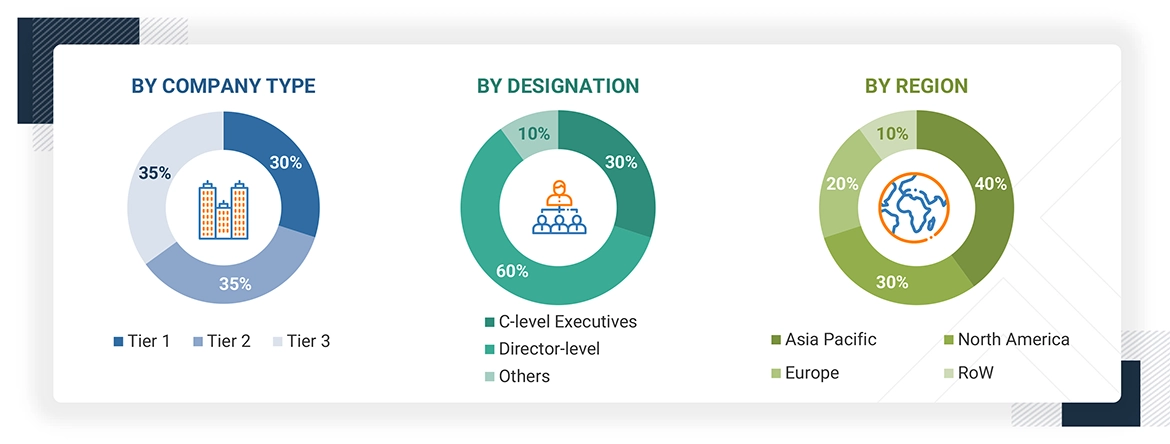
To know about the assumptions considered for the study, download the pdf brochure
Market Size Estimation
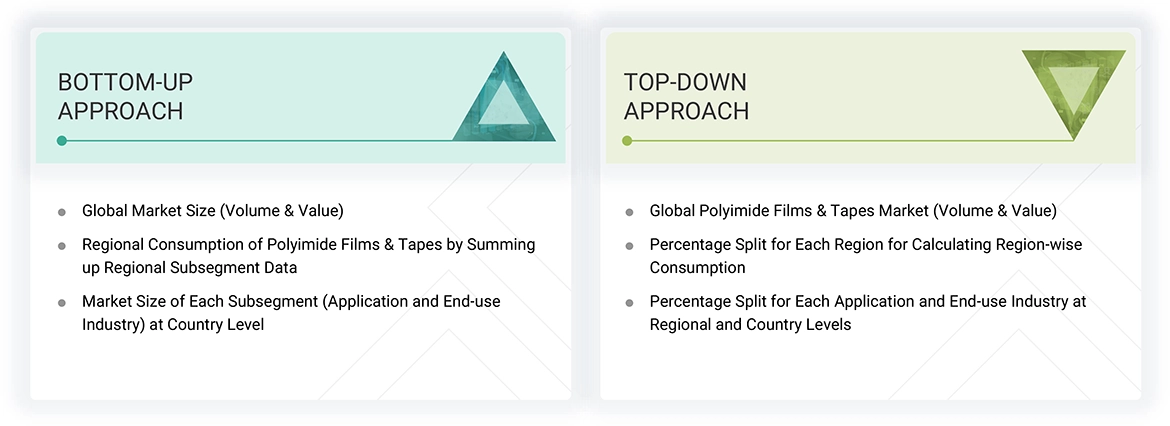
Both the top-down and bottom-up approaches were used to estimate and validate the total size of the polyimide films & tapes market. These methods were also used extensively to determine the size of various subsegments in the market. The research methodology used to estimate the market size included the following:
- The key players were identified through extensive primary and secondary research
- The value chain and market size of the polyimide films & tapes market, in terms of value, were determined through primary and secondary research
- All percentage shares, splits, and breakdowns were determined using secondary sources and verified through primary sources
- All possible parameters that affect the markets covered in this research study were accounted for, viewed in extensive detail, verified through primary research, and analyzed to obtain the final quantitative and qualitative data
- The research included the study of reports, reviews, and newsletters of top market players, along with extensive interviews for opinions from key leaders, such as CEOs, directors, and marketing executives
Global Polyimide Films & Tapes Market Size: Bottom-up and Top-down Approaches
Data Triangulation
Following the above-described market size estimation procedures, the market was divided into segments and subsegments. Wherever relevant, data triangulation and market breakdown techniques were used to finish the whole process of market engineering and arrive at the precise statistics of each market segment and subsegment. Summing the country-level and regional-level data helped to estimate the size of the market worldwide.
Market Definition
High-performance polyimides are a class of polymers distinguished by exceptional thermal stability, electrical insulating qualities, and chemical and radiation resistance. From electronics, aerospace, automotive, and industrial sectors to flexible circuitry, insulation, and high-temperature masking, these materials find extensive use due to their unique qualities.
Stakeholders
- Raw Material Manufacturers
- Polyimide Films & Tapes Manufacturers
- Distributors and Suppliers of Polyimide Films & Tapes Goods
- Manufacturers of Automobiles, Medical Equipment, and Agricultural Equipment
- Associations and Industrial Bodies Such As Flexible Display Consortium, 60-inch Flexible OLED Consortium, Advanced Concepts for Aero-Structures with Integrated Antennas and Sensors (ACASIAS) Consortium, and Others
- NGOs, Governments, Investment Banks, Venture Capitalists, and Private Equity Firms
Report Objectives
- To define, describe, and forecast the size of the global polyimide films & tapes market in terms of volume and value
- To provide detailed information regarding the key factors, such as drivers, restraints, opportunities, and industry-specific challenges, influencing the growth of the global polyimide films & tapes market
- To analyze and forecast the size of various segments (application and end-use industry) of the polyimide films & tapes market based on five major regions—North America, Asia Pacific, Europe, South America, and the Middle East & Africa—along with key countries in each of these regions
- To analyze recent developments and competitive strategies, such as expansions, product developments, agreements, and acquisitions, to draw the competitive landscape of the market
- To strategically profile the key players in the market and comprehensively analyze their core competencies
Get the Full Polyimide Films & Tapes Market Report
Full forecast, segment splits, and company analysis for all Polyimide Films & Tapes Market.
- China Polyimide Films & Tapes Market
- India Polyimide Films & Tapes Market
- Japan Polyimide Films & Tapes Market
- South Korea Polyimide Films & Tapes Market
- Taiwan Polyimide Films & Tapes Market
- Malaysia Polyimide Films & Tapes Market
- Canada Polyimide Films & Tapes Market
- Mexico Polyimide Films & Tapes Market
- US Polyimide Films & Tapes Market
- Germany Polyimide Films & Tapes Market
- France Polyimide Films & Tapes Market
- Italy Polyimide Films & Tapes Market
- UK Polyimide Films & Tapes Market
- Russia Polyimide Films & Tapes Market
- Spain Polyimide Films & Tapes Market
- South Africa Polyimide Films & Tapes Market
- Brazil Polyimide Films & Tapes Market
- Argentina Polyimide Films & Tapes Market
- Rest Of Europe Polyimide Films & Tapes Market
- GCC Countries Polyimide Films & Tapes Market
- -Rest Of GCC Countries Polyimide Films & Tapes Market
- Rest Of South America Polyimide Films & Tapes Market
Need a Tailored Report?
Customize this report to your needs
Get 10% FREE Customization
Customize This Report
