
Mexico Polylactic Acid Market (2025-2030)

The Mexico Polylactic Acid Market was valued at $54.5 Million in 2025 and projected to reach to $112.4 Million by 2030, representing a compound annual growth rate of CAGR 15.6%. Mexico's polylactic acid market is positioned for substantial growth through 2030, driven by regulatory pressures favoring biodegradable materials and increasing corporate sustainability commitments.


| Market Size in | USD 26.32 MN |
| Market Forecast in | |
| CAGR | |
| Forecast Period | |
| Units Considered | Value (USD MN) |
Mexico Polylactic Acid Market Trends and Insights
- This expansion reflects Mexico's increasing adoption of sustainable biopolymers across packaging, textiles, and consumer goods sectors.
- Mexico's strategic position in North America and growing environmental regulations are driving demand for biodegradable alternatives to conventional plastics. The 15.6% compound annual growth rate in Mexico underscores the country's commitment to circular economy principles and corporate sustainability initiatives.
- Mexico's manufacturing base and proximity to major North American markets position it as a key hub for polylactic acid production and consumption.
- Between 2025 and 2030, Mexico is expected to capture significant market share as industries transition toward eco-friendly materials and comply with emerging plastic reduction mandates..
Key Market Statistics
- CAGR (2025-2030) CAGR 15.6%
- Market Size, 2025 ~USD 54.5 Million
- Forecast, 2030 ~USD 112.4 Million
- Country Mexico
Mexico Polylactic Acid Market Overview
Market Valuation Growth :
Mexico's polylactic acid market is valued at USD 54.5 million in 2025, with a projected CAGR of 15.6%, reaching USD 112.4 million by 2030, demonstrating strong double-digit expansion.
Sustainable Packaging Adoption :
Mexican manufacturers are increasingly shifting toward biodegradable polylactic acid for packaging applications, driven by stricter environmental regulations and consumer demand for eco-friendly alternatives.
North American Strategic Position :
Mexico's geographic advantage within North America enables it to serve as a regional hub for PLA production and distribution, supporting both domestic and cross-border market opportunities.
Multi-Sector Application Growth :
PLA adoption is expanding across textiles, consumer goods, and food packaging sectors in Mexico, reflecting diversification beyond traditional applications and growing industrial demand.
Mexico Polylactic Acid Market Dynamics
- The country's manufacturing base is rapidly integrating PLA into packaging and consumer product lines, supported by improving supply chain infrastructure and competitive production costs.
- Growing environmental consciousness among Mexican consumers and stringent government policies on single-use plastics are accelerating market penetration across multiple industries, creating significant opportunities for suppliers and manufacturers..
Market Ecosystem
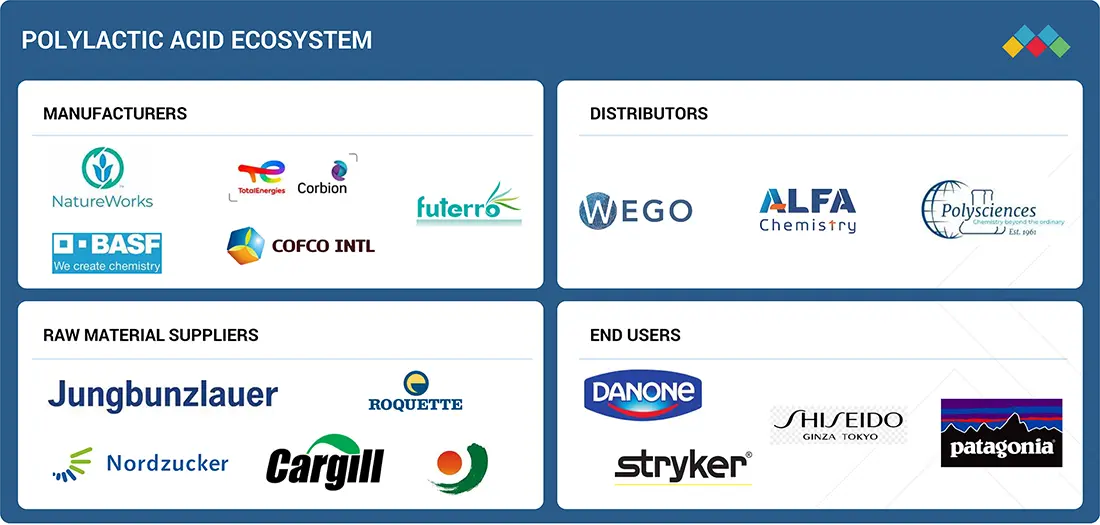
Polylactic Acid Market: COMMERCIAL USE CASES ACROSS INDUSTRIES
| COMPANY | USE CASE DESCRIPTION | BENEFITS |
|---|---|---|
 |
Developed Ingeo PLA biopolymers are used widely in food packaging, 3D printing, fibers for textiles, and nonwovens (personal care, hygiene) | Enabled compostable, bio-based packaging; reduced landfill waste; improved material clarity; used in medical implants and 3D-printed devices |
 |
Launched Luminy PLA grades for rigid thermoformed packaging, compostable straws/cups, single-use food service ware; works with PHA for sustainable biomaterial blends in China | Delivered fully recyclable, compostable solutions for food packaging, cutlery, and promoted circular plastics in large-scale manufacturing |
 |
Developed a full-cycle PLA biorefinery for both PLA production and chemical recycling; serves packaging, textiles, and consumer goods | Achieved reduced carbon footprint, promoted circular economy via recycling, and advanced high-quality PLA for major brands |
 |
Developed PHA/PLA blends for marine-degradable packaging, films, and coatings for food and beverage sector | Created rapidly degradable bioplastics for ocean-safe, single-use items, supporting regulatory compliance in global markets |
Logos and trademarks shown above are the property of their respective owners. Their use here is for informational and illustrative purposes only.
Related Ecosystem
Agricultural Biologicals
- Bionematicides
- Auxins
- Cytokinins
- Ethylene
- Humic Substances
- NICHINO INDIA PVT LTD.
- Corteva, Inc.
- Basf se
- AZELIS HOLDINGS SA
- BAYER AG
Green Bio Chemicals
- Animal-Based Sealants
- Bacterial Fermentation
- Corrosion Inhibitors
- Hydrogen Peroxide
- Nitrile Butadiene Rubber (NBR)
- Basf se
- Evonik industries ag
- Solvay sa
- AZELIS HOLDINGS SA
- CARGILL, INCORPORATED
Resins And Polymers
- Polycarbonate
- Acrylonitrile Butadiene Styrene (ABS)
- Epoxy Resin
- Light Commercial Vehicles (LCVs)
- Polypropylene (PP)
- Basf se
- DOW CHEMICAL COMPANY
- Solvay sa
- Saudi arabia basic industries corporation (sabic)
- DuPont de Nemours, Inc.
Key Takeaways
- Mexico's polylactic acid market will nearly double from USD 54.5M (2025) to USD 112.4M (2030), growing at 15.6% CAGR.
- Mexico's packaging and consumer goods industries are primary drivers of polylactic acid adoption and market expansion.
- Mexico's regulatory environment and sustainability commitments are accelerating the shift from conventional plastics to biodegradable alternatives.
- Mexico's manufacturing infrastructure and North American trade relationships position it as a critical growth market for polylactic acid producers.
Polylactic Acid Market Report Scope
| Report Metric | Details |
|---|---|
| Base Year | 2025 |
| Fastest Growing Segment | RIGID THERMOFORMS (Application) |
| Forecast Period | 2025–2030 |
| Growth Rate | CAGR of 17.5% from 2025 to 2030 |
| Largest Segment | PACKAGING (End-Use Industry) |
| Market Size Base Year (Billions) | ~USD 2.01 (2025) |
| Revenue Forecast (Billions) | ~USD 4.51 (2030) |
| Segments Covered | Grade, Raw Material, Application, End-Use Industry |
Mexico Polylactic Acid Market Report Segmentation
4 segment dimensions are covered across the global market.
By Grade
- Blow Molding
- Blow Molding Grade
- Extrusion
- Extrusion Grade
- Injection Molding
- Injection Molding Grade
- Other Grades
- Other Raw Materials
- Thermoforming
- Thermoforming Grade
By Raw Material
- Cassava
- Corn Starch
- Other Raw Materials
- Sugar Beet
- Sugarbeet
- Sugarcane
By Application
- Bottles
- Films & Sheets
- Other Applications
- Rigid Thermoforms
By End-Use Industry
- Agricultural
- Bio-Medical
- Consumer Goods
- Other End-Use Industries
- Other Raw Materials
- Packaging
- Textile
MEXICO: POLYLACTIC ACID MARKET, BY END-USE INDUSTRY, 2025–2030
| Segment | 2025 | 2026 | 2027 | 2028 | 2029 | 2030 | CAGR (%) |
|---|---|---|---|---|---|---|---|
| AGRICULTURAL | 4.3 | 4.9 | 5.6 | 6.5 | 7.4 | 8.5 | 14.6 |
| BIO-MEDICAL | 2.8 | 3.2 | 3.7 | 4.2 | 4.8 | 5.6 | 14.9 |
| CONSUMER GOODS | 8.2 | 9.4 | 10.7 | 12.3 | 14 | 16.1 | 14.5 |
| OTHER END-USE INDUSTRIES | 5.1 | 5.8 | 6.6 | 7.5 | 8.6 | 9.8 | 14.2 |
| PACKAGING | 30.2 | 35.1 | 40.9 | 47.6 | 55.4 | 64.6 | 16.4 |
| TEXTILE | 4 | 4.6 | 5.2 | 5.9 | 6.8 | 7.7 | 14.1 |
| TOTAL | 54.5 | 62.9 | 72.6 | 84 | 97 | 112.4 | 15.6 |
Target Audience
- Packaging Manufacturers : Mexican and multinational packaging companies need detailed market data to transition product lines to PLA-based solutions and capitalize on growing demand for sustainable alternatives.
- Chemical & Material Suppliers : Raw material suppliers and chemical distributors require Mexico-specific market intelligence to identify growth opportunities and develop targeted sales strategies for PLA products.
- Investment & Private Equity Firms : Investors evaluating opportunities in Mexico's sustainable materials sector need comprehensive market analysis to assess growth potential and make informed capital allocation decisions.
- Consumer Goods Manufacturers : Mexican and regional consumer goods companies need market insights to understand PLA adoption trends and plan product reformulation strategies aligned with sustainability goals.
- Government & Policy Makers : Mexican regulatory bodies and trade organizations require market data to develop informed environmental policies and support domestic biopolymer industry development.
Key Companies in the Mexico Polylactic Acid Market
| Company | HQ | Ownership | Strongest segments |
|---|---|---|---|
| SHANGHAI TONG-JIE-LIANG BIOMATERIALSCO., LTD. | China | Thermoforming Grade PLA,Extrusion Grade PLA,Injection Molding Grade PLA, | |
| TOTALENERGIES CORBION | Netherlands | Joint Venture | Thermoforming Grade PLA,Extrusion Grade PLA,Injection Molding Grade PLA, |
| BASF SE | Germany | Public Company | Thermoforming Grade PLA,Injection Molding Grade PLA,Extrusion Grade PLA, |
| COFCO | China | Private Company | Thermoforming Grade PLA,Injection Molding Grade PLA,Extrusion Grade PLA, |
| FUTERRO | Belgium | Subsidiary | Thermoforming Grade PLA,Extrusion Grade PLA,Injection Molding Grade PLA, |
| DANIMER SCIENTIFIC | United States | Public Company | Thermoforming Grade PLA,Extrusion Grade PLA,Injection Molding Grade PLA, |
| TORAY INDUSTRIES, INC. | Japan | Public Company | Thermoforming Grade PLA,Injection Molding Grade PLA,Extrusion Grade PLA, |
| EVONIK INDUSTRIES | Germany | Public Company | Thermoforming Grade PLA systems (rigid thermoforms, trays, cups),Injection Molding Grade PLA systems (consumer goods, bio-medical components),Extrusion Grade PLA systems (films & sheets), |
| MITSUBISHI CHEMICAL GROUP CORPORATION | Japan | Public Company | Thermoforming Grade PLA,Injection Molding Grade PLA,Extrusion Grade PLA (Films & Sheets), |
| UNITIKA LTD. | Japan | Public Company | Thermoforming Grade PLA,Injection Molding Grade PLA,Extrusion Grade PLA, |
| ADBIOPLASTICS | Spain | Private Company | Thermoforming Grade PLA,Injection Molding Grade PLA,Extrusion Grade PLA, |
SHANGHAI TONG-JIE-LIANG BIOMATERIALSCO., LTD.
Shanghai Tong-Jie-Liang Biomaterials Co., Ltd. is a Chinese biomaterials company founded in 2009.
TOTALENERGIES CORBION
TotalEnergies Corbion is a joint venture established in 2017 in the Netherlands.
BASF SE
BASF SE is a German public company founded in 1865 with 94,910 employees, operating as a major chemical manufacturer.
COFCO
COFCO is a Chinese private company founded in 1949.
FUTERRO
Futerro is a Belgian subsidiary company founded in 1992.
DANIMER SCIENTIFIC
Danimer Scientific is a United States-based public company founded in 2004.
TORAY INDUSTRIES, INC.
Toray Industries, Inc. is a Japanese public company founded in 1926 with 46,294 employees.
EVONIK INDUSTRIES
Evonik Industries is a German public company founded in 1847 with 30,643 employees.
MITSUBISHI CHEMICAL GROUP CORPORATION
Mitsubishi Chemical Group Corporation is a Japanese public company founded in 1933 with 56,678 employees.
UNITIKA LTD.
Unitika Ltd. is a Japanese public company founded in 1889 with 1,692 employees.
ADBIOPLASTICS
ADBioplastics is a Spanish private company founded in 2015.
Reasons to Buy this Report
- Market-Specific Growth Projections : Access detailed forecasts showing Mexico's PLA market expanding from USD 54.5M to USD 112.4M by 2030, enabling precise investment and expansion planning for the Mexican market.
- Regulatory Landscape Intelligence : Understand Mexico's environmental regulations driving PLA adoption and identify compliance opportunities that position your business ahead of competitors in this rapidly evolving market.
- Sector-Specific Demand Analysis : Gain insights into PLA adoption patterns across Mexican packaging, textiles, and consumer goods sectors to identify high-potential application areas and customer segments.
- Competitive Positioning Strategy : Leverage Mexico-focused market data to benchmark against regional competitors, identify market gaps, and develop targeted strategies for capturing market share in this 15.6% CAGR growth environment.
- Supply Chain Optimization : Utilize country-specific insights to optimize sourcing, production, and distribution strategies within Mexico's North American supply chain ecosystem.
Frequently asked questions
What is the current size of Mexico's polylactic acid market?
Mexico's polylactic acid market is valued at USD 54.5 million in 2025 and is expected to grow significantly through 2030.
What is the projected market size for polylactic acid in Mexico by 2030?
Mexico's polylactic acid market is forecasted to reach USD 112.4 million by 2030, representing a 15.6% compound annual growth rate.
Which industries are driving polylactic acid demand in Mexico?
Mexico's packaging, textiles, consumer goods, and food service sectors are primary drivers of polylactic acid consumption and market growth.
Why is Mexico's polylactic acid market growing faster than global averages?
Mexico's growth is driven by regulatory pressures, corporate sustainability initiatives, manufacturing expansion, and proximity to North American markets seeking sustainable materials.
What factors will influence Mexico's polylactic acid market between 2025 and 2030?
Mexico's market growth will be influenced by plastic reduction regulations, consumer demand for eco-friendly products, investment in biopolymer infrastructure, and trade dynamics within North America.
RESEARCH METHODOLOGY
The study carried out four key activities to measure the size of the global polylactic acid (PLA) market. Extensive secondary research was performed to gather information on the PLA market, related bioplastic markets, and the broader markets for bio-based polymers. These findings were verified through primary research with industry experts from various parts of the PLA value chain, including sources from raw material supply industries, polymer manufacturers, compounders, and end-use industries. The overall PLA market size was estimated using both top-down and bottom-up approaches. Market segmentation and data triangulation were then used to accurately determine the sizes of the segments and sub-segments of the PLA market.
Secondary Research
We developed a market landscape for companies providing PLA and related solutions using a combination of secondary data sources, both publicly available and those we paid for, including evaluation of company product portfolios, industry publications, and trade databases. The following sources were examined to assess macroeconomic and industry-level trends influencing PLA uptake: Bloomberg, Factiva, Business Standard, and the World Bank. In addition, we used annual reports from our climate policy framework assessment, press releases, sustainability reports, and investor briefings of PLA manufacturers and bio-based (derived from renewable biomass) polymer manufacturers and as well as guidance from industry associations, environmental policy frameworks, and whitepapers related to bioplastics. This research led to an understanding of the various components of the PLA value chain, the top players in the PLA business, how the market is categorized, innovation developments in technology, and related information in the PLA ecosystem.
Primary Research
In the primary research process, various primary sources from both the supply and demand sides were interviewed to obtain qualitative and quantitative information for this report. The primary sources from the supply side included industry experts, such as Chief Executive Officers (CEOs), Vice Presidents (VPs), marketing directors, technology and innovation directors, and related key executives from several key companies and organizations operating in the PLA market. After the complete market engineering (calculations for market statistics, market breakdown, market size estimations, market forecasting, and data triangulation), extensive primary research was conducted to gather information and verify and validate the critical numbers arrived at. Primary research was also conducted to identify the segmentation types, industry trends, competitive landscape of PLA offered by various market players, and key market dynamics, such as drivers, restraints, opportunities, challenges, industry trends, and key player strategies. In the complete market engineering process, the top-down and bottom-up approaches and several data triangulation methods were extensively used to perform the market estimation and market forecasting for the overall market segments and subsegments listed in this report. Extensive qualitative and quantitative analysis was performed on the complete market engineering process to list the key information/insights throughout the report.
The following is the breakdown of primary respondents:
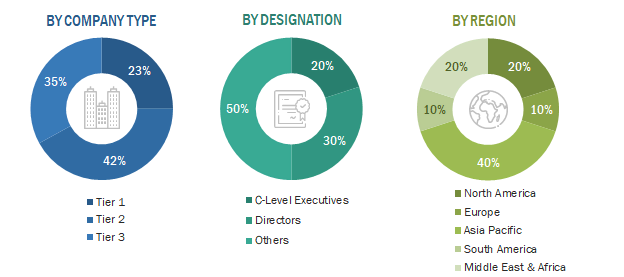
Notes: Other designations include sales, marketing, and product managers.
Tier 1: >USD 1 Billion; Tier 2: USD 500 million–1 Billion; and Tier 3: < USD 500 million.
To know about the assumptions considered for the study, download the pdf brochure
Market Size Estimation
The top-down and bottom-up approaches were used to estimate and validate the size of the global PLA market. These approaches were also used extensively to estimate the size of various dependent market segments. The research methodology used to estimate the market size included the following:
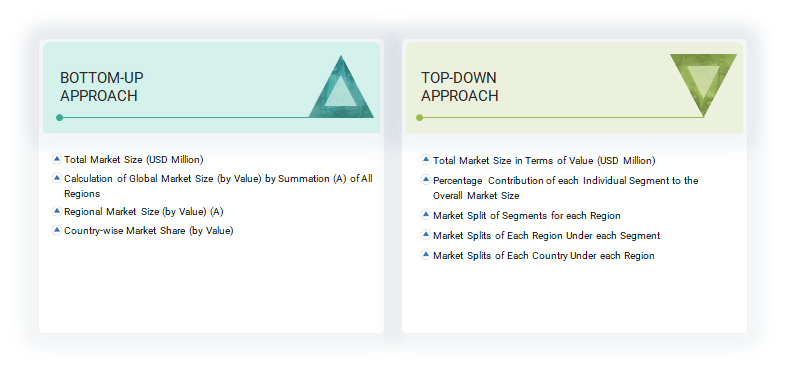
Data Triangulation
After estimating the overall market size using standardized methodologies, the PLA market was divided into various application areas, grades, raw materials, and regional markets. Data triangulation and market breakup techniques were used, when necessary, to complete the market analysis and produce accurate statistics for each segment and subsegment. The triangulation process involved analyzing and confirming data from supply-side factors (such as production capacities, raw material availability, technology adoption) and demand-side trends (including end-use consumption, application growth, regulatory requirements) to ensure consistency and precision in the final market estimates.
Market Definition
PLA is a bio-based and fully biodegradable thermoplastic polyester typically derived from renewable resources that include corn starch, sugarcane, cassava, and sugarbeet. PLA is produced from the fermentation of sugars to lactic acid, followed by polymerization. It is recognized for its clarity, compostability, and being easy to process, and is frequently used in packaging, 3D printing, textiles, medical devices, and in the disposal of products. PLA offers adequate mechanical strength, biocompatibility, and significantly less environmental impact when compared to traditional fossil-fuel-based plastics; however, there are some limitations with PLA, specifically with regard to heat resistance and its rate of degradation in non-industrial composting situations. Overall, PLA can be made using conventional plastic processing methods, such as injection molding, thermoforming, blow molding, and extrusion. Because of increasing demand for more sustainable alternatives, PLA is changing its position in the new world manufacturing sector with the rapid transition to circular and bio-economy-based manufacturing.
Stakeholders
- PLA manufacturers
- Raw material suppliers
- Downstream converters and processors
- Distributors and traders
- Industry associations and regulatory bodies
- End users
Report Objectives
- To define, describe, and forecast the size of the global PLA market based on application, grade, sales channel, and region in terms of value and volume
- To provide detailed information on the significant drivers, restraints, opportunities, and challenges influencing the market
- To strategically analyze micromarkets concerning individual growth trends, prospects, and their contribution to the market
- To assess the growth opportunities in the market for stakeholders and provide details on the competitive landscape for market leaders
- To forecast the market size of segments and subsegments for North America, Europe, Asia Pacific, South America, and the Middle East & Africa
- To strategically profile key players and comprehensively analyze their market shares and core competencies
- To analyze competitive developments such as product launches, acquisitions, expansions, partnerships, and agreements in the PLA market
- To provide the impact of AI/Gen AI on the market
Get the Full Polylactic Acid Market Report
Full forecast, segment splits, and company analysis for all Polylactic Acid Market.
- Rest Of Asia Pacific Polylactic Acid Market
- Rest Of South America Polylactic Acid Market
- China Polylactic Acid Market
- India Polylactic Acid Market
- Japan Polylactic Acid Market
- South Korea Polylactic Acid Market
- Germany Polylactic Acid Market
- UK Polylactic Acid Market
- France Polylactic Acid Market
- Italy Polylactic Acid Market
- Spain Polylactic Acid Market
- Canada Polylactic Acid Market
- US Polylactic Acid Market
- Brazil Polylactic Acid Market
- Saudi Arabia Polylactic Acid Market
- UAE Polylactic Acid Market
- Rest Of Europe Polylactic Acid Market
Need a Tailored Report?
Customize this report to your needs
Get 10% FREE Customization
Customize This Report
