
Rest Of Asia Pacific Polyvinyl Butyral Market (2025-2030)

The Rest Of Asia Pacific Polyvinyl Butyral Market was valued at $89.5 Million in 2025 and projected to reach to $111 Million by 2030, representing a compound annual growth rate of 4.4%. The Rest Of Asia Pacific polyvinyl butyral market is positioned for steady growth through 2030, driven by accelerating automotive production and construction activities across emerging economies.


| Market Size in | USD 26.32 MN |
| Market Forecast in | |
| CAGR | |
| Forecast Period | |
| Units Considered | Value (USD MN) |
Rest Of Asia Pacific Polyvinyl Butyral Market Trends and Insights
- Rest Of Asia Pacific represents a significant emerging market for polyvinyl butyral applications, driven by expanding automotive, construction, and packaging sectors across the region.
- The growth trajectory in Rest Of Asia Pacific reflects increasing industrialization and rising demand for safety glass laminates in developing economies. Rest Of Asia Pacific's polyvinyl butyral market is characterized by growing adoption in automotive windshields and architectural glazing applications.
- The region's market expansion is supported by infrastructure development initiatives and rising consumer awareness regarding safety standards.
- Rest Of Asia Pacific manufacturers are increasingly investing in production capacity to meet the forecasted demand surge through 2030, positioning the region as a key growth contributor within the broader Asia Pacific polyvinyl butyral landscape..
Key Market Statistics
- CAGR (2025-2030) 4.4% CAGR
- Market Size, 2025 ~USD 89.5 Million
- Forecast, 2030 ~USD 111 Million
- Country Rest Of Asia Pacific
Rest Of Asia Pacific Polyvinyl Butyral Market Overview
Market Size & Growth :
Rest Of Asia Pacific polyvinyl butyral market valued at USD 89.5 million in 2025, projected to reach USD 111.0 million by 2030 with a steady 4.4% CAGR, reflecting robust regional demand.
Automotive Sector Expansion :
Growing automotive manufacturing across emerging economies in Rest Of Asia Pacific drives polyvinyl butyral demand for safety glass applications, windshields, and laminated glass components.
Construction & Infrastructure Growth :
Rapid urbanization and infrastructure development in Rest Of Asia Pacific countries boost demand for polyvinyl butyral in building safety glass, architectural applications, and protective glazing solutions.
Packaging & Industrial Applications :
Expanding packaging and industrial sectors in Rest Of Asia Pacific leverage polyvinyl butyral for adhesive films, protective coatings, and specialty applications, supporting market diversification.
Rest Of Asia Pacific Polyvinyl Butyral Market Dynamics
- Rising safety regulations and consumer awareness regarding laminated glass applications in vehicles and buildings create sustained demand.
- The region's lower CAGR of 4.4% compared to the global 5% reflects a maturing but still-expanding market with significant untapped potential in secondary cities and rural infrastructure projects. Key growth catalysts include increasing foreign direct investment in automotive manufacturing, government infrastructure initiatives, and rising disposable incomes supporting construction spending.
- However, competition from alternative materials and price sensitivity in cost-conscious markets may moderate growth rates.
- Strategic partnerships with local distributors and manufacturers will be critical for capturing market share in this diverse and fragmented regional landscape..
Market Ecosystem
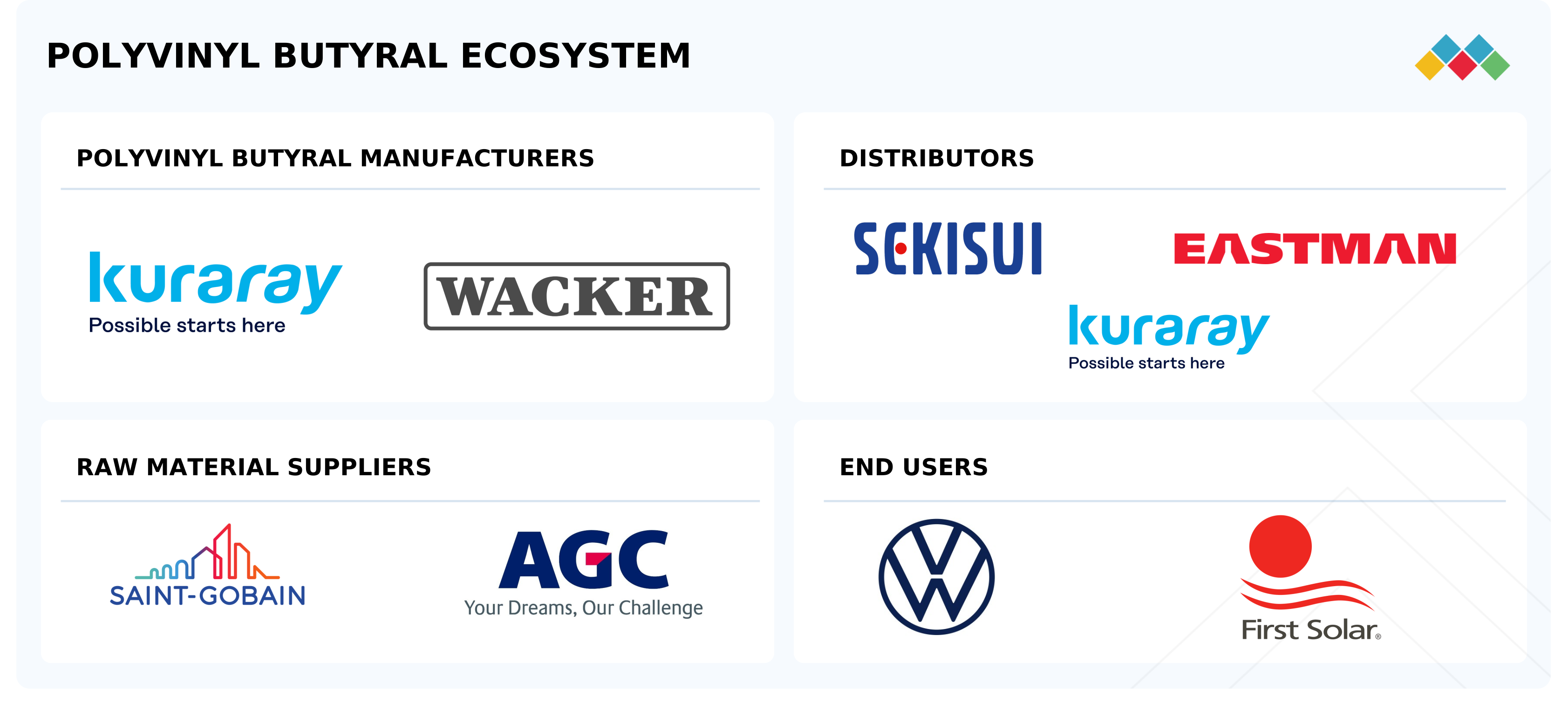
Polyvinyl Butyral Market: COMMERCIAL USE CASES ACROSS INDUSTRIES
| COMPANY | USE CASE DESCRIPTION | BENEFITS |
|---|---|---|
 |
PVB interlayers in laminated automotive windshields and panoramic roofs | Enhanced passenger safety, noise reduction, UV protection, compliance with automotive safety standards |
 |
PVB films in architectural glazing for commercial & residential buildings | Improved acoustic insulation, energy efficiency, shatter resistance, and support for green building certification |
 |
Development of high-clarity and acoustic PVB resins for laminated glass | Superior optical quality, premium design appeal, better noise control, higher value-added product offering |
 |
Solar encapsulation and advanced glazing applications using modified PVB | Improved durability, UV stability, contribution to renewable energy adoption, long-term performance |
Logos and trademarks shown above are the property of their respective owners. Their use here is for informational and illustrative purposes only.
Related Ecosystem
Resins And Polymers
- Polycarbonate
- Acrylonitrile Butadiene Styrene (ABS)
- Epoxy Resin
- Light Commercial Vehicles (LCVs)
- Polypropylene (PP)
- Basf se
- DOW CHEMICAL COMPANY
- Solvay sa
- Saudi arabia basic industries corporation (sabic)
- DuPont de Nemours, Inc.
Key Takeaways
- Rest Of Asia Pacific polyvinyl butyral market valued at USD 89.5 million in 2025, growing to USD 111.0 million by 2030
- Rest Of Asia Pacific exhibits a 4.4% CAGR, driven by automotive and construction sector expansion
- Rest Of Asia Pacific demand is fueled by increasing safety glass laminate adoption and infrastructure development
- Rest Of Asia Pacific manufacturers are scaling production capacity to capitalize on emerging market opportunities through 2030
Polyvinyl Butyral Market Report Scope
| Report Metric | Details |
|---|---|
| Base Year | 2025 |
| Fastest Growing Segment | HIGHER MOLECULAR WEIGHT PVB RESIN (Resin Type) |
| Forecast Period | 2025-2030 |
| Growth Rate | CAGR of 5% from 2025 to 2030 |
| Largest Segment | POWDER & GRANULES (Product Type) |
| Market Size Base Year (Billions) | ~USD 1.49 (2025) |
| Revenue Forecast (Billions) | ~USD 1.9 (2030) |
| Segments Covered | Application, End-Use Industry, Product Type, Resin Type, Thickness |
Rest Of Asia Pacific Polyvinyl Butyral Market Report Segmentation
5 segment dimensions are covered across the global market.
By Application
- Adhesives
- Films & Sheets
- Other Applications
- Paints & Coatings
By End-Use Industry
- Automotive
- Construction
- Electrical & Electronics
- Other End-Use Industries
- Others End-Use Industries
By Product Type
- Other Product Types
- Powder & Granules
By Resin Type
- Higher Molecular Weight Pvb Resin
- Lower Molecular Weight Pvb Resin
- Medium Molecular Weight Pvb Resin
- Modified Pvb Resin
By Thickness
- Mid-Range Films
- Standard Films
- Thick & Composite Interlayers
- Ultra-Thin Films
Target Audience
- Automotive Manufacturers & Suppliers : Need Rest Of Asia Pacific market data to assess laminated glass and safety component demand, plan production capacity expansion, and identify partnership opportunities with regional OEMs.
- Construction & Building Material Companies : Require regional market insights to evaluate architectural glass applications, building safety regulations, and growth potential in Rest Of Asia Pacific's rapidly expanding construction sector.
- Polyvinyl Butyral Producers & Distributors : Need Rest Of Asia Pacific-specific market analysis to optimize supply chain positioning, identify high-growth sub-regions, and develop localized sales and distribution strategies.
- Investment & Private Equity Firms : Seek detailed Rest Of Asia Pacific market forecasts and growth drivers to evaluate acquisition targets, assess investment returns, and identify emerging opportunities in polyvinyl butyral sector.
- Packaging & Industrial Material Buyers : Require Rest Of Asia Pacific demand forecasts and application trends to secure reliable polyvinyl butyral supply, negotiate contracts, and plan inventory management for regional operations.
Reasons to Buy this Report
- Regional Market Sizing & Forecasts : Obtain precise market valuation for Rest Of Asia Pacific (USD 89.5M in 2025) with detailed 5-year projections to 2030, enabling accurate budget allocation and investment planning specific to this emerging region.
- Sector-Specific Growth Drivers : Understand automotive, construction, and packaging sector dynamics unique to Rest Of Asia Pacific, identifying which sub-segments offer highest growth potential and fastest ROI opportunities.
- Competitive Landscape Intelligence : Gain insights into regional competitor positioning, market share distribution, and strategic opportunities within Rest Of Asia Pacific's fragmented polyvinyl butyral supply chain.
- Localized Market Entry Strategy : Develop targeted go-to-market strategies for Rest Of Asia Pacific with country-specific insights, regulatory considerations, and distribution channel recommendations for successful market penetration.
- Risk Assessment & Mitigation : Identify region-specific risks including price sensitivity, alternative material competition, and supply chain vulnerabilities, with actionable mitigation strategies for Rest Of Asia Pacific operations.
Frequently asked questions
What is the current market size of polyvinyl butyral in Rest Of Asia Pacific?
Rest Of Asia Pacific polyvinyl butyral market is estimated at USD 89.5 million in 2025.
What is the projected market size for Rest Of Asia Pacific polyvinyl butyral by 2030?
Rest Of Asia Pacific polyvinyl butyral market is forecasted to reach USD 111.0 million by 2030.
What is the CAGR for Rest Of Asia Pacific polyvinyl butyral market?
Rest Of Asia Pacific polyvinyl butyral market is expected to grow at a CAGR of 4.4% from 2025 to 2030.
Which applications drive demand in Rest Of Asia Pacific polyvinyl butyral market?
Rest Of Asia Pacific polyvinyl butyral demand is primarily driven by automotive windshields, architectural glazing, and safety glass laminate applications.
What factors support growth in Rest Of Asia Pacific polyvinyl butyral market?
Rest Of Asia Pacific market growth is supported by industrialization, infrastructure development, rising safety standards, and expanding automotive and construction sectors.
RESEARCH METHODOLOGY
The study involved four key activities in estimating the market size of polyvinyl butyral. Extensive secondary research was conducted to gather information on the market, related markets, and the broader industry. The next step was to validate these findings, assumptions, and size estimates with industry experts across the value chain through primary research. Both top-down and bottom-up approaches were used to determine the total market size. Afterward, market segmentation and data triangulation techniques were applied to estimate the sizes of segments and subsegments.
Secondary Research
In the secondary research process, various secondary sources were used to identify and collect information for this study. These sources include annual reports, press releases, investor presentations of companies, white papers, certified publications, trade directories, articles from recognized authors, gold standard and silver standard websites, and databases.
Secondary research was used to gather essential information about the industry’s value chain, the market’s monetary flow, the overall pool of key polyvinyl butyral market classifications, and segmentation based on industry trends down to the most detailed level, and regional markets. It was also employed to collect information on key developments from a market-oriented perspective.
Primary Research
The polyvinyl butyral market consists of several stakeholders in the value chain, including raw material suppliers, manufacturers, and end users. Various primary sources from both supply and demand sides of the polyvinyl butyral market have been interviewed to gather qualitative and quantitative information. Key opinion leaders in end-use sectors are the primary interviewees from the demand side. Manufacturers, associations, and institutions involved in the polyvinyl butyral industry are the main sources from the supply side.
Primary interviews were conducted to gather insights such as market statistics, revenue data from products and services, market breakdowns, market size estimates, market forecasts, and data triangulation. Primary research also helped us understand various trends related to resin type, thickness, product type, end-use industry, application, and region. Stakeholders from the demand side, such as CIOs, CTOs, and CSOs, were interviewed to understand the buyers’ perspectives on the suppliers, products, component providers, and their current use of the polyvinyl butyral market, as well as the future outlook of their business, which will influence the overall market.
The breakdown of profiles of the primary interviewees is illustrated in the figure below:
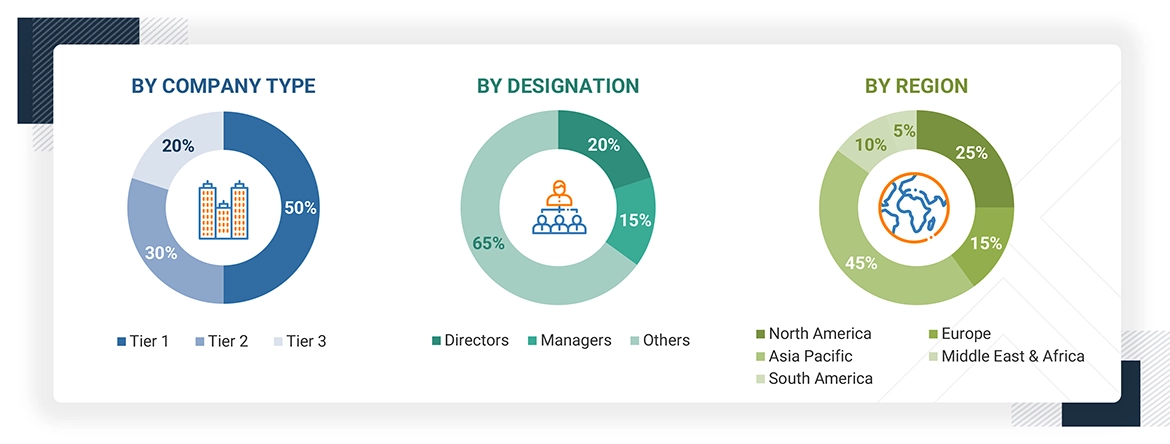
Note: Tier 1, Tier 2, and Tier 3 companies are classified based on their market revenue in 2024 available in the public domain, product portfolios, and geographic presence.
Other designations include sales representatives, production heads, and technicians.
To know about the assumptions considered for the study, download the pdf brochure
Market Size Estimation
The top-down approach was used to estimate and validate the size of various submarkets for the polyvinyl butyral market in the region. The research methodology used to estimate the market size included the following steps:
- The key players in the industry have been identified through extensive secondary research.
- The supply chain of the industry has been determined through primary and secondary research.
- All percentage shares, splits, and breakdowns based on type, electrode material, application and end-use industries, region were determined using secondary sources and verified through primary sources.
- All possible parameters that impact the markets covered in this research study were accounted for, viewed in extensive detail, verified through primary research, and analyzed to get the final quantitative and qualitative data. This data was consolidated and added with detailed inputs and analysis, and presented in this report.
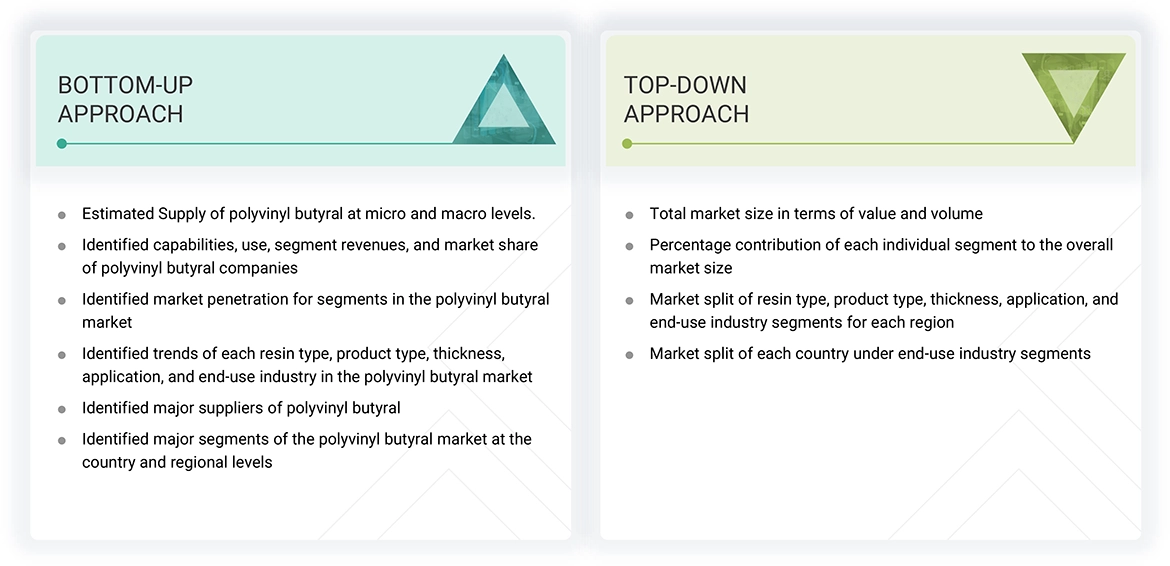
Data Triangulation
After determining the total market size from the estimation process for the polyvinyl butyral market above, the overall market has been divided into several segments and sub-segments. Data triangulation and market breakdown methods have been used, where applicable, to complete the overall market analysis and obtain accurate statistics for all segments and sub-segments. The data was triangulated by examining various factors and trends from both demand and supply sides. Additionally, the market size was confirmed using both top-down and bottom-up approaches, along with primary interviews. For each data segment, three sources were used—top-down approach, bottom-up approach, and expert interviews. The data was considered accurate when the values from these three sources matched.
Market Definition
Polyvinyl butyral (PVB) is a resin formed through the chemical reaction of polyvinyl alcohol (PVA) with butyraldehyde under acidic conditions, resulting in a polymer rich in acetal linkages. This reaction produces a material that exhibits excellent transparency, flexibility, strong adhesion to glass and metal surfaces, and notable impact resistance. PVB is primarily used in the production of laminated safety glass, where it functions as an interlayer between two sheets of glass to hold them together upon impact. This not only enhances the safety of the glass by preventing shattering but also improves its acoustic insulation and UV resistance properties. The global PVB market includes various product types such as films & sheets, powders & granules, and aqueous dispersions, catering to various industries. Key application sectors include automotive (windshields, side, and rear windows), construction (architectural glazing and glass facades), solar energy (photovoltaic panels), and paints & coatings. With growing emphasis on energy-efficient buildings and rising vehicle safety standards, the demand for laminated glass and, thus, PVB is increasing worldwide. Moreover, advancements in solar technology and the integration of PVB in flexible solar panels are opening new avenues for growth. Innovation, regional capacity expansions, and evolving safety and sustainability regulations drive the market.
Stakeholders
- Polyvinyl butyral manufacturers
- Polyvinyl butyral traders, distributors, and suppliers
- Raw material suppliers
- Government and private research organizations
- Associations and industrial bodies
- R&D institutions
- Environmental support agencies
Report Objectives
- To define, describe, and forecast the size of the polyvinyl butyral market, in terms of value and volume
- To provide detailed information regarding the major factors (drivers, opportunities, restraints, and challenges) influencing the growth of the market
- To estimate and forecast the market size based on resin type, product type, thickness, application, end-use industry, and region
- To forecast the size of the market with respect to major regions, namely, North America, Asia Pacific, Europe, the Middle East & Africa, and South America, along with their key countries
- To strategically analyze micromarkets with respect to individual growth trends, prospects, and their contribution to the overall market
- To analyze opportunities in the market for stakeholders and provide a competitive landscape of market leaders
- To track and analyze recent developments such as partnerships, agreements, joint ventures, collaborations, announcements, awards, and expansions in the market
- To strategically profile key market players and comprehensively analyze their core competencies
Get the Full Polyvinyl Butyral Market Report
Full forecast, segment splits, and company analysis for all Polyvinyl Butyral Market.
- China Polyvinyl Butyral Market
- Japan Polyvinyl Butyral Market
- India Polyvinyl Butyral Market
- South Korea Polyvinyl Butyral Market
- Canada Polyvinyl Butyral Market
- Mexico Polyvinyl Butyral Market
- US Polyvinyl Butyral Market
- Germany Polyvinyl Butyral Market
- Italy Polyvinyl Butyral Market
- France Polyvinyl Butyral Market
- UK Polyvinyl Butyral Market
- Spain Polyvinyl Butyral Market
- South Africa Polyvinyl Butyral Market
- Brazil Polyvinyl Butyral Market
- Argentina Polyvinyl Butyral Market
- Rest Of Europe Polyvinyl Butyral Market
- GCC Countries Polyvinyl Butyral Market
- -Rest Of GCC Polyvinyl Butyral Market
- Rest Of South America Polyvinyl Butyral Market
Need a Tailored Report?
Customize this report to your needs
Get 10% FREE Customization
Customize This Report
