
Canada Power Tools Market (2024-2029)

The Canada Power Tools Market was valued at $3044 Million in 2024 and projected to reach to $3537.1 Million by 2029, representing a compound annual growth rate of 3.0%. Canada's power tools market is positioned for steady growth through 2029, supported by sustained construction activity, infrastructure modernization, and the ongoing transition to cordless technologies.


| Market Size in | USD 26.32 MN |
| Market Forecast in | |
| CAGR | |
| Forecast Period | |
| Units Considered | Value (USD MN) |
Canada Power Tools Market Trends and Insights
- This steady expansion reflects Canada's robust construction and manufacturing sectors, alongside increasing adoption of cordless and battery-powered tools among both professional and DIY consumers.
- Canada's market growth is supported by infrastructure investments, residential renovation activity, and the rising demand for ergonomic and technologically advanced power tools. The Canadian power tools market benefits from strong consumer spending on home improvement projects and commercial construction activity across provinces.
- Canada's emphasis on sustainable building practices and energy-efficient tools is driving innovation in the sector.
- Between 2024 and 2029, Canada is expected to see increased penetration of smart power tools and IoT-enabled devices, particularly in urban centers.
- The market's 3.0% CAGR positions Canada as a stable and growing segment within the North American power tools landscape..
Key Market Statistics
- CAGR (2024-2029) 3.0% CAGR
- Market Size, 2024 ~USD 3044 Million
- Forecast, 2029 ~USD 3537.1 Million
- Country Canada
Canada Power Tools Market Overview
Market Size & Growth :
Canada's power tools market is valued at $3,044.0 million in 2024 and is projected to reach $3,537.1 million by 2029, with a steady CAGR of 3.0%, outpacing the global growth rate of 2.9%.
Construction & Manufacturing Drivers :
Canada's robust construction and manufacturing sectors are primary growth catalysts, with increased infrastructure investments and residential building projects fueling demand for professional-grade power tools across provinces.
Cordless & Battery-Powered Adoption :
Both professional contractors and DIY consumers in Canada are increasingly shifting toward cordless and battery-powered tools, driven by convenience, portability, and advancements in lithium-ion battery technology.
Regional Market Dynamics :
Ontario and British Columbia lead market consumption due to active construction sectors, while growing e-commerce penetration and retail expansion are making power tools more accessible across rural and urban Canadian markets.
Canada Power Tools Market Dynamics
- The market benefits from a skilled workforce, strong DIY culture, and increasing adoption among homeowners undertaking renovation projects.
- Professional segments remain robust as contractors invest in updated equipment to improve productivity and safety standards. Looking ahead, market expansion will be driven by technological innovations, including smart tools with IoT connectivity, improved battery efficiency, and ergonomic designs.
- Supply chain stabilization post-pandemic and competitive pricing from both established and emerging manufacturers will enhance market accessibility.
- Environmental regulations favoring electric over gas-powered tools will further accelerate the shift toward sustainable power tool solutions across Canada..
Market Ecosystem
Related Ecosystem
Electrical System And Components
- Natural Language Processing (NLP)
- Sensors
- Machine Learning
- Temperature Sensors
- Actuators
- ABB India Limited
- Siemens ag
- SCHNEIDER ELECTRIC SE
- Eaton Corporation plc
- Lenovo
Automotive Materials
- Light Commercial Vehicles (LCVs)
- Battery Electric Vehicle (BEV)
- Hybrid Electric Vehicle (HEV)
- Fuel Cell Electric Vehicle (FCEV)
- Agricultural Tractors
- AISIN CORPORATION
- GORKOVSKY AVTOMOBILNY ZAVOD
- Continental ag
- Basf se
- BOSCH LIMITED
Industrial Automation
- Sensors
- Image Sensors
- Manufacturing Execution System (MES)
- Actuators
- Flow Sensors
- Siemens ag
- ABB India Limited
- Emerson Electric Co.
- HONEYWELL INTERNATIONAL INC.
- SCHNEIDER ELECTRIC SE
Key Takeaways
- Canada's power tools market is valued at $3,044.0 million in 2024 and will reach $3,537.1 million by 2029.
- Canada experiences a steady 3.0% CAGR, driven by construction activity and residential renovation demand.
- Canada's market is increasingly focused on cordless, battery-powered, and smart-enabled power tools.
- Canada's emphasis on sustainability and energy efficiency is shaping product innovation and consumer preferences.
Power Tools Market Report Scope
| Report Metric | Details |
|---|---|
| Base Year | 2024 |
| Fastest Growing Segment | RESIDENTIAL/DIY (Application) |
| Forecast Period | 2024-2029 |
| Growth Rate | CAGR of 2.9% from 2024 to 2029 |
| Largest Segment | INDUSTRIAL/PROFESSIONAL (Application) |
| Market Size Base Year (Billions) | ~USD 39.44 (2024) |
| Revenue Forecast (Billions) | ~USD 45.5 (2029) |
| Segments Covered | Tool Type, Mode Of Operation, Application, Industrial/Professional Application, Type, Industrial/Professional, Equipment Type |
Canada Power Tools Market Report Segmentation
7 segment dimensions are covered across the global market.
By Tool Type
- Demolition Tools
- Drilling And Fastening Tools
- Material Removal Tools
- Other Tools
- Routing Tools
- Sawing & Cutting Tools
- Sawing And Cutting Tools
By Mode Of Operation
- Electric
- Hydraulic
- Pneumatic
By Application
- Commercial
- Industrial/Professional
- Residential/Diy
By Industrial/Professional Application
- Aerospace
- Automotive
- Construction
- Energy
- Other Industries
- Shipbuilding
By Type
- Aerospace
- Automotive
- Construction
- Corded
- Cordless
- Energy
- Other Industries
- Shipbuilding
By Industrial/Professional
- Aerospace
- Automotive
- Construction
- Energy
- Other Industries
- Shipbuilding
By Equipment Type
- Blowers
- Lawn Mowers
- Saws
- Snow Throwers
- Tillers & Cultivators
- Trimmers & Edgers
Target Audience
- Power Tool Manufacturers : Manufacturers need Canada-specific market data to optimize product development, pricing strategies, and distribution networks while identifying growth opportunities in cordless and smart tool segments.
- Distributors & Retailers : Canadian distributors and retailers require market forecasts and segment analysis to make informed inventory decisions, negotiate supplier terms, and align product offerings with regional demand trends.
- Construction & Contracting Companies : Contractors and construction firms use market insights to evaluate equipment investment ROI, identify emerging tool technologies, and benchmark operational costs against industry standards in Canada.
- Investment & Private Equity Firms : Investors seeking Canadian market opportunities need detailed growth projections, competitive landscape analysis, and sector dynamics to evaluate acquisition targets and portfolio company performance.
- Market Consultants & Analysts : Business consultants and research analysts require Canada-specific market data to support client advisory services, competitive intelligence reports, and strategic planning recommendations.
Reasons to Buy this Report
- Accurate Market Sizing : Obtain precise valuation data for Canada's power tools market with verified 2024 baseline ($3,044M) and 2029 forecasts ($3,537.1M), enabling confident investment and expansion planning decisions.
- Regional Growth Intelligence : Understand Canada-specific growth drivers including construction sector dynamics, provincial market variations, and consumer preference shifts toward cordless technologies to identify high-opportunity segments.
- Competitive Positioning : Benchmark your product portfolio and pricing strategies against the Canadian market's 3% CAGR, outperforming global growth, to capture market share in this expanding economy.
- Sector-Specific Insights : Access detailed analysis of professional contractor demand, DIY consumer trends, and manufacturing sector requirements specific to Canada's unique market landscape and regulatory environment.
- Strategic Market Entry : Leverage comprehensive Canada market data to develop targeted go-to-market strategies, distribution partnerships, and product localization plans for successful market penetration and revenue growth.
Frequently asked questions
What is the current size of Canada's power tools market?
Canada's power tools market is estimated at $3,044.0 million in 2024.
What is the projected market size for Canada by 2029?
Canada's power tools market is projected to reach $3,537.1 million by 2029.
What is the CAGR for Canada's power tools market?
Canada's power tools market is expected to grow at a CAGR of 3.0% from 2024 to 2029.
What factors are driving growth in Canada's power tools market?
Growth in Canada is driven by infrastructure investments, residential renovation activity, increased adoption of cordless tools, and demand for smart, energy-efficient power tools.
Which product types are gaining traction in Canada's power tools market?
Cordless and battery-powered tools, smart power tools with IoT capabilities, and ergonomic designs are gaining significant traction in Canada.
RESEARCH METHODOLOGY
The study involved four major activities in estimating the current size of the power tool market. Exhaustive secondary research was conducted to collect information on the market, peer market, and parent market. The next step was to validate these findings, assumptions, and sizing with industry experts across the value chain through primary research. Finally, both top-down and bottom-up approaches were employed to estimate the complete market size. After that, market breakdown and data triangulation methods were used to estimate the market size of segments and subsegments.
Secondary Research
In the secondary research process, various secondary sources were referred to identify and collect information relevant to this study. The secondary sources include annual reports, press releases, and investor presentations of companies; white papers, certified publications, and articles from recognized authors; directories; and databases. Secondary research was conducted mainly to obtain key information about the industry’s supply chain, value chain of the market, the total pool of key players, market classification and segmentation according to industry trends, geographic markets, and key developments from both market- and technology-oriented perspectives.
Primary Research
In the primary research process, various primary sources from both supply and demand sides were interviewed to obtain the qualitative and quantitative information relevant to this report. Primary sources from the supply side include experts such as CEOs, VPs, marketing directors, technology and innovation directors, application developers, application users, and related executives from various key companies and organizations operating in the power tools ecosystem. Following is the breakdown of primary respondents:
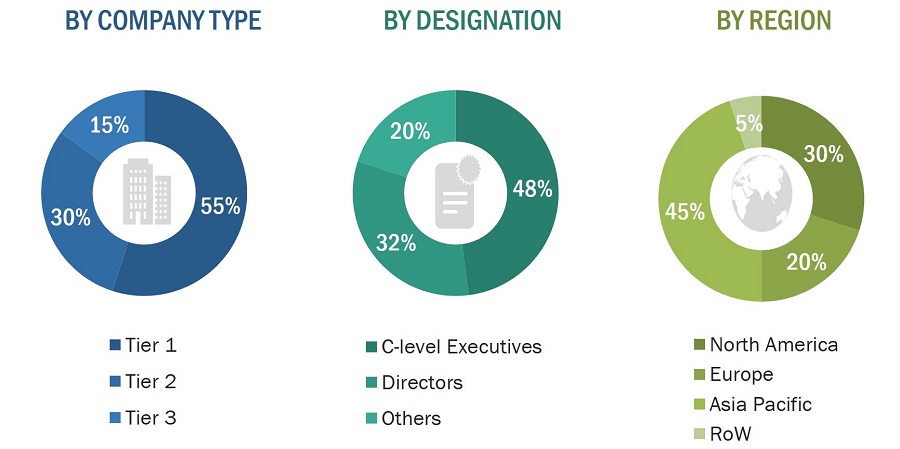
To know about the assumptions considered for the study, download the pdf brochure
Market Size Estimation
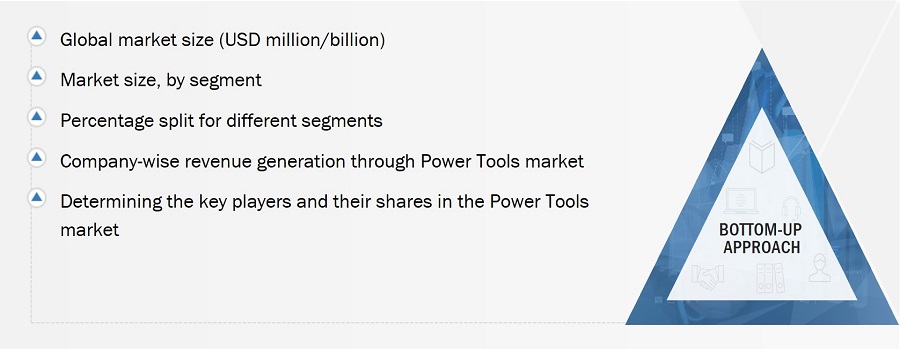
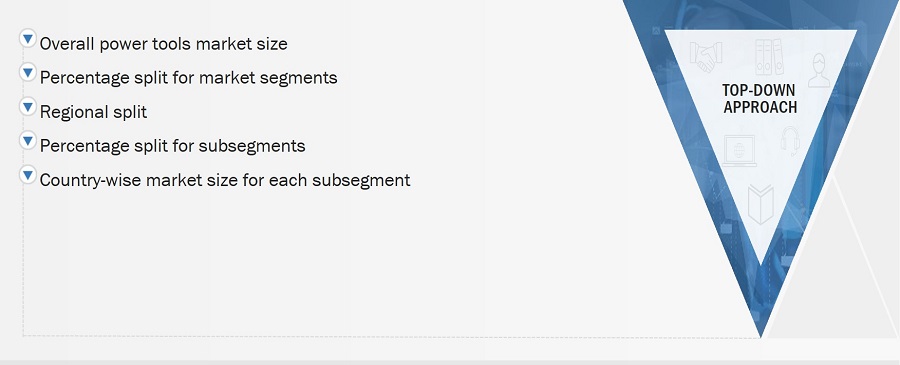
Both the top-down and bottom-up approaches were used to estimate and validate the size of the overall power tool market and the market based on segments. The research methodology used to estimate the market size was given below:
- Major players operating in the power tools market were identified and considered for the report through extensive secondary research.
- The supply chain and market size of the power tool market, both in terms of value and units, were estimated/determined through secondary and primary research processes.
- All estimations and calculations, including percentage share, revenue mix, splits, and breakdowns, were determined through the use of secondary sources, which were further verified through primary sources.
Global Power Tools market Size: Bottom-Up Approach
Global Power Tools Market Size: Top-Down Approach
Market Definition
Power tools are mechanical devices that rely on an external power source, such as electricity, compressed air, or hydraulic pressure, for operation. They are designed to carry out a wide array of tasks, including cutting, drilling, grinding, fastening, and shaping materials. These tools find extensive use across industries and in households, offering increased efficiency and productivity compared to manual alternatives.
Key Stakeholders
- End Users
- Government Bodies, Venture Capitalists, and Private Equity Firms
- Power Tool Manufacturers
- Power Tool Distributors
- Power Tool Industry Associations
- Professional Service/Solution Providers
- Research Institutions and Organizations
- Standards Organizations and Regulatory Authorities Related to the Power Tools Market
- System Integrators
- Technology Consultants
Data Triangulation
After arriving at the overall market size from the market size estimation process explained above, the total market was split into several segments and subsegments. To complete the overall market engineering process and arrive at the exact statistics for all segments and subsegments, data triangulation and market breakdown procedures were employed, wherever applicable. The data was triangulated by studying various factors and trends from both the demand and supply sides. Along with this, the market was validated using both top-down and bottom-up approaches.
Report Objectives:
- To describe and forecast the power tools market, in terms of value, based on tool type, mode of operation, and application
- To forecast the market size, in terms of value, for four main regions—North America, Europe, Asia Pacific, and the Rest of World (RoW)
- To provide detailed information regarding drivers, restraints, opportunities, and challenges influencing the market growth
- To provide a detailed overview of the value chain of the Power Tools ecosystem
- To strategically analyze micro markets with respect to individual growth trends, prospects, and contributions to the total market
- To analyze the opportunities in the market for stakeholders and details of the competitive landscape of the market
- To strategically profile the key players and comprehensively analyze their market position in terms of ranking and core competencies
- To analyze the major growth strategies implemented by key market players, such as contracts, agreements, acquisitions, product launches, expansions, and partnerships
Available Customizations
Based on the given market data, MarketsandMarkets offers customizations in the reports according to the client’s specific requirements. The available customization options are as follows:
Product Analysis
- Product matrix that gives a detailed comparison of the product portfolio of each company
Company Information
- Detailed analysis and profiling of 25 key players
Get the Full Power Tools Market Report
Full forecast, segment splits, and company analysis for all Power Tools Market.
- US Power Tools Market
- Mexico Power Tools Market
- Germany Power Tools Market
- UK Power Tools Market
- France Power Tools Market
- Italy Power Tools Market
- Rest Of Europe Power Tools Market
- China Power Tools Market
- Japan Power Tools Market
- India Power Tools Market
- South Korea Power Tools Market
- Rest Of Asia Pacific Power Tools Market
Need a Tailored Report?
Customize this report to your needs
Get 10% FREE Customization
Customize This Report
