
Japan Precision Farming Market (2025-2030)

The Japan Precision Farming Market was valued at $304.9 Million in 2025 and projected to reach to $492.1 Million by 2030, representing a compound annual growth rate of 7.1%. Japan's precision farming market is poised for sustained growth as the nation addresses critical agricultural challenges through technological innovation.


| Market Size in | USD 26.32 MN |
| Market Forecast in | |
| CAGR | |
| Forecast Period | |
| Units Considered | Value (USD MN) |
Japan Precision Farming Market Trends and Insights
- Japan is leveraging advanced semiconductor and electronics technologies to modernize agricultural practices, driven by labor shortages and the need for sustainable farming solutions.
- The country's strong electronics manufacturing base positions Japan as a key innovator in precision farming hardware and IoT-enabled agricultural systems. The Japanese precision farming sector benefits from government support for agricultural digitalization and the adoption of smart farming technologies across the nation's farming communities.
- Japan's aging rural population and declining farmland have accelerated investment in automation and data-driven farming techniques.
- Between 2025 and 2030, Japan is expected to see increased deployment of sensors, drones, and AI-powered analytics platforms tailored to the country's unique agricultural landscape and regulatory environment..
Key Market Statistics
- CAGR (2025-2030) 7.1% CAGR
- Market Size, 2025 ~USD 304.9 Million
- Forecast, 2030 ~USD 492.1 Million
- Country Japan
Japan Precision Farming Market Overview
Market Size & Growth :
Japan's precision farming market is valued at USD 304.9 million in 2025, with a projected CAGR of 7.1% through 2030, reaching USD 492.1 million. This steady growth reflects Japan's commitment to agricultural modernization despite slower expansion compared to the global 9.5% CAGR.
Labor Shortage Solutions :
Japan's aging agricultural workforce and declining rural population are driving adoption of precision farming technologies. Automated systems and IoT-enabled monitoring solutions are becoming essential to maintain productivity and reduce dependency on manual labor in farming operations.
Electronics Manufacturing Advantage :
Japan's world-class semiconductor and electronics manufacturing base provides a competitive edge in developing and deploying precision farming solutions. Local expertise in robotics, sensors, and automation technologies accelerates innovation in agricultural technology integration.
Sustainability & Resource Efficiency :
Japanese farmers are increasingly adopting precision farming to optimize water usage, reduce chemical inputs, and improve crop yields. Government initiatives promoting sustainable agriculture align with precision farming technologies that minimize environmental impact while enhancing food security.
Japan Precision Farming Market Dynamics
- The convergence of labor shortages, aging farmer demographics, and strong domestic electronics capabilities creates a favorable environment for precision farming adoption.
- Government support for agricultural modernization and investments in smart farming infrastructure will further accelerate market expansion. The forecast period through 2030 will see increased integration of AI, IoT sensors, and autonomous systems in Japanese farming operations.
- Regional players leveraging Japan's semiconductor expertise will drive product innovation, while partnerships between technology companies and agricultural cooperatives will expand market penetration.
- Sustainability mandates and premium pricing for high-quality produce will incentivize farmers to adopt precision farming solutions..
Market Ecosystem

PRECISION FARMING MARKET SIZE, SHARE & TRENDS: COMMERCIAL USE CASES ACROSS INDUSTRIES
| COMPANY | USE CASE DESCRIPTION | BENEFITS |
|---|---|---|
 |
Integration of GPS-guided autonomous tractors and real-time data analytics through the John Deere Operations Center platform | Enhances planting accuracy, optimizes input use, reduces labor dependency, and increases overall yield efficiency |
 |
Deployment of precision farming and variable rate application technologies via Fendt and Massey Ferguson machinery | Reduces seed and fertilizer wastage, improves field uniformity, and boosts crop productivity |
 |
Use of AFS (Advanced Farming Systems) for automated steering, yield mapping, and field data integration across Case IH and New Holland brands | Improves resource utilization, minimizes overlaps, reduces fuel consumption, and enhances farm profitability |
 |
Implementation of smart tractors and remote farm monitoring systems integrated with IoT sensors and GNSS-based guidance | Increases operational precision, lowers input costs, and supports sustainable farming practices |
 |
Development of GNSS-based precision guidance systems, crop health monitoring, and machine control solutions | Provides centimeter-level accuracy, enhances operational efficiency, and ensures data-driven decision-making in farm management |
Logos and trademarks shown above are the property of their respective owners. Their use here is for informational and illustrative purposes only.
Related Ecosystem
Agricultural Biologicals
- Bionematicides
- Auxins
- Cytokinins
- Ethylene
- Humic Substances
- NICHINO INDIA PVT LTD.
- Corteva, Inc.
- Basf se
- AZELIS HOLDINGS SA
- BAYER AG
Precision Agriculture
- Sensors
- Global Positioning System (GPS)
- Camera Systems
- Data Services
- Platform as A Service (PaaS)
- MITSUBISHI AGRICULTURAL MACHINERY
- MSK FARM MACHINERY CORPORATION
- MITSUBISHI CHEMICAL AGRI DREAM
- Trimble Inc.
- Deere & Company
Digitalization And Iot
- Sensors
- Remote Monitoring
- Supply Chain Management
- Passenger Information System (PIS)
- Platform as A Service (PaaS)
- International Business Machines Corporation
- Cisco Systems, Inc.
- MICROSOFT CORPORATION
- Oracle Corporation
- HUAWEI TECHNOLOGIES CO LTD
Key Takeaways
- Japan's precision farming market will grow from USD 304.9M (2025) to USD 492.1M (2030) at a 7.1% CAGR.
- Japan's aging agricultural workforce and labor scarcity are primary drivers for precision farming adoption.
- Japan's electronics manufacturing expertise enables competitive development of precision farming hardware and IoT solutions.
- Government digitalization initiatives in Japan are accelerating smart farming technology deployment through 2030.
Precision Farming Market Report Scope
| Report Metric | Details |
|---|---|
| Base Year | 2025 |
| Fastest Growing Segment | SOFTWARE (Offering) |
| Forecast Period | 2025–2030 |
| Growth Rate | CAGR of 9.5% from 2025 to 2030 |
| Largest Segment | HARDWARE (Offering) |
| Market Size Base Year (Billions) | ~USD 11.36 (2025) |
| Revenue Forecast (Billions) | ~USD 17.89 (2030) |
| Segments Covered | Offering, Hardware, Technology, Device Type, Volume, Sensor Type |
Japan Precision Farming Market Report Segmentation
6 segment dimensions are covered across the global market.
By Offering
- Hardware
- Services
- Software
By Hardware
- Automation & Control Systems
- Sensing & Monitoring Devices
By Technology
- Guidance Technology
- Remote Sensing Technology
- Variable Rate Technology
By Device Type
- Climate Sensors
- Displays
- Drones/Uavs
- Flow & Application Control Devices
- Gps/Gnss Devices
- Guidance & Steering Systems
- Handheld Mobile Devices/Handheld Computers
- Irrigation Controllers
- Soil Sensors
- Water Sensors
- Yield Monitors
By Volume
- Market Size In Terms Of Volume (Thousand Units)
By Sensor Type
- Moisture Sensors
- Nutrient Sensors
- Temperature Sensors
JAPAN: PRECISION FARMING MARKET, BY APPLICATION, 2025–2032
| Segment | 2025 | 2026 | 2027 | 2029 | 2030 | 2031 | 2032 | CAGR (%) |
|---|---|---|---|---|---|---|---|---|
| CROP SCOUTING | 60.1 | 61.3 | 63.2 | 69.8 | 75.2 | 82.8 | 95 | 6.7 |
| FARM LABOR MANAGEMENT | 5.2 | 5.2 | 5.2 | 5.5 | 5.7 | 6.2 | 6.9 | 4.1 |
| FIELD MAPPING | 45.4 | 46.6 | 48.4 | 54.2 | 58.8 | 65.2 | 75.3 | 7.5 |
| FINANCIAL MANAGEMENT | 6.2 | 6.2 | 6.3 | 6.8 | 7.2 | 7.8 | 8.9 | 5.3 |
| INVENTORY MANAGEMENT | 13.1 | 13.1 | 13.3 | 14.3 | 15.1 | 16.4 | 18.5 | 5.1 |
| OTHER APPLICATIONS | 8.5 | 8.8 | 9.1 | 9.5 | 9.6 | 10.5 | 10.7 | 3.2 |
| VARIABLE RATE APPLICATION | 53.5 | 54.9 | 57.1 | 64.5 | 70.5 | 80.4 | 94 | 8.4 |
| WEATHER TRACKING & FORECASTING | 35.8 | 37.8 | 40.2 | 47.5 | 52.9 | 57.7 | 68.4 | 9.7 |
| YIELD MONITORING | 77 | 77.9 | 79.6 | 86.4 | 92.3 | 100.7 | 114.5 | 5.8 |
| TOTAL | 304.9 | 311.9 | 322.4 | 358.3 | 387.3 | 427.6 | 492.1 | 7.1 |
Target Audience
- Agricultural Technology Vendors : Precision farming solution providers need Japan-specific market data to identify growth opportunities, benchmark competitive positioning, and develop localized product strategies that address Japanese farmer needs and regulatory requirements.
- Electronics & Semiconductor Manufacturers : Japanese and international electronics companies require market intelligence to understand demand for sensors, IoT devices, and automation components in agriculture, and to identify partnerships with agritech firms for market expansion.
- Investment & Private Equity Firms : Investors evaluating opportunities in Japan's agritech sector need comprehensive market sizing, growth projections, and competitive analysis to make informed investment decisions and identify high-potential portfolio companies.
- Government & Policy Makers : Japanese agricultural ministries and regional governments require market data to assess the effectiveness of modernization initiatives, allocate subsidies efficiently, and develop policies supporting precision farming adoption among farmers.
- Agricultural Cooperatives & Farmer Organizations : Japanese farming cooperatives need market insights to guide member adoption of precision farming technologies, negotiate with vendors, and develop training programs that maximize technology ROI for member farmers.
Key Companies in the Japan Precision Farming Market
| Company | HQ | Ownership | Strongest segments |
|---|---|---|---|
| MITSUI & CO., LTD. | Japan | Public Company | Energy (LNG, oil, fuels, carbon solutions),Mobility, Digital & Infrastructure,Chemicals (gas, basic, performance monomers), |
| CLAAS KGAA MBH | Germany | Private Company | Combine harvesters,Forage harvesters and forage harvesting machinery,Tractors, |
| DEERE & COMPANY | United States | Public Company | Production and Precision Agriculture,Small Agriculture and Turf,Construction and Forestry, |
| AGCO CORPORATION | United States | Public Company | High-horsepower and utility tractors,Combines and harvesting machinery,Implements and hay/forage equipment, |
| CNH INDUSTRIAL N.V. | United Kingdom | Public Company | Agriculture equipment and precision solutions,Construction equipment,Financial services, |
| AGEAGLE AERIAL SYSTEMS INC. | United States | Public Company | Fixed-wing UAS platforms (senseFly, eBee TAC, eBee X, eBee VISION),MicaSense multispectral sensors (Altum-PT, RedEdge-P family),Ground Control and software/services, |
| TOPCON CORPORATION | Japan | Private Company | Positioning Business – Construction (total stations, 3D scanners, IT construction systems, software),Positioning Business – Agriculture (GNSS, guidance, precision ag systems),Positioning Business – Surveying & GNSS instruments, |
| HEXAGON AB | Sweden | Public Company | Manufacturing Intelligence (metrology, CAD/CAM, CAE, QA software),Geosystems (survey, mapping, laser scanning, AEC),Autonomous Solutions & Positioning (GNSS, anti-jam, autonomy), |
| KUBOTA CORPORATION | Japan | Public Company | Agricultural machinery (tractors, rice machinery, implements, turf, utility vehicles),Construction machinery (mini excavators, wheel loaders, compact track and skid steer loaders),Engines and industrial machinery, |
| TRIMBLE INC. | United States | Public Company | Construction lifecycle software (design, BIM/VDC, project management),Field and office construction solutions (estimating, job cost, visualization),Machine control and guidance systems, |
| FARMERS EDGE INC. | Canada | Private Company | Precision agriculture and digital agronomy managed services,Risk solutions and crop insurance workflow optimization,Sustainability reporting and carbon intensity scoring, |
MITSUI & CO., LTD.
Mitsui & Co., Ltd. is a Japanese public company founded in 1947 with 55,463 employees. The company operates as a diversified trading and investment corporation with global operations across multiple industries.
CLAAS KGAA MBH
CLAAS KGAA MBH is a German private company founded in 1913 with 11,654 employees. The company specializes in the manufacture of agricultural machinery and equipment.
DEERE & COMPANY
Deere & Company is a United States-based public company founded in 1837 with 73,100 employees. The company is a leading manufacturer of agricultural, construction, and forestry equipment.
AGCO CORPORATION
AGCO Corporation is a United States-based public company founded in 1990 with 22,000 employees. The company designs, manufactures, and distributes agricultural equipment and related replacement parts.
CNH INDUSTRIAL N.V.
CNH Industrial N.V. is a United Kingdom-based public company founded in 1842 with 34,197 employees. The company manufactures and sells agricultural and construction equipment globally.
AGEAGLE AERIAL SYSTEMS INC.
AgeEagle Aerial Systems Inc. is a United States-based public company founded in 2010 with 59 employees. The company provides aerial imaging and data analytics services for agriculture and other industries.
TOPCON CORPORATION
Topcon Corporation is a Japanese private company founded in 1932 with 5,327 employees. The company manufactures precision optical instruments and positioning systems for surveying, construction, and agriculture.
HEXAGON AB
Hexagon AB is a Swedish public company founded in 1975 with 16,118 employees. The company provides digital solutions and sensor technologies for industrial, construction, and agriculture sectors.
KUBOTA CORPORATION
Kubota Corporation is a Japanese public company founded in 1890 with 52,503 employees. The company manufactures and sells agricultural machinery, engines, and industrial equipment globally.
TRIMBLE INC.
Trimble Inc. is a United States-based public company founded in 1978 with 11,500 employees. The company develops GPS, laser, and optical technologies for agriculture, construction, and surveying applications.
FARMERS EDGE INC.
Farmers Edge Inc. is a Canadian private company founded in 2005 with 500 employees. The company provides digital agriculture solutions and farm management services to optimize crop production.
Reasons to Buy this Report
- Japan-Specific Market Sizing : Obtain precise market valuation data for Japan's precision farming sector with verified figures for 2025 (USD 304.9M) and 2030 forecasts (USD 492.1M), enabling accurate business planning and investment decisions tailored to the Japanese market.
- Competitive Landscape Intelligence : Understand Japan's unique competitive dynamics shaped by domestic electronics manufacturers, local agritech startups, and international players. Identify market gaps and opportunities specific to Japan's agricultural technology ecosystem.
- Growth Driver Analysis : Gain insights into Japan-specific growth catalysts including labor shortage solutions, government agricultural modernization policies, and sustainability initiatives. Understand how demographic trends and regulatory frameworks impact market expansion.
- Technology Adoption Trends : Access detailed analysis of precision farming technology adoption patterns in Japan, including IoT sensor deployment, autonomous systems integration, and AI-driven farm management solutions tailored to Japanese farming practices.
- Strategic Market Entry Guidance : Develop informed market entry strategies with Japan-specific insights on customer segments, distribution channels, partnership opportunities with agricultural cooperatives, and regulatory requirements for precision farming solutions.
Frequently asked questions
What is the current size of Japan's precision farming market?
Japan's precision farming market is valued at USD 304.9 million in 2025 and is expected to reach USD 492.1 million by 2030.
What is the growth rate of precision farming in Japan?
Japan's precision farming market is growing at a compound annual growth rate (CAGR) of 7.1% from 2025 to 2030.
What are the main drivers of precision farming adoption in Japan?
Japan's main drivers include labor shortages in agriculture, an aging rural population, government support for agricultural digitalization, and the need for sustainable farming practices.
How does Japan's electronics industry support precision farming?
Japan's strong semiconductor and electronics manufacturing base enables the development of advanced sensors, drones, IoT devices, and AI-powered analytics platforms for precision farming applications.
What technologies are being deployed in Japan's precision farming sector?
Japan is deploying sensors, drones, IoT-enabled systems, AI-powered analytics, and automation technologies tailored to the country's unique agricultural landscape and regulatory requirements.
RESEARCH METHODOLOGY
The research process for this technical, market-oriented, and commercial study of the precision farming market included systematic gathering, recording, and analysis of data about companies operating in the market. It involved the extensive use of secondary sources, directories, and databases (Factiva, Oanda) to identify and collect relevant information. In-depth interviews were conducted with various primary respondents, including experts from core and related industries and preferred manufacturers, to obtain and verify critical qualitative and quantitative information, as well as to assess the growth prospects of the market. Key players in the precision farming market were identified through secondary research, and their market rankings were determined through primary and secondary research. This included studying annual reports of top players and interviewing key industry experts, such as CEOs, directors, and marketing executives.
Secondary Research
In the secondary research process, various secondary sources have been referred to for identifying and collecting information relevant to this study. Secondary sources include annual reports, press releases, and investor presentations of companies; white papers, certified publications, and articles from recognized authors; directories; and databases. Secondary research has been mainly conducted to obtain key information about the supply of the industry; a total pool of key players; segmentation of the market according to industry trends, geographic markets, and key developments from market- and technology-oriented perspectives.
Primary Research
In the primary research process, primary sources from the supply and demand sides have been interviewed to obtain qualitative and quantitative information for this report. Primary sources from the supply side include experts, such as CEOs, vice presidents, marketing directors, technology and innovation directors, subject-matter experts, consultants, and related key executives from major companies and organizations operating in the precision farming market.
After the complete market engineering process (market statistics calculations, market breakdown, market size estimations, market forecasting, and data triangulation), extensive primary research has been conducted to gather information and verify and validate the critical market numbers.
Several primary interviews have been conducted with experts from the demand and supply sides across four major regions—North America, Europe, Asia Pacific, and RoW. Approximately 25% of the primary interviews were conducted with the demand side and 75% with the supply side. This primary data has been collected through questionnaires, emails, and telephonic interviews.
Breakdown of Primary Interviews
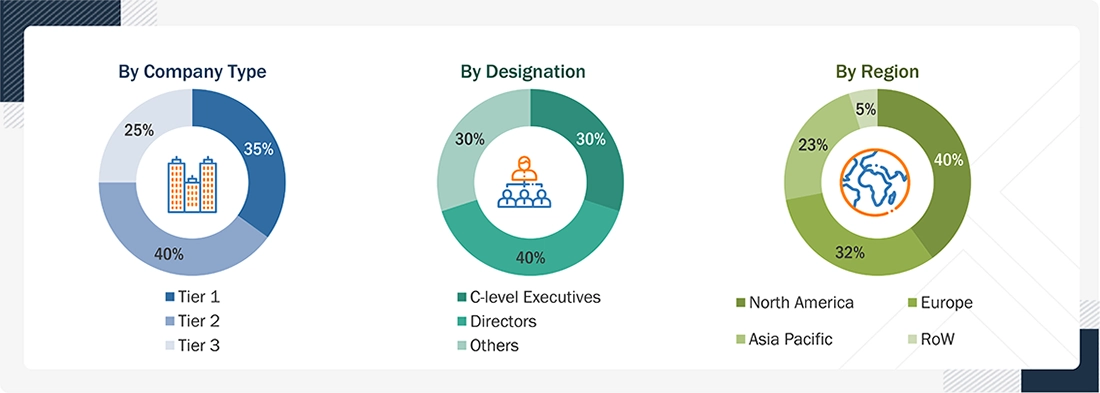
Notes: RoW mainly comprises the Middle East, Africa, and South America.
Other designations include product managers, sales managers, and marketing managers.
Three tiers of companies have been defined based on their total revenue as of 2025: tier 3: revenue lesser than USD 500 million; tier 2: revenue between USD 500 million and 1 billion; and tier 1: revenue more than USD 1 billion.
To know about the assumptions considered for the study, download the pdf brochure
Market Size Estimation
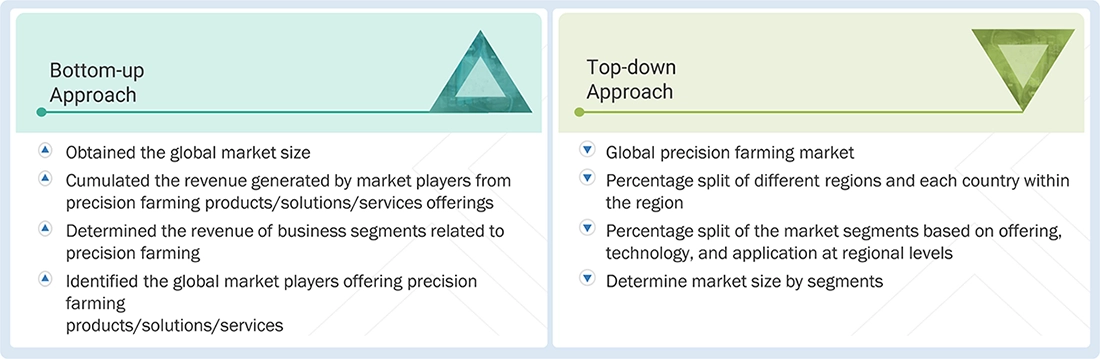
The bottom-up procedure has been employed to arrive at the overall size of the precision farming market.
- Analyzed major precision farming hardware, software, and service providers, studied their portfolios, and understood products/solutions/services based on their features and functions
- Analyzed the segmental revenue and scope revenue of the companies profiled in the study
- Arrived at the global precision farming market size by adding the scope revenue of key manufacturers in the market
- Conducted multiple discussions with key opinion leaders to understand different precision farming offerings (hardware, software, and service), technology, applications, and current trends in the market, and analyzed the breakup of the scope of study by major precision farming hardware, software, and service providers
The top-down approach has been used to estimate and validate the total size of the precision farming market.
- The global size of the precision farming market was estimated through the data analysis of major companies offering precision farming products/solutions/services.
- The geographic penetration splits were estimated using secondary sources, based on several factors, such as the number of players in a specific region (North America, Europe, Asia Pacific, and RoW).
- The country-level penetration split was analyzed for each region to estimate the market size.
- The market size for the global offering (hardware, software, and service) was determined by understanding the penetration split of each offering in each region.
- The market size for the global application segments was estimated by analyzing the penetration split of each offering for each application.
- The market size for the global technology segments was estimated by analyzing the penetration split of each offering for each technology.
Precision Farming Market: Top-Down and Bottom-Up Approach
Data Triangulation
After arriving at the overall market size using the market size estimation processes as explained above, the market has been split into several segments and subsegments. To complete the entire market engineering process and arrive at the exact statistics of each market segment and subsegment, data triangulation and market breakdown procedures have been employed, wherever applicable. The data has been triangulated by studying various factors and trends from the demand and supply sides in the precision farming market.
Market Definition
Precision farming, also referred to as precision agriculture, is a modern farm management approach that utilizes advanced technologies to monitor and enhance agricultural operations. It focuses on aligning field inputs with specific crop requirements. Technologies such as satellite positioning systems, including global positioning system (GPS), remote sensing, and variable rate technology (VRT), are used to manage crops efficiently and optimize the use of resources such as fertilizers, pesticides, and water.
Key Stakeholders
- Precision farming component providers
- Precision farming integrators and installers
- Precision farming solution providers
- Product manufacturers
- Precision farming-related associations, organizations, forums, and alliances
- Government and corporate bodies
- Research institutes and organizations
- Venture capitalists, private equity firms, and startups
- Distributors and traders
- OEMs
- End users
- Market research and consulting firms
- Agri-food buyers
- Agriculture technology providers
Report Objectives
- To define, describe, and forecast the size of the precision farming market by offering, technology, application, and region, in terms of value
- To describe and forecast the size of the precision farming market by offering, in terms of volume
- To forecast the market for various segments with respect to the main regions, namely, North America, Europe, Asia Pacific, and the Rest of the World (RoW), in terms of value
- To provide macroeconomic outlooks with respect to the main regions, namely, North America, Europe, Asia Pacific, and Rest of the World (RoW)
- To provide detailed information regarding the drivers, restraints, opportunities, and challenges influencing the market’s growth
- To strategically analyze micromarkets with respect to individual growth trends, prospects, and contributions to the total market
- To provide ecosystem analysis, value chain, trends/disruptions impacting customer business, technology analysis, pricing analysis, technology analysis, key stakeholders and buying criteria, case study analysis, trade analysis, patent analysis, Porter’s five forces, key conferences & events, AI impact, impact of 2025 US tariff, and regulations related to the precision farming market
- To analyze the opportunities in the market for stakeholders by identifying high-growth segments and detailing the competitive landscape for market players
- To strategically profile key players and comprehensively analyze their market rankings, core competencies, company valuation, and financial metrics, and product/brand comparison, along with detailing the competitive landscape for the market leaders
- To analyze the competitive developments, such as product launches, software launches, agreements, collaborations, joint ventures, and acquisitions, carried out by market players
- To map the competitive intelligence based on company profiles, key player strategies, and game-changing developments, such as product developments, collaborations, and acquisitions
- To benchmark players within the market using the competitive leadership mapping framework, which analyzes market players on various parameters within the broad categories of business strategy excellence and strength of product portfolio.
Available customizations:
With the given market data, MarketsandMarkets offers customizations according to the company‘s specific needs. The following customization options are available for the report.
Company Information
- Detailed analysis and profiling of additional market players (up to five)
Get the Full Precision Farming Market Report
Full forecast, segment splits, and company analysis for all Precision Farming Market.
- India Precision Farming Market
- Australia Precision Farming Market
- Indonesia Precision Farming Market
- Malaysia Precision Farming Market
- Thailand Precision Farming Market
- Vietnam Precision Farming Market
- US Precision Farming Market
- Canada Precision Farming Market
- Mexico Precision Farming Market
- Germany Precision Farming Market
- UK Precision Farming Market
- France Precision Farming Market
- Spain Precision Farming Market
- Italy Precision Farming Market
- Poland Precision Farming Market
- China Precision Farming Market
- South Korea Precision Farming Market
Need a Tailored Report?
Customize this report to your needs
Get 10% FREE Customization
Customize This Report
