
US Precision Forestry Market (2025-2030)

The US Precision Forestry Market was valued at $563.5 Million in 2025 and projected to reach to $724.1 Million by 2030, representing a compound annual growth rate of 5.1%. The US Precision Forestry Market is poised for sustained growth as forest management operators increasingly recognize the value of digital transformation.


| Market Size in | USD 26.32 MN |
| Market Forecast in | |
| CAGR | |
| Forecast Period | |
| Units Considered | Value (USD MN) |
US Precision Forestry Market Trends and Insights
- The US market is driven by increasing adoption of advanced technologies such as drones, LiDAR, and AI-powered analytics in forest management and timber harvesting operations.
- The US forestry sector is leveraging precision tools to optimize resource allocation, reduce operational costs, and enhance sustainability practices across both public and private forest lands. In the US, precision forestry solutions are gaining traction due to regulatory pressures for sustainable forest management and the need to combat climate change through improved carbon sequestration monitoring.
- The US market benefits from strong technological infrastructure, significant R&D investments, and a mature forestry industry seeking digital transformation.
- Between 2025 and 2030, the US is expected to see accelerated adoption of IoT sensors, satellite imagery, and real-time data analytics platforms that enable forest owners and operators to make data-driven decisions..
Key Market Statistics
- CAGR (2025-2030) 5.1% CAGR
- Market Size, 2025 ~USD 563.5 Million
- Forecast, 2030 ~USD 724.1 Million
- Country US
US Precision Forestry Market Overview
Market Valuation :
The US Precision Forestry Market is valued at $563.5 million in 2025 and is projected to reach $724.1 million by 2030, demonstrating strong growth potential in the domestic forestry sector.
Technology Adoption :
US forestry operators are increasingly adopting drone technology, LiDAR systems, and AI-powered analytics platforms to optimize forest management, enhance timber harvesting efficiency, and reduce operational costs.
Growth Trajectory :
With a CAGR of 5.1% through 2030, the US market is experiencing steady expansion driven by regulatory compliance requirements, sustainability initiatives, and the need for data-driven forest management practices.
Competitive Landscape :
The US market features a mix of established forestry equipment manufacturers and emerging precision technology providers competing to capture market share in the rapidly evolving digital forestry space.
US Precision Forestry Market Dynamics
- Investment in drone technology, remote sensing, and artificial intelligence is becoming standard practice among large-scale timber companies and forest service agencies seeking to improve operational efficiency and environmental stewardship.
- Regulatory pressures around sustainable forestry practices and carbon accounting are accelerating technology adoption across the sector.
- The market will continue to benefit from declining hardware costs, improved software capabilities, and growing integration of precision forestry solutions into existing enterprise systems.
- By 2030, precision forestry technologies are expected to become mainstream across US commercial and public forest management operations..
Market Ecosystem
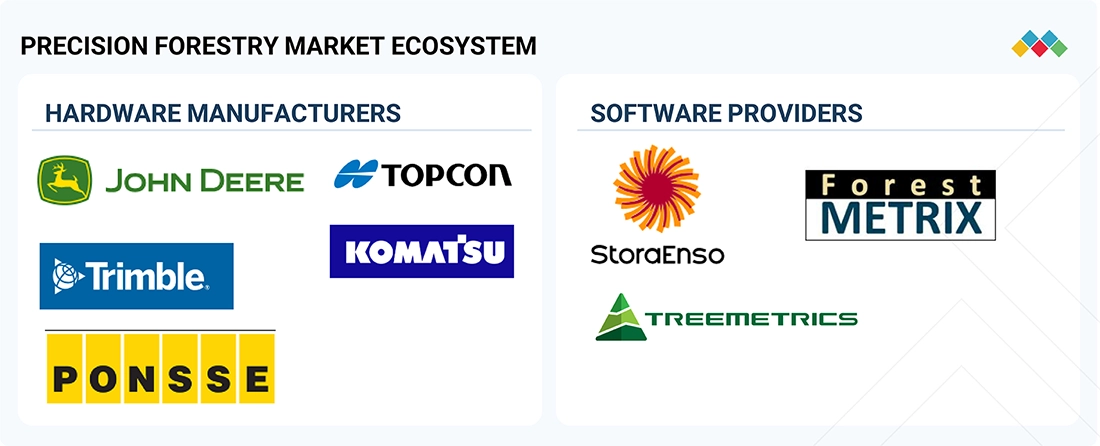
PRECISION FORESTRY MARKET: COMMERCIAL USE CASES ACROSS INDUSTRIES
| COMPANY | USE CASE DESCRIPTION | BENEFITS |
|---|---|---|
 |
Stora Enso (Finland) introduced its precision forestry program to overcome inefficiencies in traditional forest management. Using drones, satellites, LiDAR, and AI-driven harvesting machines, it developed a Digital Twin of its forests, enabling real-time data collection, precise mapping, and informed decision-making for sustainable and efficient forestry operations. | The precision forestry program improved Stora Enso’s resource efficiency, biodiversity management, and sustainability performance | Real-time data enhanced decision-making | Optimized harvesting and regeneration planning |Reduced operational waste | The initiative demonstrated how advanced digital technologies can modernize forest management, aligning productivity with ecological preservation and long-term sustainability goals |
 |
Holmen (Sweden) partnered with AI Sweden (Sweden) and Arboair to implement an AI-driven Precision Forestry platform addressing challenges in biodiversity and forest regeneration. The solution utilized synthetic digital twins to create high-resolution datasets, enabling precise tree-level analysis and enhancing data-driven decision-making for sustainable forest management. | The implementation allowed Holmen to achieve more accurate and timely forest management decisions, improving biodiversity conservation and regeneration planning |The AI-based approach enhanced operational efficiency | It provided scalable analytical capabilities |It showcased how synthetic data and machine learning can transform forestry into a more sustainable and precise practice |
 |
Emerson & Sons Logging, Inc. (US) partnered with Deere & Company (US) to modernize its operations through precision forestry technologies. The solution included Intelligent Boom Control (IBC) for enhanced boom precision and TimberMatic Maps for real-time data sharing, route optimization, and efficient logging operation management. | The adoption of Deere & Company’s precision forestry technologies improved operational efficiency, sustainability, and productivity for Emerson & Sons Logging, Inc. | IBC reduced operator fatigue and improved precision | TimberMatic Maps optimized resource use and reduced environmental impact, demonstrating the transformative potential of digital forestry innovations |
Logos and trademarks shown above are the property of their respective owners. Their use here is for informational and illustrative purposes only.
Related Ecosystem
Internet Of Things And M2M
- Sensors
- Cellular Network
- Digital Signal Processor (DSP)
- Global Positioning System (GPS)
- Image Sensors
- MITSUI ELECTRONICS INC
- INTEL CORPORATION
- MICROSOFT CORPORATION
- Amazon.com, Inc.
- Cisco Systems, Inc.
Sensors And Control
- Sensors
- Image Sensors
- Temperature Sensors
- Pressure Sensors
- Flow Sensors
- BAUMER ELECTRIC AG
- HONEYWELL INTERNATIONAL INC.
- Lenovo
- Stmicroelectronics
- Texas Instruments Incorporated
Key Takeaways
- The US Precision Forestry Market will grow from $563.5M (2025) to $724.1M (2030) at a 5.1% CAGR.
- The US market is driven by digital transformation initiatives and sustainability mandates in the forestry sector.
- Advanced technologies including drones, LiDAR, and AI analytics are accelerating adoption across US forest operations.
- The US forestry industry is increasingly investing in precision tools to optimize costs and meet environmental compliance requirements.
Precision Forestry Market Report Scope
| Report Metric | Details |
|---|---|
| Base Year | 2025 |
| Fastest Growing Segment | FIRE MANAGEMENT & DETECTION (Application) |
| Forecast Period | 2025–2030 |
| Growth Rate | CAGR of 5.8% from 2025 to 2030 |
| Largest Segment | HARDWARE (Offering) |
| Market Size Base Year (Billions) | ~USD 3.55 (2025) |
| Revenue Forecast (Billions) | ~USD 4.7 (2030) |
| Segments Covered | Offering, Type, Technology, Application, System Architecture, Ownership Type, End User |
US Precision Forestry Market Report Segmentation
7 segment dimensions are covered across the global market.
By Offering
- Hardware
- Services
- Software
By Type
- Cameras
- Cloud-Based
- Data Management & Analytics
- Gis & Mapping
- Gps/Gnss
- Gps/Gnss Devices
- Harvesters & Forwarders
- Hybrid
- Lidar
- On-Premises
- Other Hardware Products
- Remote Sensing
- Rfid Solutions And Sensors
- Uavs/Drones
- Unmanned Aerial Vehicles
- Variable Rate Controllers
By Technology
- Fire Detection
- Fire Detection Systems
- Geospatial
- Geospatial Tools
- Inventory & Yield Monitoring
- IoT
- IoT (Internet Of Things)
- Other Technologies
- Robotics & Sensors
- Smart Harvesting /Cut-To-Length (Ctl)
- Smart Harvesting/Ctl
By Application
- Environmental & Conservation
- Fire Management & Detection
- Forest Management & Planning
- Genetics
- Harvesting & Operations
- Inventory & Logistics Management
- Other Applications
- Pest & Disease Management
- Reforestation & Afforestation
- Silviculture
- Soil Testing
- Wildlife Habitat Management
By System Architecture
- Fixed/Stationary Systems
- Mobile/Handheld Systems
By Ownership Type
- Commercial Forest Owners
- Industrial Forestry Companies
- Small Landowners/Private Forest Owners
By End User
- Agriculture & Farming Cooperatives
- Forestry Companies
- Government Agencies
- Non-Profit Organizations
- Other End Users
Target Audience
- Forestry Equipment Manufacturers : Manufacturers need detailed US market insights to develop targeted product strategies, understand technology adoption rates, and identify opportunities to expand precision forestry equipment portfolios in the American market.
- Software & Analytics Providers : SaaS and analytics companies require market data to assess demand for AI-powered forest management solutions, benchmark pricing strategies, and prioritize US market entry or expansion initiatives.
- Timber & Forest Management Companies : Large-scale forestry operators need market intelligence to evaluate technology investments, understand competitive pressures, and make informed decisions about adopting precision forestry solutions for operational efficiency.
- Investment & Private Equity Firms : Investors evaluating forestry technology companies require comprehensive US market data to assess growth potential, validate business models, and identify acquisition or funding opportunities in the precision forestry sector.
- Government & Regulatory Agencies : Federal and state forestry agencies need market insights to understand technology trends, inform policy decisions around sustainable forest management, and evaluate procurement strategies for precision forestry tools.
Key Companies in the US Precision Forestry Market
| Company | HQ | Ownership | Strongest segments |
|---|---|---|---|
| CLAAS KGAA MBH | Germany | Private Company | Combine harvesters,Forage harvesters and forage harvesting machinery,Balers and hay tools, |
| DEERE & COMPANY | United States | Public Company | Production & Precision Agriculture,Small Agriculture & Turf,Construction & Forestry, |
| PONSSE OYJ | Finland | Public Company | Harvesters,Forwarders,Harvester heads, |
| KOMATSU LTD. | Japan | Public Company | Construction Machinery and Vehicles,Mining Equipment (within Construction segment),Utility, Forestry, and Industrial Machinery, |
| TRIMBLE INC. | United States | Public Company | Construction lifecycle software and machine control,Positioning and correction services (VRSNow, RTX, xFill),Transportation and logistics platforms (TMS, Transporeon, MAPS), |
| CATERPILLAR | United States | Public Company | Construction Industries equipment and parts,Resource Industries mining equipment and services,Energy & Transportation engines and turbines, |
| ROTTNE | Sweden | Public Company | Elemental chlorine free bleached softwood sulphate pulp,Unbleached kraft long-fiber sulphate pulp,Bleached/unbleached chemi-thermo-mechanical pulp (CTMP), |
| TOPCON | Japan | Private Company | Positioning – Surveying Instruments (total stations, GNSS, laser products),Positioning – IT Construction and Agricultural Systems,Eye Care – Diagnostic Systems (OCT, retinal cameras, slit lamps, tonometers), |
| HITACHI CONSTRUCTION MACHINERY CO., LTD. | Japan | Public Company | Hydraulic excavators,Wheel loaders and compaction equipment,Rigid dump trucks and mining systems, |
| KESLA | Finland | Public Company | Truck & stationary cranes (timber, city, industrial),Forest machine cranes & harvester heads,Tractor loaders & forestry trailers, |
| HUSQVARNA GROUP | Sweden | Public Company | Husqvarna Forest & Garden,Gardena,Husqvarna Construction, |
CLAAS KGAA MBH
CLAAS KGAA MBH is a German private company founded in 1913 that employs 11,654 people. The company operates in the agricultural and forestry machinery sector.
DEERE & COMPANY
Deere & Company is a publicly traded American manufacturer founded in 1837 with 73,100 employees. The company is a major producer of agricultural, construction, and forestry equipment.
PONSSE OYJ
PONSSE OYJ is a Finnish public company established in 1970 with 1,973 employees. The company specializes in forestry machinery and equipment.
KOMATSU LTD.
Komatsu Ltd. is a Japanese public company founded in 1884 with 67,279 employees. The company manufactures construction, mining, and forestry equipment.
TRIMBLE INC.
Trimble Inc. is an American public company founded in 1978 with 11,500 employees. The company provides positioning, navigation, and information technology solutions for various industries.
CATERPILLAR
Caterpillar is an American public company founded in 1925 with 118,000 employees. The company is a leading manufacturer of construction, mining, and forestry machinery and equipment.
ROTTNE
Rottne is a Swedish public company founded in 1887 with 278 employees. The company specializes in forestry machinery and equipment.
TOPCON
Topcon is a Japanese private company founded in 1932 with 5,327 employees. The company provides positioning, optical, and imaging technology solutions.
HITACHI CONSTRUCTION MACHINERY CO., LTD.
Hitachi Construction Machinery Co., Ltd. is a Japanese public company founded in 1951 with 25,304 employees. The company manufactures construction and mining equipment.
KESLA
Kesla is a Finnish public company founded in 1960 with 224 employees. The company manufactures forestry equipment and machinery.
HUSQVARNA GROUP
Husqvarna Group is a Swedish public company founded in 1689 with 11,655 employees. The company manufactures outdoor power products, forestry equipment, and garden machinery.
Reasons to Buy this Report
- Market Size & Growth Data : Access precise valuation figures for the US market ($563.5M in 2025) with detailed forecasts through 2030, enabling accurate budget allocation and investment planning for forestry technology initiatives.
- Technology Adoption Insights : Understand which precision technologies (drones, LiDAR, AI analytics) are gaining traction in US forestry operations, helping identify the most viable solutions for your business model and competitive positioning.
- Regional Market Dynamics : Gain exclusive intelligence on US-specific drivers, regulatory factors, and market trends that differentiate the American forestry sector from global markets, informing localized strategy development.
- Competitive Benchmarking : Evaluate your market position against competitors with comprehensive analysis of the US precision forestry landscape, including key players, market share dynamics, and emerging opportunities.
- Investment & Growth Opportunities : Identify high-potential segments and geographic areas within the US market experiencing accelerated adoption of precision forestry technologies, guiding capital allocation and expansion strategies.
Frequently asked questions
What is the current size of the US Precision Forestry Market?
The US Precision Forestry Market is valued at $563.5 million in 2025.
What is the projected size of the US Precision Forestry Market by 2030?
The US Precision Forestry Market is projected to reach $724.1 million by 2030.
What is the CAGR for the US Precision Forestry Market?
The US Precision Forestry Market is expected to grow at a compound annual growth rate (CAGR) of 5.1% from 2025 to 2030.
What technologies are driving growth in the US Precision Forestry Market?
Key technologies driving the US market include drones, LiDAR sensors, AI-powered analytics, IoT devices, and satellite imagery for forest monitoring and management.
Why is the US Precision Forestry Market growing?
The US market is growing due to regulatory pressures for sustainable forest management, climate change mitigation efforts, cost optimization needs, and digital transformation in the forestry industry.
RESEARCH METHODOLOGY
The study involved major activities in estimating the current size of the precision forestry market. Exhaustive secondary research was done to collect information on the market, peer market, and parent market. The next step was to validate these findings, assumptions, and sizing with industry experts across the supply chain through primary research. Both top-down and bottom-up approaches were employed to estimate the complete market size. Following this, market breakdown and data triangulation methods were employed to determine the market size of each segment and its subsegments. Secondary and primary sources have been used to identify and collect information for an extensive technical and commercial study of the precision forestry market.
Secondary Research
Secondary research for this study involved gathering information from various credible sources, such as company reports, white papers, journals, and industry publications. This process helped in understanding the supply and value chains, identifying key players, analyzing market segmentation and regional trends, and tracking major market and technology developments. The data collected was used to estimate the overall market size, which was later validated through primary research.
Primary Research
Extensive primary research was conducted after gaining knowledge about the current scenario of the precision forestry market through secondary research. Several primary interviews were conducted with experts from the demand and supply sides across four major regions: North America, Europe, Asia Pacific, and RoW. This primary data was collected through questionnaires, emails, and telephone interviews.
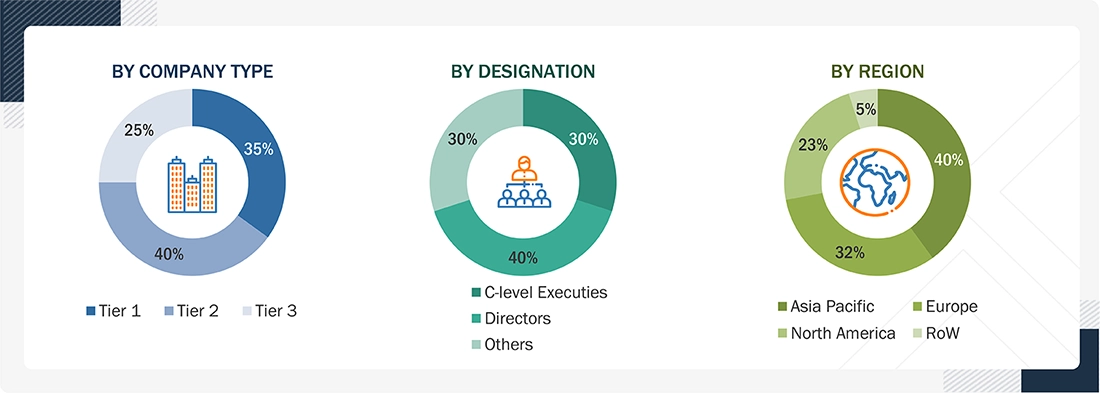
Notes: RoW mainly comprises the Middle East, Africa, and South America.
Other designations include product managers, sales managers, and marketing managers.
Three tiers of companies have been defined based on their total revenue as of 2024: Tier 3, with revenue less than USD 500 million; Tier 2, with revenue between USD 500 million and 1 billion; and Tier 1, with revenue more than USD 1 billion.
To know about the assumptions considered for the study, download the pdf brochure
Market Size Estimation
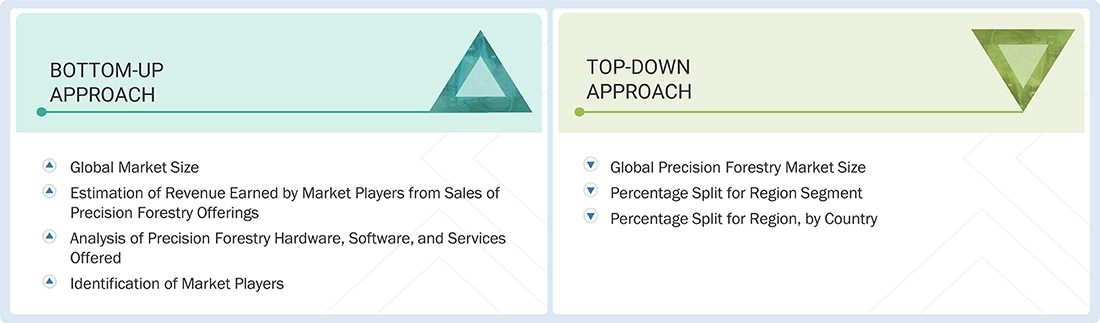
In the market engineering process, both top-down and bottom-up approaches, along with data triangulation methods, were used to estimate and validate the size of the precision forestry market and other dependent submarkets. The research methodology used to estimate the market sizes includes the following:
Approach to arrive at market size using bottom-up analysis (demand side):
- Identified major companies in the precision forestry market who are technology providers, equipment manufacturers, software developers, and consulting/service providers across the supply chain
- Analyzed the total revenue and key offerings, including hardware products such as harvesters & forwarders, UAVs/drones, GPS/GNSS devices, cameras, RFID devices, sensors, variable rate controllers, along with software solutions and services, offered by the key players
- Understood the segmental revenue and scope revenue of the key players
- Arrived at the global precision forestry market size by adding the scope revenue of the key players in the market
- Studied the trend of precision forestry adoption across ownership types, applications, and regions, based on products, technologies, and end users
- Tracked recent market developments, including technology upgrades, strategic collaborations, product launches, facility expansions, and developments of key players, to forecast market size and growth trends accurately
- Conducted multiple discussions with key opinion leaders across equipment manufacturers, forestry companies, service providers, and regulatory authorities to understand real-time adoption dynamics, operational challenges, and the shift toward data-driven, automated, and sustainable forest management practices
- Validated market estimates through in-depth consultations with industry experts, from R&D heads of leading forestry technology providers to forest management officers and technical advisors, ensuring alignment with domain insights for robust and accurate market projections
Approach to arrive at market size using top-down analysis (supply side):
- Estimated the global precision forestry market size by aggregating revenue from key players of the precision forestry market
- Breaking down the global market into regional segments (North America, Europe, Asia Pacific, and RoW (Middle East & Africa, South America)) based on forest acres, adoption rate, and growth potential
- Further segmented each region into country-level markets, analyzed adoption trends, technology penetration, and operational scale for precision forestry
- Evaluating regional and country-specific drivers, restraints, and regulatory frameworks to refine market sizing and ensure accuracy in regional forecasts
- Cross-verifying market projections with historical trends, government policies, and expert insights to ensure consistency and reliability in forecasting from global to country-level
Precision Forestry Market: Top-Down and Bottom-Up Approach
Data Triangulation
After determining the overall market size using the market size estimation processes explained above, the market was classified into several segments and subsegments. To complete the entire market engineering process and obtain precise statistics for each market segment and subsegment, data triangulation and market breakdown procedures were employed as applicable. The data was triangulated by examining various factors and trends from both the demand and supply sides of the precision forestry market.
Market Definition
The precision forestry market refers to the industry focused on the adoption and integration of advanced digital and automation technologies to improve the accuracy, efficiency, and sustainability of forest management operations. It involves the application of technologies such as smart harvesting/CTL, inventory and yield monitoring, fire detection, geospatial, IoT, robotics, and sensors to collect and analyze real-time forest data. These technologies support key functions including forest mapping, growth assessment, resource planning, harvesting optimization, and risk management. Overall, the precision forestry market enables data-driven decision-making to enhance timber productivity, reduce operational costs, promote sustainable forestry practices, and ensure environmental preservation.
Key Stakeholders
- Forest owners and landholders
- Forestry companies
- Government agencies and regulatory bodies
- Technology providers
- Equipment manufacturers
- Software developers
- Research and academic institutions
- Consulting and service providers
- Environmental and conservation organizations
- Investors and financial institutions
- Supply chain partners
- End users
Report Objectives
- To describe and forecast the precision forestry market by offering, application, technology, ownership type, system architecture, end user, and region, in terms of value
- To describe and forecast the precision forestry market for harvesters & forwarders, in terms of volume
- To forecast the market size for various segments across the main regions: North America, Europe, Asia Pacific, and the Rest of the World (RoW)
- To provide industry-specific information regarding the major drivers, restraints, opportunities, and challenges influencing the growth of the precision forestry market
- To study the complete supply chain and related industry segments for the precision forestry market
- To identify key precision forestry equipment manufacturers and analyze their product offerings in the market
- To strategically analyze the micromarkets concerning individual growth trends, prospects, and contributions to the total market
- To analyze trends/disruptions impacting customer business; pricing analysis; patents analysis; trade analysis (export and import scenario); tariff and regulatory landscape; Porter's five forces analysis; case studies; investment and funding scenario; key stakeholders and their buying criteria; technology analysis; ecosystem mapping; impact of artificial intelligence; impact of 2025 US tariff; and key conferences and events related to the precision forestry market
- To analyze opportunities in the market for various stakeholders by identifying high-growth segments of the market
- To strategically profile the key players and comprehensively analyze their market position regarding ranking and core competencies, along with detailing the competitive landscape for the market leaders
- To analyze competitive developments, such as product launches/enhancements, expansions, partnerships, collaborations, and research and development (R&D) activities carried out by players in the precision forestry market
Available Customizations:
With the given market data, MarketsandMarkets offers customizations according to the company‘s specific needs. The following customization options are available for the report.
Company Information
- Detailed analysis and profiling of additional market players (up to five)
Get the Full Precision Forestry Market Report
Full forecast, segment splits, and company analysis for all Precision Forestry Market.
- Canada Precision Forestry Market
- Mexico Precision Forestry Market
- Bahrain Precision Forestry Market
- Kuwait Precision Forestry Market
- Oman Precision Forestry Market
- Rest Of Middle East Precision Forestry Market
- Saudi Arabia Precision Forestry Market
- UAE Precision Forestry Market
- Rest Of Africa Precision Forestry Market
- South Africa Precision Forestry Market
- Brazil Precision Forestry Market
- Rest Of South America Precision Forestry Market
Need a Tailored Report?
Customize this report to your needs
Get 10% FREE Customization
Customize This Report
