
France Precision Harvesting Market (2025-2030)

The France Precision Harvesting Market was valued at $1136.8 Million in 2025 and projected to reach to $1502 Million by 2030, representing a compound annual growth rate of 5.7%. France's precision harvesting market is poised for steady growth through 2030, driven by the country's commitment to agricultural modernization and digital transformation.


| Market Size in | USD 26.32 MN |
| Market Forecast in | |
| CAGR | |
| Forecast Period | |
| Units Considered | Value (USD MN) |
France Precision Harvesting Market Trends and Insights
- France is establishing itself as a key player in the European precision harvesting sector, driven by increasing adoption of advanced agricultural technologies and automation in the semiconductor and electronics supply chain.
- The French market benefits from strong industrial infrastructure, government support for digital agriculture initiatives, and growing demand for efficient resource management across the country's farming and manufacturing sectors..
Key Market Statistics
- CAGR (2025-2030) 5.7% CAGR
- Market Size, 2025 ~USD 1136.8 Million
- Forecast, 2030 ~USD 1502 Million
- Country France
France Precision Harvesting Market Overview
Market Size & Growth :
France's precision harvesting market is valued at USD 1,136.8 million in 2025, with projected growth to USD 1,502.0 million by 2030, demonstrating a steady CAGR of 5.7% over the forecast period.
European Leadership Position :
France is establishing itself as a key player in the European precision harvesting sector, leveraging its strong agricultural heritage and technological innovation capabilities to drive market expansion.
Technology Adoption Drivers :
Increasing adoption of advanced agricultural technologies and automation solutions in France's semiconductor and electronics industries is accelerating precision harvesting implementation across the country.
Below-Global Growth Rate :
France's CAGR of 5.7% is slightly below the global average of 6.7%, indicating a more conservative but stable market maturation compared to faster-growing international regions.
France Precision Harvesting Market Dynamics
- The integration of advanced semiconductor technologies and automation solutions is reshaping France's farming landscape, with increasing investments in precision agriculture infrastructure and smart farming initiatives.
- Government support for sustainable agricultural practices and EU regulations promoting technological adoption are key catalysts for market expansion. The French market benefits from strong industrial capabilities in electronics manufacturing and a skilled workforce capable of deploying sophisticated harvesting systems.
- Regional collaborations within Europe and partnerships between technology providers and agricultural stakeholders are expected to accelerate innovation.
- As France continues to balance productivity with environmental sustainability, precision harvesting technologies will play an increasingly vital role in achieving these dual objectives through 2030..
Market Ecosystem
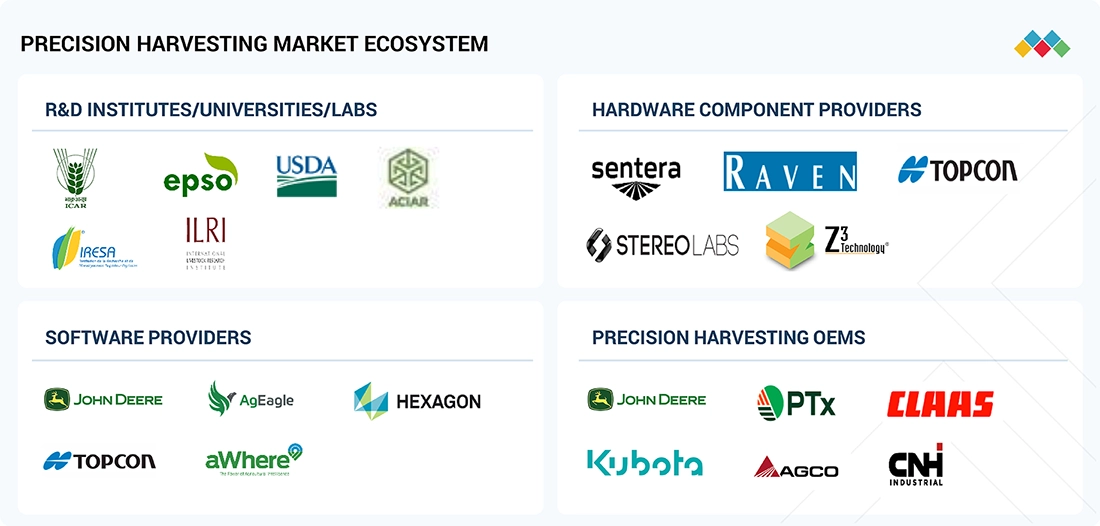
Precision Harvesting Market: COMMERCIAL USE CASES ACROSS INDUSTRIES
| COMPANY | USE CASE DESCRIPTION | BENEFITS |
|---|---|---|
 |
Uses John Deere’s S-Series combines with integrated GPS, AutoTrac guidance, and yield mapping for large-scale row crop harvesting | Improved yield consistency, reduced fuel use, and optimized harvest timing |
 |
Employs FarmWise’s AI-powered Vulcan implement for precision harvesting and weeding of leafy vegetables | Lower labor costs, minimal crop damage, and enhanced harvest quality |
 |
Utilizes New Holland CR Revelation combines with real-time yield mapping and moisture sensors for salad and vegetable crops | Efficient crop tracking, better yield forecasting, and resource optimization |
 |
Deploys Case IH Axial-Flow combines equipped with AFS Harvest Command automation across large cotton and grain operations | Increased throughput, reduced grain loss, and improved cost efficiency |
 |
Uses John Deere precision harvesting systems integrated with soil and crop analytics for organic carrot harvesting | Enhanced soil management, reduced waste, and sustainable harvesting practices |
Logos and trademarks shown above are the property of their respective owners. Their use here is for informational and illustrative purposes only.
Related Ecosystem
Precision Agriculture
- Sensors
- Global Positioning System (GPS)
- Camera Systems
- Data Services
- Platform as A Service (PaaS)
- MSK FARM MACHINERY CORPORATION
- MITSUBISHI AGRICULTURAL MACHINERY
- MITSUBISHI CHEMICAL AGRI DREAM
- Trimble Inc.
- Deere & Company
Sensors And Control
- Sensors
- Image Sensors
- Temperature Sensors
- Pressure Sensors
- Flow Sensors
- BAUMER ELECTRIC AG
- HONEYWELL INTERNATIONAL INC.
- Lenovo
- Stmicroelectronics
- Texas Instruments Incorporated
Key Takeaways
- France's precision harvesting market will expand from USD 1,136.8M (2025) to USD 1,502.0M (2030) at a 5.7% CAGR.
- France is leveraging digital agriculture and automation technologies to enhance operational efficiency in harvesting operations.
- Government initiatives and EU regulations in France are accelerating the adoption of precision harvesting solutions.
- France's strong semiconductor and electronics ecosystem positions the country as a regional hub for precision harvesting innovation.
Precision Harvesting Market Report Scope
| Report Metric | Details |
|---|---|
| Base Year | 2025 |
| Fastest Growing Segment | SOFTWARE (Offering) |
| Forecast Period | 2025–2030 |
| Growth Rate | CAGR of 6.7% from 2025 to 2030 |
| Largest Segment | CROPS (Application) |
| Market Size Base Year (Billions) | ~USD 21.54 (2025) |
| Revenue Forecast (Billions) | ~USD 29.79 (2030) |
| Segments Covered | Offering, Type, Product Type, Farm Size, Application |
France Precision Harvesting Market Report Segmentation
5 segment dimensions are covered across the global market.
By Offering
- Hardware
- Services
- Software
By Type
- Cameras
- Combine Harvesters
- Gps
- Guidance & Steering Systems
- Harvesters
- Harvesting Robots
- Other Hardware Component Types
- Other Hardware Components
- Robotic Arms
- Self-Propelled Forage Harvesters
- Sensors
- Yield Monitoring Systems
By Product Type
- Combine Harvesters
- Harvesting Robots
- Self-Propelled Forage Harvesters
By Farm Size
- Large
- Medium
- Small
By Application
- Crops
- Greenhouse
- Horticulture
- Other Applications
Target Audience
- Agricultural Technology Manufacturers : Precision harvesting equipment and automation solution providers need France-specific market data to assess market potential, identify customer segments, and develop localized product strategies for the French agricultural sector.
- Semiconductor & Electronics Companies : Firms supplying components and technologies for precision harvesting systems require detailed French market insights to understand demand drivers, competitive positioning, and opportunities within France's growing agritech ecosystem.
- Investment & Private Equity Firms : Investors evaluating opportunities in French agricultural technology and precision farming require comprehensive market sizing, growth forecasts, and competitive analysis to support due diligence and portfolio decisions.
- Government & Policy Makers : French agricultural and technology policy officials need market intelligence to inform subsidy programs, regulatory frameworks, and strategic initiatives supporting precision harvesting adoption and rural innovation.
- Consulting & Strategy Firms : Business consultants advising clients on French market entry, expansion, or competitive strategy in precision harvesting require validated market data, growth projections, and regional insights for client recommendations.
Key Companies in the France Precision Harvesting Market
| Company | HQ | Ownership | Strongest segments |
|---|---|---|---|
| DEERE & COMPANY | United States | Public Company | Combine Harvesters (with precision packages),Self-Propelled Forage Harvesters,Guidance & Steering Systems, |
| CNH INDUSTRIAL N.V. | United Kingdom | Public Company | Combine Harvesters,Self-Propelled Forage Harvesters,Harvesting Robots, |
| CLAAS KGAA MBH | Germany | Private Company | Combine Harvesters,Self-Propelled Forage Harvesters,Harvesting Robots, |
| AGCO CORPORATION | United States | Public Company | Combine Harvesters,Self-Propelled Forage Harvesters,Harvesting Robots, |
| KUBOTA CORPORATION | Japan | Public Company | Combine Harvesters,Self-Propelled Forage Harvesters,Harvesting Robots, |
| TOPCON CORPORATION | Japan | Private Company | Guidance & Steering System,GPS / GNSS Hardware & Positioning Software,Yield Monitoring System, |
| TRIMBLE INC. | United States | Public Company | Guidance & Steering System,GPS (including correction services),Yield Monitoring System, |
| HEXAGON AB | Sweden | Public Company | Guidance & Steering System,GPS / GNSS and Correction Services,Yield Monitoring System, |
DEERE & COMPANY
DEERE & COMPANY is a public American manufacturer founded in 1837 with 73,100 employees, a leading global producer of agricultural and construction equipment.
CNH INDUSTRIAL N.V.
CNH INDUSTRIAL N.V. is a public company founded in 1842 with 34,197 employees, headquartered in the United Kingdom and engaged in the manufacture of agricultural and construction machinery.
CLAAS KGAA MBH
CLAAS KGAA MBH is a private German company founded in 1913 with 11,654 employees, a major manufacturer of agricultural machinery and equipment.
AGCO CORPORATION
AGCO CORPORATION is a public American company founded in 1990 with 22,000 employees that designs, manufactures, and distributes agricultural equipment and solutions.
KUBOTA CORPORATION
KUBOTA CORPORATION is a public Japanese company founded in 1890 with 52,503 employees, a global manufacturer of agricultural machinery, engines, and related equipment.
TOPCON CORPORATION
TOPCON CORPORATION is a private Japanese company founded in 1932 with 5,327 employees specializing in precision technology and positioning solutions.
TRIMBLE INC.
TRIMBLE INC. is a public American company founded in 1978 with 11,500 employees offering positioning, navigation, and information technology solutions for agriculture and other industries.
HEXAGON AB
HEXAGON AB is a public Swedish company founded in 1975 with 16,118 employees providing digital solutions and sensor technology across multiple sectors including agriculture.
Reasons to Buy this Report
- France-Specific Market Sizing : Obtain accurate, validated market size data for France with precise valuations for 2025 (USD 1,136.8M) and 2030 (USD 1,502.0M), enabling confident business planning and investment decisions tailored to the French market.
- Competitive Landscape Intelligence : Understand France's unique competitive dynamics, local player strategies, and market positioning within the broader European precision harvesting sector to identify partnership and expansion opportunities.
- Growth Trajectory Analysis : Leverage France's 5.7% CAGR forecast to benchmark performance expectations, identify growth drivers specific to the French market, and develop targeted go-to-market strategies for agricultural technology solutions.
- Regulatory & Policy Insights : Access France-specific regulatory frameworks, EU compliance requirements, and government incentives driving precision harvesting adoption, essential for navigating the French agricultural technology landscape.
- Strategic Investment Guidance : Make informed investment and resource allocation decisions for France operations with comprehensive market outlook data, identifying high-potential segments and timing for market entry or expansion initiatives.
Frequently asked questions
What is the current market size of precision harvesting in France?
France's precision harvesting market is valued at USD 1,136.8 million in 2025.
What is the projected market size for precision harvesting in France by 2030?
France's precision harvesting market is forecast to reach USD 1,502.0 million by 2030.
What is the CAGR for France's precision harvesting market?
France's precision harvesting market is expected to grow at a CAGR of 5.7% from 2025 to 2030.
What factors are driving growth in France's precision harvesting market?
Growth in France is driven by digital agriculture adoption, automation technologies, government support, and EU regulatory frameworks promoting sustainable harvesting practices.
How does France's precision harvesting market compare to Europe?
France represents a significant portion of the European precision harvesting market, benefiting from advanced industrial infrastructure and strong semiconductor and electronics capabilities.
RESEARCH METHODOLOGY
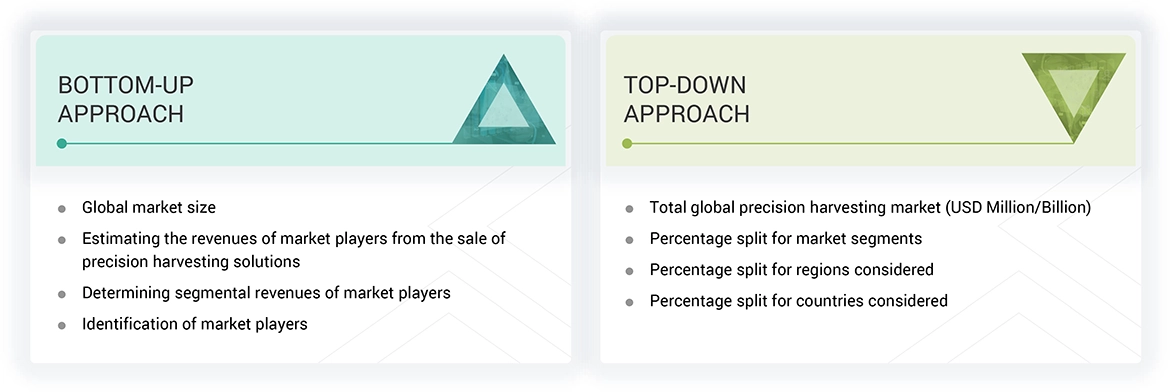
The research study involved four major activities in estimating the size of the precision harvesting market. Exhaustive secondary research has been done to collect important information about the market and peer markets. The next step has been to validate these findings and assumptions and size them with the help of primary research with industry experts across the value chain. Both top-down and bottom-up approaches have been used to estimate the market size. Post which the market breakdown and data triangulation have been adopted to estimate the market sizes of segments and sub-segments.
Secondary Research
In the secondary research process, various secondary sources were referred to identify and collect information required for this study. The secondary sources include annual reports, press releases, investor presentations of companies, white papers, and articles from recognized authors. Secondary research has been mainly done to obtain key information about the market’s value chain, the pool of key market players, market segmentation according to industry trends, regional outlook, and developments from both market and technology perspectives.
The precision harvesting market report estimates the global market size using both the top-down and bottom-up approaches, along with several other dependent submarkets. The major players in the market were identified using extensive secondary research, and their presence in the market was determined using secondary and primary research. All the percentage shares, splits, and breakdowns have been determined using secondary sources and verified through primary sources.
Primary Research
Extensive primary research has been conducted after understanding the precision harvesting market scenario through secondary research. Several primary interviews have been conducted with key opinion leaders from demand- and supply-side vendors across four major regions—Americas, Europe, Asia Pacific, and the Rest of the World. Approximately 25% of the primary interviews have been conducted with the demand-side vendors and 75% with the supply-side vendors. Primary data has been collected mainly through telephonic interviews, which consist of 80% of the total primary interviews; questionnaires and emails have also been used to collect the data.
After successful interaction with industry experts, brief sessions were conducted with highly experienced independent consultants to reinforce the findings of our primary research. This, along with the in-house subject matter experts’ opinions, has led us to the findings as described in the report.
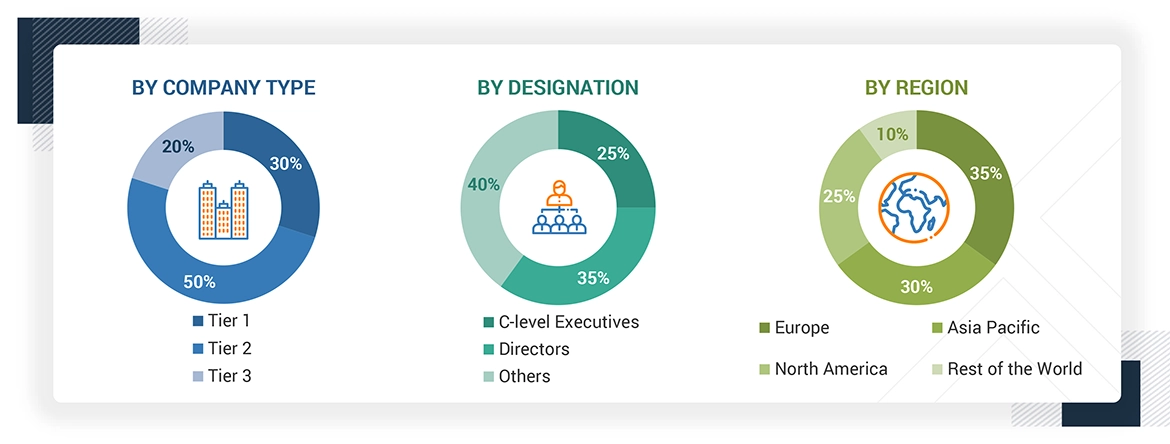
Note: “Others” includes sales, marketing, and product managers
To know about the assumptions considered for the study, download the pdf brochure
Market Size Estimation
In the market engineering process, top-down and bottom-up approaches and data triangulation methods have been used to estimate and validate the size of the precision harvesting market and other dependent submarkets. The research methodology used to estimate the market sizes includes the following:
- Identifying top-line investments and spending in the ecosystem and considering segment-level splits and major market developments
- Identifying different stakeholders in the precision harvesting market that influence the entire market, along with participants across the supply chain
- Analyzing major manufacturers in the precision harvesting market and studying their product portfolio
- Analyzing trends related to the adoption of precision harvesting products
- Tracking recent and upcoming market developments, including investments, R&D activities, product launches, expansions, acquisitions, partnerships, collaborations, agreements, and investments, as well as forecasting the market size based on these developments and other critical parameters
- Carrying out multiple discussions with key opinion leaders to identify the adoption trends of precision harvesting
- Segmenting the overall market into various other market segments
- Validating the estimates at every level through discussions with key opinion leaders, such as chief executives (CXOs), directors, and operation managers, and finally with the domain experts at MarketsandMarkets
Precision Harvesting Market : Top-Down and Bottom-Up Approach
Data Triangulation
After arriving at the overall market size by the market size estimation process explained in the earlier section, the overall precision harvesting market has been divided into several segments and subsegments. The data triangulation and market breakdown procedures have been used to complete the overall market engineering process and arrive at the exact statistics for all segments, wherever applicable. The data has been triangulated by studying various factors and trends from both the demand and supply side perspectives. Along with data triangulation and market breakdown, the market has been validated by top-down and bottom-up approaches.
Market Definition
Precision harvesting harnesses the tools of modern technology such as GPS, sensors, artificial intelligence, data analysis, and automation in agricultural harvesting. It relates to discovering the best way to harvest crops and the best time to harvest crops to maximize yield, reduce waste, and improve efficiency.
Precision harvesting techniques typically involve unmanned harvesting machines, robotic harvesting arms, yield monitoring devices, and real-time data-supported decision-making tools, providing farmers useful insights on field and crop conditions throughout the season. This approach supports sustainable agriculture by removing the need for labor, reducing costs, and enhancing crop quality.
The precision harvesting industry is segmented based on offering, farm size, application, and region. By offering, the market includes hardware, software, and services. The hardware segment is further divided into harvesters and aftermarket hardware components. The hardware segment is further divided into harvesters and various types of aftermarket hardware components. Moreover, the harvesters are categorized by combine harvesters, self-propelled forage harvesters, and harvesting robots. Steering systems, GPS, yield monitors, robotic arms, sensors, cameras, and various precision components are included in aftermarket hardware. Both software and services target data analysis, field mapping, system running, and user assistance. The technology is embraced by small, medium, and large farms, depending on their capacity and how many resources they have. Many farming activities, such as crop production, horticulture, greenhouses, and specialty farming, use precision harvesting. Similarly, combining hardware, software, and services allows for custom strategies to improve performance, lower the amount of labor used, and boost crop output.
Key Stakeholders
- Original Equipment Manufacturers (OEMs)
- Software & Data Analytics Providers
- Hardware Component Providers
- Government Bodies & Policy Makers
- Research Institutes / Universities
- Farm Operators and Growers
- Leasing and Financing Companies
- Service Providers
- Distributors and Dealers
Report Objectives
- To describe and forecast the overall precision harvesting market, by offering, farm size, and application in terms of value
- To forecast the market for harvester, in terms of volume
- To evaluate the market for four key regions: Americas, Europe, Asia Pacific, and the Rest of the World, in terms of value
- To provide detailed information regarding drivers, restraints, opportunities, and challenges influencing the growth of the market
- To give a detailed overview of the supply chain of the precision harvesting market ecosystem.
- To strategically analyze micromarkets1 with regard to individual growth trends, prospects, and contributions to the overall market
- To analyze opportunities in the market for stakeholders and provide a competitive landscape of the market
- To analyze competitive developments such as product launches, expansions, partnerships, collaborations, and agreements in the market
- To strategically profile the key players in the market and comprehensively analyze their market ranking and core competencies2
- To strategically analyze the impact of the US tariff 2025 on the precision harvesting market.
- To analyze the impact of AI/Gen AI on the precision harvesting market
Available Customizations:
With the given market data, MarketsandMarkets offers customizations according to the specific requirements of companies. The following customization options are available for the report:
Country-wise Information:
- Country-wise breakdown for Americas, Europe, Asia Pacific, and Rest of the World
Company Information
- Detailed analysis and profiling of additional market players (up to five)
Get the Full Precision Harvesting Market Report
Full forecast, segment splits, and company analysis for all Precision Harvesting Market.
- Canada Precision Harvesting Market
- Mexico Precision Harvesting Market
- US Precision Harvesting Market
- Brazil Precision Harvesting Market
- Argentina Precision Harvesting Market
- Germany Precision Harvesting Market
- UK Precision Harvesting Market
- Italy Precision Harvesting Market
- Poland Precision Harvesting Market
- Netherlands Precision Harvesting Market
- China Precision Harvesting Market
- India Precision Harvesting Market
- Australia Precision Harvesting Market
- Japan Precision Harvesting Market
- South Korea Precision Harvesting Market
- Rest Of Europe Precision Harvesting Market
- Rest Of Asia Pacific Precision Harvesting Market
- Rest Of South America Precision Harvesting Market
Need a Tailored Report?
Customize this report to your needs
Get 10% FREE Customization
Customize This Report
