
Rest Of Apac Printed Electronics Market (2025-2030)

The Rest Of Apac Printed Electronics Market was valued at $394 Million in 2025 and projected to reach to $739.7 Million by 2030, representing a compound annual growth rate of 13.4%. Rest Of Apac represents a critical growth frontier for the printed electronics market, driven by rapid industrialization and increasing consumer electronics demand across emerging economies.


| Market Size in | USD 26.32 MN |
| Market Forecast in | |
| CAGR | |
| Forecast Period | |
| Units Considered | Value (USD MN) |
Rest Of Apac Printed Electronics Market Trends and Insights
- In 2025, Rest Of Apac is estimated at USD 394.0 million, with strong momentum expected through the forecast period.
- By 2030, Rest Of Apac is projected to reach USD 739.7 million, reflecting a compound annual growth rate of 13.4%, driven by increasing adoption of flexible electronics, IoT applications, and cost-effective manufacturing solutions across emerging economies in the region. The printed electronics sector in Rest Of Apac is characterized by rising demand from consumer electronics, automotive, and healthcare industries.
- Rest Of Apac benefits from expanding manufacturing capabilities and growing investments in advanced printing technologies.
- The region's competitive labor costs and improving infrastructure position Rest Of Apac as an attractive hub for printed electronics production and innovation. Rest Of Apac's growth trajectory reflects broader regional trends toward miniaturization, sustainability, and functional integration in electronic devices.
- As Rest Of Apac continues to develop its supply chain ecosystem and technical expertise, the market is expected to capture increasing market share within the global printed electronics landscape through 2030..
Key Market Statistics
- CAGR (2025-2030) 13.4% CAGR
- Market Size, 2025 ~USD 394 Million
- Forecast, 2030 ~USD 739.7 Million
- Country Rest Of Apac
Rest Of Apac Printed Electronics Market Overview
Market Size & Growth :
Rest Of Apac printed electronics market valued at USD 394.0 million in 2025, expanding to USD 739.7 million by 2030 at a 13.4% CAGR, demonstrating robust regional expansion.
Flexible Electronics Adoption :
Increasing adoption of flexible electronics across Rest Of Apac is driving market growth, with emerging economies investing in advanced manufacturing capabilities and consumer demand rising.
Regional Growth Dynamics :
Rest Of Apac outpaces global average with 13.4% CAGR compared to global 15.4%, indicating strong localized demand and market maturation in secondary Asia Pacific markets.
Emerging Market Opportunities :
Untapped markets within Rest Of Apac present significant opportunities for printed electronics applications in packaging, displays, and IoT devices as manufacturing infrastructure develops.
Rest Of Apac Printed Electronics Market Dynamics
- The region's 13.4% CAGR reflects strong momentum as manufacturers establish production facilities and supply chains mature.
- Government initiatives supporting electronics manufacturing and rising investments in R&D are accelerating technology adoption. By 2030, Rest Of Apac is positioned to capture nearly USD 740 million in market value, fueled by expanding applications in flexible displays, smart packaging, and wearable devices.
- The region's cost-competitive manufacturing landscape and growing middle-class consumer base create favorable conditions for printed electronics proliferation.
- Strategic partnerships and technology transfer from developed markets will further accelerate regional market penetration..
Market Ecosystem
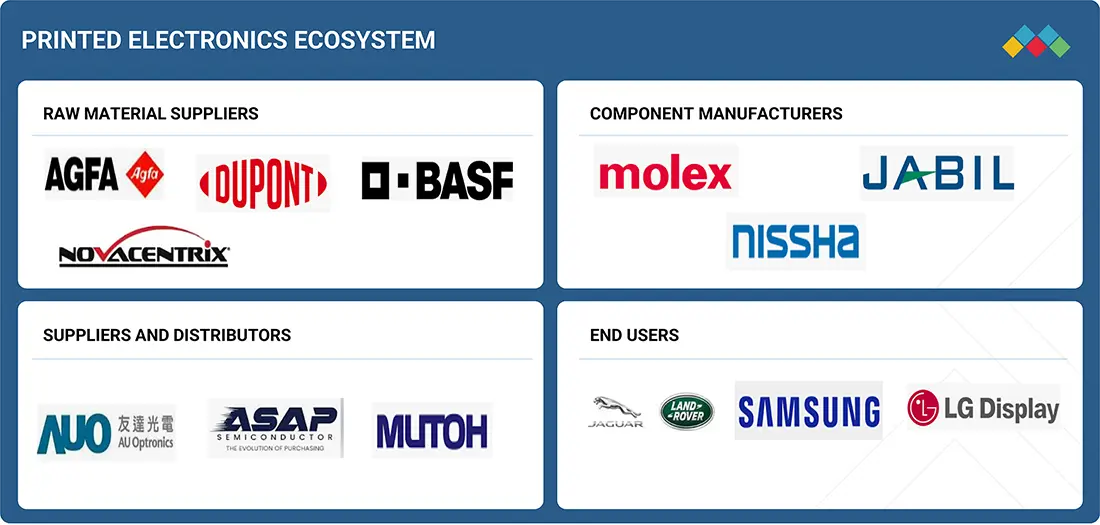
Printed Electronics Market Growth: COMMERCIAL USE CASES ACROSS INDUSTRIES
| COMPANY | USE CASE DESCRIPTION | BENEFITS |
|---|---|---|
 |
Conductive inks, flexible substrates, and advanced materials for printed sensors, OLED displays, photovoltaics, and smart packaging | High conductivity, durability, and scalability for large-area electronics; supports flexible, lightweight, and eco-friendly device manufacturing |
 |
Development of specialty polymers, dispersions, and nanomaterials for printed electronics applications like flexible displays, smart labels, and printed batteries | Enhanced material performance, chemical stability, and sustainability; enables cost-efficient production with improved energy efficiency |
 |
Printed conductive inks and functional materials for OLED lighting, smart packaging, printed sensors, and industrial IoT devices | Cost-effective printing solutions, compatibility with multiple substrates, high print quality, and energy-efficient production processes |
 |
Adhesives, conductive inks, and coatings for printed circuit boards, flexible electronics, and wearable medical devices | Strong adhesion, electrical reliability, and protection; supports miniaturization, durability, and design flexibility for consumer and healthcare applications |
 |
Conductive inks and photonic curing systems for printed sensors, RFID antennas, photovoltaics, and flexible displays | High-speed, low-temperature curing for mass production; cost efficiency, scalability, and support for next-gen IoT and smart device integration |
Logos and trademarks shown above are the property of their respective owners. Their use here is for informational and illustrative purposes only.
Related Ecosystem
Electronics System And Components
- Sensors
- Temperature Sensors
- Pressure Sensors
- Actuators
- Image Sensors
- Lenovo
- Samsung
- Texas Instruments Incorporated
- HONEYWELL INTERNATIONAL INC.
- Teledyne Technologies Incorporated
Key Takeaways
- Rest Of Apac printed electronics market is valued at USD 394.0 million in 2025 and projected to grow to USD 739.7 million by 2030.
- Rest Of Apac is experiencing a 13.4% CAGR, outpacing slower-growth mature markets and reflecting strong regional demand for flexible and functional electronics.
- Rest Of Apac's growth is fueled by IoT expansion, consumer electronics innovation, and automotive electrification across emerging economies.
- Rest Of Apac's competitive manufacturing ecosystem and cost advantages position the region as a key production and innovation hub for printed electronics.
Printed Electronics Market Report Scope
| Report Metric | Details |
|---|---|
| Base Year | 2025 |
| Fastest Growing Segment | BELOW 1 V (Voltage) |
| Forecast Period | 2025-2030 |
| Growth Rate | CAGR of 15.4% from 2025 to 2030 |
| Largest Segment | BELOW 100 LINES/CM (Resolution) |
| Market Size Base Year (Billions) | ~USD 19.47 (2025) |
| Revenue Forecast (Billions) | ~USD 39.85 (2030) |
| Segments Covered | Printing Technology, Application, Resolution, Material, Type, Voltage, End-Use Industry |
Rest Of Apac Printed Electronics Market Report Segmentation
7 segment dimensions are covered across the global market.
By Printing Technology
- Flexographic Printing
- Gravure Printing
- Inkjet Printing
- Other Printing Technologies
- Screen Printing
By Application
- Batteries
- Displays
- Lighting
- Other Applications
- Pv Cells
- Rfid Tags
- Sensors
By Resolution
- 100-200 Lines/Cm
- Above 200 Lines/Cm
- Below 100 Lines/Cm
By Material
- Inks
- Substrates
By Type
- Conductive Inks
- Dielectric Inks
- E-Paper Displays
- Electrochromic Displays
- Electroluminescent Displays
- Electroluminescent Lighting
- Electrophoretic Displays
- Gas Sensors
- Glass
- Humidity Sensors
- Image Sensors
- Inorganic Substrates
- Oled Lighting
- Organic Substrates
- Other E-Paper Displays
- Other Organic & Inorganic Substrates
- Other Sensors
- Paper
- Polymer
- Pressure Sensors
- Temperature Sensors
- Touch Sensors
By Voltage
- 1 V To 3 V
- 3 V To 6 V
- Above 6 V
- Below 1 V
By End-Use Industry
- Aerospace & Defense
- Automotive & Transportation
- Construction & Architecture
- Consumer Electronics
- Healthcare
- Other End-Use Industries
- Retail & Packaging
Target Audience
- Electronics Manufacturers : Manufacturers need Rest Of Apac market intelligence to identify expansion opportunities, assess regional demand for flexible electronics, and plan production facility investments.
- Investment & Private Equity Firms : Investors require detailed Rest Of Apac market analysis to evaluate portfolio opportunities, assess growth potential, and make informed funding decisions in emerging electronics markets.
- Strategic Business Planners : Business strategists need Rest Of Apac-specific forecasts and market dynamics to develop regional strategies, allocate resources effectively, and identify partnership opportunities.
- Technology & Innovation Teams : R&D and innovation leaders need Rest Of Apac adoption trends and application insights to prioritize product development and align technology roadmaps with regional market needs.
- Market Entry & Expansion Teams : Companies planning Rest Of Apac market entry require localized market data, competitive analysis, and growth forecasts to minimize risks and maximize market penetration success.
Reasons to Buy this Report
- Regional Market Sizing : Obtain precise market valuation for Rest Of Apac (USD 394M in 2025) with detailed forecasts through 2030, enabling accurate regional budget allocation and investment planning.
- Growth Opportunity Identification : Identify high-potential sub-markets and applications within Rest Of Apac experiencing 13.4% CAGR, allowing strategic positioning ahead of competitors in emerging economies.
- Competitive Landscape Intelligence : Understand Rest Of Apac-specific competitive dynamics, local player strategies, and market entry barriers to develop targeted go-to-market approaches for the region.
- Technology Adoption Trends : Analyze flexible electronics adoption patterns unique to Rest Of Apac markets, including consumer preferences, regulatory environment, and manufacturing capabilities.
- Investment Decision Support : Leverage Rest Of Apac-specific market data and forecasts to justify capital investments, partnerships, and expansion decisions with data-driven confidence.
Frequently asked questions
What is the market size of printed electronics in Rest Of Apac in 2025?
Rest Of Apac's printed electronics market is estimated at USD 394.0 million in 2025, representing a substantial segment within the Asia Pacific region.
What is the projected market size for Rest Of Apac printed electronics by 2030?
Rest Of Apac's printed electronics market is forecast to reach USD 739.7 million by 2030, nearly doubling from 2025 levels.
What is the CAGR for Rest Of Apac printed electronics market?
Rest Of Apac's printed electronics market is expected to grow at a compound annual growth rate of 13.4% from 2025 to 2030.
What are the primary drivers of growth in Rest Of Apac printed electronics?
Rest Of Apac's growth is driven by increasing IoT adoption, flexible electronics demand, automotive electrification, and cost-effective manufacturing capabilities in emerging economies.
Why is Rest Of Apac significant for printed electronics manufacturing?
Rest Of Apac offers competitive labor costs, improving infrastructure, expanding technical expertise, and strategic positioning within global supply chains, making it an attractive hub for printed electronics production.
RESEARCH METHODOLOGY
The study involved major activities in estimating the current size of the printed electronics market. Exhaustive secondary research was done to collect information on printed electronics. The next step was to validate these findings, assumptions, and sizing with industry experts across the value chain using primary research. Different approaches, such as top-down and bottom-up, were employed to estimate the total market size. After that, the market breakup and data triangulation procedures were used to estimate the market size of the segments and subsegments of the printed electronics.
Secondary Research
Revenues from companies offering printed electronics solutions worldwide have been obtained based on the secondary data made available through paid and unpaid sources. They have also been derived by analyzing the product portfolio of key companies, and these companies have been rated according to the performance and quality of their products.
Various sources have been referred to in the secondary research process for identifying and collecting information for this study on the printed electronics market. Secondary sources considered for this research study include government sources; corporate filings (such as annual reports, investor presentations, and financial statements); and trade, business, and professional associations. Secondary data has been collected and analyzed to arrive at the overall market size, which is further validated through primary research.
Secondary research has been mainly used to obtain key information about the supply chain of the printed electronics industry to identify the key players based on their products and identify the prevailing industry trends in the printed electronics market based on the product material, application, and region. It also includes information about the key developments undertaken from both market and technology-oriented perspectives.
Primary Research
In the primary research process, various primary sources from both supply and demand sides have been interviewed to obtain qualitative and quantitative information for this report. The primary sources from the supply side include industry experts such as CEOs, vice presidents, marketing directors, technology and innovation directors, and related key executives from leading companies and organizations operating in the printed electronics markets.
Extensive primary research has been conducted after understanding and analyzing the current scenario of the printed electronics market through secondary research. Several primary interviews have been conducted with key opinion leaders from the demand and supply sides across four main regions—North America, Europe, Asia Pacific, and the RoW. Approximately 25% of the primary interviews were conducted with the demand side, while approximately 75% were conducted with the supply side. This primary data has been collected through questionnaires, emails, and telephonic interviews.
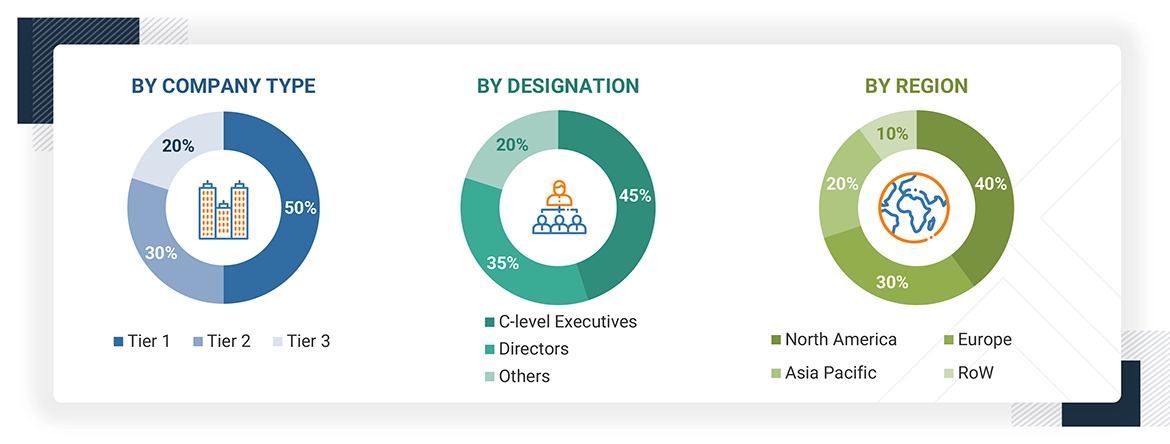
Notes: Other designations include sales & marketing executives and researchers.
The three tiers of the companies are defined based on their total revenue as of 2024; Tier 1: revenue more than or equal to USD 500 million, Tier 2: revenue between USD 100 million and USD 500 million, and Tier 3: revenue less than or equal to USD 100 million.
To know about the assumptions considered for the study, download the pdf brochure
Market Size Estimation
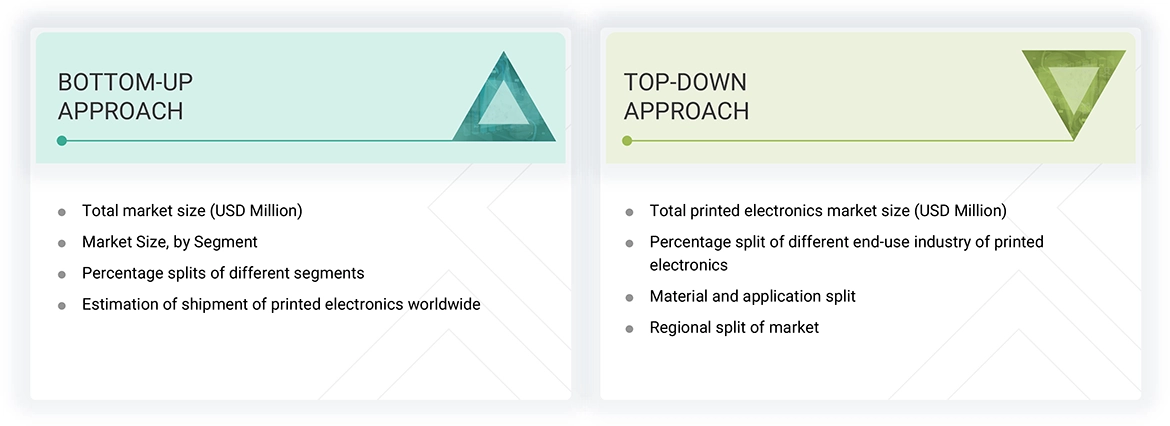
Both the bottom-up and top-down approaches have been adopted to estimate and forecast the size of the printed electronics market.
Bottom-Up Approach
The bottom-up approach has been employed to arrive at the overall size of the printed electronics market. This approach includes estimating the global shipment of printed electronics. This has been followed by the analysis of the average selling prices of global printed electronics. The global market size has been validated through primary interviews with industry stakeholders and subject matter experts.
Approach for obtaining market size using bottom-up analysis (demand side)
- Identifying the companies influencing the entire material market for printed electronics, along with related players
- Analyzing major material manufacturers, studying their portfolios, and understanding the different types of materials offered
- Conducting multiple discussion sessions with key opinion leaders to understand different printed electronic products and their deployment in multiple end-use industries; analyzing the breakup of the work carried out by each key company
- Verifying and cross-checking estimates at every level with key opinion leaders, including chief executive officers (CEO), directors, and operation managers, and then finally with the domain experts of MarketsandMarkets
- Studying various paid and unpaid sources of information, such as annual reports, press releases, white papers, and databases, for the company and region-specific developments undertaken in the printed electronics market
Top-Down Approach
In the top-down approach, the overall size of the printed electronics market has been used to estimate the size of the individual markets (mentioned in the market segmentation) through percentage splits obtained from secondary and primary research. For calculating the size of the specific market segments, the size of the most appropriate and immediate parent market has been used to implement the top-down approach. The bottom-up approach has also been implemented for the data extracted from the secondary research to validate the market size obtained. The sizes of the parent and individual markets have been determined and confirmed in this study by data triangulation and data validation through primaries. The data triangulation procedure used for this study has been explained in the next section.
Approach for obtaining market share using top-down analysis (supply side)
- Focusing initially on top-line investments and expenditures being made in the ecosystem of printed electronics, and listing key developments in key market areas
- Identifying all major players in the printed electronics market by printed electronics-based materials, and their penetration in various end-use industries through secondary research, and verifying through brief discussions with industry experts
- Analyzing revenues, product mix, geographic presence, and key end-use industries for which printed electronics are served by all identified players to estimate and arrive at the percentage splits for all key segments
- Discussing these splits with the industry experts to validate the information and identify key growth pockets across all key segments
- Breaking down the total market based on verified splits and key growth pockets across all segments
Printed Electronics Market : Top-Down and Bottom-Up Approach
Data Triangulation
After arriving at the overall size of the printed electronics market through the process explained above, the total market has been split into several segments and subsegments. Market breakdown and data triangulation procedures have been employed, wherever applicable, to complete the overall market engineering process and arrive at the exact statistics for all segments and subsegments. The data has been triangulated by studying various factors and trends from the demand and supply sides. The market has also been validated using top-down and bottom-up approaches.
Market Definition
Printed electronics is an all-encompassing term referring to the printing method used to create electronic devices by printing on a wide range of substrates. Different technologies, such as screen printing, inkjet printing, or flexographic printing, are used for printing electronic devices on different substrates. Earlier, printed electronics were limited to organic or plastic electronics that used one or more inks made of carbon-based compounds. With the increased demand for compact wearable devices and thinner electronics, printed electronics now form flexible displays, keyboards, antennas, electronic skin patches, and sensors. Printed electronics enable the development of high-quality electronic products, which are thin, flexible, wearable, lightweight, cost-effective, and environmentally friendly.
Key Stakeholders
- Suppliers of raw materials
- Technology investors
- Designers, manufacturers, and suppliers of printed electronic components
- Integrators, suppliers, and service providers of printed electronics equipment
- Government labs
- In-house testing labs
- System integrators
- Distributors, resellers, and traders
- Research institutions and organizations
- Providers of application software
- Printed electronics forums, alliances, consortiums, and associations
- Market research and consulting firms
- End users
Report Objectives
- To describe and forecast the global size of the printed electronics market, in terms of value and volume
- To describe, segment, and forecast the printed electronics market based on printing technology, material, resolution, application, and end-use industry, in terms of value
- To describe and forecast the market for four key regions: North America, Europe, Asia Pacific, and the Rest of the World (RoW), in terms of value
- To describe different substrate transport techniques in printed electronics
- To provide detailed information regarding drivers, restraints, opportunities, and challenges influencing the growth of the printed electronics market
- To provide a detailed overview of the supply chain of the printed electronics ecosystem, along with the average selling prices of printed electronics materials
- To strategically analyze the ecosystem, tariffs & regulations, patent landscape, trade landscape, and case studies pertaining to the market under study
- To strategically analyze micromarkets1 with respect to individual growth trends, prospects, and contributions to the overall market
- To analyze opportunities in the market for stakeholders and provide a competitive landscape of the market
- To analyze competitive developments such as product launches, expansions, partnerships, collaborations, agreements, and acquisitions in the printed electronics market
- To strategically profile the key players in the printed electronics market and comprehensively analyze their market ranking and core competencies2
- To analyze the impact of AI/GenAI, the 2025 US tariff, and the macroeconomic outlook for each region in the printed electronics market
Available Customizations
With the market data given, MarketsandMarkets offers customizations according to the company’s specific needs. The following customization options are available for the report:
Company Information:
- Detailed analysis and profiling of additional market players (up to 7)
Get the Full Printed Electronics Market Report
Full forecast, segment splits, and company analysis for all Printed Electronics Market.
- US Printed Electronics Market
- Canada Printed Electronics Market
- Mexico Printed Electronics Market
- Germany Printed Electronics Market
- UK Printed Electronics Market
- France Printed Electronics Market
- Rest Of Europe Printed Electronics Market
- China Printed Electronics Market
- Japan Printed Electronics Market
- South Korea Printed Electronics Market
- Australia Printed Electronics Market
Need a Tailored Report?
Customize this report to your needs
Get 10% FREE Customization
Customize This Report
