
India Probiotics in Animal Feed Market (2025-2030)

The India Probiotics in Animal Feed Market was valued at $234.2 Million in 2025 and projected to reach to $387.6 Million by 2030, representing a compound annual growth rate of 10.6%. India's probiotics in animal feed market is poised for substantial expansion over the next five years, driven by escalating demand for high-quality protein sources and dairy products.


| Market Size in | USD 26.32 MN |
| Market Forecast in | |
| CAGR | |
| Forecast Period | |
| Units Considered | Value (USD MN) |
India Probiotics in Animal Feed Market Trends and Insights
- This represents a compound annual growth rate (CAGR) of 10.6%, significantly outpacing global averages.
- India's livestock sector, driven by rising meat and dairy consumption, is increasingly adopting probiotic solutions to enhance animal health, improve feed efficiency, and reduce antibiotic dependency. The Indian market is propelled by growing awareness among farmers regarding animal nutrition and gut health management.
- India's expanding poultry and dairy industries are key consumers of probiotic feed additives, supported by government initiatives promoting sustainable livestock practices.
- Between 2025 and 2030, India is expected to witness accelerated adoption of probiotics as regulatory frameworks tighten around antimicrobial use in animal agriculture. India's competitive landscape includes both domestic and international players offering tailored probiotic formulations for regional livestock breeds.
- The market's growth trajectory reflects India's commitment to modernizing its animal husbandry practices while maintaining cost-effectiveness for smallholder farmers..
Key Market Statistics
- CAGR (2025-2030) 10.6% CAGR
- Market Size, 2025 ~USD 234.2 Million
- Forecast, 2030 ~USD 387.6 Million
- Country India
India Probiotics in Animal Feed Market Overview
Market Valuation Growth :
India's probiotics in animal feed market is valued at USD 234.2 million in 2025, with projections reaching USD 387.6 million by 2030, demonstrating strong investor confidence in the sector.
Superior Growth Rate :
India's market CAGR of 10.6% significantly exceeds the global average of 8.9%, positioning the country as a high-growth hub for probiotic animal feed solutions in Asia.
Livestock Sector Expansion :
Rising meat and dairy consumption across India is driving increased adoption of probiotic solutions among livestock farmers seeking improved animal health and productivity.
Regulatory Support & Modernization :
India's growing focus on sustainable animal husbandry practices and government initiatives promoting modern farming techniques are accelerating probiotic adoption in the agricultural sector.
India Probiotics in Animal Feed Market Dynamics
- The country's burgeoning middle class and urbanization trends are fueling consumption patterns that necessitate improved livestock health management.
- Farmers are increasingly recognizing probiotics as cost-effective solutions to enhance feed efficiency, reduce disease incidence, and improve overall animal performance, creating a favorable environment for market penetration. The competitive landscape in India is becoming increasingly dynamic, with both domestic and international players investing in localized production and distribution networks.
- Government support for animal welfare standards, combined with rising awareness among farmers about probiotic benefits, is expected to accelerate market adoption.
- Strategic partnerships between feed manufacturers and probiotic producers will likely drive innovation and market accessibility across rural and semi-urban farming communities throughout the forecast period..
Market Ecosystem
probiotics animal feed market: COMMERCIAL USE CASES ACROSS INDUSTRIES
| COMPANY | USE CASE DESCRIPTION | BENEFITS |
|---|---|---|
 |
Develops science-backed probiotic feed additives such as GutCare® designed to improve gut microbiota balance, reduce harmful pathogens, and enhance feed efficiency in poultry and swine. | Strengthens livestock performance, reduces dependency on antibiotic growth promoters (AGPs), and enhances farm profitability through efficiency gains. |
 |
Offers multi-strain probiotics and tailored nutrition solutions that support digestion, nutrient utilization, and stress management in animals across poultry, swine, and ruminants. | Expands integrated nutrition portfolio, increases brand value in sustainable animal farming, and boosts global market penetration. |
 |
Provides advanced microbial solutions targeting immunity improvement, productivity enhancement, and improved gut integrity for dairy cattle and poultry. | Enhances competitive advantage through innovation leadership, supports premium pricing, and strengthens customer trust in scientific-performance solutions. |
 |
Delivers next-generation microbial probiotics designed to enhance digestive resilience, improve feed conversion, and support healthier animals in intensive farming systems. | Differentiates through strong biotechnology expertise, drives adoption in high-growth markets like aquaculture, and boosts margins with high-value microbial solutions. |
 |
Supplies targeted probiotic formulations that enhance gut health, maintaining a stable microbiome to improve immunity and reduce disease outbreaks in livestock and pets. | Grows presence in value-added feed additives, diversifies revenue streams beyond flavors & ingredients, and supports expansion into companion animal nutrition. |
Logos and trademarks shown above are the property of their respective owners. Their use here is for informational and illustrative purposes only.
Related Ecosystem
Feed And Animal Nutrition
- Animal-Based Sealants
- Camera Systems
- Lactic Acid
- Tricalcium Phosphate
- Citric Acid
- AZELIS HOLDINGS SA
- NOVUS INTERNATIONAL, INC.
- Feedone Co., Ltd.
- NOSAN CORPORATION
- Mitsui & Co., Ltd.
Key Takeaways
- India's probiotics in animal feed market is valued at USD 234.2 million in 2025 and will reach USD 387.6 million by 2030, growing at 10.6% CAGR.
- India's poultry and dairy sectors are primary drivers, with farmers increasingly adopting probiotics to improve feed efficiency and reduce antibiotic use.
- Government regulations restricting antimicrobial use in India are accelerating the shift toward probiotic-based animal nutrition solutions.
- India's cost-sensitive market demands localized probiotic formulations, creating opportunities for both domestic and international manufacturers.
Probiotics in Animal Feed Market Report Scope
| Report Metric | Details |
|---|---|
| Base Year | 2025 |
| Fastest Growing Segment | AQUACULTURE (Livestock) |
| Forecast Period | 2025–2030 |
| Growth Rate | CAGR of 8.9% from 2025 to 2030 |
| Largest Segment | HUMAN (End User) |
| Market Size Base Year (Billions) | ~USD 5.4 (2025) |
| Revenue Forecast (Billions) | ~USD 8.27 (2030) |
| Segments Covered | Source, Type, Livestock, Form, Strain, Distribution Channel, End User |
India Probiotics in Animal Feed Market Report Segmentation
7 segment dimensions are covered across the global market.
By Source
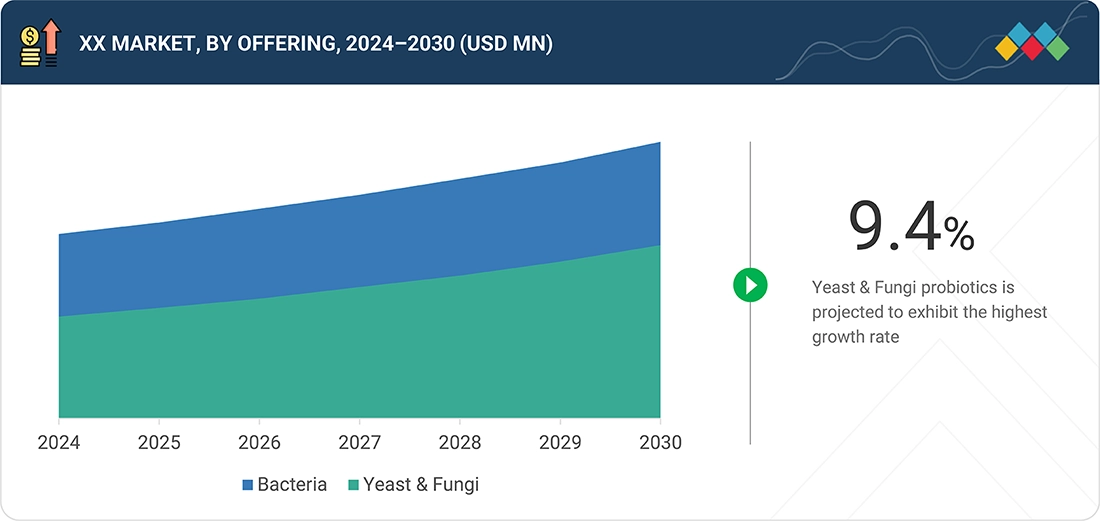
- Bacteria
- Yeast & Fungi
By Type
- Bifidobacteria
- Defluorinated Phosphate
- Dicalcium Phosphate
- Lactobacilli
- Mono-Dicalcium Phosphate
- Monocalcium Phosphate
- Other Types
- Other Yeast & Fungi Sources
- Saccharomyces Boulardii
- Saccharomyces Cerevisiae
- Streptococcus Thermophilus
- Tricalcium Phosphate
By Livestock
- Aquaculture
- Other Livestock
- Pets
- Poultry
- Ruminants
- Swine
By Form
- Dry
- Liquid
By Strain
- Multi-Strain Probiotics
- Single-Strain Probiotics
By Distribution Channel
- Direct Sales To Distributors
- Direct Sales To Livestock Growers & Feed Integrators
- Other Distribution Channels
By End User
- Animal
- Human
Target Audience
- Feed Manufacturers & Distributors : Indian feed producers need market data to develop probiotic-enriched product lines, optimize distribution networks, and compete effectively in the rapidly expanding livestock nutrition segment.
- Livestock Farmers & Cooperatives : Dairy and meat producers require insights into probiotic benefits, cost-effectiveness, and supplier options to make informed purchasing decisions that improve herd health and productivity.
- Probiotic Producers & Suppliers : Domestic and international probiotic manufacturers need India-specific market intelligence to identify growth opportunities, understand regulatory requirements, and develop localized go-to-market strategies.
- Agricultural Investment Firms : Private equity and venture capital investors targeting India's agritech sector require detailed market analysis to evaluate investment opportunities and assess growth potential in animal nutrition.
- Government & Policy Bodies : Agricultural ministries and regulatory agencies need market data to develop livestock health policies, set industry standards, and align probiotic adoption with national food security objectives.
Key Companies in the India Probiotics in Animal Feed Market
| Company | HQ | Ownership | Strongest segments |
|---|---|---|---|
| ORIGIN ENTERPRISES PLC | Ireland | Public Company | Agronomy advice and on-farm services,Seed, crop protection, nutrition, and biologicals,Fertilizer blending and distribution, |
| FEED ONE CO., LTD. | Japan | Public Company | Poultry feed (layers, breeders, broilers, quail),Pig feed (nursery, grow-finish, sow diets),Cattle feed (dairy, beef, wagyu), |
| NOSAN CORPORATION | Japan | Private Company | Poultry feed (layers, broilers) and iodine-enriched eggs,Swine, dairy, and beef cattle feed,Aquaculture feed (fish, eels, prawns, abalones, bivalves, hatchery), |
| CERMAQ GROUP AS | Norway | Private Company | Atlantic salmon,Trout,Coho and other salmonids, |
| ADM | United States | Public Company | Ag Services and Oilseeds,Carbohydrate Solutions,Nutrition (human and animal), |
| DSM-FIRMENICH | Switzerland | Public Company | Perfumery & Beauty,Taste, Texture & Health,Health, Nutrition & Care, |
| EVONIK INDUSTRIES AG | Germany | Public Company | Advanced Technologies,Custom Solutions,Infrastructure, |
| INTERNATIONAL FLAVORS & FRAGRANCES INC. | United States | Public Company | Taste,Food Ingredients,Health & Biosciences, |
| LAND O'LAKES, INC. | United States | Private Company | Farmer-facing conservation and climate-smart practice programs,Scope 3 emissions quantification and data platforms,Carbon market and ecosystem services access, |
| PHIBRO ANIMAL HEALTH CORPORATION | United States | Public Company | Animal Health (antibacterials, anticoccidials, nutritional specialties, vaccines and adjuvants),Mineral Nutrition (trace mineral formulations and concentrations),Performance Products and Microbial/Bioproducts, |
| CHURCH & DWIGHT CO., INC | United States | Public Company | Fabric and home care (ARM & HAMMER, OXICLEAN, XTRA, deodorizers, cat litter),Personal care and wellness (TROJAN, FIRST RESPONSE, NAIR, ORAJEL, ZICAM, HERO, TOUCHLAND, THERABREATH),Beauty and devices (BATISTE, WATERPIK, select premium SKUs), |
| VIRBAC | France | Public Company | Companion animal therapeutics (vaccines, antibiotics, parasiticides, anti-inflammatories),Companion animal specialty & behavior (dermatology, dental, Zenidog/Zenifel, Ursolyx, chronic-care),Farm animal vaccines (Suigen swine portfolio and related biologics), |
ORIGIN ENTERPRISES PLC
Origin Enterprises PLC is an Irish public company founded in 2006 with 2,997 employees. The company operates as a significant player in its sector with a substantial workforce across its operations.
FEED ONE CO., LTD.
Feed One Co., Ltd. is a Japanese public company established in 2014 with 935 employees. The company has grown to become a notable enterprise in its industry.
NOSAN CORPORATION
Nosan Corporation is a Japanese private company with a long history, founded in 1931 and employing 1,079 people. The company has established itself as a longstanding enterprise in its market.
CERMAQ GROUP AS
Cermaq Group AS is a Norwegian private company founded in 1994 with 4,361 employees. The company operates as a substantial organization within its industry.
ADM
ADM is a United States-based public company with roots dating back to 1902 and 41,147 employees. The company is one of the largest enterprises in its sector globally.
DSM-FIRMENICH
DSM-Firmenich is a Swiss public company founded in 1902 with 26,873 employees. The company operates as a major multinational organization in its field.
EVONIK INDUSTRIES AG
Evonik Industries AG is a German public company with a history extending back to 1847 and 30,643 employees. The company is a significant global player in its industry.
INTERNATIONAL FLAVORS & FRAGRANCES INC.
International Flavors & Fragrances Inc. is a United States-based public company founded in 1909 with 21,500 employees. The company operates as a major multinational enterprise.
LAND O'LAKES, INC.
Land O'Lakes, Inc. is a United States-based private company founded in 1921 with 10,000 employees. The company has established itself as a substantial organization in its sector.
PHIBRO ANIMAL HEALTH CORPORATION
Phibro Animal Health Corporation is a United States-based public company founded in 1946 with 2,475 employees. The company operates as an established player in its industry.
CHURCH & DWIGHT CO., INC
Church & Dwight Co., Inc. is a United States-based public company with origins dating to 1846 and 5,550 employees. The company is a long-established enterprise in its market.
VIRBAC
Virbac is a French public company founded in 1968 with 6,442 employees. The company operates as a notable multinational organization in its sector.
Reasons to Buy this Report
- India-Specific Market Sizing : Access precise valuation data for India's probiotics in animal feed market with detailed 2025-2030 forecasts, enabling accurate business planning and investment decisions tailored to the Indian market context.
- Competitive Landscape Analysis : Understand India's unique competitive dynamics, including domestic players, international entrants, and emerging startups, with insights into market positioning strategies specific to Indian agricultural conditions.
- Livestock Sector Drivers : Identify key growth catalysts unique to India including rising meat/dairy consumption, government livestock policies, and farmer adoption patterns to capitalize on emerging opportunities.
- Regional Distribution Insights : Gain actionable intelligence on India's regional variations in probiotic adoption across different states, farming communities, and livestock segments for targeted market entry strategies.
- Strategic Investment Guidance : Leverage India-focused market intelligence to identify high-potential segments, partnership opportunities, and expansion strategies aligned with the country's 10.6% CAGR growth trajectory.
Frequently asked questions
What is the current market size of probiotics in animal feed in India?
India's probiotics in animal feed market was valued at USD 234.2 million in 2025 and is projected to grow to USD 387.6 million by 2030.
What is the growth rate of India's probiotics in animal feed market?
India's probiotics in animal feed market is growing at a compound annual growth rate (CAGR) of 10.6% from 2025 to 2030.
Which livestock sectors drive India's probiotics market?
India's poultry and dairy industries are the primary consumers of probiotic feed additives, supported by rising meat and dairy consumption.
What factors are accelerating probiotic adoption in India?
India's adoption of probiotics is driven by regulatory restrictions on antimicrobials, growing farmer awareness of animal nutrition, and government initiatives promoting sustainable livestock practices.
How does India's market growth compare to global trends?
India's probiotics in animal feed market is growing at 10.6% CAGR, significantly outpacing the global average of 8.9% CAGR.
RESEARCH METHODOLOGY
The study involved two major approaches in estimating the current size of the probiotics in animal feed market. Exhaustive secondary research was done to collect information on the market, peer, and parent markets. The next step was to validate these findings, assumptions, and sizing with industry experts across the value chain through primary research. Both top-down and bottom-up approaches were employed to estimate the complete market size. After that, market breakdown and data triangulation were used to estimate the market size of segments and subsegments.
Secondary Research
This research study involved the extensive use of secondary sources—directories and databases such as Bloomberg Businessweek and Factiva—to identify and collect information useful for a technical, market-oriented, and commercial study of the market.
In the secondary research process, various sources such as the International Probiotics Association (IPA), American Feed Industry Association (AFIA), annual reports, press releases & investor presentations of companies, white papers, food journals, certified publications, articles from recognized authors, gold & silver standard websites, directories, and databases were referred to identify and collect information.
Secondary research was used to obtain key information about the industry’s supply chain, the total pool of key players, and market classification and segmentation as per the industry trends to the bottom-most level, regional markets, and key developments from the market- and technology-oriented perspectives.
Primary Research
The market comprises several stakeholders in the supply chain: suppliers, manufacturers, and end-use product manufacturers. Various primary sources from the supply and demand sides of the market were interviewed to obtain qualitative and quantitative information.
In the primary research process, various sources from the supply and demand sides were interviewed to obtain qualitative and quantitative information. The primary sources from the supply side included industry experts, such as CEOs, vice presidents, marketing directors, technology and innovation directors, and related key executives from various key companies and organizations operating in the manufacturing of probiotics in animal feed market. The primary interviewees from the demand side include feed mills, livestock growers, feed integrators, and co-operatives of the feed industry.
After the complete market engineering (which included calculations for market statistics, market breakdown, market size estimations, market forecasting, and data triangulation), extensive primary research was conducted to gather information and to verify and validate the critical numbers arrived at. Primary research was also conducted to identify the segmentation types, industry trends, key players, competitive landscape of probiotics in animal feed supplied by different market players, and key market dynamics, such as drivers, restraints, opportunities, industry trends, and key player strategies.
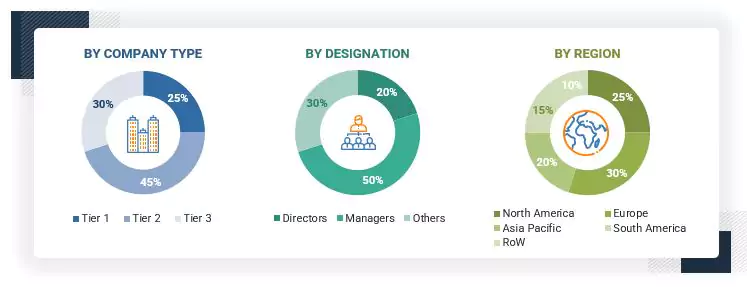
Note: The three tiers of the companies are defined based on their total revenues in 2023 or 2024,
as per the availability of financial data: Tier 1: Revenue > USD 1 billion; Tier 2: USD
100 million ≤ Revenue ≤ USD 1 billion; Tier 3: Revenue < USD 100 million.
To know about the assumptions considered for the study, download the pdf brochure
|
COMPANY NAME |
DESIGNATION |
|
Evonik Industries AG (Germany) |
R&D Expert |
|
ADM (US) |
Sales Manager |
|
DSM-Firmenich (Switzerland) |
Manager |
|
International Flavors & Fragrances Inc. (US) |
Sales Manager |
|
Sanzyme Biologics (India) |
Marketing Manager |
Market Size Estimation
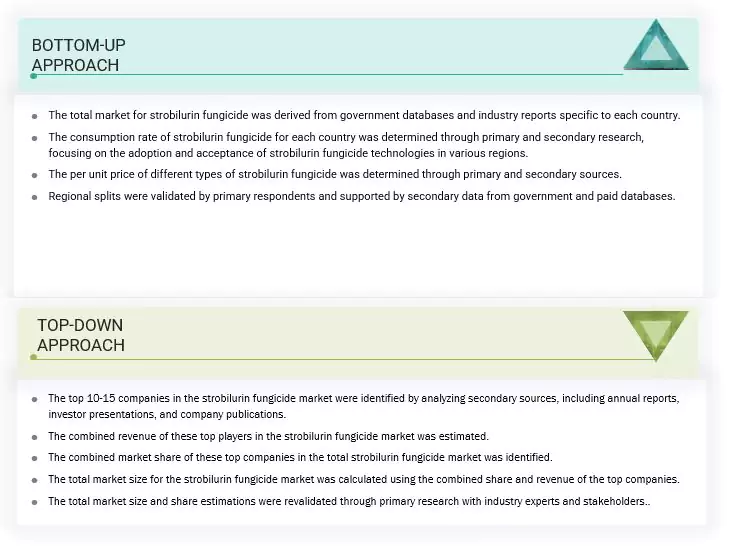
Both top-down and bottom-up approaches were used to estimate and validate the market's total size. These approaches were also used extensively to determine the size of various subsegments in the market. The research methodology used to estimate the market size includes the following details:
- The key players in the industry and the markets were identified through extensive secondary research.
- The probiotics in animal feed market was determined through primary and secondary research.
- All percentage shares, splits, and breakdowns were determined using secondary sources and verified through primary sources.
- All macroeconomic and microeconomic factors affecting the growth of the probiotics in animal feed market were considered while estimating the market size.
- All possible parameters that affect the market covered in this research study were accounted for, viewed in extensive detail, verified through primary research, and analyzed to obtain final quantitative and qualitative data.
Probiotics in Animal Feed Market : Top-Down and Bottom-Up Approach
Data Triangulation
After arriving at the overall market size from the estimation process explained above, the total market was split into several segments and subsegments. The data triangulation and market breakdown procedures were employed, wherever applicable, to estimate the overall probiotics in animal feed market and arrive at the exact statistics for all segments and subsegments. The data was triangulated by studying various factors and trends from the demand and supply sides. The market size was also validated using both the top-down and bottom-up approaches.
Market Definition
The Food and Agriculture Organization of the United Nations (FAO) and World Health Organization (WHO) Working Group define probiotics as “live micro-organisms which, when administered in adequate amounts, confer a health benefit on the host. However, there are several types, including bacteria or non-bacterial; spore-forming and non-spore-forming; multi-species or single-species; and allochthonous or autochthonous; those are that are or aren’t likely to be found in an animal’s gastrointestinal tract (FAO/WHO, 2001).”
The probiotics in animal feed market is defined as the segment of the animal nutrition industry focused on the production, distribution, and use of live beneficial microorganisms—primarily bacteria and sometimes yeasts or fungi—added to animal feed to enhance gut health, immunity, productivity, and overall well-being of livestock such as poultry, swine, ruminants, aquaculture species, and pets. According to the Food and Agriculture Organization (FAO) and World Health Organization (WHO), probiotics are “live micro-organisms which when administered in adequate amounts confer a health benefit on the host,” and in the context of animal feed, these microorganisms are used as natural alternatives to antibiotics, supporting sustainable and efficient animal farming practices. The market encompasses a wide range of stakeholders, including manufacturers, feed processors, livestock producers, veterinarians, and regulatory authorities, all working towards improving animal health and productivity through the adoption of probiotic feed additives.
Stakeholders
- Raw material suppliers of probiotics used in animal feed
- Intermediate stakeholders, including distributors, retailers, associations, and regulatory bodies
- Manufacturers and traders of probiotics used in animal feed
- Manufacturers and processors of animal feed and farmers
- Trade associations and industry bodies
- Government organizations, research organizations, and consulting firms
- Importers and exporters of probiotics incorporated animal feed
-
Associations, regulatory bodies, and other industry-related bodies:
- Food and Agriculture Organization (FAO)
- European Food and Fermentation Cultures Association (EFFCA)
- International Scientific Association for Probiotics and Prebiotics (ISAPP)
- International Probiotics Association (IPA)
- American Feed Industry Association (AFIA)
- United States Department of Agriculture (USDA)
- Organisation for Economic Co-operation and Development (OECD)
Report Objectives
- Determining and projecting the size of the market for probiotics in animal feed, with respect to its source, livestock, form, strain specificity, function, distribution channel and regional markets
- Identifying the attractive opportunities in the market by determining the largest and fastest-growing segments across regions
- Understanding the market trends with respect to the function of probiotics in animal feed and distribution channels
- Providing detailed information about the key factors influencing the market growth
- (drivers, restraints, opportunities, and industry-specific challenges)
- Providing the regulatory framework for major countries related to the market for probiotics in animal feed
- Analyzing the micro-markets with respect to individual growth trends, prospects, and their contribution to the total market
Available Customizations
With the given market data, MarketsandMarkets offers customizations according to company-specific scientific needs.
The following customization options are available for the report:
Product Analysis
- Service Matrix, which gives a detailed comparison of the service portfolio of each company.
Geographic Analysis as per Feasibility
With the given market data, MarketsandMarkets offers customizations according to company-specific scientific needs.
- Further breakdown of the Rest of European probiotics in animal feed market into key countries.
- Further breakdown of the Rest of Asia Pacific probiotics in animal feed market into key countries.
- Further breakdown of the Rest of South American probiotics in animal feed market into key countries.
Company Information
- Detailed analyses and profiling of additional market players (up to five)
Get the Full Probiotics in Animal Feed Market Report
Full forecast, segment splits, and company analysis for all Probiotics in Animal Feed Market.
- US Probiotics in Animal Feed Market
- Canada Probiotics in Animal Feed Market
- Mexico Probiotics in Animal Feed Market
- Germany Probiotics in Animal Feed Market
- UK Probiotics in Animal Feed Market
- France Probiotics in Animal Feed Market
- Spain Probiotics in Animal Feed Market
- Italy Probiotics in Animal Feed Market
- China Probiotics in Animal Feed Market
- Japan Probiotics in Animal Feed Market
- Brazil Probiotics in Animal Feed Market
- Argentina Probiotics in Animal Feed Market
- South America Probiotics in Animal Feed Market
Need a Tailored Report?
Customize this report to your needs
Get 10% FREE Customization
Customize This Report
