
Latin America Property Management Market (2024-2029)

The Latin America Property Management Market was valued at $2248.4 Million in 2024 and projected to reach to $3705.2 Million by 2029, representing a compound annual growth rate of 8.7%. Latin America's property management market is positioned for sustained expansion driven by urbanization, technological adoption, and increasing demand for automated solutions across both residential and commercial real estate sectors.


| Market Size in | USD 26.32 MN |
| Market Forecast in | |
| CAGR | |
| Forecast Period | |
| Units Considered | Value (USD MN) |
Latin America Property Management Market Trends and Insights
- Latin America's market expansion is driven by increasing urbanization, rising demand for automated property solutions, and growing adoption of cloud-based management platforms across residential and commercial sectors.
- In 2024, Latin America represents a significant opportunity for technology vendors seeking to penetrate emerging markets with scalable property management solutions. By 2029, Latin America's property management market is expected to demonstrate accelerating momentum as digital transformation initiatives gain traction across the region.
- Latin America's growth trajectory outpaces global averages, reflecting strong demand from property owners and managers seeking operational efficiency and tenant engagement tools.
- The forecast period through 2029 will see Latin America increasingly adopt integrated platforms that combine lease management, maintenance tracking, and financial reporting capabilities..
Key Market Statistics
- CAGR (2024-2029) 8.7% CAGR
- Market Size, 2024 ~USD 2248.4 Million
- Forecast, 2029 ~USD 3705.2 Million
- Geography Latin America
Latin America Property Management Market Overview
Strong Regional Growth Trajectory :
Latin America's property management market is expanding at 8.7% CAGR, outpacing the global average of 8.3%, demonstrating the region's accelerating digital transformation in real estate operations.
Urbanization Driving Demand :
Rapid urbanization across Latin America is fueling demand for sophisticated property management solutions, as cities expand and property portfolios become increasingly complex and distributed.
Cloud-Based Platform Adoption :
Growing adoption of cloud-based management platforms across residential and commercial sectors is modernizing property operations, reducing costs, and improving tenant experiences throughout Latin America.
Market Valuation & Forecast :
The market is valued at $2,248.4 million in 2024 and is projected to reach $3,705.2 million by 2029, representing a 64.8% increase over the five-year forecast period.
Latin America Property Management Market Dynamics
- The region's 8.7% CAGR reflects strong investor confidence and growing recognition of digital property management's value proposition.
- Cloud-based platforms are becoming standard, enabling property managers to streamline operations, enhance tenant engagement, and optimize asset performance across geographically dispersed portfolios. The forecast period through 2029 presents significant opportunities as Latin American property owners and managers increasingly prioritize operational efficiency and data-driven decision-making.
- Rising middle-class populations, commercial real estate expansion, and regulatory pressures for transparency are accelerating technology adoption.
- Market players investing in localized solutions, integration capabilities, and customer support will capture substantial growth as the region transitions from traditional management practices to modern, cloud-enabled ecosystems..
Market Ecosystem
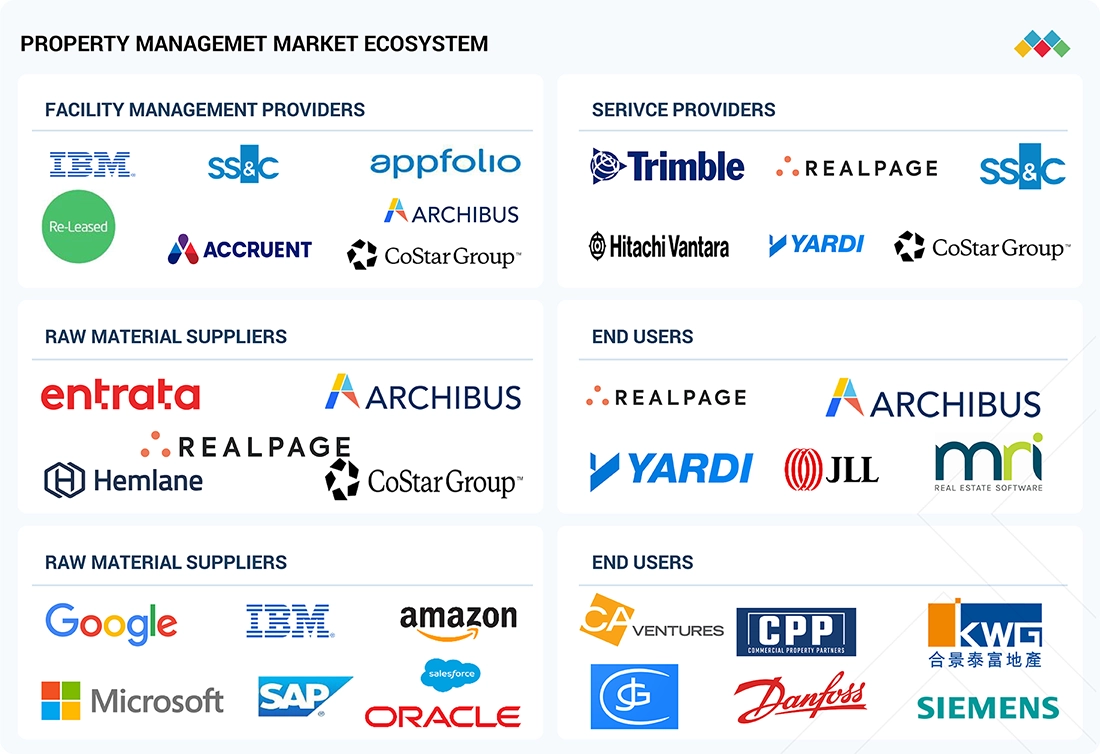
Property Management Market: COMMERCIAL USE CASES ACROSS INDUSTRIES
| COMPANY | USE CASE DESCRIPTION | BENEFITS |
|---|---|---|
 |
Commercial Property Partners (CPP) replaced manual spreadsheets and Sage with Re-Leased, a cloud-based property management software integrated with Xero accounting. The solution automated invoicing, centralized lease data, and delivered real-time insights to support seamless remote and in-office operations. | Administrative tasks like invoicing were reduced from a full day to 30 minutes. Cloud scalability improved flexibility, while automation enhanced accuracy and productivity, enabling CPP to expand operations without additional manual overheads. |
 |
Siemens Real Estate (SRE), managing 15 million square meters across 2,400 sites, deployed Planon’s cloud-based Real Estate Management (REM) software. The solution integrated facility management and lifecycle management into a centralized platform for global portfolio oversight. | The platform standardized processes across locations, reduced IT costs, and enhanced efficiency. Real-time data and analytics improved decision-making, delivering productivity gains and cost savings across Siemens’ global real estate operations. |
 |
JG Capital Realty Inc., facing limited international exposure, adopted CoStar and LoopNet to strengthen market reach. Leveraging digital platforms, the firm expanded visibility and tapped into international investors, particularly across the US market. | Using CoStar and LoopNet significantly increased the firm's visibility, resulting in a 25% revenue boost and a 70% increase in listings. The solution also saved time, reduced research effort, and enabled faster deal closures, thus enhancing the company's competitiveness. |
Logos and trademarks shown above are the property of their respective owners. Their use here is for informational and illustrative purposes only.
Related Ecosystem
Software And Services
- Natural Language Processing (NLP)
- Machine Learning
- Supply Chain Management
- Predictive Analytics
- Image Sensors
- International Business Machines Corporation
- MICROSOFT CORPORATION
- Oracle Corporation
- SAP SE
- Amazon.com, Inc.
Key Takeaways
- Latin America's property management market will grow from $2,248.4M (2024) to $3,705.2M (2029) at an 8.7% CAGR.
- Latin America's growth rate exceeds global average, driven by urbanization and digital transformation initiatives.
- Cloud-based and integrated property management solutions are gaining significant traction across Latin America.
- Latin America presents a high-opportunity market for vendors targeting emerging economies with scalable technology platforms.
Property Management Market Report Scope
| Report Metric | Details |
|---|---|
| Base Year | 2024 |
| Fastest Growing Segment | PRESCRIPTIVE ANALYTICS (Technology) |
| Forecast Period | 2024-2029 |
| Growth Rate | CAGR of 8.3% from 2024 to 2029 |
| Largest Segment | SOFTWARE (Offering) |
| Market Size Base Year (Billions) | ~USD 26.51 (2024) |
| Revenue Forecast (Billions) | ~USD 42.78 (2029) |
| Segments Covered | Offering, Type, Software Type, Deployment Mode, Channel Mode, Services, Professional Service Type, Property Type, End User, Lease Management Software Type, Mode Of Channel, Professional Services, Lease Management Type, Solution, Service, Vertical, Data Source, Technology, Application |
Latin America Property Management Market Report Segmentation
19 segment dimensions are covered across the global market.
By Offering
- Services
- Software
- Solutions
By Type
- Apartments
- Association Management
- Construction Sites
- Dod Facilities
- Educational Institutes
- Energy & Utilities
- Facility Property Management
- Federal, State, & Local Government Office Buildings
- Gated Communities
- Healthcare Institutions
- Law Enforcement Facilities
- Lease Management
- Logistics & Distribution Centers
- Manufacturing Facilities/ Plants
- Marketing & Tenant Communication
- Military Bases & Installations
- Offices & Coworking Spaces
- Other Commercial Property Type
- Other Government & Military Property Types
- Other Industrial Property Types
- Other Residential Property Types
- Public Housing Authorities
- Reporting & Analytics
- Retail Spaces
- Security & Payments
- Villas Compounds
By Software Type
- AI Lease Abstraction
- Document Storage & Management
- Facility Management
- Facility Property Management
- Lease Accounting & Administration
- Lease Management
- Marketing & Tenant Communications
- Portfolio Management
- Reporting & Analytics
- Security & Payments
- Tenant & Lease Tracking
By Deployment Mode
- Cloud
- On-Premises
By Channel Mode
- App-Based
- Web-Based
By Services
- Managed
- Professional
By Professional Service Type
- Customer Support
- Onboarding
- Sla Management
- Training & Consulting
By Property Type
- Commercial
- Government & Military
- Industrial
- Mixed-Use
- Residential
- Vacation Homes
By End User
- Bfsi
- Energy & Utilities
- Facility Managers
- Franchise Operators
- Government & Defense
- Government Agencies
- Healthcare & Life Sciences
- Housing Associations
- It & Ites
- Manufacturing
- Other End Users
- Property Management Firms
- Property Managers & Real Estate Agents
- Property Managers And Real Estate Agents
- Real Estate Investors/ Developers & Owners
- Real Estate Investors/Developers And Owners
- Retail & Ecommerce
- Telecommunication
- Tenants/ Residents
- Tenants/Residents
- Transportation & Logistics
By Lease Management Software Type
- AI Lease Abstraction
- Document Storage & Management
- Lease Accounting & Administration
- Portfolio Management
- Tenant & Lease Tracking
By Mode Of Channel
- App-Based
- Web-Based
By Professional Services
- Customer Support
- Onboarding
- Sla Management
- Training & Consulting
By Lease Management Type
- AI Lease Abstraction
- Document Storage & Management
- Lease Accounting & Administration
- Portfolio Management
- Tenant & Lease Tracking
By Solution
- Bim
- Facility Environment Management
- Facility Operations And Security Management
- Facility Property Management
- Iwms
By Service
- Managed Services
- Professional Services
By Vertical
- Bfsi
- Construction & Real Estate
- Education
- Government & Public Sector
- Healthcare & Life Sciences
- It & Ites
- Manufacturing
- Other Verticals
- Retail
- Telecom
- Travel & Hospitality
By Data Source
- Agent Data
- Human Data
- Machine Data
- Synthetic Data
- Wire Data
By Technology
- Descriptive Analytics
- Diagnostic Analytics
- Predictive Analytics
- Prescriptive Analytics
By Application
- Anomaly Detection & Root Cause Analysis
- Application Performance Monitoring
- Infrastructure Management
- It Service Management
- Log Management & Analysis
- Network Management
- Other Applications
- Security & Event Management
Target Audience
- Property Management Software Vendors : SaaS and software providers need Latin America market data to develop localized solutions, identify expansion opportunities, and understand regional adoption barriers and preferences.
- Real Estate Investment Firms : REITs and property investors require market insights to assess technology spending trends, operational efficiency gains, and competitive positioning of property management solutions in Latin America.
- Technology Consultants & Integrators : Implementation partners and consultants need regional market intelligence to advise clients on technology selection, benchmark costs, and identify best practices for Latin American property portfolios.
- Property Management Companies : Regional and local property managers need competitive intelligence and market forecasts to guide technology investments, service expansion, and strategic positioning in their respective Latin American markets.
- Private Equity & Strategic Investors : Investment firms evaluating acquisitions or partnerships in Latin America's property management sector require market sizing, growth projections, and competitive analysis to support due diligence.
Countries within Latin America - compare and drill down
| Country | 2025 size (native) |
|---|---|
| Brazil | USD 1106.7 Million |
| Mexico | USD 1071.5 Million |
| Argentina | USD 875.8 Million |
| Rest Of Latin America | USD 651.2 Million |
Country market size visualization
Reasons to Buy this Report
- Regional Market Intelligence : Gain comprehensive insights into Latin America's $2.2B property management market with detailed forecasts through 2029, enabling informed strategic planning and investment decisions specific to the region.
- Growth Opportunity Identification : Identify high-growth segments and emerging opportunities across Latin America's urbanizing markets, where cloud adoption and automation are creating new revenue streams for technology providers.
- Competitive Landscape Analysis : Understand competitive dynamics, market consolidation trends, and key player strategies specific to Latin America's property management sector to benchmark performance and identify differentiation opportunities.
- Country-Level Breakdown : Access granular market data for Brazil, Mexico, Argentina, and other Latin American countries, enabling targeted go-to-market strategies and localized product development initiatives.
- Technology Adoption Trends : Analyze cloud platform adoption rates, automation preferences, and digital transformation priorities among Latin American property managers to align product roadmaps with regional demand.
Frequently asked questions
What is the current size of the property management market in Latin America?
In 2024, Latin America's property management market is valued at $2,248.4 million USD.
What is the projected market size for Latin America by 2029?
Latin America's property management market is forecast to reach $3,705.2 million USD by 2029.
What is the CAGR for Latin America's property management market?
Latin America's property management market is expected to grow at a compound annual growth rate of 8.7% from 2024 to 2029.
What factors are driving growth in Latin America's property management market?
Latin America's market growth is driven by urbanization, increased demand for automation, cloud adoption, and digital transformation across residential and commercial property sectors.
How does Latin America's growth compare to the global property management market?
Latin America's 8.7% CAGR outpaces the global market CAGR of 8.3%, indicating stronger regional momentum and emerging market opportunity.
RESEARCH METHODOLOGY
This research study involves the extensive use of secondary sources, directories, and databases, such as D&B Hoovers, Bloomberg Businessweek, and Factiva, to identify and collect information useful for this technical, market-oriented, and commercial study of the property management market. The primary sources are mainly industry experts from the core and related industries, preferred property management systems, software, and service providers, third-party service providers, consulting service providers, end users, and other commercial enterprises. In-depth interviews have been conducted with various primary respondents, including key industry participants and subject matter experts, to obtain and verify critical qualitative and quantitative information, as well as to assess the growth prospects. The following figure highlights the market research methodology applied to make the property management market report.
Secondary Research
In the secondary research process, various secondary sources have been referred to for identifying and collecting information for the study. The secondary sources include annual reports, press releases, and investor presentations of companies, white papers, certified publications, and articles from recognized associations and government publishing sources. Several journals and various associations have also been referred to, such as the Journal of Property Management (JPM), Journal of Real Estate Research (JRER), Building Owners and Managers Association (BOMA) International and National Apartment Association (NAA).
Secondary research has been mainly used to obtain key information about industry insights, the market's monetary chain, the overall pool of key players, market classification and segmentation according to industry trends to the bottom-most level, regional markets, and key developments from both market- and technology-oriented perspectives.
Primary Research
In the primary research process, various primary sources from both supply and demand sides have been interviewed to obtain qualitative and quantitative information on the market. The primary sources from the supply side include various industry experts, including Chief Technology Officers (CTOs); Vice Presidents (VPs); directors from business development, marketing, and product development/innovation teams; related key executives from property management solution and service vendors, system integrators, professional and managed service providers, industry associations, and consultants; and key opinion leaders.
Primary interviews have been conducted to gather insights, such as market statistics, data of revenue collected from solutions and services, market breakups, market size estimations, market forecasts, and data triangulation. Primary research also helps understand various trends related to technology, application, deployment, and region. Stakeholders from the demand side, such as Chief Information Officers (CIOs), Chief Finance Officers (CFOs), and Chief Strategy Officers (CSOs), and the installation team of end users who use property management solutions, have been interviewed to understand the buyer's perspective on suppliers, products, service providers, and their current usage of property management solutions, which is expected to affect the overall property management market growth.
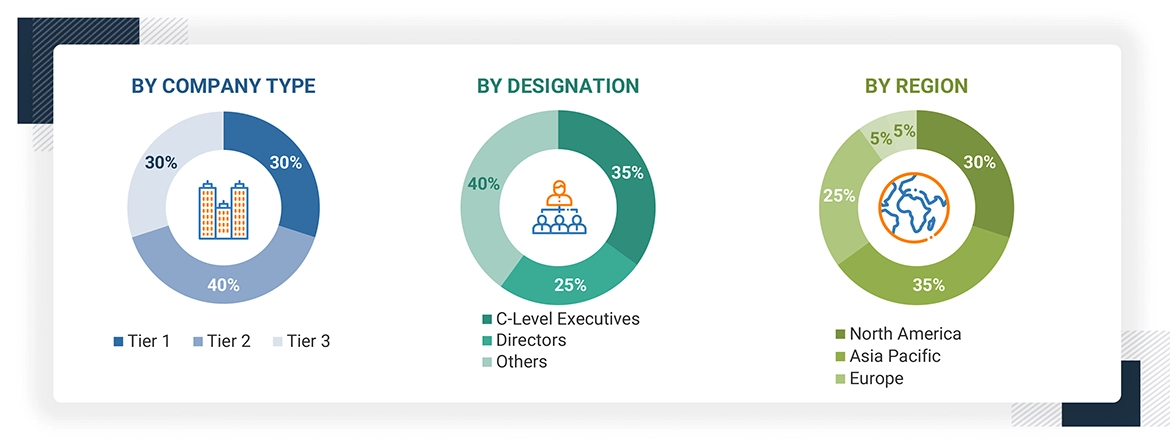
Note 1: Others include sales managers, marketing managers, and product managers.
Note 2: Tier 1 companies’ revenues are more than USD 10 billion; tier 2 companies’ revenues range
between USD 1 and 10 billion; and tier 3 companies’ revenues range between USD 500 million and USD 1 billion.
Source: Industry Experts
To know about the assumptions considered for the study, download the pdf brochure
Market Size Estimation
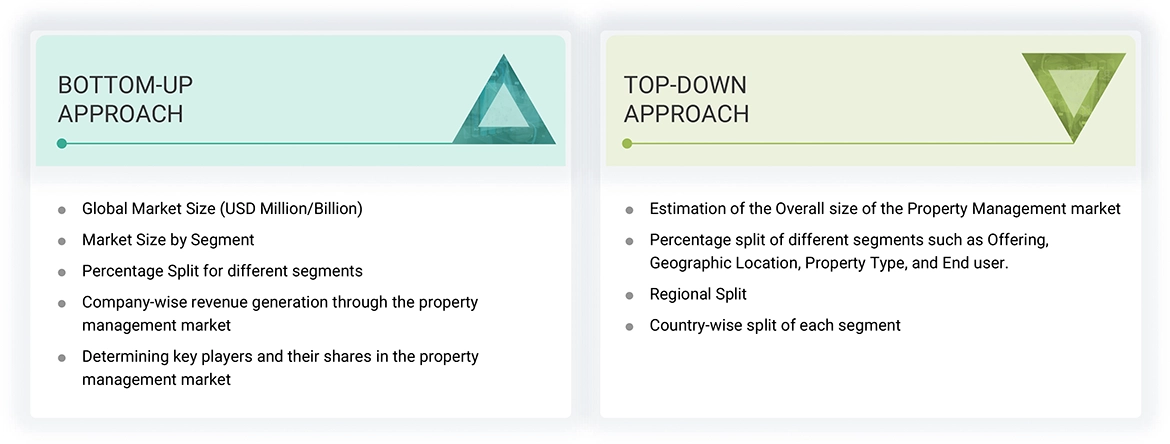
Multiple approaches were adopted for estimating and forecasting the property management market. The first approach involves estimating the market size by companies’ revenue generated through the sale of property management products.
Market Size Estimation Methodology- Top-down approach
In the top-down approach, an exhaustive list of all the vendors offering products in the property management market was prepared. The revenue contribution of the market vendors was estimated through annual reports, press releases, funding, investor presentations, paid databases, and primary interviews. Each vendor's offerings were evaluated based on the breadth of product type, deployment mode, architecture, and end user. The aggregate of all the companies’ revenue was extrapolated to reach the overall market size. Each subsegment was studied and analyzed for its global market size and regional penetration. The markets were triangulated through both primary and secondary research. The primary procedure included extensive interviews for key insights from industry leaders, such as CIOs, CEOs, VPs, directors, and marketing executives. The market numbers were further triangulated with the existing MarketsandMarkets repository for validation.
Market Size Estimation Methodology-Bottom-up approach
In the bottom-up approach, the adoption rate of property management products among different verticals in key countries with respect to their regions contributing the most to the market share was identified. For cross-validation, the adoption of property management products among enterprises, along with different use cases with respect to their regions, was identified and extrapolated. Weightage was given to use cases identified in different regions for the market size calculation.
Based on the market numbers, the regional split was determined by primary and secondary sources. The procedure included the analysis of the property management market’s regional penetration. Based on secondary research, the regional spending on Information and Communications Technology (ICT), socio-economic analysis of each country, strategic vendor analysis of major property management providers, and organic and inorganic business development activities of regional and global players were estimated. With the data triangulation procedure and data validation through primaries, the exact values of the overall property management market size and segments’ size were determined and confirmed using the study.
Property Management Market : Top-Down and Bottom-Up Approach
Data Triangulation
After arriving at the overall market size using the market size estimation processes as explained above, the market was split into several segments and subsegments. To complete the overall market engineering process and arrive at the exact statistics of each market segment and subsegment, data triangulation and market breakup procedures were employed, wherever applicable. The overall market size was then used in the top-down procedure to estimate the size of other individual markets via percentage splits of the market segmentation.
Market Definition
Property management software is designed to help property managers and landlords efficiently manage various aspects of their real estate properties, including tenant management, maintenance tracking, and financial management for both residential and commercial spaces. This software streamlines and automates tasks related to property operations, financial management, tenant engagement, and overall lease administration. Moreover, property management software provides a broad view of property operations, and lease management software focuses on the details of individual leases.
Stakeholders
- Property management vendors
- Property Owners
- Tenants
- Real Estate Technology Providers
- Real Estate Developers
- Regulatory Bodies and Governments
- Service Providers
- Financial Institutions and Investors
- Consultants and Advisors
- Insurance Providers
- Industry Associations and Advocacy Groups
Report Objectives
- To define, describe, and predict the property management market by offering, geographic location, property type, end user, and region
- To describe and forecast the market, in terms of value, by region—North America, Europe, Asia Pacific, the Middle East & Africa, and Latin America
- To provide detailed information regarding major factors influencing the market growth (drivers, restraints, opportunities, and challenges)
- To strategically analyze micro markets with respect to individual growth trends, prospects, and contributions to the overall market
- To profile key players and comprehensively analyze their market positions in terms of ranking and core competencies, along with detailing the competitive landscape for market leaders
- To analyze competitive developments such as mergers and acquisitions, partnerships, collaborations, product launches and enhancements, and ongoing research and development (R&D) in the market
- To provide the illustrative segmentation, analysis, and projection of the main regional markets.
Note 1: Micromarkets refer to further segments and subsegments of the property management market included in the report.
Note 2:Companies' core competencies were captured in terms of their key developments and key strategies for sustaining their position in the market.
Available Customizations
With the given market data, MarketsandMarkets offers customizations as per the company’s specific needs. The following customization options are available for the report:
Product Analysis
- The product matrix provides a detailed comparison of the product portfolio of each company.
Geographic Analysis as per Feasibility
- Further breakup of the property management market
- Further breakup of the European property management Market
- Further breakup of the Asia Pacific property management Market
- Further breakup of the Middle East & Africa property management Market
- Further breakup of the Latin American logistics property management Market
Company Information
- Detailed analysis and profiling of additional market players (up to five)
Get the Full Property Management Market Report
Full forecast, segment splits, and company analysis for all Property Management Market.
- Canada Property Management Market
- US Property Management Market
- France Property Management Market
- Germany Property Management Market
- Italy Property Management Market
- Rest Of Europe Property Management Market
- Spain Property Management Market
- UK Property Management Market
- Anz Property Management Market
- Asean Property Management Market
- China Property Management Market
- India Property Management Market
- Japan Property Management Market
- Rest Of Asia Pacific Property Management Market
- South Korea Property Management Market
- Argentina Property Management Market
- Brazil Property Management Market
- Mexico Property Management Market
- Rest Of Latin America Property Management Market
- Bahrain Property Management Market
- Ksa Property Management Market
- Kuwait Property Management Market
- Rest Of Middle East Property Management Market
- UAE Property Management Market
Need a Tailored Report?
Customize this report to your needs
Get 10% FREE Customization
Customize This Report
