
South Korea Protective Clothing Market (2025-2030)

The South Korea Protective Clothing Market was valued at $71.9 Million in 2025 and projected to reach to $94.6 Million by 2030, representing a compound annual growth rate of 5.64%. South Korea's protective clothing market is positioned for sustained growth through 2030, supported by the country's advanced manufacturing sector and stringent workplace safety regulations.


| Market Size in | USD 26.32 MN |
| Market Forecast in | |
| CAGR | |
| Forecast Period | |
| Units Considered | Value (USD MN) |
South Korea Protective Clothing Market Trends and Insights
- This growth trajectory reflects South Korea's robust industrial base, stringent occupational safety regulations, and increasing demand across manufacturing, chemical, and healthcare sectors.
- South Korea's advanced manufacturing capabilities and emphasis on worker safety standards are driving adoption of high-performance protective apparel. The South Korea protective clothing market benefits from the country's strong chemical and material processing industries, which require comprehensive personal protective equipment (PPE) solutions.
- South Korea's regulatory framework mandates compliance with international safety standards, compelling enterprises to invest in quality protective clothing.
- Between 2025 and 2030, South Korea is expected to see accelerated demand driven by technological innovations in fabric materials, increased workplace safety awareness, and expansion of industrial operations in emerging sectors..
Key Market Statistics
- CAGR (2025-2030) 5.64% CAGR
- Market Size, 2025 ~USD 71.9 Million
- Forecast, 2030 ~USD 94.6 Million
- Country South Korea
South Korea Protective Clothing Market Overview
Market Valuation :
South Korea's protective clothing market is valued at USD 71.9 million in 2025, with strong growth momentum driven by industrial expansion and regulatory compliance requirements across manufacturing and chemical sectors.
Robust CAGR Performance :
The market is projected to grow at a CAGR of 5.64% from 2025 to 2030, outpacing the global average of 5.48%, reflecting South Korea's competitive advantage in occupational safety standards and industrial innovation.
Stringent Safety Regulations :
South Korea's strict occupational safety and health regulations mandate comprehensive protective clothing across manufacturing, chemical processing, and healthcare facilities, driving consistent market demand and compliance investments.
Diversified End-User Base :
Growth is fueled by demand across multiple sectors including semiconductor manufacturing, automotive, petrochemicals, pharmaceuticals, and healthcare, reflecting South Korea's diversified industrial economy.
South Korea Protective Clothing Market Dynamics
- The market's 5.64% CAGR reflects increasing investments in worker protection across semiconductor fabrication, chemical processing, and automotive industries.
- Government initiatives promoting occupational health standards and corporate compliance with international safety protocols continue to drive adoption of specialized protective equipment. The forecast expansion to USD 94.6 million by 2030 is underpinned by technological advancements in fabric innovation, rising awareness of workplace hazards, and growing demand from healthcare and pharmaceutical sectors.
- South Korea's position as a global manufacturing hub ensures sustained demand for high-performance protective clothing, while domestic companies' focus on product innovation and quality enhancement strengthens competitive positioning in both domestic and export markets..
Market Ecosystem
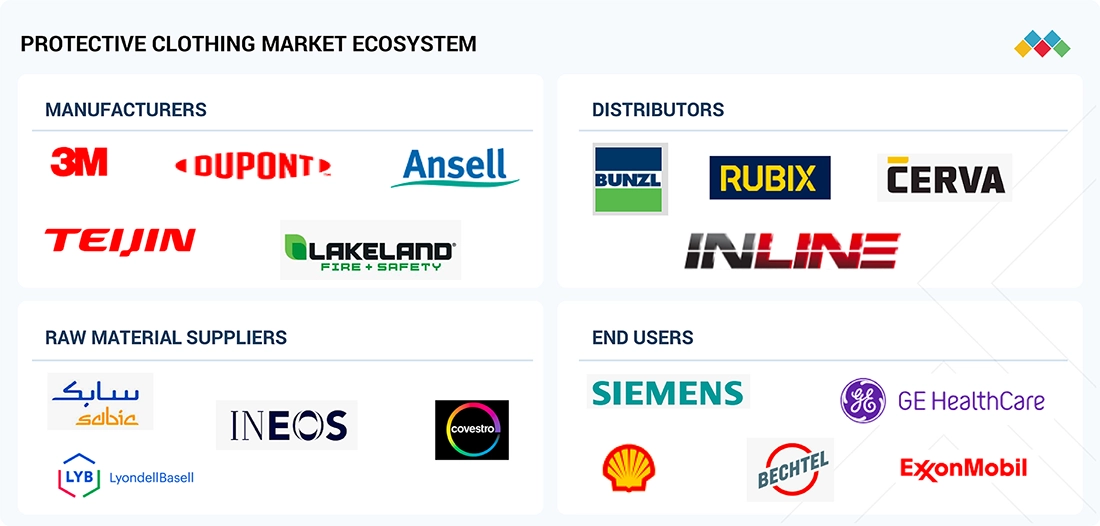
protective-clothing-market: COMMERCIAL USE CASES ACROSS INDUSTRIES
| COMPANY | USE CASE DESCRIPTION | BENEFITS |
|---|---|---|
 |
Flame-retardant and chemical-resistant protective clothing for refinery and maintenance workers | Provides superior protection from flash fires and chemical splashes, ensures comfort during long shifts, and supports safety compliance |
 |
Arc-flash protective suits for technicians in high-voltage equipment maintenance | Reduces burn risk from electrical arcs, enhances mobility and comfort, and maintains durability under frequent use |
 |
Antimicrobial and fluid-resistant protective gowns for healthcare and laboratory personnel | Prevents cross-contamination, provides superior barrier against fluids and pathogens, and supports hygiene and regulatory safety standards |
 |
High-visibility and cut-resistant workwear for infrastructure and heavy engineering projects | Improves worker visibility in complex sites, resists wear and tear from sharp tools and materials, and enhances safety compliance and comfort |
Logos and trademarks shown above are the property of their respective owners. Their use here is for informational and illustrative purposes only.
Related Ecosystem
Yarns Fabric And Textile
- Agrotech
- Clothtech
- Indutech
- Oekotech
- Packtech
- MILLIKEN & COMPANY
- Toray Industries, Inc.
- 3M COMPANY
- DuPont de Nemours, Inc.
- Kimberly-Clark Corporation
Key Takeaways
- South Korea's protective clothing market is valued at USD 71.9 million in 2025 and will reach USD 94.6 million by 2030.
- South Korea maintains a 5.64% CAGR, outpacing the global average of 5.48%, driven by stringent safety regulations and industrial growth.
- South Korea's advanced manufacturing sector and chemical processing industries are primary demand drivers for protective apparel.
- South Korea's compliance-focused regulatory environment and technological innovation in protective materials support sustained market expansion through 2030.
Protective Clothing Market Report Scope
| Report Metric | Details |
|---|---|
| Base Year | 2025 |
| Fastest Growing Segment | BIOLOGICAL/RADIATION (Application) |
| Forecast Period | 2025–2030 |
| Growth Rate | CAGR of 5.48% from 2025 to 2030 |
| Largest Segment | INDUSTRIAL (End-User Type) |
| Market Size Base Year (Billions) | ~USD 11.53 (2025) |
| Revenue Forecast (Billions) | ~USD 15.06 (2030) |
| Segments Covered | Material Type, Application, End-Use Industry, End-User Type |
South Korea Protective Clothing Market Report Segmentation
4 segment dimensions are covered across the global market.
By Material Type
- Aramid & Blends
- Cotton Fibers
- Laminated Polyesters
- Other Material Types
- Pbi
- Polyamide
- Polyolefin & Blends
- Uhmw Polyethylene
By Application
- Biological/Radiation
- Chemical
- Mechanical
- Other Applications
- Thermal
- Visibility
By End-Use Industry
- Construction
- Firefighting & Law Enforcement
- Healthcare/Medical
- Manufacturing
- Military
- Mining
- Oil & Gas
- Other End-Use Industries
- Warehouse & Logistics
By End-User Type
- Industrial
- Personal
Target Audience
- Protective Clothing Manufacturers : Manufacturers need South Korea-specific market data to identify growth opportunities, understand local regulatory requirements, and develop products tailored to the country's advanced industrial sectors and safety standards.
- Industrial Safety Distributors : Distributors require detailed market insights to optimize inventory, identify high-demand product categories across South Korea's manufacturing and chemical sectors, and plan regional expansion strategies.
- Corporate Safety Managers : Safety professionals in South Korean companies need market intelligence to benchmark compliance investments, evaluate supplier options, and ensure workforce protection meets evolving regulatory standards.
- Investment & Private Equity Firms : Investors seeking opportunities in South Korea's protective equipment sector need market valuation, growth forecasts, and sector analysis to evaluate acquisition targets and portfolio companies in this expanding market.
- Healthcare & Pharmaceutical Operators : Healthcare facilities and pharmaceutical companies require market data to understand protective clothing availability, pricing trends, and supplier capabilities to support operational safety and regulatory compliance.
Key Companies in the South Korea Protective Clothing Market
| Company | HQ | Ownership | Strongest segments |
|---|---|---|---|
| SOLVAY SA | Belgium | Public Company | Soda ash and derivatives,Sodium bicarbonate and flue gas/healthcare applications,Hydrogen peroxide, |
| LG CHEM LTD. | South Korea | Public Company | Ethylene-based synthetic resins (PE, EVA, POE, UNIQABLE),Styrene-based resins (ABS, ASA, PS, EPS, SAN),Propylene- and benzene-based resins (PP, PC, engineering plastics brands), |
| 3M COMPANY | United States | Public Company | Safety and Industrial,Transportation and Electronics,Consumer, |
| DUPONT DE NEMOURS, INC. | United States | Public Company | Healthcare & medical packaging (TYVEK and specialty components),Water filtration, separation, and ion exchange (FILMTEC, AMBERLITE, INGE, ITEGRATEC),Construction materials (TYVEK house wrap, STYROFOAM, CORIAN), |
| ANSELL LIMITED | Australia | Public Company | Healthcare examination and single-use gloves,Surgical and sterile gloves,Industrial mechanical and cut-protection gloves, |
| LAKELAND INDUSTRIES, INC. | United States | Public Company | Limited use / disposable protective clothing,Firefighter protective apparel and services,High-end chemical protective suits, |
| TEIJIN LIMITED | Japan | Public Company | High-performance fibers (aramid, carbon, glass, oxidized PAN),Films and sheets (polycarbonate, microporous, HDPE porous),Composites and molded parts (automotive, adhesives, resins), |
| SIOEN INDUSTRIES NV | Belgium | Private Company | Coating (yarns, woven/non-woven, coated textiles, membranes, finished products),Apparel (professional, protective, lifestyle),Chemicals (pigment pastes, inks, varnishes, dispersions), |
| MSA SAFETY INCORPORATED | United States | Public Company | Fixed gas and flame detection (FGFD) systems,Self-contained breathing apparatus (SCBA) and respiratory protection,Firefighter helmets and protective apparel, |
| MALLCOM INDIA LIMITED | India | Public Company | Gloves (industrial and specialty),Workwear and protective garments,Safety footwear, |
SOLVAY SA
Solvay SA is a Belgian public company established in 1863 with 8,400 employees, specializing in advanced materials and specialty chemicals for diverse industrial applications.
LG CHEM LTD.
LG Chem Ltd. is a South Korean public company founded in 1947 with 14,019 employees, operating as a major chemical and materials manufacturer serving global markets.
3M COMPANY
3M Company is an American multinational public corporation founded in 1902 with 60,500 employees, known for manufacturing a diverse range of products including adhesives, abrasives, and safety equipment.
DUPONT DE NEMOURS, INC.
DuPont de Nemours, Inc. is an American public company established in 2015 with 15,000 employees, operating as a specialty materials and chemicals manufacturer.
ANSELL LIMITED
Ansell Limited is an Australian public company founded in 1893 with 15,000 employees, specializing in protective equipment and safety solutions for industrial and healthcare markets.
LAKELAND INDUSTRIES, INC.
Lakeland Industries, Inc. is an American public company established in 1982 with 2,585 employees, manufacturing protective clothing and safety equipment for industrial and emergency response applications.
TEIJIN LIMITED
Teijin Limited is a Japanese public company founded in 1918 with 15,689 employees, operating across advanced fibers, chemicals, and healthcare sectors.
SIOEN INDUSTRIES NV
Sioen Industries NV is a Belgian private company established in 1960 with 4,541 employees, specializing in technical textiles and protective fabrics.
MSA SAFETY INCORPORATED
MSA Safety Incorporated is an American public company founded in 1914 with 5,300 employees, specializing in safety equipment and protective solutions for industrial and emergency response markets.
MALLCOM INDIA LIMITED
Mallcom India Limited is an Indian public company established in 1983 with 282 employees, manufacturing personal protective equipment and safety products.
Reasons to Buy this Report
- Market-Specific Growth Insights : Gain detailed understanding of South Korea's 5.64% CAGR trajectory and the specific industrial drivers—semiconductor, automotive, and chemical sectors—that differentiate this market from global trends.
- Regulatory Landscape Analysis : Access comprehensive insights into South Korea's stringent occupational safety regulations and compliance requirements that create sustained demand for protective clothing across manufacturing and healthcare sectors.
- Competitive Market Positioning : Identify opportunities within South Korea's diversified industrial base and understand how local manufacturers and international players are capturing market share in this high-growth economy.
- Sector-Specific Demand Forecasts : Leverage detailed projections for protective clothing demand across South Korea's key industries—semiconductors, chemicals, pharmaceuticals, and healthcare—to inform strategic business decisions.
- Investment & Expansion Strategy : Use market valuation data (USD 71.9M in 2025 to USD 94.6M in 2030) to evaluate entry strategies, partnership opportunities, and expansion potential in South Korea's growing protective equipment market.
Frequently asked questions
What is the current size of South Korea's protective clothing market?
South Korea's protective clothing market is valued at USD 71.9 million in 2025.
What is the projected market size for South Korea by 2030?
South Korea's protective clothing market is forecast to reach USD 94.6 million by 2030.
What is the CAGR for South Korea's protective clothing market?
South Korea's protective clothing market is growing at a CAGR of 5.64% from 2025 to 2030.
Which industries drive demand for protective clothing in South Korea?
South Korea's manufacturing, chemical processing, healthcare, and industrial sectors are primary drivers of protective clothing demand.
How does South Korea's market growth compare to global trends?
South Korea's CAGR of 5.64% exceeds the global CAGR of 5.48%, reflecting stronger regional demand and regulatory compliance requirements.
RESEARCH METHODOLOGY
The study involved four major activities in estimating the market size for protective clothing market. Exhaustive secondary research was done to collect information on the market, the peer market, and the parent market. The next step was to validate these findings, assumptions, and sizing with industry experts across the value chain through primary research. Both top-down and bottom-up approaches were employed to estimate the complete market size. After that, the market breakdown and data triangulation procedures were used to estimate the market size of the segments and subsegments.
Secondary Research
Secondary sources used in this study included annual reports, press releases, and investor presentations of companies; white papers; certified publications; articles from recognized authors; and gold standard & silver standard websites such as Factiva, ICIS, Bloomberg, and others. The findings of this study were verified through primary research by conducting extensive interviews with key officials such as CEOs, VPs, directors, and other executives.
Primary Research
The protective clothing market comprises several stakeholders, such as raw material suppliers, end-product manufacturers, and regulatory organizations in the supply chain. The demand side of this market is characterized by key opinion leaders in various applications for the protective clothing market. The supply side is characterized by advancements in technology and diverse application industries. Various primary sources from both the supply and demand sides of the market were interviewed to obtain qualitative and quantitative information. The breakdown of profiles of the primary interviewees is illustrated in the figure below:
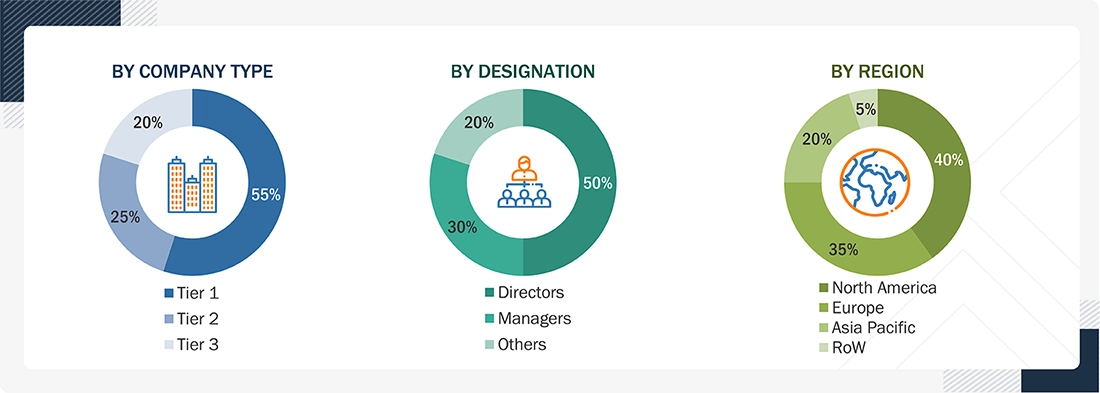
Note: Tier 1, Tier 2, and Tier 3 companies are classified based on their market revenue in 2023/2024, available in the public domain, product portfolios, and geographical presence.
Other designations include consultants and sales, marketing, and procurement managers.
To know about the assumptions considered for the study, download the pdf brochure
|
COMPANY NAME |
DESIGNATION |
|
3M Company |
Senior Manager |
|
DuPont de Nemours, Inc. |
Innovation Manager |
|
Ansell Limited |
Vice-President |
|
Lakeland Industries, Inc. |
Production Supervisor |
|
TEIJIN LIMITED |
Sales Manager |
Market Size Estimation
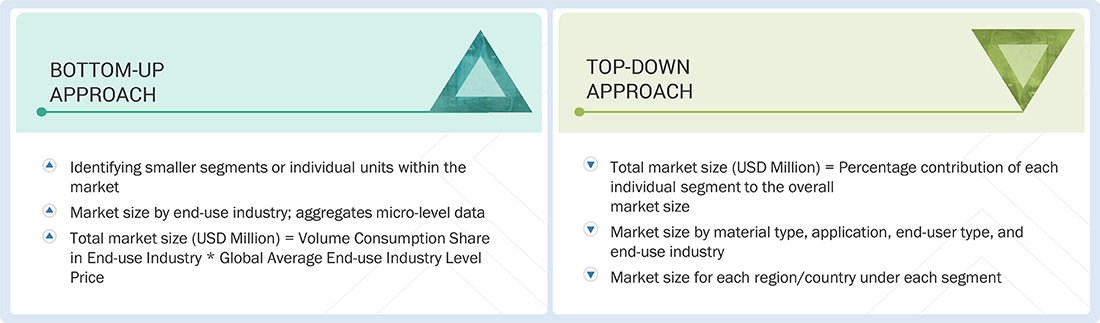
Both top-down and bottom-up approaches were used to estimate and validate the total size of the protective clothing market. These methods were also used extensively to estimate the size of various subsegments in the market. The research methodology used to estimate the market size includes the following:
- The key players in the industry have been identified through extensive secondary research.
- The supply chain of the industry has been determined through primary and secondary research.
- All percentage shares, splits, and breakdowns have been determined using secondary sources and verified through primary sources.
- All possible parameters that affect the markets covered in this research study have been accounted for, viewed in extensive detail, verified through primary research, and analyzed to obtain the final quantitative and qualitative data.
Protective Clothing Market : Top-Down and Bottom-Up Approach
Data Triangulation
After arriving at the overall market size—using the market size estimation processes as explained above—the market was split into several segments and subsegments. To complete the overall market engineering process and arrive at the exact statistics of each market segment and subsegment, data triangulation, and market breakdown procedures were employed, wherever applicable. The data was triangulated by studying various factors and trends from both the demand and supply sides in the protective clothing industry.
Market Definition
According to the International Safety Equipment Association, protective clothing is designed to shield the body from external hazards such as heat, chemicals, biological agents, and mechanical risks. This includes garments like aprons, coveralls, coats, pants, hoods, sleeves, gloves, and fully encapsulating chemical suits, all intended to protect the wearer from environmental dangers..
Key Stakeholders
- Manufacturers, Dealers, and Suppliers Manufacturers of protective clothing and their raw materials
- Manufacturers in various end-use industries
- Traders, distributors, and suppliers of protective clothing
- Regional manufacturers’ associations and protective clothing associations
- Government and regional agencies and research organizations
Report Objectives
- To analyze and forecast the protective clothing market in terms of value
- To provide detailed information about the key factors (drivers, restraints, opportunities, and challenges) influencing market growth
- To define, segment, and project the size of the global protective clothing market based on material type, application, end-user type, and end-use industry.
- To project the market size for six main regions: North America, Europe, Asia Pacific, the Middle East & Africa, and South America, with their key countries
- To analyze the micromarkets1 concerning individual growth trends, prospects, and their contribution to the overall market
- To analyze opportunities in the market for stakeholders and provide a competitive landscape of the market leaders
- To track and analyze R&D and competitive developments such as expansions, product launches, collaborations, investments, partnerships, agreements, developments, collaborations, and mergers & acquisitions in the protective clothing market
Customization Options:
Along with the given market data, MarketsandMarkets offers customizations according to the company’s specific needs. The following customization options are available for the report:
Regional Analysis
- Further breakdown of a region with respect to a particular country or additional application
Company Information
- Detailed analysis and profiles of additional market players (up to five)
Get the Full Protective Clothing Market Report
Full forecast, segment splits, and company analysis for all Protective Clothing Market.
- China Protective Clothing Market
- India Protective Clothing Market
- Japan Protective Clothing Market
- Australia Protective Clothing Market
- Canada Protective Clothing Market
- Mexico Protective Clothing Market
- US Protective Clothing Market
- Germany Protective Clothing Market
- France Protective Clothing Market
- Italy Protective Clothing Market
- UK Protective Clothing Market
- Russia Protective Clothing Market
- Spain Protective Clothing Market
- Saudi Arabia Protective Clothing Market
- UAE Protective Clothing Market
- Iraq Protective Clothing Market
- Brazil Protective Clothing Market
- Rest Of Europe Protective Clothing Market
- Rest Of Asia Pacific Protective Clothing Market
Need a Tailored Report?
Customize this report to your needs
Get 10% FREE Customization
Customize This Report
