
Australia Proteomics Market (2026-2031)

The Australia Proteomics Market was valued at $215.7 Million in 2026 and projected to reach to $333.4 Million by 2031, representing a compound annual growth rate of 9.1%. Australia's proteomics market is poised for sustained growth through 2031, driven by strengthening healthcare infrastructure, rising demand for precision diagnostics, and expanding biopharmaceutical research activities.


| Market Size in | USD 26.32 MN |
| Market Forecast in | |
| CAGR | |
| Forecast Period | |
| Units Considered | Value (USD MN) |
Australia Proteomics Market Trends and Insights
- Australia is establishing itself as a key player in the Asia Pacific proteomics landscape, driven by advances in diagnostic technologies and increased investment in life sciences research.
- The Australian market benefits from strong healthcare infrastructure, government support for biomedical innovation, and growing adoption of protein-based therapeutics and diagnostics across clinical and research settings. The 9.1% compound annual growth rate reflects Australia's commitment to precision medicine and personalized healthcare solutions.
- Australia's proteomics sector is supported by leading research institutions, pharmaceutical companies, and diagnostic laboratories that are integrating proteomics into drug development and disease management workflows.
- Between 2026 and 2031, Australia is expected to see accelerated demand for mass spectrometry platforms, biomarker discovery services, and protein analysis tools, positioning the country as a regional hub for proteomics innovation and clinical application..
Key Market Statistics
- CAGR (2026-2031) 9.1% CAGR
- Market Size, 2026 ~USD 215.7 Million
- Forecast, 2031 ~USD 333.4 Million
- Country Australia
Australia Proteomics Market Overview
Market Valuation Growth :
Australia's proteomics market is valued at USD 215.7 million in 2026 and is projected to reach USD 333.4 million by 2031, representing a robust 9.1% CAGR over the forecast period.
Asia Pacific Leadership :
Australia is positioning itself as a key regional player in the Asia Pacific proteomics landscape, leveraging its advanced research infrastructure and strategic location to drive innovation and market expansion.
Diagnostic Technology Advancement :
The Australian market is being propelled by significant advances in diagnostic proteomics technologies, enabling improved disease detection, personalized medicine applications, and enhanced clinical outcomes across healthcare institutions.
Research Investment Surge :
Increased government and private sector investment in life sciences research across Australia is accelerating proteomics adoption, with major research institutions and biotech companies expanding their proteomics capabilities and applications.
Australia Proteomics Market Dynamics
- The country's commitment to life sciences innovation and competitive advantage in the Asia Pacific region creates favorable conditions for market expansion.
- Government initiatives supporting medical research and increasing collaboration between academic institutions and industry players are expected to accelerate proteomics technology adoption across diagnostic laboratories and research centers.
- Australia's aging population and growing prevalence of chronic diseases further support demand for advanced proteomics-based diagnostic solutions and therapeutic development..
Market Ecosystem

PROTEOMICS MARKET: COMMERCIAL USE CASES ACROSS INDUSTRIES
| COMPANY | USE CASE DESCRIPTION | BENEFITS |
|---|---|---|
 |
SomaScan proteomics platform applied in clinical trials to analyze proteomic biomarkers across multiple therapeutic areas and support translational medicine research | Proteomic biomarker identification | Improved translational insights | Better patient stratification | Enhanced clinical trial decision-making |
 |
Olink Explore platform applied in a large-scale human proteome study to measure thousands of proteins across population-scale samples and support disease research and biomarker discovery | Large-scale biomarker discovery | Improved disease prediction research | Support for drug target identification | Acceleration of precision medicine research |
Logos and trademarks shown above are the property of their respective owners. Their use here is for informational and illustrative purposes only.
Related Ecosystem
Advanced Genetic Sequencing
- Polymerase Chain Reaction (PCR)
- Reagents
- Assay Kits
- Bioinformatics
- Flow Cytometry
- Thermo Fisher Scientific Inc.
- Illumina, Inc.
- Qiagen N.V.
- Agilent Technologies, Inc.
- Danaher Corporation
Biotechnology
- Reagents
- Polymerase Chain Reaction (PCR)
- Stem Cells
- Assay Kits
- Flow Cytometers
- Thermo Fisher Scientific Inc.
- Merck KGaA
- Danaher Corporation
- Agilent Technologies, Inc.
- Bio-Rad Laboratories, Inc.
Key Takeaways
- Australia's proteomics market is valued at USD 215.7 million in 2026 and is forecast to reach USD 333.4 million by 2031, representing a 9.1% CAGR.
- Australia's strong healthcare infrastructure and government investment in biomedical research are driving adoption of proteomics technologies across diagnostic and therapeutic applications.
- Mass spectrometry platforms and biomarker discovery services are emerging as key growth drivers in Australia's proteomics sector.
- Australia is positioned as a regional leader in precision medicine, with increasing integration of proteomics into clinical workflows and drug development pipelines.
Proteomics Market Report Scope
| Report Metric | Details |
|---|---|
| Base Year | 2026 |
| Fastest Growing Segment | ANTIBODIES & HIGH-AFFINITY BINDERS (Type) |
| Forecast Period | 2026–2031 |
| Growth Rate | CAGR of 11.1% from 2026 to 2031 |
| Largest Segment | REAGENTS & CONSUMABLES (Offering) |
| Market Size Base Year (Billions) | ~USD 39.91 (2026) |
| Revenue Forecast (Billions) | ~USD 67.55 (2031) |
| Segments Covered | Offering, Reagents & Consumables, Type, Instrumentation Technology |
Australia Proteomics Market Report Segmentation
4 segment dimensions are covered across the global market.
By Offering
- Instruments
- Reagents & Consumables
- Services
- Software
By Reagents & Consumables
- Chromatography Reagents & Consumables
- Electrophoresis Reagents & Consumables
- Immunoassay Reagents & Consumables
- Other Reagents & Consumables
- Protein Fractionation Reagents & Consumables
- Protein Microarray Reagents & Consumables
- Spectroscopy Reagents & Consumables
- X-Ray Crystallography Reagents & Consumables
By Type
- Analytical Columns
- Antibodies & High-Affinity Binders
- Assay Kits
- Biochips
- Cd Spectroscopy
- Crystallization Screens
- Detection Reagents
- Electrophoresis Stains & Dyes
- Enzymes
- Lab-On-Chips
- Mass Spectrometry
- Mass Tagging & Labeling Kits
- Nmr Spectroscopy
- Other Chromatography Reagents & Consumables
- Other Electrophoresis Reagents & Consumables
- Other Immunoassay Reagents & Consumables
- Other Protein Fractionation Reagents & Consumables
- Other Spectroscopy Reagents & Consumables
- Other X-Ray Crystallography Reagents & Consumables
- Protein Chips
- Protein Fractionation & Enrichment Kits
- Reagents
By Instrumentation Technology
- Chromatography
- Electrophoresis
- Other Instrumentation Technologies
- Protein Fractionation
- Protein Microarrays
- Spectroscopy
- Surface Plasmon Resonance
- X-Ray Crystallography
AUSTRALIA: PROTEOMICS MARKET, BY END USER, 2024–2031
| Segment | 2024 | 2025 | 2026 | 2027 | 2028 | 2029 | 2030 | 2031 | CAGR (%) |
|---|---|---|---|---|---|---|---|---|---|
| ACADEMIC AND RESEARCH INSTITUTES | 162.6 | 174.5 | 189.9 | 206.3 | 225.3 | 248 | 276.3 | 311.3 | 10.4 |
| BIOPHARMACEUTICAL COMPANIES | 249.6 | 268.6 | 292.9 | 319 | 349.4 | 385.5 | 430.4 | 486.1 | 10.7 |
| CLINICAL LABORATORIES | 60.3 | 62.6 | 65.9 | 69.3 | 73.2 | 77.8 | 83.7 | 91 | 6.7 |
| HOSPITALS | 76.7 | 80.5 | 85.8 | 91.2 | 97.5 | 105.1 | 114.5 | 126.2 | 8 |
| OTHER END USERS | 91.4 | 95.2 | 100.6 | 106 | 112.4 | 120 | 129.5 | 141.4 | 7.1 |
| TOTAL | 640.6 | 681.4 | 735 | 791.8 | 857.8 | 936.3 | 1034.3 | 1156 | 9.5 |
Target Audience
- Pharmaceutical & Biotech Companies : Require Australia-specific market data to develop targeted product strategies, identify partnership opportunities with local research institutions, and optimize commercial expansion in this growing regional market.
- Diagnostic Laboratory Operators : Need insights into proteomics technology adoption trends and market growth drivers in Australia to make informed investment decisions in diagnostic capabilities and service expansion.
- Medical Device & Equipment Manufacturers : Seek Australia market intelligence to understand demand for proteomics instrumentation, identify key customer segments, and develop localized sales and distribution strategies.
- Healthcare Investors & Venture Capitalists : Require detailed market forecasts and growth drivers specific to Australia to evaluate investment opportunities in proteomics startups, research initiatives, and healthcare technology companies.
- Research Institutions & Academic Centers : Need market data on funding trends, technology adoption, and collaborative opportunities in Australia's proteomics sector to guide research priorities and secure institutional resources.
Key Companies in the Australia Proteomics Market
| Company | HQ | Ownership | Strongest segments |
|---|---|---|---|
| ABCAM PLC | United Kingdom | Private Company | Primary and secondary antibodies,Conjugated antibodies and conjugation kits,Singleplex immunoassays, |
| BECKMAN COULTER | United States | Private Company | Clinical diagnostics systems (chemistry, hematology, immunoassay, urinalysis, blood banking, hemostasis),Research and discovery instruments (flow cytometry, centrifugation, capillary electrophoresis, genomics, liquid handling, automation),Industrial and particle characterization systems, |
| CONSORT MEDICAL | United Kingdom | Private Company | Inhalation devices (pMDIs, DPIs) and components,Autoinjectors and injectable delivery systems,Nasal and other specialty drug delivery devices, |
| TOSOH CORPORATION | Japan | Public Company | Basic chemicals & chlor-alkali (caustic soda, VCM, sodium bicarbonate, related),Petrochemicals & polymers (ethylene, propylene, PE, EVA, synthetic rubber, functional polymers),Advanced materials (battery materials, quartzware, silica glass, thin films, zeolites, zirconia, fine beads), |
| CODEXIS, INC. | United States | Public Company | CodeEvolver-enabled enzymes for therapeutics manufacturing,ECO Synthesis platform for RNAi and nucleic acid manufacturing,Licensing and technology access agreements, |
| MAXCYTE, INC | United States | Public Company | ExPERT instruments (ATx, STx, GTx, VLx),Processing assemblies and consumables,Licensing and technology access, |
| THERMO FISHER SCIENTIFIC INC. | United States | Public Company | Life Sciences Solutions,Analytical Instruments,Specialty Diagnostics, |
| AGILENT T ECHNOLOGIES, INC. | United States | Public Company | Life Sciences and Diagnostics Markets,Agilent CrossLab,Applied Markets, |
| MERCK KGAA | Germany | Public Company | Life Science (tools, reagents, bioprocessing, CDMO services),Healthcare (prescription drugs and biopharmaceuticals),Electronics (semiconductor and display materials, gases, equipment), |
| DANAHER C O RPORATION | United States | Public Company | Biotechnology (bioprocessing and related solutions),Life Sciences (instruments, genomics, and lab automation),Diagnostics (clinical instruments and consumables), |
| SHIM A DZU CORPORATION | Japan | Public Company | Analytical and Measuring Instruments,Medical Systems,Industrial and Vacuum Machinery, |
| WATER S CORPORATION | United States | Public Company | Liquid Chromatography Systems and Columns,Mass Spectrometry Systems,TA Instruments (Thermal Analysis, Rheometry, Calorimetry), |
| BIO-RAD LABOR A TORIES, INC. | United States | Public Company | Clinical Diagnostics systems, kits, and quality controls,Life Science instruments and reagents,Software, informatics, and other, |
| BRUKER | United States | Public Company | BSI BioSpin (NMR/EPR and preclinical imaging),BSI CALID (mass spectrometry and diagnostics),BSI Nano (X-ray, AFM, EM analytics, optical microscopy), |
| REVVITY | United States | Public Company | Clinical diagnostics (prenatal, newborn, infectious disease, autoimmune),Life science reagents and assays (BioLegend, Dharmacon, AlphaLISA, etc.),Instruments and imaging systems, |
| ILLUMINA, INC. | United States | Public Company | Sequencing instruments,Sequencing consumables (reagents, flow cells, library prep, WGS and targeted kits),Arrays and genotyping solutions, |
| EUROF I NS SCIENTIFIC | Luxembourg | Public Company | Food and Feed Testing,Environment Testing,Biopharma Testing and Services, |
| QIAG E N | Netherlands | Public Company | Sample technology consumables and instruments,PCR and digital PCR (consumables and instruments),Immune response and infectious disease assays (incl. TB), |
| CHARLES R IVER LABORATORIES | United States | Public Company | Research Models and Services,Discovery and Safety Assessment,Manufacturing Solutions, |
ABCAM PLC
Abcam PLC is a United Kingdom-based private company founded in 1998 that employs 1,760 people. The company operates in the life sciences sector.
BECKMAN COULTER
Beckman Coulter is a United States-based private company founded in 1935 with 11,900 employees. The company operates in the diagnostics and laboratory equipment industry.
CONSORT MEDICAL
Consort Medical is a United Kingdom-based private company founded in 1938 with 2,000 employees. The company operates in the medical devices and healthcare sector.
TOSOH CORPORATION
Tosoh Corporation is a Japan-based public company founded in 1935 with 14,850 employees. The company operates across multiple sectors including specialty chemicals and diagnostics.
CODEXIS, INC.
Codexis, Inc. is a United States-based public company founded in 2002 with 146 employees. The company specializes in enzyme engineering and biocatalysis technologies.
MAXCYTE, INC
MaxCyte, Inc. is a United States-based public company founded in 1998 with 91 employees. The company develops cell engineering technologies and solutions.
THERMO FISHER SCIENTIFIC INC.
Thermo Fisher Scientific Inc. is a United States-based public company founded in 1956 with 125,000 employees. The company is a global leader in life sciences, analytical instruments, and laboratory services.
AGILENT T ECHNOLOGIES, INC.
Agilent Technologies, Inc. is a United States-based public company founded in 1999 with 18,000 employees. The company provides analytical instruments, software, and services for life sciences and diagnostics.
MERCK KGAA
Merck KGaA is a Germany-based public company founded in 1668 with 59,077 employees. The company operates in pharmaceuticals, life sciences, and performance materials sectors.
DANAHER C O RPORATION
Danaher Corporation is a United States-based public company founded in 1969 with 59,000 employees. The company operates across diagnostics, life sciences, environmental and applied solutions.
SHIM A DZU CORPORATION
Shimadzu Corporation is a Japan-based public company founded in 1875 with 14,649 employees. The company manufactures analytical and measuring instruments, medical devices, and industrial equipment.
WATER S CORPORATION
Waters Corporation is a United States-based public company founded in 1958 with 7,900 employees. The company develops and manufactures analytical instruments and software for laboratory analysis.
BIO-RAD LABOR A TORIES, INC.
Bio-Rad Laboratories, Inc. is a United States-based public company founded in 1952 with 7,450 employees. The company manufactures and distributes life science research and clinical diagnostics products.
BRUKER
Bruker is a United States-based public company founded in 1960 with 11,085 employees. The company develops and manufactures scientific instruments for molecular and materials research.
REVVITY
Revvity is a United States-based public company founded in 1937 with 11,000 employees. The company provides analytical instruments, software, and services for life sciences and diagnostics.
ILLUMINA, INC.
Illumina, Inc. is a United States-based public company founded in 1998 with 8,625 employees. The company is a leader in DNA sequencing and genetic analysis technologies.
EUROF I NS SCIENTIFIC
Eurofins Scientific is a Luxembourg-based public company founded in 1987 with 65,694 employees. The company provides laboratory testing services across pharmaceutical, food, environmental, and clinical sectors.
QIAG E N
Qiagen is a Netherlands-based public company founded in 1984 with 5,500 employees. The company develops and manufactures molecular diagnostics and sample preparation technologies.
CHARLES R IVER LABORATORIES
Charles River Laboratories is a United States-based public company founded in 1947 with 19,000 employees. The company provides preclinical and clinical laboratory services for drug development and safety testing.
Reasons to Buy this Report
- Market-Specific Growth Projections : Access detailed forecasts showing Australia's proteomics market expansion from USD 215.7M to USD 333.4M (2031), enabling accurate business planning and investment decisions tailored to the Australian market trajectory.
- Regional Competitive Intelligence : Understand Australia's positioning within the Asia Pacific proteomics landscape, identifying competitive advantages, market gaps, and opportunities for differentiation in this high-growth regional market.
- Diagnostic Technology Trends : Gain insights into advancing diagnostic proteomics technologies driving adoption across Australian healthcare institutions, informing product development, partnerships, and market entry strategies.
- Investment & Funding Landscape : Analyze increased life sciences research investment patterns in Australia, identifying funding sources, key research institutions, and collaboration opportunities for market participants and investors.
- Healthcare Infrastructure Analysis : Evaluate Australia's strong healthcare infrastructure and regulatory environment, understanding how these factors support proteomics market growth and inform go-to-market strategies for new solutions.
Frequently asked questions
What is the current size of Australia's proteomics market?
Australia's proteomics market is valued at USD 215.7 million in 2026 and is expected to grow to USD 333.4 million by 2031.
What is the projected growth rate for Australia's proteomics market?
Australia's proteomics market is projected to grow at a compound annual growth rate (CAGR) of 9.1% from 2026 to 2031.
What are the main drivers of growth in Australia's proteomics market?
Key drivers include strong healthcare infrastructure, government support for biomedical innovation, increased adoption of precision medicine, and growing demand for protein-based diagnostics and therapeutics in Australia.
Which technologies are leading Australia's proteomics market expansion?
Mass spectrometry platforms, biomarker discovery services, and advanced protein analysis tools are among the leading technologies driving growth in Australia's proteomics sector.
How does Australia's proteomics market compare to the Asia Pacific region?
Australia represents a significant segment of the Asia Pacific proteomics market, with strong research capabilities and clinical adoption positioning it as a regional leader in proteomics innovation and application.
RESEARCH METHODOLOGY
This research study extensively utilized secondary sources, directories, and databases to identify and collect valuable information for analyzing the global proteomics market. In-depth interviews were conducted with various primary respondents, including key industry participants, subject-matter experts (SMEs), C-level executives of key market players, and industry consultants, to obtain and verify critical qualitative & quantitative information and assess the growth prospects of the market. The global market size estimated through secondary research was triangulated with inputs from primary research to determine the final market size.
Secondary Research
Secondary research was primarily used to identify and collect information for the comprehensive technical, market-oriented, and commercial study of the proteomics market. The secondary sources used for this study include Centre for Drug Evaluation and Research, European Proteomics Association (EuPA), European Medicines Agency (EMA), European Bioinformatics Institute (EMBL-EBI), French Society for Electrophoresis and Proteomics Analysis (SFEAP), International Federation of Pharmaceutical Manufacturers & Associations (IFPMA), Food and Drug Administration (FDA), Biotechnology and Biological Sciences Research Council (BBSRC), Pharmaceutical Research and Manufacturers of America (PhRMA), United Kingdom’s Research and Innovation’s (UKRI), World Journal of Pharmaceutical Sciences (WJPS), National Institutes of Health, and National Center for Biotechnology Information (NCBI). Academic Journals and Company Websites, corporate & regulatory filings, such as annual reports, SEC filings, investor presentations, and financial statements; business magazines & research journals; press releases; and trade, business, and professional associations, among others. Secondary data were collected and analyzed to determine the overall size of the global proteomics market, which was subsequently validated through primary research. These sources were also used to gather key information about major players, market classification, and segmentation based on industry trends, regional/country-level markets, market developments, and technological perspectives.
Primary Research
In-depth interviews were conducted with various primary respondents, including key industry participants, subject-matter experts (SMEs), C-level executives of key market players, and industry consultants, to obtain and verify critical qualitative & quantitative information and assess the market’s prospects. Various primary sources from the supply & demand sides of the market were interviewed to obtain qualitative and quantitative information.
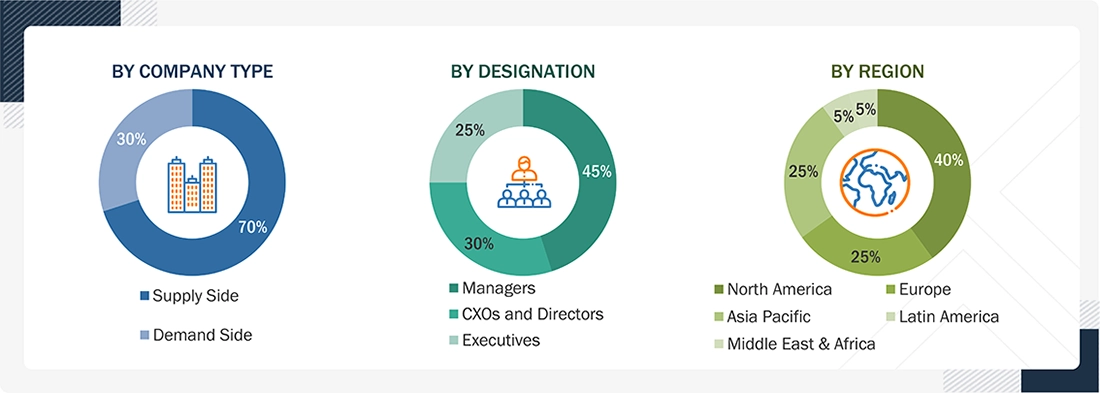
To know about the assumptions considered for the study, download the pdf brochure
Market Size Estimation
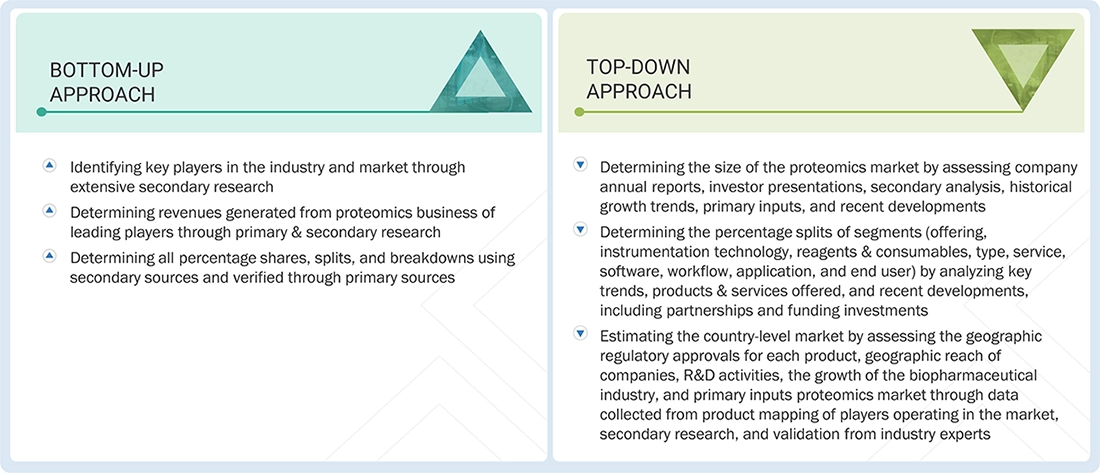
The top-down and bottom-up approaches were used to estimate & validate the total size of the proteomics market. These methods were also used extensively to estimate the size of various market segments.
Data Triangulation
After evaluating the overall market size through the market size estimation process, the total market was divided into several segments and subsegments. Data triangulation and market breakdown procedures were used, whenever applicable, to complete the overall market engineering process and obtain precise statistics for all segments and subsegments. The data was triangulated by analyzing various factors and trends from the demand and supply sides.
Market Definition
Proteomics involves the comprehensive evaluation of the structure and function of proteins to understand an organism's nature. It systematically identifies and characterizes proteins, including their sequences, abundances, post-translational modifications, interactions, activities, subcellular localizations, and structures.
Key Stakeholders
- Pharmaceutical & biotechnology companies
- Contract research organizations (CROs)
- Life science companies
- Academic & research institutes
- Private research institutes
- Venture capitalists & investors
- Clinical laboratories and diagnostic laboratories
- Biobanks and translational research centers
- Market research & consulting firms
- Government associations
- Medical institutions & universities
- Hospitals & clinics
Report Objectives
- To define, describe, and forecast the proteomics market based on offering, instrumentation technology, reagents & consumables, type, service, software, workflow, application, end user, and region
- To provide detailed information regarding the major factors influencing the market growth (such as drivers, restraints, opportunities, and challenges)
- To strategically analyze micromarkets concerning individual growth trends, prospects, and contributions to the overall proteomics market
- To analyze the opportunities in the market for stakeholders and provide details of the competitive landscape for market leaders
- To forecast the size of the market segments concerning six main regions, namely, North America, Europe, the Asia Pacific, Latin America, the Middle East, and Africa
- To strategically profile the key players in the proteomics market and comprehensively analyze their core competencies and market rankings
- To track and analyze competitive developments such as product launches, acquisitions, expansions, agreements, partnerships, and collaborations in the proteomics market
- To benchmark players within the proteomics market using the ‘Company Evaluation Matrix' framework, which analyzes market players based on various parameters within the broad categories of business and product/service strategy.
Available customizations:
With the given market data, MarketsandMarkets offers customizations per the company’s specific needs. The following customization options are available for this report:
Geographical Analysis
- Further breakdown of the Rest of Europe Proteomics Market, by country
- Further breakdown of the Rest of Asia Pacific Proteomics Market, by country
- Further breakdown of the Rest of Latin America Proteomics Market, by country
- Further breakdown of the Rest of Middle East Proteomics Market, by country
Company Information
- Detailed analysis and profiling of additional market players (up to five)
Get the Full Proteomics Market Report
Full forecast, segment splits, and company analysis for all Proteomics Market.
- Canada Proteomics Market
- US Proteomics Market
- Germany Proteomics Market
- UK Proteomics Market
- France Proteomics Market
- Switzerland Proteomics Market
- Italy Proteomics Market
- Spain Proteomics Market
- China Proteomics Market
- Japan Proteomics Market
- India Proteomics Market
- South Korea Proteomics Market
- Brazil Proteomics Market
- Mexico Proteomics Market
- Saudi Arabia Proteomics Market
- UAE Proteomics Market
Need a Tailored Report?
Customize this report to your needs
Get 10% FREE Customization
Customize This Report
