
Canada Radiation Dose Management Market (2023-2028)

The Canada Radiation Dose Management Market was valued at $12.4 Million in 2023 and projected to reach to $23.4 Million by 2028, representing a compound annual growth rate of 13.6%. Canada's radiation dose management market is positioned for sustained growth as healthcare providers prioritize patient safety and regulatory compliance.


| Market Size in | USD 26.32 MN |
| Market Forecast in | |
| CAGR | |
| Forecast Period | |
| Units Considered | Value (USD MN) |
Canada Radiation Dose Management Market Trends and Insights
- This growth in Canada reflects increasing adoption of advanced imaging technologies and heightened regulatory focus on patient safety across Canadian healthcare institutions.
- Canada's market expansion is driven by investments in diagnostic imaging infrastructure and growing awareness of radiation safety protocols among Canadian medical professionals. The Canadian radiation dose management sector is benefiting from modernization of hospital imaging departments and integration of dose tracking software across major Canadian medical centers.
- Canada's healthcare system's emphasis on evidence-based practices and quality improvement initiatives supports market penetration of dose management solutions.
- By 2028, Canada is expected to see widespread implementation of automated dose monitoring systems in both urban and regional healthcare facilities..
Key Market Statistics
- CAGR (2023-2028) 13.6% CAGR
- Market Size, 2023 ~USD 12.4 Million
- Forecast, 2028 ~USD 23.4 Million
- Country Canada
Canada Radiation Dose Management Market Overview
Market Valuation Growth :
Canada's radiation dose management market reached $12.4 million in 2023 and is projected to expand to $23.4 million by 2028, demonstrating robust 13.6% CAGR driven by healthcare modernization initiatives.
Regulatory Compliance Drivers :
Canadian healthcare institutions face stringent regulatory requirements from Health Canada and provincial health authorities, accelerating adoption of advanced dose management solutions to ensure patient safety compliance.
Advanced Imaging Technology Adoption :
Canadian hospitals and diagnostic centers are increasingly investing in state-of-the-art imaging technologies, creating strong demand for integrated radiation dose monitoring and optimization systems.
Healthcare Infrastructure Investment :
Federal and provincial funding initiatives supporting digital health transformation across Canada are facilitating deployment of sophisticated radiation dose management platforms in medical facilities nationwide.
Canada Radiation Dose Management Market Dynamics
- The 13.6% CAGR reflects increasing investments in diagnostic imaging infrastructure and the adoption of AI-powered dose optimization technologies across Canadian provinces.
- Major teaching hospitals and regional medical centers are leading implementation efforts, setting benchmarks for smaller facilities. The market outlook remains positive through 2028, supported by ongoing healthcare digitalization, rising awareness of radiation safety protocols, and government initiatives promoting advanced medical technologies.
- Canadian healthcare institutions' commitment to evidence-based imaging practices and dose reduction strategies will continue driving market expansion, with particular growth in oncology, cardiology, and emergency imaging departments..
Market Ecosystem
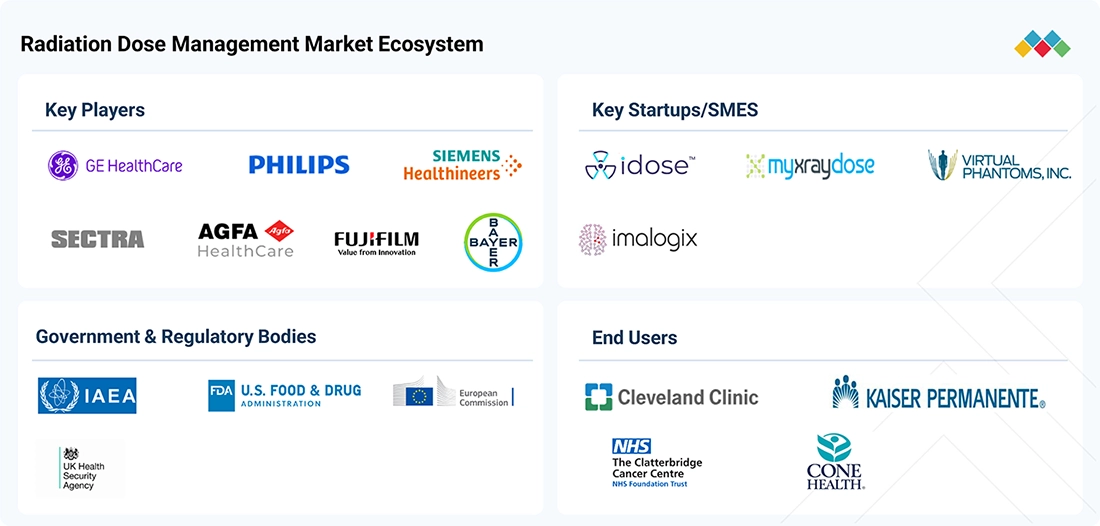
RADIATION DOSE MANAGEMENT MARKET: COMMERCIAL USE CASES ACROSS INDUSTRIES
| COMPANY | USE CASE DESCRIPTION | BENEFITS |
|---|---|---|
 |
Provides Radimetrics® Enterprise Application for automated radiation-dose documentation and management across CT, mammography, CR, DX, XA, RF, and nuclear medicine. The platform supports dose-reference levels, outlier identification, protocol management, compliance KPI tracking, flexible reporting, and integration with PACS, RIS, and speech-reporting systems. | Reduces manual dose documentation, supports regulatory and quality requirements, enables enterprise-wide dose benchmarking and outlier identification, facilitates protocol optimization, improves workflow efficiency, and provides visibility into cumulative and examination-level patient dose. |
 |
Provides teamplay Dose, a cloud-based, enterprise-wide radiation dose management solution that collects and analyzes dose data across radiation-emitting imaging devices and vendors. It uses DICOM dose reports, image-header data, and OCR, and provides patient-centric monitoring, dose-event alerts, benchmarking against institutional/national reference levels, and protocol-optimization insights. | Enables enterprise-wide dose visibility, supports regulatory compliance and ALARA-based optimization, identifies dose outliers and their causes, facilitates benchmarking and protocol improvement, and improves efficiency of dose monitoring, reporting, and quality assurance |
 |
Offers DoseWise Portal, a vendor-agnostic, web-based radiation dose management solution that collects, measures, analyzes, and reports patient and staff radiation exposure. It provides dose dashboards, CT exposure summaries, dose-reference levels, exam-dose alerts, patient dose-history warnings, and customizable reporting and analytics. | Supports radiation-safety and dose-management programs, facilitates monitoring against dose-reference levels, enables identification of potentially high-dose examinations, improves dose reporting and analytics, and supports workflow and quality-improvement initiatives |
 |
Provides DoseWatch, an enterprise-wide dose management solution that automatically collects and analyzes patient radiation and contrast-exposure data across multi-facility, multi-modality, and multi-vendor imaging environments. It identifies dose outliers and their potential root causes and supports dose tracking, reporting, benchmarking, and optimization. | Enables automated dose monitoring and outlier detection, supports regulatory and quality-improvement activities, facilitates protocol and dose optimization, reduces variability in imaging practices, and improves operational efficiency across imaging networks |
 |
Offers a vendor-neutral, web-based radiation dose management solution that collects, monitors, and analyzes radiation dose information across imaging modalities. The platform supports centralized dose monitoring, dose tracking, alerts, reporting, and analysis to identify dose outliers and support optimization of imaging protocols and patient radiation exposure. | Enables centralized radiation dose visibility, reduces manual dose monitoring and reporting, supports regulatory and patient-safety requirements, helps identify dose outliers and optimization opportunities, facilitates protocol standardization and benchmarking, and improves workflow efficiency and management of patient radiation exposure |
Logos and trademarks shown above are the property of their respective owners. Their use here is for informational and illustrative purposes only.
Related Ecosystem
Healthcare It
- Computed Tomography (CT)
- Machine Learning
- Magnetic Resonance Imaging (MRI)
- Natural Language Processing (NLP)
- Predictive Analytics
- CERNER CORPORATION
- PHILIPS HEALTHCARE
- Oracle Corporation
- GE HealthCare Technologies Inc.
- Siemens healthineers
Key Takeaways
- Canada's radiation dose management market is valued at $12.4 million in 2023 and will nearly double to $23.4 million by 2028.
- Canada's 13.6% CAGR reflects strong demand for dose optimization solutions across Canadian diagnostic imaging departments.
- Regulatory compliance and patient safety initiatives are primary growth drivers for radiation dose management adoption in Canada.
- Canada's healthcare modernization efforts are accelerating integration of automated dose tracking and monitoring technologies.
Radiation Dose Management Market Report Scope
| Report Metric | Details |
|---|---|
| Base Year | 2023 |
| Fastest Growing Segment | FLUOROSCOPY & INTERVENTIONAL IMAGING (Modality) |
| Forecast Period | 2023–2028 |
| Growth Rate | CAGR of 13.8% from 2023 to 2028 |
| Largest Segment | SOLUTIONS (Product & Service) |
| Market Size Base Year (Billions) | ~USD 0.34 (2023) |
| Revenue Forecast (Billions) | ~USD 0.65 (2028) |
| Segments Covered | Product & Service, Type, Modality, Mode Of Deployment, Revenue Model, Application, End User |
Canada Radiation Dose Management Market Report Segmentation
7 segment dimensions are covered across the global market.
By Product & Service
- Radiation Dose Management Services
- Services
- Solutions
By Type
- Consulting Services
- Education & Training Services
- Implementation & Integration Services
- Integrated Solutions
- Standalone Solutions
- Support & Maintenance Services
By Modality
- Computed Tomography
- Fluoroscopy & Interventional Imaging
- Mammography
- Nuclear Medicine
- Radiography
By Mode Of Deployment
- Cloud-Based Deployment
- On-Premise Deployment
- Web-Based Deployment
By Revenue Model
- Capital/Annual Purchase Model
- Pay-Per-Procedure Model
By Application
- Cardiology
- Dental
- Oncology
- Orthopedic
- Other Applications
By End User
- Ambulatory Surgery Centers
- Diagnostic And Imaging Centers
- Hospitals And Healthcare Systems
- Other End Users
CANADA: RADIATION DOSE MANAGEMENT MARKET, BY END USER, 2021–2028
| Segment | 2021 | 2022 | 2023 | 2024 | 2025 | 2026 | 2027 | 2028 | CAGR (%) |
|---|---|---|---|---|---|---|---|---|---|
| AMBULATORY SURGERY CENTERS | 2.7 | 3.14 | 3.61 | 4.11 | 4.63 | 5.18 | 5.74 | 6.31 | 11.8 |
| DIAGNOSTIC AND IMAGING CENTERS | 1.32 | 1.55 | 1.8 | 2.07 | 2.35 | 2.65 | 2.97 | 3.3 | 12.9 |
| HOSPITALS AND HEALTHCARE SYSTEMS | 8.4 | 9.93 | 11.57 | 13.36 | 15.28 | 17.32 | 19.47 | 21.72 | 13.4 |
| OTHER END USERS | 0.66 | 0.78 | 0.91 | 1.04 | 1.19 | 1.35 | 1.51 | 1.69 | 13.3 |
| TOTAL | 13.07 | 15.39 | 17.89 | 20.58 | 23.46 | 26.5 | 29.69 | 33.02 | 13 |
Target Audience
- Medical Device Manufacturers : Manufacturers of radiation dose management systems need Canada-specific market data to develop localized products, navigate regulatory pathways, and establish distribution partnerships with Canadian healthcare providers.
- Healthcare IT Solution Providers : Software and IT companies require detailed Canadian market insights to design integrated dose management platforms compliant with provincial health IT standards and interoperability requirements.
- Hospital & Imaging Center Administrators : Healthcare facility leaders need market analysis to justify capital investments in dose management technologies, benchmark against peer institutions, and optimize imaging protocols across their networks.
- Investment & Private Equity Firms : Investors evaluating opportunities in Canadian healthcare technology require comprehensive market sizing, growth projections, and competitive dynamics to assess investment viability and exit potential.
- Regulatory & Compliance Consultants : Consultants advising healthcare organizations on radiation safety compliance need Canada-specific regulatory context and market adoption trends to guide clients through implementation and certification processes.
Key Companies in the Canada Radiation Dose Management Market
| Company | HQ | Ownership | Strongest segments |
|---|---|---|---|
| BIOMERIEUX S.A. | France | Public Company | Clinical Microbiology (culture media, VITEK, VIRTUO, ETEST, API),Molecular Syndromic & PCR (BIOFIRE, SPOTFIRE, ARGENE, EMAG/NUCLISENS),Immunoassays & CLIA (VIDAS, Hybiome and related markers), |
| CERNER CORPORATION | United States | Private Company | Cerner Millennium EHR and core clinical/financial platforms,HealtheIntent population health, analytics, and real-world evidence,CareAware and device connectivity solutions, |
| GENERAL ELECTRIC | United States | Public Company | Commercial Engines & Services,Defense & Propulsion Technologies,Additive and Specialized Components, |
| BAYER AG | Germany | Public Company | Crop Science,Pharmaceuticals,Consumer Health, |
| GE HEALTHCARE | United States | Public Company | Imaging (CT, MR, X-ray, Molecular, Women’s Health),Advanced Visualization Solutions & Ultrasound / Image-Guided Therapies,Patient Care Solutions (Monitoring, Cardiology, Anesthesia, Maternal Infant), |
| KONINKLIJKE PHILIPS N.V. | Netherlands | Public Company | Diagnostic Imaging (MR, CT, X-ray, Ultrasound),Image Guided Therapy Systems and Devices,Monitoring and Enterprise Informatics, |
| SECTRA AB | Sweden | Public Company | Imaging IT Solutions,Secure Communications,Business Innovation (orthopedics, education, cancer diagnostics IT), |
| AGFA-GEVAERT GROUP | Belgium | Public Company | Enterprise and Diagnostic Imaging (incl. DR, X-ray film, hardcopy, software, SmartXR),Industrial Inkjet (printers, inks, fluids for sign, display, packaging, industrial applications),Specialty Materials (synthetic papers, films, NDT, aerial, PCB, electrolysis membranes), |
| GUERBET | France | Public Company | MRI contrast media (DOTAREM, Elucirem, Artirem and related),CT and Cath lab iodinated contrast (Optiray, Xenetix/ScanBag, Telebrix Gastro and related),Barium and legacy agents (Micropaque/Microtrast, Conray/Cysto-Conray and related), |
| FUJIFILM HOLDINGS CORPORATION | Japan | Public Company | Healthcare (medical systems, CDMO, pharma, regenerative medicine, cosmetics/supplements),Business Innovation (office equipment, document solutions, graphic communications),Electronics (display, semiconductors, storage media, industrial equipment, fine chemicals), |
| INFINITT HEALTHCARE CO., LTD. | South Korea | Public Company | Enterprise Imaging (VNA, Enterprise Viewer, Unified Worklist, image sharing),Radiology PACS, Reporting, and Advanced Visualization (INFINITT Results, Xelis Fusion, DoseM, Exam Quality Reporting),Specialty Imaging (Mammo PACS, Cardiology Suite, Digital Pathology, Radiation Oncology, Ophthalmology), |
| MEDSQUARE | United States | Public Company | Ticketing and premium seating,Sponsorship, advertising, and naming rights,Media and league distributions, |
BIOMERIEUX S.A.
bioMérieux S.A. is a French public company founded in 1963 that employs 14,894 people. The company operates in the diagnostics and life sciences sector.
CERNER CORPORATION
Cerner Corporation is a United States-based private company founded in 1979 with 25,150 employees. The company provides healthcare information technology solutions.
GENERAL ELECTRIC
General Electric is a United States public company founded in 1892 with 57,000 employees. The company operates across multiple industrial and technology sectors.
BAYER AG
Bayer AG is a German public company founded in 1863 with 87,757 employees. The company operates in pharmaceuticals, crop science, and consumer health.
GE HEALTHCARE
GE Healthcare is a United States-based public company founded in 2022 with 54,000 employees. The company provides medical imaging, diagnostics, and healthcare IT solutions.
KONINKLIJKE PHILIPS N.V.
Koninklijke Philips N.V. is a Netherlands-based public company founded in 1891 with 64,317 employees. The company operates in healthcare, consumer lifestyle, and lighting sectors.
SECTRA AB
Sectra AB is a Swedish public company founded in 1957 with 1,365 employees. The company specializes in medical imaging IT solutions and cybersecurity.
AGFA-GEVAERT GROUP
Agfa-Gevaert Group is a Belgian public company founded in 1867 with 4,211 employees. The company operates in imaging technology and healthcare IT.
GUERBET
Guerbet is a France-based public company founded in 1901 with 2,700 employees. The company develops and manufactures contrast media and medical imaging solutions.
FUJIFILM HOLDINGS CORPORATION
Fujifilm Holdings Corporation is a Japan-based public company founded in 1934 with 73,526 employees. The company operates in imaging, healthcare, and materials technology.
INFINITT HEALTHCARE CO., LTD.
Infinitt Healthcare Co., Ltd. is a South Korea-based public company founded in 2002 with 246 employees. The company provides healthcare IT and medical imaging solutions.
MEDSQUARE
MedSquare is a United States-based public company founded in 2015 with 761 employees. The company operates in healthcare technology and medical imaging.
Reasons to Buy this Report
- Market-Specific Sizing & Forecasts : Access precise valuation data for Canada's radiation dose management market with detailed 2023-2028 projections, enabling accurate budget allocation and investment planning specific to the Canadian healthcare landscape.
- Regulatory & Compliance Insights : Understand Health Canada requirements and provincial regulations driving adoption, helping stakeholders align product development and market strategies with Canada's stringent patient safety and radiation protection standards.
- Competitive Landscape Analysis : Identify key players, market share distribution, and competitive positioning within Canada's radiation dose management sector to inform partnership, acquisition, and go-to-market strategies.
- Growth Opportunity Identification : Discover high-potential segments and geographic hotspots across Canadian provinces where radiation dose management adoption is accelerating, enabling targeted expansion and resource optimization.
- Strategic Decision Support : Leverage Canada-specific market intelligence to support executive decision-making on market entry, product localization, pricing strategies, and partnership development in the Canadian healthcare sector.
Frequently asked questions
What is the current size of Canada's radiation dose management market?
Canada's radiation dose management market was valued at $12.4 million in 2023 and is expected to reach $23.4 million by 2028.
What is the projected growth rate for Canada's radiation dose management market?
Canada's radiation dose management market is projected to grow at a compound annual growth rate of 13.6% from 2023 to 2028.
What factors are driving growth in Canada's radiation dose management market?
Key drivers include regulatory compliance requirements, patient safety initiatives, modernization of imaging infrastructure, and increased adoption of dose tracking software across Canadian healthcare facilities.
Which Canadian healthcare sectors are adopting radiation dose management solutions?
Major adoption is occurring in diagnostic imaging departments, radiology centers, and hospitals across Canada, with both urban and regional facilities implementing dose monitoring systems.
How does Canada's market compare to global radiation dose management trends?
Canada's 13.6% CAGR is slightly below the global average of 13.8%, reflecting Canada's mature healthcare system and steady, consistent adoption of dose management technologies.
RESEARCH METHODOLOGY
The study involved five major activities to estimate the current size of the radiation dose management market. Exhaustive secondary research was done to collect information on the market and its different subsegments. The next step was to validate these findings, assumptions, and sizing with industry experts across the value chain through primary research. Both top-down and bottom-up approaches were employed to estimate the complete market size. Thereafter, market breakdown and data triangulation procedures were used to estimate the market size of the segments and subsegments.
Secondary Research
This research study involved the widespread usage of secondary sources, directories, databases such as Bloomberg Business, Factiva, and Dun & Bradstreet, white papers, annual reports, company house documents, investor presentations, and the SEC filings of companies. Secondary research was used to identify and collect valuable information for this study. It was also used to obtain important information about the key players, market classification and segmentation according to industry trends to the bottom- most level, and key market & technology developments. A database of the key industry leaders was also prepared using secondary research.
Some of the key secondary sources referred to for this study include:
- International Atomic Energy Agency (IAEA)
- International Commission on Radiological Protection (ICRP)
- United Nations Scientific Committee on the Effects of Atomic Radiation (UNSCEAR)
- World Health Organization (WHO)
- US Food and Drug Administration (FDA)
- American College of Radiology (ACR)
- Radiological Society of North America (RSNA)
- European Society of Radiology (ESR)
- European Commission (EC)
- UK Health Security Agency (UKHSA)
- Government and national radiation-protection/regulatory authorities
- Investor Presentations, SEC Filings, and Company Annual Reports
- White Papers, Scientific Journals/Magazines, and News Articles
- Paid Databases, such as Factiva, D&B Hoovers, and Bloomberg
Primary Research
Extensive primary research was conducted after acquiring basic knowledge about the global radiation dose management market scenario through secondary research. Several primary interviews were conducted with market experts from both the demand side (hospital directors, hospital vice presidents, department heads, and critical care specialists) and supply side (such as C-level and D-level executives, technology experts, product managers, marketing and sales managers, among others) across five major regions - North America, Europe, the Asia Pacific, Latin America, and the Middle East & Africa. This primary data was collected through questionnaires, e-mails, online surveys, personal interviews, and telephonic interviews. In the primary research process, various supply and demand sources were interviewed to obtain qualitative and quantitative information for this report. Primary sources are mainly industry experts from core and related industries and solution providers, technology vendors, system integrators, researchers, and organizations related to all segments of this industry’s value chain. In-depth interviews were conducted with various primary respondents, including key industry participants, subject-matter experts (SMEs), C-level executives of key market players, and industry consultants, among others, to obtain and verify critical qualitative and quantitative information and assess prospects. Primary research was conducted to identify segmentation, industry trends, key players, and key market dynamics such as drivers, restraints, opportunities, challenges, industry trends, and strategies adopted by key players.
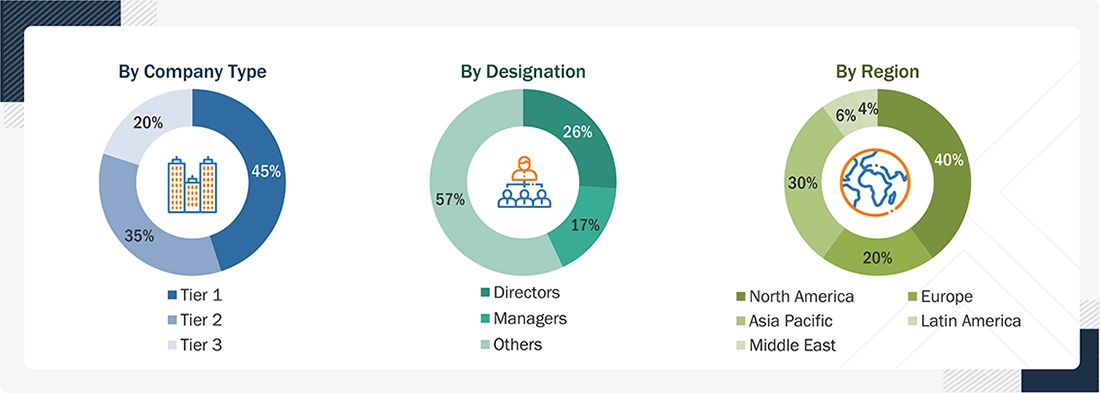
Note 1: C-level primaries include CEOs, CFOs, and COOs.
Note 2: Others include sales managers, marketing managers, business development managers, product managers, distributors, and suppliers.
Note 3: Companies are classified into tiers based on their total revenues. As of 2025, Tier 1 = >USD 2 billion, Tier 2 = USD 50 million to USD 2 billion, and Tier 3 = <USD 50 million.
To know about the assumptions considered for the study, download the pdf brochure
Market Size Estimation
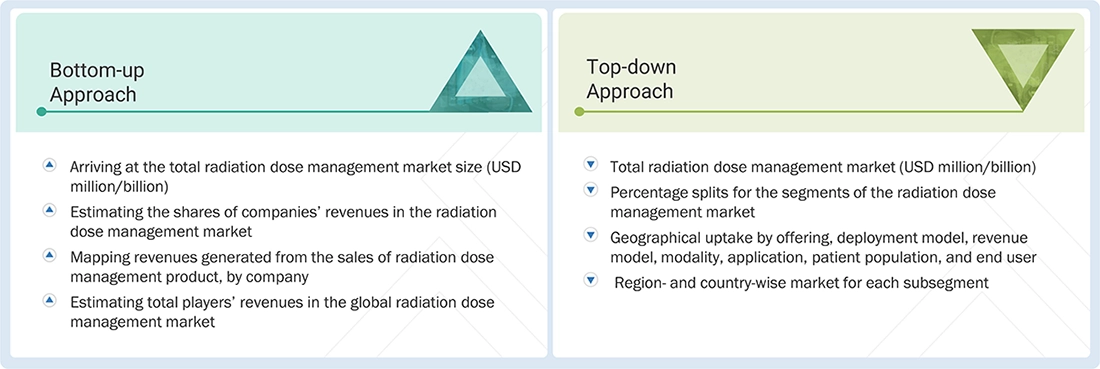
Both top-down and bottom-up approaches were used to estimate and validate the total size of the radiation dose management market. These methods were also used extensively to estimate the size of various subsegments in the market.
Global Radiation Dose Management Market Size: Top-Down Approach and Bottom-Up Approach
Data Triangulation
After arriving at the overall market size, using the market size estimation processes, the market was split into several segments and subsegments. To complete the overall market engineering process and arrive at the exact statistics of each market segment and sub-segment, the data triangulation and market breakdown procedures were employed, wherever applicable. The data was triangulated by studying various factors and trends from both the demand and supply sides in the radiation dose management market.
Market Definition
Radiation dose management (RDM) refers to software-based systems used to collect, monitor, analyze, and manage patient-related radiation-dose metrics and technical data generated during medical imaging and image-guided procedures. These systems can integrate dose and related technical information from multiple imaging modalities and interface with healthcare information systems such as Picture Archiving and Communication System (PACS), Radiology Information System (RIS), and Hospital Information System (HIS).
Key Stakeholders
- Radiation Dose Management and Related Solution Providers
- Medical Imaging Equipment Manufacturers
- Hospitals and Healthcare Systems (Public and Private)
- Diagnostic and Imaging Centers
- Ambulatory Care Settings
- Academic and Research Institutions
- Government and Radiation Protection Regulatory Agencies
- Radiologists, Medical Physicists, and Other Radiation Protection Professionals
Report Objectives
- To define, describe, and forecast the global radiation dose management market based on offering, function, technology, deployment model, revenue model, modality, application, end user, and region
- To provide detailed information regarding the major factors (such as drivers, restraints, opportunities, and challenges) influencing the market growth
- To strategically analyze micro-markets with respect to individual growth trends, prospects, and contributions to the overall radiation dose management market
- To analyze opportunities in the market for stakeholders and provide details of the competitive landscape for market leaders
- To strategically analyze the market structure profile of the key players of the radiation dose management market and comprehensively analyze their core competencies
- To forecast the size of the market segments with respect to five regions, namely, North America, Europe, Asia Pacific, Latin America, and the Middle East & Africa
- To track and analyze competitive developments such as product launches, partnerships, collaborations, acquisitions, expansions, and agreements in the radiation dose management market during the forecast period.
Available customizations:
With the given market data, MarketsandMarkets offers customizations as per the company’s specific needs. The following customization options are available for the report:
- Product Analysis: Product matrix, which gives a detailed comparison of the product portfolios of each company.
- Geographic Analysis: Further breakdown of the Rest of the Asia Pacific radiation dose management market into Taiwan, New Zealand, Thailand, Singapore, Malaysia, and other countries. Further breakdown of the Rest of the European radiation dose management market into Russia, Austria, Finland, Turkey, Norway, Poland, Portugal, Romania, Denmark, and other countries.
Get the Full Radiation Dose Management Market Report
Full forecast, segment splits, and company analysis for all Radiation Dose Management Market.
- US Radiation Dose Management Market
- France Radiation Dose Management Market
- Germany Radiation Dose Management Market
- UK Radiation Dose Management Market
- Italy Radiation Dose Management Market
- Spain Radiation Dose Management Market
- Japan Radiation Dose Management Market
- China Radiation Dose Management Market
- India Radiation Dose Management Market
- Brazil Radiation Dose Management Market
- Mexico Radiation Dose Management Market
Need a Tailored Report?
Customize this report to your needs
Get 10% FREE Customization
Customize This Report
