
Asia Pacific Radiation Hardened Electronics Market (2025-2030)

The Asia Pacific Radiation Hardened Electronics Market was valued at $506.7 Million in 2025 and projected to reach to $697.1 Million by 2030, representing a compound annual growth rate of 6.6%. Asia Pacific's radiation hardened electronics market is poised for sustained growth through 2030, expanding from $506.7 million to $697.1 million.


| Market Size in | USD 26.32 MN |
| Market Forecast in | |
| CAGR | |
| Forecast Period | |
| Units Considered | Value (USD MN) |
Asia Pacific Radiation Hardened Electronics Market Trends and Insights
- This 6.6% compound annual growth rate reflects Asia Pacific's increasing demand for mission-critical semiconductor solutions across space, defense, and nuclear applications.
- Asia Pacific's strategic position in global supply chains and rising investments in satellite communications and aerospace programs are driving market expansion throughout the forecast period. The Asia Pacific region is becoming a critical hub for radiation hardened component manufacturing and deployment.
- Asia Pacific's growing space exploration initiatives, particularly from emerging economies, coupled with heightened defense modernization efforts, are accelerating adoption of radiation-resistant electronics.
- By 2030, Asia Pacific is expected to capture significant market share as regional governments and private enterprises invest heavily in resilient semiconductor technologies to support next-generation space missions and secure defense infrastructure..
Key Market Statistics
- CAGR (2025-2030) 6.6% CAGR
- Market Size, 2025 ~USD 506.7 Million
- Forecast, 2030 ~USD 697.1 Million
- Geography Asia Pacific
Asia Pacific Radiation Hardened Electronics Market Overview
Rapid Market Expansion :
Asia Pacific's radiation hardened electronics market is growing at 6.6% CAGR, outpacing the global rate of 5.4%, driven by increased investments in space exploration and satellite programs across the region.
Strategic Supply Chain Hub :
Asia Pacific's position as a critical node in global semiconductor manufacturing enables cost-effective production of radiation hardened components, attracting both regional and international defense contractors.
Defense & Space Modernization :
Rising military expenditures in India, Japan, South Korea, and Australia are accelerating demand for radiation hardened electronics in defense systems, missiles, and next-generation space platforms.
Nuclear Infrastructure Growth :
Expansion of nuclear power generation across Asia Pacific, particularly in China and India, is creating sustained demand for radiation hardened semiconductors in reactor control and monitoring systems.
Asia Pacific Radiation Hardened Electronics Market Dynamics
- This trajectory is underpinned by accelerating space programs, including India's Chandrayaan missions and Japan's space initiatives, coupled with modernization of defense capabilities across the region.
- Government investments in indigenous satellite manufacturing and space technology development are creating new opportunities for specialized semiconductor suppliers. The region's competitive manufacturing ecosystem and proximity to emerging space economies position Asia Pacific as a critical growth engine.
- Increasing collaboration between government space agencies and private sector players, combined with rising nuclear energy adoption, will sustain demand for radiation hardened solutions.
- Supply chain diversification efforts by global OEMs are also redirecting production capacity to Asia Pacific, further strengthening market fundamentals through 2030..
Market Ecosystem
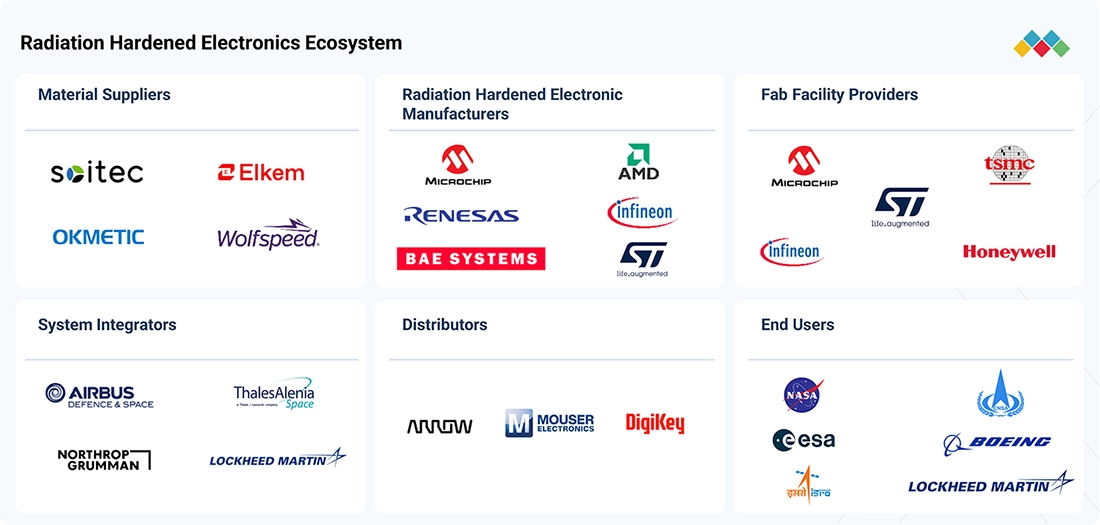
RADIATION HARDENED ELECTRONICS MARKET SIZE, SHARE & TRENDS: COMMERCIAL USE CASES ACROSS INDUSTRIES
| COMPANY | USE CASE DESCRIPTION | BENEFITS |
|---|---|---|
 |
Deployment of BAE Systems’ RAD750 radiation-hardened processor in NASA’s Perseverance Mars Rover to support the Rover Compute Element for spacecraft command, instrument control, engineering functions, and science-data processing. | Enables reliable onboard computing in high-radiation environments, protects critical processing functions from radiation-induced failures, and supports continuous command, navigation, and scientific data processing during long-duration planetary missions. |
 |
Deployment of RTG4 radiation-tolerant FPGAs across space missions, including Mission Extension Vehicles (MEV-1 and MEV-2), CAS-500, and Artemis II, supporting high-speed processing and programmable spacecraft electronics. | Provides resistance to single-event upsets and radiation damage, improves reliability of mission-critical electronics, enables high-speed signal processing, and supports long-duration operation across LEO, GEO, and deep-space missions. |
 |
Deployment of Intersil-branded radiation-hardened ICs in NASA’s Artemis II mission, including the Orion spacecraft and Space Launch System, for avionics, launch-safety systems, power regulation and distribution, signal conditioning, and onboard computing. | Ensures stable power delivery and signal integrity under radiation and extreme temperatures, improves reliability of safety-critical spacecraft systems, and reduces the risk of electronic failures during crewed deep-space missions. |
Logos and trademarks shown above are the property of their respective owners. Their use here is for informational and illustrative purposes only.
Related Ecosystem
Aviation
- Narrow Body Aircraft
- Wide Body Aircraft
- Military Helicopters
- Special Mission Aircraft
- Fighter Aircraft
- HONEYWELL INTERNATIONAL INC.
- COLLINS AEROSPACE
- Thales group
- Safran group
- HEICO Corporation
Electronics System And Components
- Sensors
- Temperature Sensors
- Pressure Sensors
- Actuators
- Image Sensors
- Lenovo
- Samsung
- Texas Instruments Incorporated
- HONEYWELL INTERNATIONAL INC.
- Teledyne Technologies Incorporated
Semiconductor Materials And Components
- Sensors
- Gallium Nitride (GaN)
- Digital Signal Processor (DSP)
- Natural Language Processing (NLP)
- Silicon Carbide
- Texas Instruments Incorporated
- Samsung
- APPLIED MATERIALS, INC.
- Stmicroelectronics
- Lenovo
Key Takeaways
- Asia Pacific's radiation hardened electronics market will grow from $506.7M (2025) to $697.1M (2030) at a 6.6% CAGR.
- Asia Pacific's space and defense sectors are primary growth drivers for radiation hardened semiconductor demand.
- Asia Pacific is establishing itself as a manufacturing and innovation hub for radiation-resistant electronics.
- Asia Pacific's government investments in satellite programs and aerospace capabilities are accelerating market expansion.
Radiation Hardened Electronics Market Report Scope
| Report Metric | Details |
|---|---|
| Base Year | 2025 |
| Fastest Growing Segment | OTHER MEMORY COMPONENTS (Memory Component) |
| Forecast Period | 2025–2030 |
| Growth Rate | CAGR of 5.4% from 2025 to 2030 |
| Largest Segment | RADIATION HARDENED BY DESIGN (RHBD) (Manufacturing Technique) |
| Market Size Base Year (Billions) | ~USD 1.77 (2025) |
| Revenue Forecast (Billions) | ~USD 2.3 (2030) |
| Segments Covered | Component, Type, Manufacturing Technique, Product Type, Memory Component, Component Type, Application, Application Type |
Asia Pacific Radiation Hardened Electronics Market Report Segmentation
8 segment dimensions are covered across the global market.
By Component
- Memory
- Mixed-Signal Ics
- Power Management
- Processors & Controllers
By Type
- A/D & D/A Converters
- Asic
- Fpga
- Mcu
- Mpu
- Multiplexers/Resistors
- Non-Volatile
- Volatile
By Manufacturing Technique
- Radiation Hardened By Design (Rhbd)
- Radiation Hardened By Process (Rhbp)
By Product Type
- Commercial-Off-The-Shelf
- Custom-Made
By Memory Component
- Dram
- Flash
- Mram
- Other Memory Components
- Sram
By Component Type
- Diodes
- Igbts
- Mosfets
- Thyristors
By Application
- Aerospace & Defense
- Medical
- Nuclear Power Plants
- Other Applications
- Space (Satellites)
By Application Type
- Commercial
- Implantable Devices
- Military
- Radiology
- Vehicles/Avionics
- Weapons & Missiles
Target Audience
- Defense & Aerospace OEMs : Require Asia Pacific market intelligence to support platform development, supplier qualification, and regional expansion strategies for missile systems, aircraft, and defense electronics.
- Space Agency & Satellite Operators : Need detailed market forecasts and supplier capabilities to plan satellite constellation deployments, lunar missions, and space infrastructure projects across Asia Pacific.
- Semiconductor Manufacturers : Seek regional demand forecasts, competitive positioning data, and customer requirements to guide R&D investments and manufacturing capacity decisions in Asia Pacific markets.
- Nuclear Power Operators & Utilities : Require supply chain analysis and component availability forecasts for radiation hardened electronics used in reactor control systems and safety-critical nuclear applications.
- Investment & Strategy Consultants : Need comprehensive market data, growth drivers, and competitive dynamics to advise clients on M&A opportunities, market entry strategies, and portfolio optimization in Asia Pacific.
Key Companies in the Asia Pacific Radiation Hardened Electronics Market
| Company | HQ | Ownership | Strongest segments |
|---|---|---|---|
| INNOPHOS HOLDINGS, INC. | United States | Private Company | |
| DIODES INCORPORATED | United States | Public Company | |
| BAE SYSTEMS | United Kingdom | Public Company | |
| RENESAS ELECTRONICS CORPORATION | Japan | Public Company | |
| INFINEON TECHNOLOGIES AG | Germany | Public Company | |
| STMICROELECTRONICS | Netherlands | Public Company | |
| ADVANCED MICRO DEVICES, INC. | United States | Public Company | |
| TEXAS INSTRUMENTS INCORPORATED | United States | Public Company | Analog – Power products,Analog – Signal chain products,Embedded Processing (MCUs, processors, connectivity, radar), |
| TELEDYNE TECHNOLOGIES INCORPORATED | United States | Public Company | Digital Imaging,Instrumentation,Aerospace and Defense Electronics, |
| TTM TECHNOLOGIES INC. | United States | Public Company | A&D (mission systems, radar, hi-rel PCBs),Commercial PCBs & substrates,RF&S Components and microelectronic assemblies, |
| THALES | France | Public Company | Defence systems & C4ISR (air, land, naval, joint),Digital identity, cyber, and secure IoT,Aerospace avionics, ATM, and inflight connectivity, |
| ANALOG DEVICES, INC. | United States | Public Company | Data converters,Power management and power ICs,Amplifiers and signal conditioning, |
| MERCURY SYSTEMS, INC. | United States | Public Company | RF and microwave components and modules,Embedded processing boards and switched fabrics,Integrated subsystems and mission solutions, |
INNOPHOS HOLDINGS, INC.
Innophos Holdings, Inc. is a private U.S. company founded in 2004 that employs 1,485 people. The company operates in the specialty ingredients and chemical manufacturing sector.
DIODES INCORPORATED
Diodes Incorporated is a publicly traded U.S. semiconductor company founded in 1959 with 7,989 employees. The company designs, manufactures, and markets discrete, logic, and analog semiconductor products.
BAE SYSTEMS
BAE Systems is a publicly traded defense and aerospace company headquartered in the United Kingdom, founded in 1979 with 111,400 employees. The company provides advanced technology solutions and services for military, security, and commercial customers globally.
RENESAS ELECTRONICS CORPORATION
Renesas Electronics Corporation is a publicly traded Japanese semiconductor company founded in 2002 with 21,907 employees. The company designs and manufactures microcontrollers, analog semiconductors, and other semiconductor solutions for automotive and industrial markets.
INFINEON TECHNOLOGIES AG
Infineon Technologies AG is a publicly traded German semiconductor company founded in 1952 with 56,500 employees. The company develops and manufactures semiconductors for automotive, industrial, and consumer applications worldwide.
STMICROELECTRONICS
STMicroelectronics is a publicly traded semiconductor company headquartered in the Netherlands, founded in 1987 with 48,000 employees. The company designs and manufactures a broad range of semiconductor products for industrial, automotive, and consumer markets.
ADVANCED MICRO DEVICES, INC.
Advanced Micro Devices, Inc. is a publicly traded U.S. semiconductor company founded in 1969 with 31,000 employees. The company designs and manufactures processors, graphics processors, and related technologies for computing and gaming markets.
TEXAS INSTRUMENTS INCORPORATED
Texas Instruments Incorporated is a publicly traded U.S. semiconductor company founded in 1930 with 33,000 employees. The company designs and manufactures analog and embedded processing semiconductors for industrial, automotive, and consumer applications.
TELEDYNE TECHNOLOGIES INCORPORATED
Teledyne Technologies Incorporated is a publicly traded U.S. company founded in 1960 with 15,800 employees. The company provides instrumentation, digital imaging, aerospace and defense electronics, and engineered systems for various markets.
TTM TECHNOLOGIES INC.
TTM Technologies Inc. is a publicly traded U.S. company founded in 1978 with 18,200 employees. The company provides electronics manufacturing services, including printed circuit boards and assembly solutions for aerospace, defense, and industrial customers.
THALES
Thales is a publicly traded French multinational company founded in 1893 with 82,111 employees. The company provides aerospace, defense, security, and transportation solutions and services globally.
ANALOG DEVICES, INC.
Analog Devices, Inc. is a publicly traded U.S. semiconductor company founded in 1965 with 24,500 employees. The company designs and manufactures analog, mixed-signal, and digital signal processing semiconductors for industrial, automotive, and consumer applications.
MERCURY SYSTEMS, INC.
Mercury Systems, Inc. is a publicly traded U.S. company founded in 1981 with 2,117 employees. The company provides secure processing solutions and components for aerospace, defense, and intelligence applications.
Countries within Asia Pacific - compare and drill down
| Country | 2025 size (native) |
|---|
Country market size visualization
Reasons to Buy this Report
- Regional Market Sizing & Forecasts : Obtain precise market valuations for Asia Pacific ($506.7M in 2025, $697.1M in 2030) with segment-level breakdowns by application, enabling accurate budget allocation and competitive positioning.
- Growth Driver Analysis : Understand region-specific catalysts including space program expansion, defense modernization, and nuclear infrastructure development that differentiate Asia Pacific from other geographies.
- Competitive Landscape Intelligence : Identify key manufacturers, suppliers, and emerging players within Asia Pacific's radiation hardened ecosystem, including local champions and multinational competitors establishing regional operations.
- Supply Chain & Manufacturing Insights : Leverage detailed analysis of Asia Pacific's semiconductor manufacturing capabilities, cost structures, and supply chain dynamics to optimize sourcing and production strategies.
- Strategic Market Entry Guidance : Access actionable recommendations for market penetration, partnership opportunities, and regulatory considerations specific to major Asia Pacific markets including India, Japan, South Korea, and China.
Frequently asked questions
What is the current size of Asia Pacific's radiation hardened electronics market?
Asia Pacific's radiation hardened electronics market is valued at $506.7 million in 2025 and is projected to reach $697.1 million by 2030.
What is the growth rate for radiation hardened electronics in Asia Pacific?
Asia Pacific's radiation hardened electronics market is expected to grow at a compound annual growth rate (CAGR) of 6.6% from 2025 to 2030.
Which industries drive demand for radiation hardened electronics in Asia Pacific?
Asia Pacific's primary demand drivers include space exploration, satellite communications, defense modernization, and nuclear energy sectors requiring mission-critical semiconductor solutions.
Why is Asia Pacific becoming important for radiation hardened electronics manufacturing?
Asia Pacific's strategic geographic position, growing aerospace capabilities, government space initiatives, and established semiconductor infrastructure make it an increasingly vital manufacturing and innovation hub for radiation-resistant components.
What factors will influence Asia Pacific's radiation hardened electronics market through 2030?
Asia Pacific's market growth will be influenced by expanding satellite programs, defense spending increases, technological advancements in radiation hardening, and rising private sector space investments across the region.
RESEARCH METHODOLOGY
The study involved four major activities in estimating the size of the radiation hardened electronics market. Exhaustive secondary research has been done to collect information on the market, peer market, and parent market. Validation of these findings, assumptions, and sizing with industry experts across the value chain through primary research has been the next step. Both top-down and bottom-up approaches have been employed to estimate the global market size. After that, market breakdown and data triangulation have been used to estimate the market sizes of segments and subsegments.
Secondary Research
The secondary research process has referred to various secondary sources to identify and collect necessary information for this study. The secondary sources include annual reports, press releases, and investor presentations of companies; white papers; journals and certified publications; and articles from recognized authors, websites, directories, and databases. Secondary research was conducted to obtain critical information about the industry’s supply chain, the market’s value chain, the total pool of key players, market segmentation according to the industry trends (to the bottom-most level), regional markets, and key developments from market- and technology-oriented perspectives. The secondary data was collected and analyzed to determine the overall market size, further validated by primary research.
Primary Research
Extensive primary research was conducted after gaining knowledge about the current scenario of the radiation hardened electronics market through secondary research. Several primary interviews were conducted with experts from the demand and supply sides across four major regions—North America, Europe, Asia Pacific, and RoW. This primary data was collected through questionnaires, emails, and telephonic interviews.
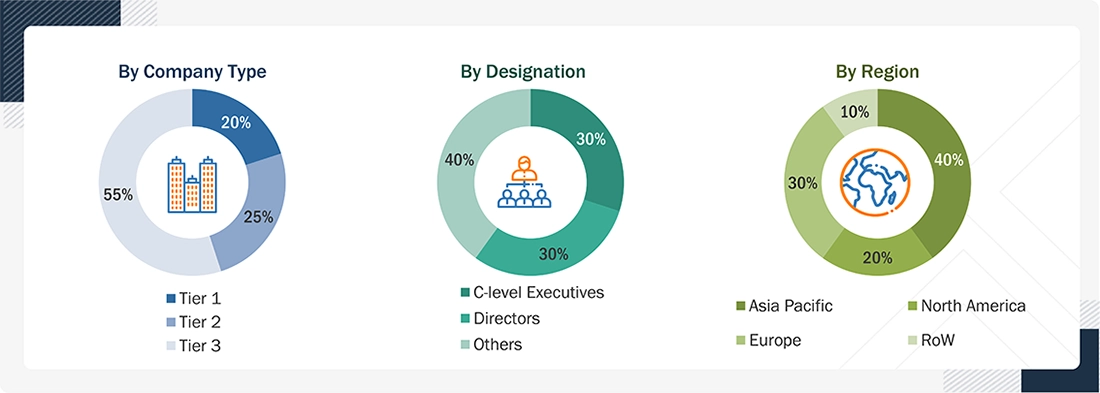
Note: Other designations include technology heads, media analysts, sales managers, marketing managers, and product managers. The three tiers of the companies are based on their total revenues as of 2025 - Tier 1: >USD 1 billion, Tier 2: USD 500 million–1 billion, and Tier 3: <USD 500 million.
To know about the assumptions considered for the study, download the pdf brochure
Market Size Estimation
In the complete market engineering process, top-down and bottom-up approaches and several data triangulation methods were used to estimate and forecast the overall market segments and subsegments listed in this report. Key players in the market were identified through secondary research, and their market shares in the respective regions were determined through primary and secondary research. This entire procedure includes the study of annual and financial reports of the top market players and extensive interviews for key insights (quantitative and qualitative) with industry experts (CEOs, VPs, directors, and marketing executives).
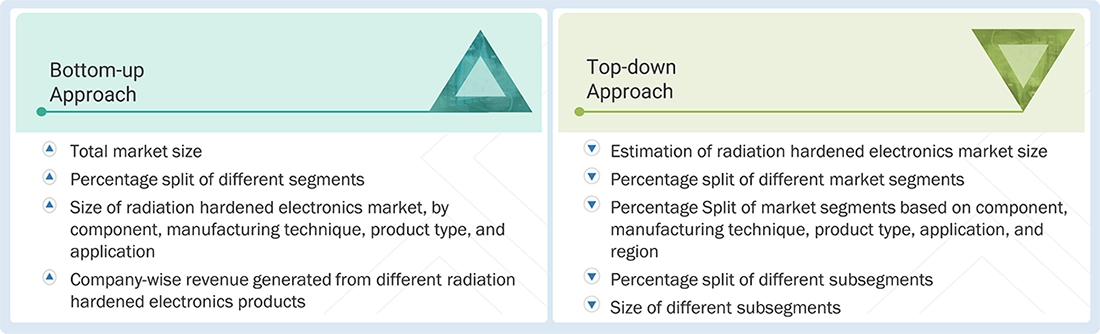
All percentage shares, splits, and breakdowns were determined using secondary sources and verified through primary sources. All the parameters affecting the markets covered in this research study were accounted for, viewed in detail, verified through primary research, and analyzed to obtain the final quantitative and qualitative data. This data was consolidated and supplemented with detailed inputs and analysis from MarketsandMarkets and presented in this report. The following figure represents this study’s overall market size estimation process.
BOTTOM-UP APPROACH
- Identifying the players in the radiation hardened electronics market that influence the global market, along with their offerings
- Analyzing major manufacturers of radiation hardened electronics, studying their portfolios, and understanding several types of products based on their features and functions
- Analyzing trends pertaining to the usage of radiation hardened electronics in end-use industries, such as space, aerospace & defense, nuclear power plants, medical, and others (scientific research and education)
- Tracking ongoing and upcoming developments in the market, such as investments made, R&D activities, product launches, acquisitions, partnerships, agreements, contracts, and expansions, and forecasting the market based on these developments and other critical parameters
- Conducting multiple discussions with key opinion leaders to understand different types of radiation hardened electronic components, manufacturing techniques, product types, applications, and current trends in the market, and analyzing the breakdown of the scope of work carried out by major manufacturing companies
- Arriving at market estimates by analyzing the revenue of these companies generated from different types of components and then combining the same to arrive at the market estimate by region
- Verifying and cross-checking the estimates at every level through discussions with key opinion leaders, such as CXOs, directors, and operations managers, and finally with the domain experts at MarketsandMarkets
- Studying various paid and unpaid sources of information, such as annual reports, press releases, white papers, and databases.
TOP-DOWN APPROACH
- In the top-down approach, the overall market size was used to estimate the size of individual markets (mentioned in the market segmentation) through percentage splits obtained from secondary and primary research.
- For calculating the size of specific market segments, the parent market size was considered when implementing the top-down approach. The bottom-up approach was also implemented for data extracted from secondary research to validate the market size of different segments.
- The market share of each company was estimated to verify the revenue share used in the bottom-up approach earlier. With data triangulation and data validation through primary data, this study determined and confirmed the size of the parent market and each segment.
Radiation Hardened Electronics Market : Top-Down and Bottom-Up Approach
Data Triangulation
After arriving at the overall market size, the market was split into several segments and subsegments using the market size estimation processes explained above. Data triangulation and market breakdown procedures were employed to complete the entire market engineering process and determine each market segment’s and subsegment’s exact statistics. The data was triangulated by studying various factors and trends from the demand and supply sides in the radiation hardened electronics market.
Market Definition
Radiation hardening is the development of electronic components and systems resistant to destruction caused by ionizing radiation (particle radiation and high-energy electromagnetic radiation) occurring in outer space, high-altitude flights, around nuclear reactors, particle accelerators, during nuclear accidents, or nuclear warfare. Most semiconductor electronic components are susceptible to damage by radiation. Radiation hardened components are based on hardened equivalents, with some design and manufacturing variations that reduce their susceptibility to damage by radiation. The ecosystem of the radiation hardened electronics market comprises manufacturers and distributors of radiation hardened components. This market is competitive and diversified, with over 25 companies competing across its value chain to sustain their positions and increase their share. The market is expected to grow significantly in the coming years, owing to the increasing deployment of communication and military satellites in space.
Key Stakeholders
- Associations and Regulatory Authorities
- Government Bodies, Venture Capitalists, and Private Equity Firms
- Original Equipment Manufacturers
- Semiconductor Component Suppliers
- Radiation Hardened Equipment Distributors and Sales Firms
- Software Solution Providers
- Radiation Hardened Electronic Component and System Integrators
- Research Institutes and Organizations
Report Objectives
- To describe and forecast the size of the radiation hardened electronics market, by component, manufacturing technique, product type, and application, in terms of value
- To analyze the material selection and packaging types utilized in the market
- To describe and forecast the market size for various segments in four key regions, namely, North America, Europe, Asia Pacific, and RoW, in terms of value
- To provide detailed information regarding the key drivers, restraints, opportunities, and challenges influencing the growth of the radiation hardened electronics market
- To analyze micromarkets with respect to individual growth trends, prospects, and contribution to the total market
- To analyze the opportunities in the market for various stakeholders by identifying its high-growth segments
- To profile the key players and comprehensively analyze their ranking and core competencies, along with a detailed competitive landscape for market leaders
- To map competitive intelligence based on company profiles, key player strategies, and game-changing developments, such as product launches/developments, partnerships, collaborations, and acquisitions, undertaken in the market
- To understand and analyze the macroeconomic outlook for North America, Europe, Asia Pacific, and RoW regions
- To understand the impact of AI/Gen AI on radiation hardened electronics market
Available customizations:
With the given market data, MarketsandMarkets offers customizations according to the specific requirements of companies. The following customization options are available for the report:
- Detailed analysis and profiling of additional market players based on various blocks of the supply chain
Get the Full Radiation Hardened Electronics Market Report
Full forecast, segment splits, and company analysis for all Radiation Hardened Electronics Market.
Need a Tailored Report?
Customize this report to your needs
Get 10% FREE Customization
Customize This Report
