
UAE Train Control Systems Market (2017-2022)

The UAE Train Control Systems Market was valued at $68.9 Million in 2017 and projected to reach to $135.4 Million by 2022, representing a compound annual growth rate of 14.46%. The UAE train control systems market is positioned for continued growth driven by ambitious rail infrastructure projects and government commitment to sustainable transportation.


| Market Size in | USD 26.32 MN |
| Market Forecast in | |
| CAGR | |
| Forecast Period | |
| Units Considered | Value (USD MN) |
UAE Train Control Systems Market Trends and Insights
- In 2017, the UAE market was valued at USD 68.9 million, driven by ongoing development of metro systems and freight rail networks across the region.
- By 2022, the UAE train control systems market is forecast to reach USD 135.4 million, representing a compound annual growth rate of 14.46%-significantly outpacing global trends. The UAE's rapid urbanization and commitment to sustainable transportation solutions have catalyzed demand for advanced train control technologies.
- Government-backed projects, including metro expansions in Dubai and Abu Dhabi, have positioned the UAE as a key market for automated signaling and control systems.
- The UAE's strategic geographic location and role as a regional logistics hub further amplify the need for efficient rail operations and safety-critical control infrastructure. Looking ahead, the UAE train control systems market is expected to benefit from continued capital expenditure in rail projects, technological upgrades to existing networks, and integration of smart city initiatives.
- The UAE's emphasis on reducing carbon emissions and enhancing passenger safety through automation will sustain market momentum through 2022 and beyond..
Key Market Statistics
- CAGR (2017-2022) 14.46% CAGR
- Market Size, 2017 ~USD 68.9 Million
- Forecast, 2022 ~USD 135.4 Million
- Country UAE
UAE Train Control Systems Market Overview
Rapid Market Expansion :
UAE train control systems market grew from USD 68.9 million in 2017 to USD 135.4 million by 2022, representing a robust 14.46% CAGR, significantly outpacing the global average of 8.02%.
Metro System Development :
Ongoing expansion of Dubai Metro, Abu Dhabi Metro, and other urban rail networks across emirates has driven substantial demand for advanced train control and signaling technologies.
Freight Rail Modernization :
Strategic investments in freight rail infrastructure, including the UAE National Railway project, have accelerated adoption of modern control systems for enhanced operational efficiency and safety.
Government Infrastructure Initiatives :
UAE's Vision 2021 and long-term development plans prioritize rail connectivity and smart transportation, creating sustained demand for integrated train control solutions through 2022 and beyond.
UAE Train Control Systems Market Dynamics
- The emirate's strategic focus on metro expansion, freight rail modernization, and smart city initiatives ensures sustained investment in advanced signaling and control technologies.
- With major projects including the UAE National Railway and ongoing metro extensions, the market will benefit from increased automation, safety requirements, and operational efficiency demands.
- Regional economic diversification efforts and tourism growth further support infrastructure development, maintaining strong market momentum through the forecast period and beyond..
Market Ecosystem
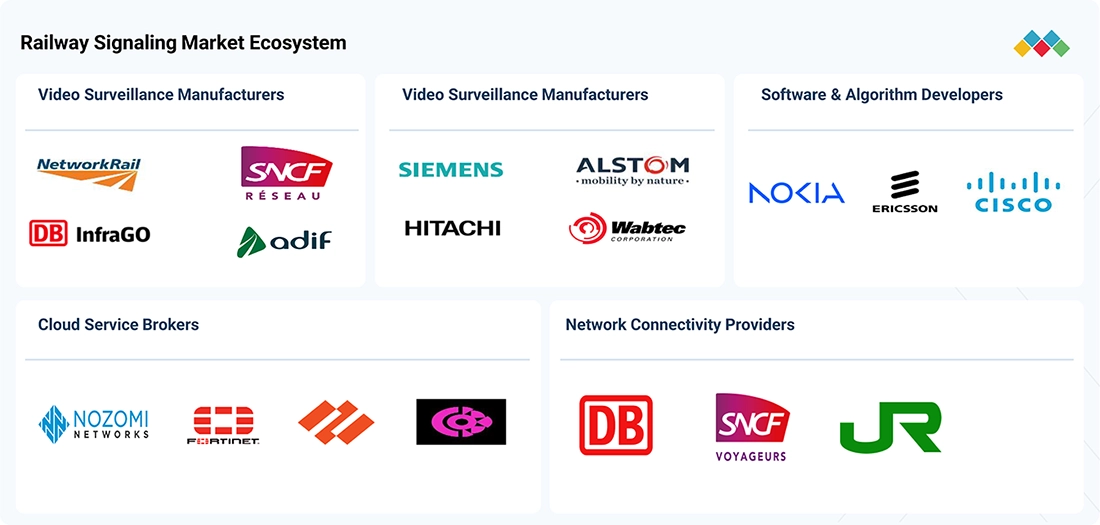
RAILWAY SIGNALING MARKET: COMMERCIAL USE CASES ACROSS INDUSTRIES
| COMPANY | USE CASE DESCRIPTION | BENEFITS |
|---|---|---|
 |
Deploys digital interlocking, CBTC, and ERTMS solutions to modernize train-control architectures across urban and mainline networks | Enables shorter headways, higher line capacity, and migration toward software-intensive automated signaling |
 |
Integrates ETCS, digital interlocking, and control systems for high-speed and mainline signaling modernization | Supports higher train throughput and standardized digital control while reducing legacy-system dependency |
 |
Deploys electronic interlocking, ETCS, and CBTC platforms for large-scale network and station modernization | Expands network capacity and enables centralized, real-time train movement management |
 |
Provides CBTC-based signaling and train-control solutions for metro and urban rail networks | Supports high-frequency operations through reduced headways and automation-ready train control |
 |
Combines electronic train management, virtual-block signaling, precision positioning, and communications into integrated train-control systems | Improves corridor capacity and operational visibility while enabling advanced train-control migration |
Logos and trademarks shown above are the property of their respective owners. Their use here is for informational and illustrative purposes only.
Related Ecosystem
Key Takeaways
- The UAE train control systems market is projected to double from USD 68.9 million in 2017 to USD 135.4 million by 2022, driven by metro expansion and rail modernization.
- The UAE's 14.46% CAGR significantly exceeds global growth rates, positioning the emirate as a high-growth market for train control technologies.
- Government-led infrastructure projects in Dubai and Abu Dhabi are primary catalysts for the UAE train control systems market expansion.
- The UAE's focus on smart city integration and sustainable transportation is accelerating adoption of automated signaling and advanced control systems.
Train Control Systems Market Report Scope
| Report Metric | Details |
|---|---|
| Base Year | 2017 |
| Fastest Growing Segment | OTHERS (SATELLITE, LTE-R) (Connectivity) |
| Forecast Period | 2017-2022 |
| Growth Rate | CAGR of 8.02% from 2017 to 2022 |
| Largest Segment | COMMUNICATION-BASED TRAIN CONTROL (Solution Type) |
| Market Size Base Year (Billions) | ~USD 2.43 (2017) |
| Revenue Forecast (Billions) | ~USD 3.58 (2022) |
| Segments Covered | Train Type, Component, Connectivity, Solution Type |
UAE Train Control Systems Market Report Segmentation
4 segment dimensions are covered across the global market.
By Train Type
- Dmu
- Emu
- Metros & High Speed Trains
By Component
- Human Machine Interface
- Mobile Communication Gateway
- Vehicle Control Unit
By Connectivity
- Gsm-R
- Others (Satellite, Lte-R)
- Tetra
- Wi-Fi
By Solution Type
- Communication-Based Train Control
- Integrated Train Control
- Positive Train Control
Target Audience
- Rail Infrastructure Operators : Metro and freight rail operators in UAE need market intelligence to plan capital expenditures, evaluate control system upgrades, and benchmark technology investments against regional standards.
- Train Control System Manufacturers : Equipment manufacturers require detailed UAE market data to assess demand, identify growth segments, develop localized solutions, and establish distribution partnerships in this high-growth market.
- Government & Planning Authorities : UAE transportation ministries and planning bodies use market research to inform infrastructure budgets, procurement strategies, and technology standards for national rail development initiatives.
- System Integrators & Consultants : Engineering firms and consultants need UAE-specific market insights to advise clients on technology selection, project feasibility, and competitive positioning in rail modernization projects.
- Investment & Financial Analysts : Investors and financial institutions require comprehensive market data to evaluate investment opportunities, assess sector growth potential, and make informed decisions on rail infrastructure funding in UAE.
Reasons to Buy this Report
- Market Size & Growth Data : Access precise valuation figures for UAE market (USD 68.9M in 2017, USD 135.4M in 2022) with detailed CAGR analysis to benchmark investments and identify growth opportunities in this high-performing regional market.
- Competitive Landscape Intelligence : Understand key players, market share distribution, and competitive strategies specific to UAE's train control systems sector, enabling informed partnership and acquisition decisions.
- Infrastructure Project Insights : Gain detailed intelligence on major metro expansions, freight rail initiatives, and government-backed projects driving demand for control systems across UAE emirates.
- Technology Adoption Trends : Identify emerging technologies, automation standards, and safety requirements shaping procurement decisions for train control systems in UAE's rapidly modernizing rail networks.
- Strategic Market Entry Planning : Leverage comprehensive UAE-specific data to develop market entry strategies, identify customer segments, and forecast revenue potential for train control system providers and suppliers.
Frequently asked questions
What was the UAE train control systems market size in 2017?
The UAE train control systems market was valued at USD 68.9 million in 2017, establishing a strong baseline for subsequent growth through 2022.
What is the forecast size of the UAE train control systems market by 2022?
The UAE train control systems market is forecast to reach USD 135.4 million by 2022, representing a doubling of market value over the five-year period.
What is the CAGR for the UAE train control systems market?
The UAE train control systems market is expected to grow at a compound annual growth rate of 14.46% from 2017 to 2022.
Which projects are driving growth in the UAE train control systems market?
Metro expansion projects in Dubai and Abu Dhabi, along with freight rail network modernization, are primary drivers of the UAE train control systems market growth.
How does the UAE market compare to global train control systems growth?
The UAE train control systems market's 14.46% CAGR substantially exceeds the global average of 8.02%, reflecting the emirate's accelerated infrastructure investment and urbanization.
RESEARCH METHODOLOGY
The study involved four major activities in estimating the current size of the railway signaling market. Exhaustive secondary research was done to collect information on the market, the peer market, and the child markets. The next step was to validate these findings and assumptions and size them with industry experts across value chains through primary research. The top-down approaches were employed to estimate the complete market size. Thereafter, market breakdown and data triangulation processes were used to estimate the market size of segments and subsegments.
Secondary Research
In the secondary research process, various secondary sources such as company annual report/presentations, press releases, investor presentations of companies, white papers, certified publications, and articles from recognized authors have been used to identify and collect information useful for an extensive commercial study of the global machine tools market.
Primary Research
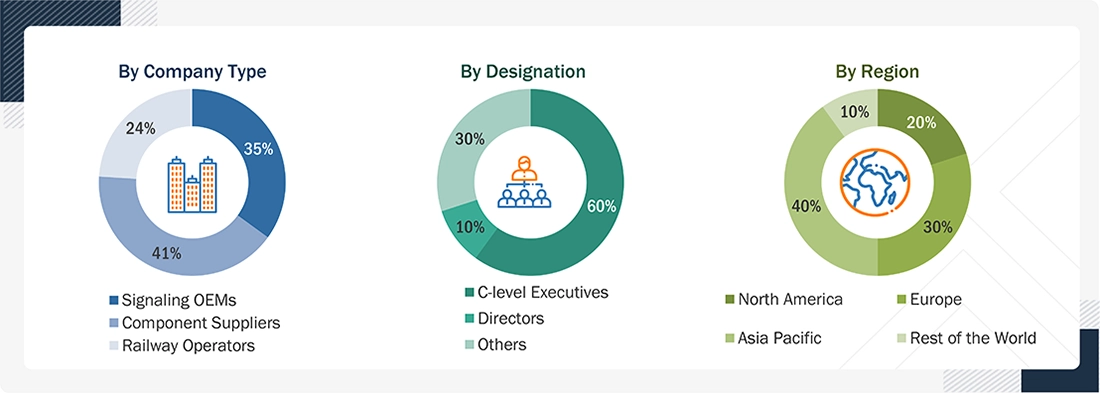
Extensive primary research was conducted after acquiring an understanding of the railway signaling market scenarios through secondary research. Several primary interviews were conducted with market experts from both the demand (railway infrastructure managers, passenger and freight operators, metro and high-speed rail authorities, government railway organizations, regulators, and signaling procurement teams) and supply (signaling OEMs, system integrators, technology and component suppliers, and signaling maintenance/service providers) sides across four major regions: North America, Europe, Asia Pacific, and the Rest of the World (RoW). Approximately 24% and 76% of primary interviews were conducted from the demand and supply sides, respectively. Primary data was collected through questionnaires, emails, and telephonic interviews.
In the canvassing of primaries, various departments within organizations, such as sales, operations, and administration, were covered to provide a holistic viewpoint in the report. After interacting with industry experts, brief sessions were conducted with highly experienced independent consultants to reinforce the findings from primaries. This, along with in-house subject-matter experts’ opinions, led to the findings described in the remainder of this report.
To know about the assumptions considered for the study, download the pdf brochure
Market Size Estimation
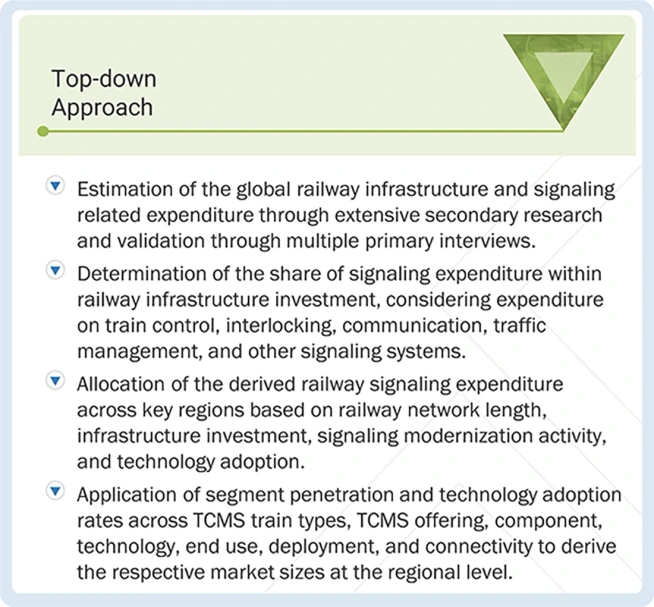
Only the top-down approach was used to estimate and validate the total size of the market. This method was also used extensively to estimate the size of various subsegments in the market. The research methodology used to estimate the market size includes the following:
Railway Signaling Market : Top-Down Approach
Data Triangulation
After arriving at the overall market size- using the market estimation processes as explained above- the market was split into several segments and subsegments. To complete the overall market engineering process and arrive at the exact statistics of each market segment and subsegment, data triangulation and market breakdown procedures were employed, wherever applicable. The data was triangulated by studying various factors and trends from both the demand and supply sides.
Market Defination
Railway signaling refers to the integrated systems used to control, supervise, and manage train movements while maintaining safe separation between trains. These systems combine train detection, interlocking, route control, train protection, onboard and wayside equipment, and signaling communications. Key technologies include ABS, CBTC, ETCS, PTC, and ATC, deployed across mainline, urban, high-speed, and freight rail networks. Modern signaling also supports continuous train localization and movement supervision, particularly in digitally controlled and automated railway operations. The market therefore covers signaling hardware, software, system integration, modernization, and associated lifecycle services used for new installations and upgrades of existing networks.
Key Stakeholders
- Railway Operators & Infrastructure Managers
- Signaling OEMs & System Integrators
- Signaling Component Suppliers
- Railway Infrastructure Contractors
- Rolling Stock OEMs
- Rail Regulators & Safety Authorities
- Standards Organizations & Industry Associations
- Testing, Certification, and Assessment Bodies
Report Objectives
-
To define, segment, and forecast the size of the railway signaling market in terms of value (USD billion) based on the following categories: TCMS train type, TCMS offering, component, technology, end-use, deployment, connectivity, and region
- TCMS Train Type [Light-Rail & Metros (DMU & EMU), High Speed Trains, Conventional Passenger Trains, Freight Trains]
- TCMS Offering (Solutions and Services)
- Component (Hardware and Software)
- Technology [Automatic Block Signaling (ABS), Communications-Based Train Control (CBTC), European Train Control System (ETCS), Positive Train Control (PTC), Automatic Train Control (ATC)]
- End-use (Mainline, Urban, Freight)
- Region [North America, Europe, Asia Pacific, and RoW]
- To cover infrastructure foundations, deployment, and connectivity segments qualitatively
- To evaluate the key market dynamics influencing the railway signaling market, including strategic drivers, restraints, opportunities, challenges, and emerging technology trends shaping future industry growth
-
To study the following with respect to the market:
- Supply Chain Analysis
- Ecosystem Analysis
- Technology Analysis
- Trade Analysis
- Case Study Analysis
- Supplier Analysis
- Investment and Funding Scenario
- Company Valuation and Financial Metrics
- Brand/Product Comparison
- Patent Analysis
- Regulatory Landscape
- Conferences and Events
- Future Revenue Models for Railway Signaling Industry
- Global Capex Pipeline Analysis
- Future Communication Technologies
- EU-India Trade Deal: Impact Analysis
- Israel-Iran Impact on Railway Signaling Market
- Railway Digitalization Roadmap
- OEM Technology Benchmarking
- To strategically analyze segments with respect to individual growth trends, prospects, and contributions to the total market
- To assess the competitive landscape by profiling leading global market participants based on their business overview, product portfolio, geographic presence, financial performance, and recent strategic developments such as product launches, partnerships, acquisitions, and capacity expansions
- To map the competitive ecosystem by categorizing market participants into Stars, Emerging Leaders, Pervasive Players, and Participants using a robust evaluation framework based on the strength of their product portfolio, business strategy, innovation capability, and market presence
Available customizations:
With the given market data, MarketsandMarkets offers customizations in line with company-specific needs.
- Further breakdown for the railway signaling market, by TCMS train type, at the country level (for countries covered in the report)
- Further breakdown for the railway signaling market, by end-use, at the country level (for countries covered in the report)
Company Profiles
- Profiles of additional market players (up to five)
Get the Full Train Control Systems Market Report
Full forecast, segment splits, and company analysis for all Train Control Systems Market.
- US Train Control Systems Market
- Canada Train Control Systems Market
- Mexico Train Control Systems Market
- Germany Train Control Systems Market
- UK Train Control Systems Market
- France Train Control Systems Market
- Italy Train Control Systems Market
- Spain Train Control Systems Market
- China Train Control Systems Market
- Japan Train Control Systems Market
- India Train Control Systems Market
- South Korea Train Control Systems Market
- Brazil Train Control Systems Market
- Russia Train Control Systems Market
Need a Tailored Report?
Customize this report to your needs
Get 10% FREE Customization
Customize This Report
