Railway Signaling Market

Railway Signaling Market by Train (Passenger, Freight), Technology (ABS, ETCS, CBTC, PTC & ATC), End-Use (Mainline, Freight), Offering (Hardware, Software), Component, Infrastructure, Deployment, Connectivity, and Region - Global Forecast to 2033




OVERVIEW
Source: Secondary Research, Interviews with Experts, MarketsandMarkets Analysis
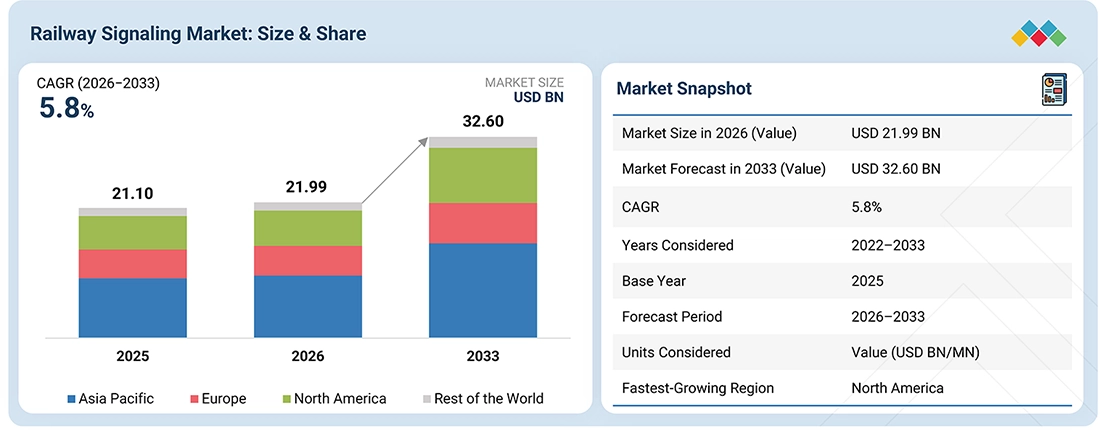
The railway signaling market is projected to reach USD 32.60 billion by 2033 from USD 21.99 billion in 2026, at a CAGR of 5.8%. The market is expanding as rail operators increase investments in network capacity enhancement, train automation, and modernization of aging signaling infrastructure. Deployment of advanced signaling technologies such as ETCS and CBTC is increasing across high-density mainline and urban rail networks, driven by the need to support higher train frequencies, improve operational control, and meet evolving safety requirements. At the same time, modernization of interlocking infrastructure, trackside signaling assets, and train detection systems is supporting replacement demand across brownfield networks. As signaling becomes more technology-intensive, suppliers with capabilities in system integration, interoperability, migration planning, and long-term asset support are better positioned to capture major modernization and network expansion programs.
KEY TAKEAWAYS
-
MARKET SNAPSHOT:
Market Size (2025): USD 21.10 Billion
Current Market Size (2026): USD 21.99 Billion
Projected Market Size (2033): USD 32.60 Billion
CAGR (2026–2033): 5.8% -
BY REGIONAsia Pacific is projected to account for the largest market share during the forecast period.
-
BY TCMS Train TypeBy TCMS train type, the light rail & metros (DMU & EMU) segment is expected to account for a significant share of 30.9% of the railway signaling market.
-
BY TechnologyBased on technology, CBTC is projected to register the highest CAGR of 9.0% during the forecast period.
-
BY End-useBy end use, urban is projected to experience the highest growth rate of 7.2% during the forecast period.
-
COMPETITIVE LANDSCAPE (KEY PLAYERS)Alstom (France), Siemens Mobility (Germany), Hitachi Rail (UK), China Railway Signal & Communication (CRSC) (China), and Wabtec (US), among others, continue to strengthen their market positions through investments in ETCS and CBTC platforms.
-
COMPETITIVE LANDSCAPE (STARTUPS/SMES)Companies such as Traffic Control Technology (India) and UniTTEC (China) are expanding their footprint by offering cost-competitive signaling solutions.
Software-based signaling is becoming a cost-focused alternative to highly proprietary signaling architectures, as rail operators seek to reduce upgrade complexity and improve the reuse of existing infrastructure. The adoption of modular signaling architectures, standardized interfaces, and software-based control functions is gaining relevance, particularly in Europe, where EU Rail and EULYNX initiatives are supporting common interfaces, data models, and scalable signaling architectures for ETCS-based operations. This shift is encouraging suppliers to separate software functions from hardware platforms, allowing upgrades without replacing entire signaling installations. At the same time, the migration toward FRMCS and higher data requirements is creating pressure to design signaling systems that can support future communication architectures and greater levels of automation. These developments are likely to increase competition around software architecture, interoperability, cybersecurity, and upgradeability, while reducing the long-term advantage of closed proprietary signaling platforms.
TRENDS & DISRUPTIONS IMPACTING CUSTOMERS' CUSTOMERS
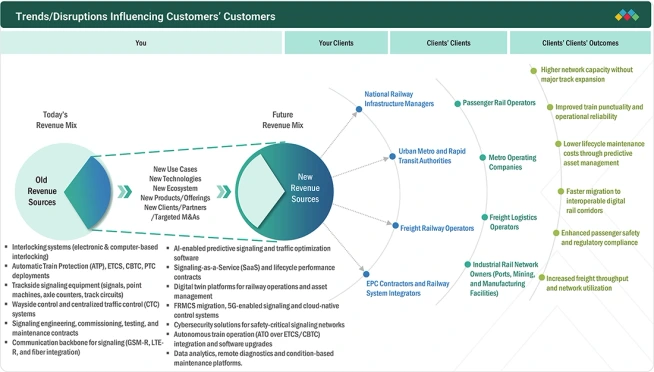
The railway signaling market is evolving from a project-based signaling equipment industry toward an integrated rail-control and lifecycle solutions ecosystem. While traditional revenue continues to come from interlocking systems, trackside signaling, train detection, onboard equipment, installation, and maintenance, future growth is increasingly supported by digital traffic management, signaling software, predictive asset management, remote diagnostics, cybersecurity, and data-driven network optimization. This transition is strengthening collaboration between signaling OEMs, railway infrastructure managers, metro and passenger rail operators, freight operators, and EPC/system integrators as operators prioritize higher network capacity, faster migration to interoperable digital corridors, improved punctuality, and reduced lifecycle costs without major track expansion. As railway operators increasingly shift toward outcome-based performance and asset availability, signaling suppliers are expanding beyond initial system deployment into remote monitoring, condition-based maintenance, software upgrades, traffic optimization, and integrated lifecycle contracts, creating recurring revenue opportunities while improving signaling availability, operational resilience, and network utilization.
Source: Secondary Research, Interviews with Experts, MarketsandMarkets Analysis
MARKET DYNAMICS

Level
-
Network capacity optimization through moving block signals and traffic digitalization

-
Increasing automation across metro and mainline rail network


Level
-
Legacy signaling migration creating opportunity cost for operators


Level
-
Transition from GSM-R to FRMCS and 5G railway communications

-
AI-driven traffic orchestration enabling autonomous freight rail operations


Level
-
Interoperability requirements reducing product differentiation

Source: Secondary Research, Interviews with Experts, MarketsandMarkets Analysis
Driver: Network capacity optimization through moving block signals and traffic digitalization
Capacity pressure is shifting signaling investment toward systems that extract more throughput from existing corridors. ETCS, CBTC, centralized traffic management, and digital interlocking are increasingly being combined with timetable optimization and real-time traffic control, allowing operators to improve network utilization without proportional civil infrastructure expansion. The commercial value is therefore moving toward integrated train control and traffic management architectures, rather than standalone signaling equipment. Siemens' 2026 Mexico ETCS project, for example, combines ETCS Level 1 with TPS.plan for timetable and network optimization.
Restraint: Legacy signaling migration creating opportunity cost for operators
Legacy replacement competes directly with other railway capacity and infrastructure investments, particularly where existing systems remain operational despite aging. The migration also requires service possessions, parallel system operation, application engineering, and extensive testing before cutover. Indian Railways' 2026 projects replacing relay-based interlocking across high-utilization routes illustrate the scale of this brownfield requirement, with INR 405 crore (USD 43.1 million) approved for 32 locations in June 2026.
Opportunity: AI-driven traffic orchestration enabling autonomous freight rail operations
AI is creating an additional software layer above conventional signaling by enabling predictive conflict detection, dynamic train sequencing, and disruption management. In 2026, Hitachi Rail demonstrated AI powered traffic management for mainline and high speed rail, while Siemens demonstrated AI supported traffic management and network optimization through its digital rail portfolio. This creates a new revenue pool for suppliers that can integrate AI decision support with existing signaling and traffic management systems, without requiring immediate replacement of safety-critical infrastructure.
Challenge: Interoperability requirements reducing product differentiation
Standardized signaling architectures are expanding addressable markets while making proprietary differentiation harder to sustain. ETCS is designed to replace multiple national train control systems with an interoperable framework, while current European requirements continue to address compatibility across train detection, onboard equipment, communications, and national rules. Suppliers therefore need to differentiate through certification efficiency, migration capability, open interfaces, integration speed, and system validation, rather than relying only on proprietary signaling hardware.
RAILWAY SIGNALING MARKET: COMMERCIAL USE CASES ACROSS INDUSTRIES
| COMPANY | USE CASE DESCRIPTION | BENEFITS |
|---|---|---|
 |
Deploys digital interlocking, CBTC, and ERTMS solutions to modernize train-control architectures across urban and mainline networks | Enables shorter headways, higher line capacity, and migration toward software-intensive automated signaling |
 |
Integrates ETCS, digital interlocking, and control systems for high-speed and mainline signaling modernization | Supports higher train throughput and standardized digital control while reducing legacy-system dependency |
 |
Deploys electronic interlocking, ETCS, and CBTC platforms for large-scale network and station modernization | Expands network capacity and enables centralized, real-time train movement management |
 |
Provides CBTC-based signaling and train-control solutions for metro and urban rail networks | Supports high-frequency operations through reduced headways and automation-ready train control |
 |
Combines electronic train management, virtual-block signaling, precision positioning, and communications into integrated train-control systems | Improves corridor capacity and operational visibility while enabling advanced train-control migration |
Logos and trademarks shown above are the property of their respective owners. Their use here is for informational and illustrative purposes only.
MARKET ECOSYSTEM
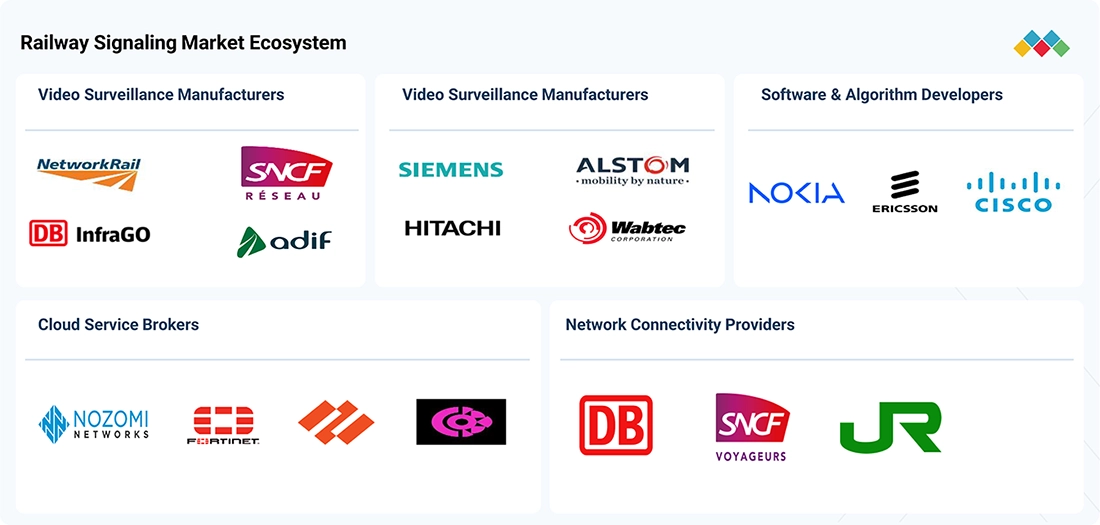
The railway signaling ecosystem is built on interdependent collaboration between rail infrastructure managers, signaling and rolling-stock OEMs, communications technology providers, cybersecurity specialists, and rail operators to deliver safety-critical and interoperable train-control systems. Infrastructure managers such as Network Rail, DB InfraGO, SNCF Réseau, and ADIF define network capacity, modernization, and interoperability requirements, while signaling OEMs including Siemens Mobility, Alstom, Hitachi Rail, and Wabtec integrate interlocking, train control, onboard systems, and wayside equipment into deployable architectures. Communications providers such as Nokia, Ericsson, and Cisco enable the connectivity required for real-time signaling and future digital rail networks, while cybersecurity and digital-asset specialists strengthen network protection, system resilience, and remote asset management. Rail operators ultimately translate these capabilities into higher capacity, improved punctuality, safer train movements, and lower disruption costs, making cross-layer integration a critical differentiator for signaling suppliers seeking long-term positions in modernization programs.
Logos and trademarks shown above are the property of their respective owners. Their use here is for informational and illustrative purposes only.
MARKET SEGMENTS
Source: Secondary Research, Interviews with Experts, MarketsandMarkets Analysis
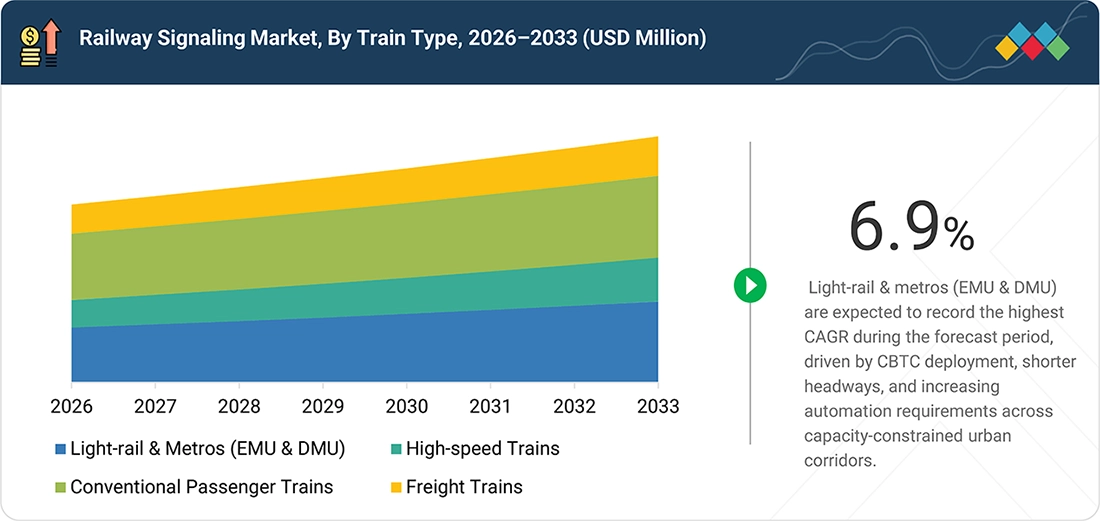
Railway Signaling Market, By Train Type
Light-rail & metros (EMU & DMU) are projected to remain the largest segment during the forecast period, supported by dense urban operations that require high-capacity, low-headway signaling. The segment has strong demand for CBTC, ATO, ATP, and centralized traffic management to maximize line capacity, operational reliability, and automation. The opportunity remains concentrated for OEMs and Tier-1 suppliers in CBTC modernization, automation-ready architectures, and integrated train-to-ground control solutions, particularly across high-density metro networks where incremental capacity gains can defer costly infrastructure expansion.
Railway Signaling Market, By Offering
Solutions are expected to remain the largest offering segment during the forecast period, as railway operators increasingly seek integrated signaling platforms that combine train control, traffic management, communications, and cybersecurity. The shift toward cloud-based interlocking, radio block center functions, AI-enabled traffic management, and predictive maintenance is increasing demand for scalable solutions that can support network upgrades without extensive infrastructure replacement. This is shifting supplier competition toward software capability, system integration, interoperability, and lifecycle scalability, with integrated solutions gaining an advantage in large modernization and network expansion programs.
Railway Signaling Market, By Component
Software is projected to be the fastest-growing component during the forecast period, as rail operators shift toward data-driven traffic management, real-time decision support, and predictive asset monitoring. This creates a strong opportunity for signaling suppliers to expand beyond hardware into traffic optimization, analytics, digital twins, and software-as-a-service capabilities, while open interfaces and standardized data architectures increasingly determine scalability across multi-vendor networks.
Railway Signaling Market, By Technology
European Train Control System (ETCS) is projected to remain the largest technology segment during the forecast period, supported by its role in standardizing train protection and enabling interoperability across diverse rail networks. Its adoption creates sustained demand for ETCS onboard and trackside integration, legacy-system migration, and interoperable control architectures, particularly as infrastructure managers modernize existing networks. For signaling OEMs and Tier-1 suppliers, competitive opportunities increasingly center on retrofit capability, cross-system compatibility, and scalable ETCS platforms that reduce migration complexity and lifecycle costs.
Railway Signaling Market, By End-use
Mainline is expected to remain the leading end-use segment during the forecast period, supported by the need to optimize capacity across long-distance passenger and freight corridors while improving interoperability and safety. Urban networks will remain a high-value application for capacity-intensive and automation-oriented signaling, whereas freight corridors will increasingly require systems that support higher axle loads, longer trains, mixed-traffic operations, and cross-border interoperability. For signaling OEMs and Tier-1 suppliers, the key opportunity lies in developing segment-specific architectures and scalable control systems that address the distinct operational requirements of mainline, urban, and freight networks rather than relying on one-size-fits-all solutions.
REGION
Asia Pacific to Lead Railway Signaling Market During Forecast Period
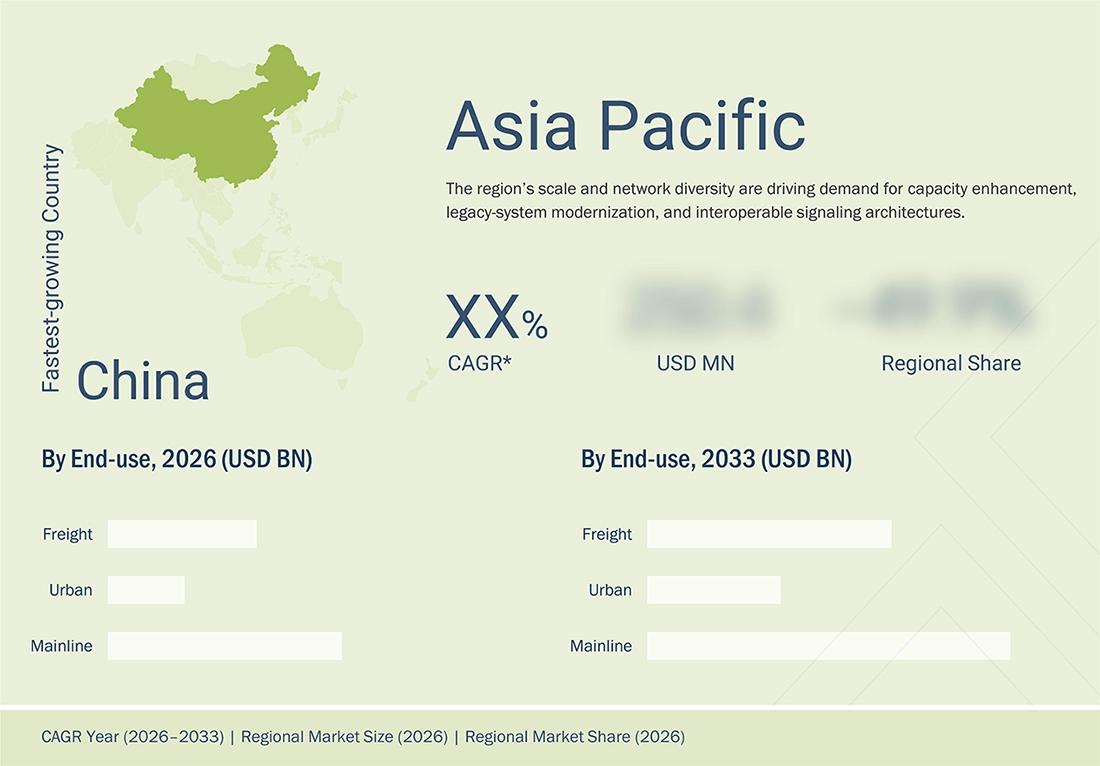
Asia Pacific is projected to remain the largest regional market for railway signaling during 2026–2033, underpinned by sustained investment in passenger, high-speed, urban, and freight rail infrastructure. The region’s scale and network diversity are driving demand for capacity enhancement, legacy-system modernization, and interoperable signaling architectures. For signaling OEMs and Tier 1 suppliers, the strongest opportunities lie in localized solutions, corridor-scale deployments, and scalable signaling platforms that can address diverse technical standards while supporting long-term network expansion and digitalization.
RAILWAY SIGNALING MARKET: COMPANY EVALUATION MATRIX
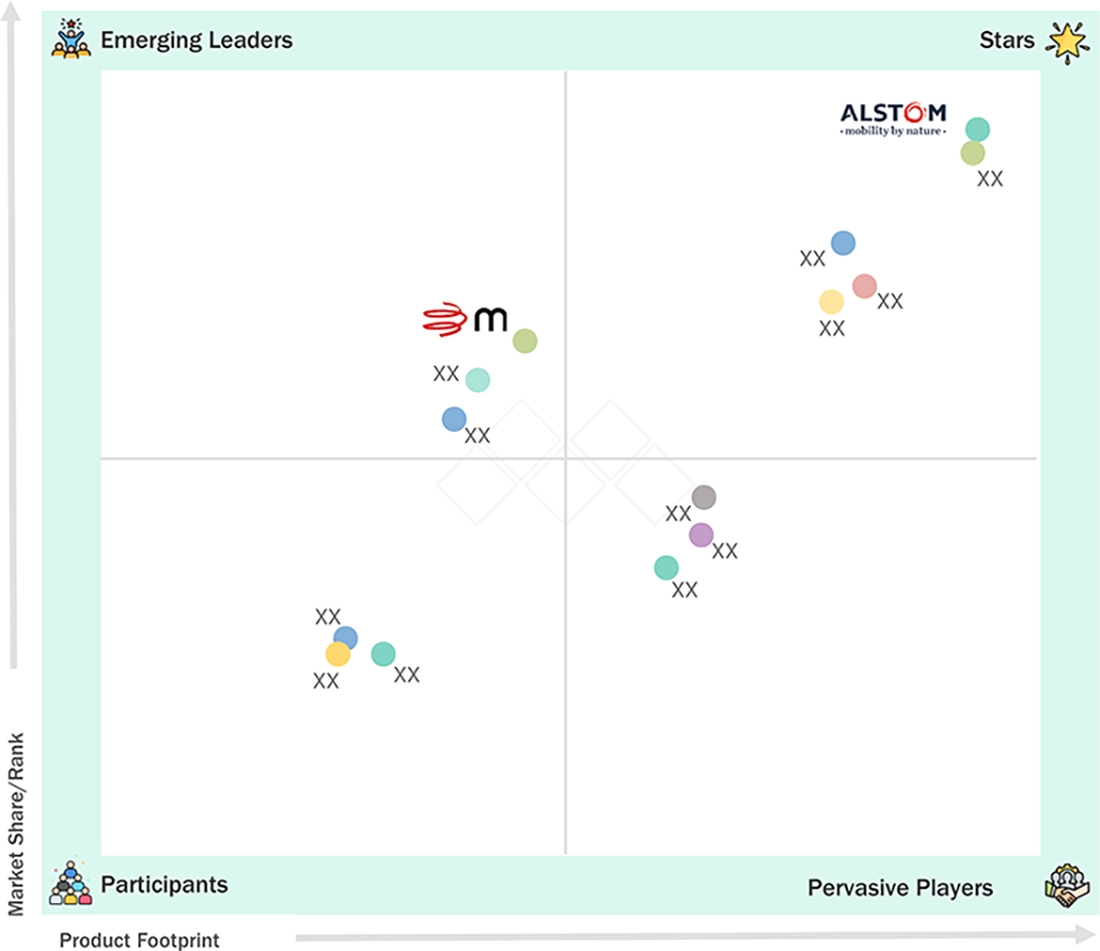
In the railway signaling market matrix, Alstom (Star) leads with a comprehensive portfolio spanning mainline, urban, freight, and digital signaling, supported by strong capabilities across ETCS, CBTC, interlocking, traffic management, and control systems. Its integrated signaling and digital rail ecosystem strengthens its position in large-scale network modernization and end-to-end system integration. MERMEC (Emerging Leader) is expanding its competitive position through a focused portfolio covering ETCS/ERTMS, radio block centers, interlocking, traffic control, lineside equipment, and diagnostic systems, enabling the company to address signaling modernization alongside railway monitoring and infrastructure intelligence. This positioning supports MERMEC’s progression toward the market leaders' quadrant by combining signaling expertise with measurement, diagnostics, and asset-monitoring capabilities, creating a differentiated proposition for integrated railway infrastructure projects.
Source: Secondary Research, Interviews with Experts, MarketsandMarkets Analysis
KEY MARKET PLAYERS
- Alstom (France)
- Siemens Mobility (Germany)
- Hitachi Rail (UK)
- China Railway & Signaling Communication (CRSC) (China)
- Wabtec (US)
- Thales (France)
- CAF S.A. (Spain)
- MER MEC S.p.A (Italy)
- Nippon Signal Co., Ltd. (Japan)
- Kyosan Electric Manufacturing Co., Ltd. (Japan)
MARKET SCOPE
| REPORT METRIC | DETAILS |
|---|---|
| Market Size in 2025 (Value) | USD 21.10 BN |
| Market Size in 2026 (Value) | USD 21.99 BN |
| Market Forecast in 2033 (Value) | USD 32.60 BN |
| Growth Rate | CAGR of 5.8% from 2026 to 2033 |
| Years Considered | 2022–2033 |
| Base Year | 2025 |
| Forecast Period | 2026–2033 |
| Units Considered | Value (USD BN/MN) |
| Report Coverage | Revenue forecast, company ranking, competitive landscape, growth factors, and trends |
| Segments Covered |
|
| Regions Covered | Asia Pacific, Europe, North America, Rest of the World |
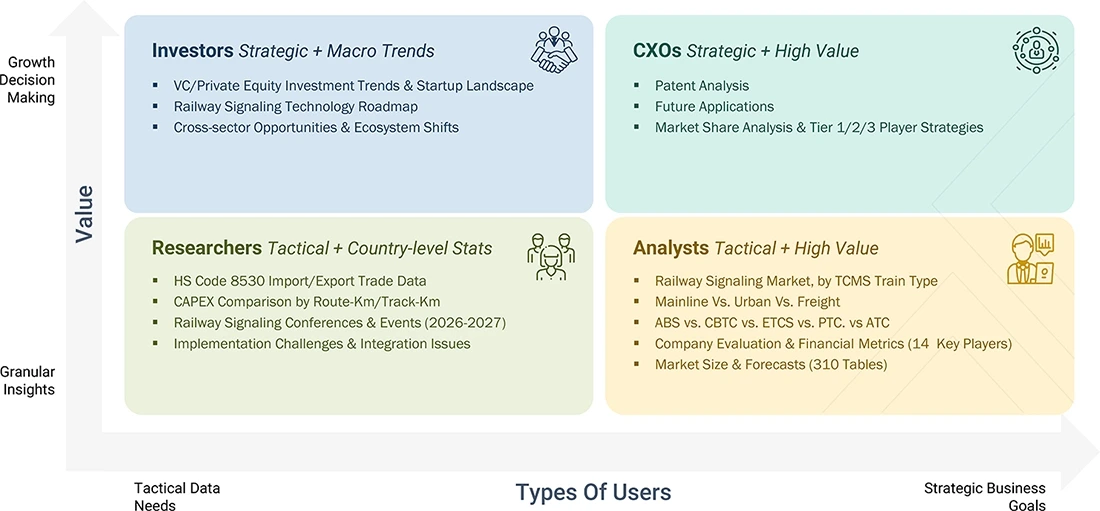
WHAT IS IN IT FOR YOU: RAILWAY SIGNALING MARKET REPORT CONTENT GUIDE
DELIVERED CUSTOMIZATIONS
We have successfully delivered the following deep-dive customizations:
| CLIENT REQUEST | CUSTOMIZATION DELIVERED | VALUE ADDS |
|---|---|---|
| Global Railway Signaling OEM/Signaling Supplier (Europe) | Competitive benchmarking of Alstom, Siemens Mobility, Hitachi Rail, Thales, Wabtec, and MERMEC across signaling technologies, regional presence, and solution portfolios | Vendor positioning matrix, technology leadership assessment, regional opportunity mapping, and white-space analysis for expansion and partnership decisions |
| Railway Infrastructure Manager (Asia Pacific) | Market sizing and demand analysis by technology (ETCS, CBTC, PTC, ATC, ABS), offering, deployment type, and end-use across mainline, urban, and freight networks | Signaling modernization roadmap, technology-selection priorities, and corridor-level investment opportunity assessment aligned with capacity and interoperability requirements |
| Metro / Urban Rail Operator (Middle East & Africa) | Assessment of signaling requirements for high-density metro networks, including CBTC, ATO, interlocking, train detection, and traffic management systems | Headway and capacity-enhancement assessment, automation readiness evaluation, and brownfield migration strategy to minimize operational disruption |
| Rail Signaling Tier-1 Supplier (North America) | Evaluation of demand for PTC, electronic interlocking, wayside systems, onboard signaling, communications, and centralized traffic management across passenger and freight applications | Technology adoption roadmap, interoperability assessment, supplier ecosystem analysis, and market-entry priorities by application and region |
| Private Equity / Infrastructure Investor (Global) | Identification and evaluation of high-growth signaling OEMs, software providers, rail technology specialists, and infrastructure-service companies | Competitive attractiveness scoring, capability benchmarking, market-entry barriers, and investment opportunity assessment based on recurring service potential, installed base, and technology exposure |
RECENT DEVELOPMENTS
- July 2026 : Siemens Mobility secured three railway signaling modernization contracts in Romania covering approximately 560 km, 66 stations, 122 level crossings, and more than 2,000 signals, reinforcing the growing opportunity for integrated signaling and interlocking modernization across legacy mainline networks.
- June 2026 : Alstom secured the first mainline ETCS contract under Queensland’s The Wave program, deploying ETCS Level 2 with integrated 5G connectivity. The development highlights the shift toward interoperable digital signaling and connectivity-enabled infrastructure in new and upgraded mainline corridors.
- May 2026 : Siemens Mobility agreed to acquire key businesses of MERMEC, strengthening its signaling, diagnostics, telecommunications, and asset-intelligence capabilities. The transaction signals increasing industry consolidation around integrated signaling, infrastructure diagnostics, and data-driven rail solutions.
- April 2026 : Siemens Mobility was selected to modernize New York City's Fulton-Liberty Lines with CBTC, covering 23 stations and 65 track kilometers, alongside a 25-year maintenance agreement. The project reinforces the commercial value of combining brownfield signaling modernization with long-term lifecycle services.
- March 2026 : Siemens Mobility and Sonda won Mexico's first ETCS contract, covering more than 300 km and integrating ETCS Level 1, OCC, SCADA, and TPS.plan train-planning software. This demonstrates growing demand for bundled signaling and operational software rather than standalone train-control systems.
Table of Contents
 Exclusive indicates content/data unique to MarketsandMarkets and not available with any competitors.
Methodology
The study involved four major activities in estimating the current size of the railway signaling market. Exhaustive secondary research was done to collect information on the market, the peer market, and the child markets. The next step was to validate these findings and assumptions and size them with industry experts across value chains through primary research. The top-down approaches were employed to estimate the complete market size. Thereafter, market breakdown and data triangulation processes were used to estimate the market size of segments and subsegments.
Secondary Research
In the secondary research process, various secondary sources such as company annual report/presentations, press releases, investor presentations of companies, white papers, certified publications, and articles from recognized authors have been used to identify and collect information useful for an extensive commercial study of the global machine tools market.
Primary Research
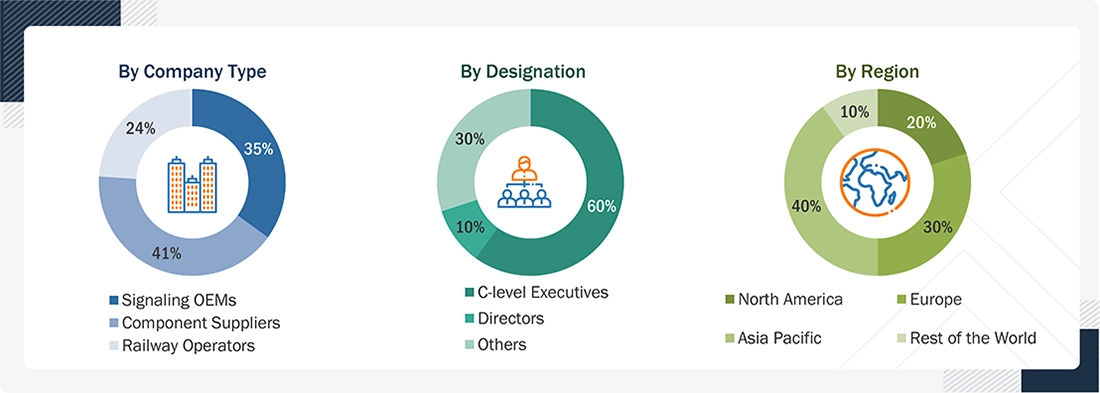
Extensive primary research was conducted after acquiring an understanding of the railway signaling market scenarios through secondary research. Several primary interviews were conducted with market experts from both the demand (railway infrastructure managers, passenger and freight operators, metro and high-speed rail authorities, government railway organizations, regulators, and signaling procurement teams) and supply (signaling OEMs, system integrators, technology and component suppliers, and signaling maintenance/service providers) sides across four major regions: North America, Europe, Asia Pacific, and the Rest of the World (RoW). Approximately 24% and 76% of primary interviews were conducted from the demand and supply sides, respectively. Primary data was collected through questionnaires, emails, and telephonic interviews.
In the canvassing of primaries, various departments within organizations, such as sales, operations, and administration, were covered to provide a holistic viewpoint in the report. After interacting with industry experts, brief sessions were conducted with highly experienced independent consultants to reinforce the findings from primaries. This, along with in-house subject-matter experts’ opinions, led to the findings described in the remainder of this report.
To know about the assumptions considered for the study, download the pdf brochure
Market Size Estimation
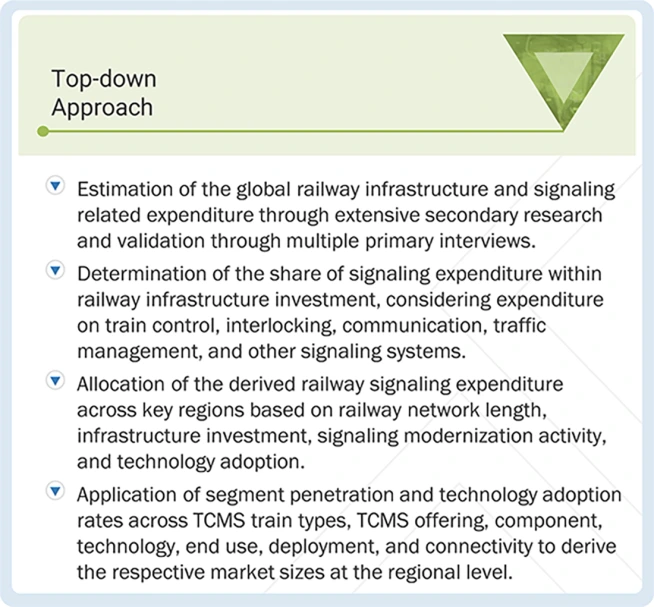
Only the top-down approach was used to estimate and validate the total size of the market. This method was also used extensively to estimate the size of various subsegments in the market. The research methodology used to estimate the market size includes the following:
Railway Signaling Market : Top-Down Approach
Data Triangulation
After arriving at the overall market size- using the market estimation processes as explained above- the market was split into several segments and subsegments. To complete the overall market engineering process and arrive at the exact statistics of each market segment and subsegment, data triangulation and market breakdown procedures were employed, wherever applicable. The data was triangulated by studying various factors and trends from both the demand and supply sides.
Market Defination
Railway signaling refers to the integrated systems used to control, supervise, and manage train movements while maintaining safe separation between trains. These systems combine train detection, interlocking, route control, train protection, onboard and wayside equipment, and signaling communications. Key technologies include ABS, CBTC, ETCS, PTC, and ATC, deployed across mainline, urban, high-speed, and freight rail networks. Modern signaling also supports continuous train localization and movement supervision, particularly in digitally controlled and automated railway operations. The market therefore covers signaling hardware, software, system integration, modernization, and associated lifecycle services used for new installations and upgrades of existing networks.
Key Stakeholders
- Railway Operators & Infrastructure Managers
- Signaling OEMs & System Integrators
- Signaling Component Suppliers
- Railway Infrastructure Contractors
- Rolling Stock OEMs
- Rail Regulators & Safety Authorities
- Standards Organizations & Industry Associations
- Testing, Certification, and Assessment Bodies
Report Objectives
-
To define, segment, and forecast the size of the railway signaling market in terms of value (USD billion) based on the following categories: TCMS train type, TCMS offering, component, technology, end-use, deployment, connectivity, and region
- TCMS Train Type [Light-Rail & Metros (DMU & EMU), High Speed Trains, Conventional Passenger Trains, Freight Trains]
- TCMS Offering (Solutions and Services)
- Component (Hardware and Software)
- Technology [Automatic Block Signaling (ABS), Communications-Based Train Control (CBTC), European Train Control System (ETCS), Positive Train Control (PTC), Automatic Train Control (ATC)]
- End-use (Mainline, Urban, Freight)
- Region [North America, Europe, Asia Pacific, and RoW]
- To cover infrastructure foundations, deployment, and connectivity segments qualitatively
- To evaluate the key market dynamics influencing the railway signaling market, including strategic drivers, restraints, opportunities, challenges, and emerging technology trends shaping future industry growth
-
To study the following with respect to the market:
- Supply Chain Analysis
- Ecosystem Analysis
- Technology Analysis
- Trade Analysis
- Case Study Analysis
- Supplier Analysis
- Investment and Funding Scenario
- Company Valuation and Financial Metrics
- Brand/Product Comparison
- Patent Analysis
- Regulatory Landscape
- Conferences and Events
- Future Revenue Models for Railway Signaling Industry
- Global Capex Pipeline Analysis
- Future Communication Technologies
- EU-India Trade Deal: Impact Analysis
- Israel-Iran Impact on Railway Signaling Market
- Railway Digitalization Roadmap
- OEM Technology Benchmarking
- To strategically analyze segments with respect to individual growth trends, prospects, and contributions to the total market
- To assess the competitive landscape by profiling leading global market participants based on their business overview, product portfolio, geographic presence, financial performance, and recent strategic developments such as product launches, partnerships, acquisitions, and capacity expansions
- To map the competitive ecosystem by categorizing market participants into Stars, Emerging Leaders, Pervasive Players, and Participants using a robust evaluation framework based on the strength of their product portfolio, business strategy, innovation capability, and market presence
Available customizations:
With the given market data, MarketsandMarkets offers customizations in line with company-specific needs.
- Further breakdown for the railway signaling market, by TCMS train type, at the country level (for countries covered in the report)
- Further breakdown for the railway signaling market, by end-use, at the country level (for countries covered in the report)
Company Profiles
- Profiles of additional market players (up to five)


Personalize This Research
- Triangulate with your Own Data
- Get Data as per your Format and Definition
- Gain a Deeper Dive on a Specific Application, Geography, Customer or Competitor
- Any level of Personalization
Let Us Help You
- What are the Known and Unknown Adjacencies Impacting the Railway Signaling Market
- What will your New Revenue Sources be?
- Who will be your Top Customer; what will make them switch?
- Defend your Market Share or Win Competitors
- Get a Scorecard for Target Partners

Custom Market Research Services
We Will Customise The Research For You, In Case The Report Listed Above Does Not Meet With Your Requirements
Get 10% Free CustomisationTESTIMONIALS

JIM NAAS
PRODUCT DIRECTOR, WEASLER
Weasler Engineering, a CentroMotion organization
Global Provider of Industrial Actuation & Control Solutionswww.weasler.com
Our organization was interested in learning more about the attractiveness of a particular market space. We contacted MarketsandMarkets to help us based on previous positive experiences we had with them. The results did not disappoint! We discussed our objectives with them, and the team at MarketsandMarkets developed and executed a proposal that met our needs precisely. We were very impressed by their level of expertise, the quality of the analysis and their insightful recommendations. We would not hesitate in working with them again in the future.

Matt Kardel,
Vice President
Aptiv,
A global technology company that develops safer, greener and more connected solutions.www.aptiv.com
We contracted with
MarketsandMarkets to evaluate the value chain and potential go-to-market partners related to our
interest in the Fleet Management space. The team successfully completed the work on time and at the
pricing agreed. MarketsandMarkets listened and understood our objectives and collaborated well with
us to help us get the visibility we needed to make an investment.
We have subsequently used
MarketsandMarkets again related to Smart Cities to good results.
- US Train Control Systems Market
- Canada Train Control Systems Market
- Mexico Train Control Systems Market
- Germany Train Control Systems Market
- UK Train Control Systems Market
- France Train Control Systems Market
- Italy Train Control Systems Market
- Spain Train Control Systems Market
- China Train Control Systems Market
- Japan Train Control Systems Market
- India Train Control Systems Market
- South Korea Train Control Systems Market
- Brazil Train Control Systems Market
- Russia Train Control Systems Market
- UAE Train Control Systems Market
Growth opportunities and latent adjacency in Railway Signaling Market






Amey
Nov, 2019
Dear all, in which of your fields of train control system does the ETCS fit it – Train Control Solutions Market or Positive Train Control or Communication-Based Train Control or Integrated Train Control? Query180047242460889000637_1573815378507.
Amey
Nov, 2019
I am Interested in the report. Please share the sample of the report. It seems a good report. i would like to see the level of information you covered in the report. Thanks. .