
Japan Rare Earth Metals Market (2025-2030)

The Japan Rare Earth Metals Market was valued at $9273 Million in 2025 and projected to reach to $10648.9 Million by 2030, representing a compound annual growth rate of 2.8%. Japan's rare earth metals market demonstrates moderate but consistent growth, driven by sustained industrial demand and technological advancement across packaging, construction, and mining sectors.


| Market Size in | USD 26.32 MN |
| Market Forecast in | |
| CAGR | |
| Forecast Period | |
| Units Considered | Value (USD MN) |
Japan Rare Earth Metals Market Trends and Insights
- Japan's market growth is driven by sustained demand from the packaging, construction, mining, and gases sectors, which rely on rare earth elements for advanced manufacturing and technological applications.
- The moderate growth trajectory reflects Japan's mature industrial base and strategic focus on resource efficiency and recycling initiatives. During the 2025–2030 forecast period, Japan's rare earth metals market will benefit from increased adoption in high-tech manufacturing, renewable energy infrastructure, and automotive electrification.
- Japan's commitment to circular economy principles and domestic supply chain resilience will shape market dynamics, as the country seeks to reduce import dependency through advanced processing technologies and strategic partnerships.
- The incremental market expansion underscores Japan's position as a critical consumer and innovator within the Asia Pacific rare earth metals ecosystem..
Key Market Statistics
- CAGR (2025-2030) 2.8% CAGR
- Market Size, 2025 ~USD 9273 Million
- Forecast, 2030 ~USD 10648.9 Million
- Country Japan
Japan Rare Earth Metals Market Overview
Market Valuation :
Japan's rare earth metals market is valued at USD 9,273 million in 2025, with projections reaching USD 10,648.9 million by 2030, reflecting steady growth in the Asia-Pacific region.
Growth Rate :
The Japanese market expands at a CAGR of 2.8% through 2030, outpacing global growth expectations and demonstrating resilience in domestic demand across key industrial sectors.
Sector Drivers :
Packaging, construction, mining, and gases industries in Japan drive rare earth metal consumption through advanced manufacturing, technological applications, and infrastructure development initiatives.
Market Maturity :
Japan's established industrial base and technological expertise position it as a mature market with stable demand patterns, supported by continuous innovation in electronics and automotive sectors.
Japan Rare Earth Metals Market Dynamics
- The 2.8% CAGR reflects Japan's mature economy and established supply chains, with particular strength in high-tech manufacturing applications.
- The market benefits from Japan's leadership in electronics and automotive industries, which require rare earth elements for permanent magnets, catalysts, and advanced materials.
- By 2030, the market is expected to reach USD 10,648.9 million, supported by infrastructure modernization and increased adoption of green technologies.
- However, growth remains tempered compared to global rates due to market saturation and established competition, requiring strategic focus on value-added applications and supply chain optimization..
Market Ecosystem
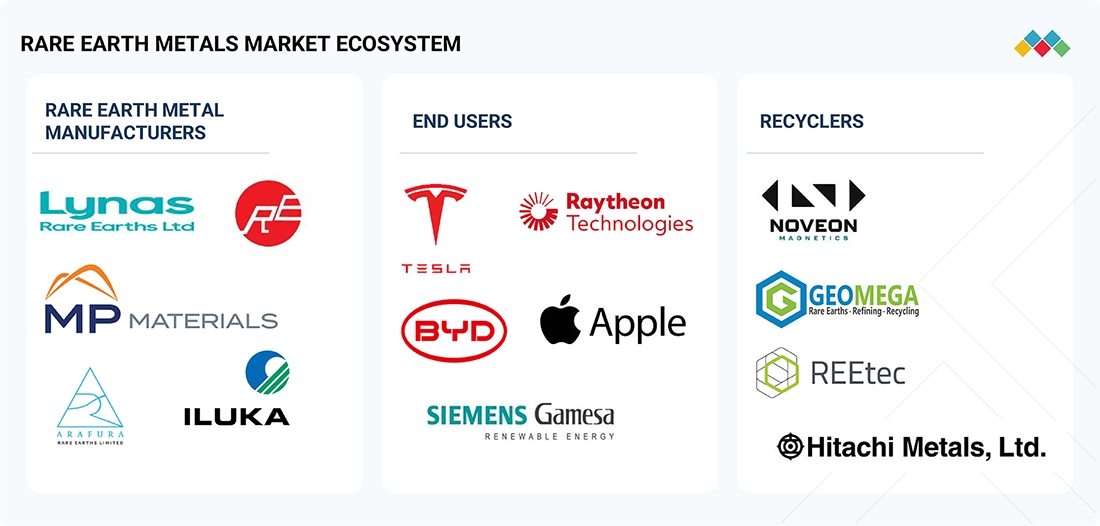
Rare Earth Metals Market: COMMERCIAL USE CASES ACROSS INDUSTRIES
| COMPANY | USE CASE DESCRIPTION | BENEFITS |
|---|---|---|
 |
Restoring US rare earth magnet production to reduce dependence on overseas supply chains and establish domestic capacity for critical materials. | Enhanced supply security, reduced reliance on imports, strengthened US manufacturing competitiveness in EVs, wind energy, and defense applications. |
 |
Pilot-scale rare-earth magnet recycling initiative using proprietary separation technologies to recover critical rare earth elements from end-of-life products. | Sustainable recovery of valuable materials, reduced environmental footprint, cost-effective recycling pathway, and lower dependence on primary mining. |
 |
Closed-loop magnet-to-magnet recycling process enabling direct reuse of rare earth elements to produce new permanent magnets. | Circular economy model, reduced waste, decreased energy consumption, and stable domestic supply of high-performance magnets for electronics and clean energy. |
Logos and trademarks shown above are the property of their respective owners. Their use here is for informational and illustrative purposes only.
Related Ecosystem
Bulk Chemicals And Inorganics
- Corrosion Inhibitors
- Glycol Ethers
- Acetic Acid
- Acetone
- Ammonium Nitrate
- Basf se
- DOW CHEMICAL COMPANY
- Exxon Mobil Corporation
- AZELIS HOLDINGS SA
- Sinopec limited
Equipment Machine And Tooling
- Wastewater Treatment
- Air Cooled Heat Exchangers
- Diaphragm Pumps
- Fiberglass
- HVAC System
- Alfa Laval Corporate AB
- Veolia
- Johnson Controls International plc
- Daikin Industries,Ltd.
- Parker-Hannifin Corporation
Mining Minerals And Metals
- Wastewater Treatment
- Fiberglass
- Light Commercial Vehicles (LCVs)
- Nitrogen
- Acetic Acid
- LHOIST S.A
- SEVERSTAL JSC
- ArcelorMittal S.A.
- TW METALS, INC.
- Linde plc
Key Takeaways
- Japan's rare earth metals market is valued at USD 9,273 million in 2025 and will reach USD 10,648.9 million by 2030, growing at a 2.8% CAGR.
- Japan's moderate growth rate reflects its mature industrial economy and emphasis on resource efficiency, recycling, and supply chain localization.
- High-tech manufacturing, renewable energy, and automotive electrification are primary growth drivers for Japan's rare earth metals demand through 2030.
- Japan's strategic focus on reducing import dependency and advancing domestic processing capabilities will reshape competitive dynamics in the Asia Pacific region.
Rare Earth Metals Market Report Scope
| Report Metric | Details |
|---|---|
| Base Year | 2025 |
| Fastest Growing Segment | TERBIUM OXIDE (Type) |
| Forecast Period | 2025–2030 |
| Growth Rate | CAGR of 6.2% from 2025 to 2030 |
| Largest Segment | PERMANENT MAGNETS (Application) |
| Market Size Base Year (Billions) | ~USD 5.46 (2025) |
| Revenue Forecast (Billions) | ~USD 7.38 (2030) |
| Segments Covered | Type, Application |
Japan Rare Earth Metals Market Report Segmentation
2 segment dimensions are covered across the global market.
By Type
- Cerium Oxide
- Dysprosium Oxide
- Europium Oxide
- Gadolinium Oxide
- Lanthanum Oxide
- Neodymium Oxide
- Other Types
- Praseodymium Oxide
- Samarium Oxide
- Terbium Oxide
- Yttrium Oxide
By Application
- Catalyst
- Catalysts
- Ceramics
- Glass Additives
- Glass Polishing
- Metal Alloys
- Other Applications
- Permanent Magnets
- Phosphors
JAPAN: RARE EARTH METALS MARKET, BY APPLICATION, 2024–2030
| Segment | 2024 | 2025 | 2026 | 2027 | 2028 | 2029 | 2030 | CAGR (%) |
|---|---|---|---|---|---|---|---|---|
| CATALYSTS | 2.9 | 3 | 3 | 3.1 | 3.2 | 3.2 | 3.3 | 2.1 |
| CERAMICS | 11.8 | 12.1 | 12.5 | 12.9 | 13.3 | 13.7 | 14.1 | 3 |
| GLASS ADDITIVES | 3.3 | 3.3 | 3.3 | 3.4 | 3.4 | 3.4 | 3.5 | 1.1 |
| GLASS POLISHING | 3 | 3.1 | 3.2 | 3.2 | 3.3 | 3.3 | 3.4 | 1.9 |
| METAL ALLOYS | 10 | 10.3 | 10.5 | 10.7 | 10.9 | 11.2 | 11.4 | 2.2 |
| OTHER APPLICATIONS | 5.3 | 5.5 | 5.6 | 5.7 | 5.9 | 6 | 6.1 | 2.4 |
| PERMANENT MAGNETS | 160.4 | 167 | 173.9 | 181 | 188.5 | 196.2 | 204.3 | 4.1 |
| PHOSPHORS | 38.1 | 39.9 | 41.7 | 43.7 | 45.7 | 47.8 | 50 | 4.6 |
| TOTAL | 234.9 | 244.2 | 253.7 | 263.7 | 274.1 | 284.9 | 296.1 | 3.9 |
Target Audience
- Industrial Manufacturers : Japanese packaging, construction, and mining companies need market data to optimize rare earth metal sourcing, manage supply chains, and plan production capacity investments.
- Investment Firms : Private equity and venture capital investors require Japan-specific market valuations and growth forecasts to evaluate investment opportunities in rare earth metals and related sectors.
- Supply Chain Managers : Procurement professionals in Japan's automotive and electronics industries need accurate market sizing to negotiate supplier contracts and ensure stable rare earth metal availability.
- Market Strategists : Business development and strategy teams require Japan market insights to identify expansion opportunities, assess competitive positioning, and plan market entry strategies.
- Government & Policy Makers : Japanese government agencies and trade organizations need market data to inform industrial policy, resource management strategies, and support domestic rare earth metal industries.
Key Companies in the Japan Rare Earth Metals Market
| Company | HQ | Ownership | Strongest segments |
|---|---|---|---|
| SOJITZ CORPORATION | Japan | Public Company | Metals, Minerals, and Resource Trading,Energy, Power, and Infrastructure (IPP, LNG, Gas-Fired, IPP/IWPP),Automotive, Industrial Machinery, and Transportation (incl. Aircraft, Marine), |
| ALBEMARLE CORPORATION | United States | Public Company | Energy Storage (lithium carbonate, hydroxide, chloride),Specialties (bromine and lithium specialties),Ketjen (clean fuels and performance catalysts), |
| IMERYS SA | France | Public Company | Performance minerals (plastics, paints, ceramics, building products),Refractory, foundry, abrasives, building chemistry,Graphite, carbon, and energy-transition minerals (incl. lithium), |
| HALDOR TOPSOE A/S | Denmark | Private Company | Ammonia and fertilizer process technology and catalysts,Methanol and petrochemical process technology and catalysts,Hydrogen and clean energy process technology and catalysts, |
| LYNAS RARE EARTHS LTD | Australia | Public Company | NdPr (neodymium-praseodymium) magnet materials,Other light rare earths (lanthanum, cerium),Heavy rare earths (Sm, Eu, Gd, Tb, Dy), |
| AUSTRALIAN STRATEGIC MATERIALS LTD. | Australia | Public Company | Rare earth oxides and metals,Zirconium products,Niobium and hafnium products, |
| CHINA RARE EARTH HOLDINGS LIMITED. | China | Public Company | Rare earth products for electronics and optics,Magnetic and energy-related rare earth applications,Fluorescent materials and polishing agents, |
| SHENGHE RESOURCES HOLDING CO., LTD. | China | Public Company | Rare earth concentrates,Rare earth compounds and REOs,Rare earth metals, |
| CHINA NORTHERN RARE EARTH (GROUP) HIGH–TECH CO., LTD. | China | Public Company | Rare earth oxides and salts,Rare earth magnetic materials,Polishing, hydrogen storage, and catalytic materials, |
| CANADA RARE EARTH CORPORATION | Canada | Public Company | Rare earth trading and marketing,Processing and tolling services,Project development and advisory, |
| NORTHERN MINERALS | Australia | Public Company | Heavy rare earth concentrate / mixed carbonate,Exploration and evaluation services / grants,By-product and ancillary income, |
| MP MATERIALS | United States | Public Company | Materials (concentrates and separated rare earths),Magnetics (NdPr metal, NdFeB magnets and precursors), |
| AMERICAN RARE EARTHS | Australia | Public Company | Rare earth oxides (NdPr-focused),Other rare earths and lanthanides,By-products (thorium, uranium, scandium), |
SOJITZ CORPORATION
Sojitz Corporation is a Japanese public company founded in 1862 with 26,789 employees. The company operates as a diversified trading and investment corporation.
ALBEMARLE CORPORATION
Albemarle Corporation is a United States-based public company founded in 1887 with 7,800 employees. The company specializes in specialty chemicals and materials.
IMERYS SA
Imerys SA is a French public company founded in 1880 with 14,878 employees. The company operates in the minerals and specialty materials sector.
HALDOR TOPSOE A/S
Haldor Topsoe A/S is a Danish private company founded in 1940 with 2,739 employees. The company specializes in catalysts and chemical technologies.
LYNAS RARE EARTHS LTD
Lynas Rare Earths Ltd is an Australian public company founded in 1983 with 47 employees. The company operates in rare earth element production and processing.
AUSTRALIAN STRATEGIC MATERIALS LTD.
Australian Strategic Materials Ltd. is an Australian public company founded in 2000. The company focuses on strategic materials and rare earth elements.
CHINA RARE EARTH HOLDINGS LIMITED.
China Rare Earth Holdings Limited is a Chinese public company founded in 1987 with 220 employees. The company operates in the rare earth elements sector.
SHENGHE RESOURCES HOLDING CO., LTD.
Shenghe Resources Holding Co., Ltd. is a Chinese public company founded in 1998 with 2,903 employees. The company specializes in rare earth materials and processing.
CHINA NORTHERN RARE EARTH (GROUP) HIGH–TECH CO., LTD.
China Northern Rare Earth (Group) High-Tech Co., Ltd. is a Chinese public company founded in 1961 with 10,948 employees. The company is a major producer of rare earth elements and related products.
CANADA RARE EARTH CORPORATION
Canada Rare Earth Corporation is a Canadian public company founded in 2001. The company operates in the rare earth elements industry.
NORTHERN MINERALS
Northern Minerals is an Australian public company founded in 2006 with 56 employees. The company focuses on rare earth element exploration and development.
MP MATERIALS
MP Materials is a United States-based public company founded in 2017 with 998 employees. The company operates in rare earth element production and processing.
AMERICAN RARE EARTHS
American Rare Earths is an Australian public company founded in 1986. The company operates in the rare earth elements sector.
Reasons to Buy this Report
- Precise Market Sizing : Access validated market data specific to Japan with exact valuations for 2025 (USD 9,273M) and 2030 (USD 10,648.9M), enabling accurate financial planning and investment decisions.
- Sector-Specific Insights : Understand demand patterns across Japan's packaging, construction, mining, and gases industries to identify growth opportunities and tailor product offerings to regional market needs.
- Competitive Intelligence : Benchmark your Japan operations against market growth rates (2.8% CAGR) and identify competitive positioning within a mature, technology-driven market landscape.
- Strategic Planning : Leverage Japan-specific forecasts and growth trajectories to develop targeted expansion strategies, supply chain optimization, and resource allocation for the next five years.
- Risk Mitigation : Understand Japan's market maturity and growth constraints to anticipate challenges, diversify revenue streams, and make informed decisions about market entry or expansion.
Frequently asked questions
What is the current market size of rare earth metals in Japan?
Japan's rare earth metals market is valued at USD 9,273 million in 2025.
What is the projected market size for rare earth metals in Japan by 2030?
Japan's rare earth metals market is projected to reach USD 10,648.9 million by 2030.
What is the CAGR for Japan's rare earth metals market?
Japan's rare earth metals market is expected to grow at a compound annual growth rate of 2.8% from 2025 to 2030.
Which industries drive demand for rare earth metals in Japan?
Japan's rare earth metals demand is primarily driven by the packaging, construction, mining, and gases sectors, along with high-tech manufacturing and automotive electrification.
Why is Japan's rare earth metals market growth rate lower than the global average?
Japan's 2.8% CAGR reflects its mature industrial economy, established manufacturing base, and strategic emphasis on resource efficiency and recycling rather than volume expansion.
RESEARCH METHODOLOGY
The study involved four major activities for estimating the current global size of the rare earth metals market. Exhaustive secondary research was conducted to gather information on the market, the peer market, and the parent market. The next step was to validate these findings, assumptions, and sizes with the industry experts across the value chain of rare earth metals through primary research. Both the top-down and bottom-up approaches were employed to estimate the overall size of the rare earth metals market. After that, market breakdown and data triangulation procedures were used to determine the size of different segments and subsegments of the market.
Secondary Research
In the secondary research process, various secondary sources such as Business Standard, Bloomberg, World Bank, and Factiva were referred to, to identify and collect information for this study on the rare earth metals market. These secondary sources included annual reports, press releases & investor presentations of companies, white papers, certified publications, articles by recognized authors, regulatory bodies, trade directories, and databases.
Primary Research
Various primary sources from both the supply and demand sides of the rare earth metals market were interviewed to obtain qualitative and quantitative information. The primary sources from the supply side included industry experts, such as Chief Executive Officers (CEOs), vice presidents, marketing directors, sales professionals, and related key executives from various leading companies and organizations operating in the rare earth metals industry.
The breakdown of the profiles of primary respondents is as follows:
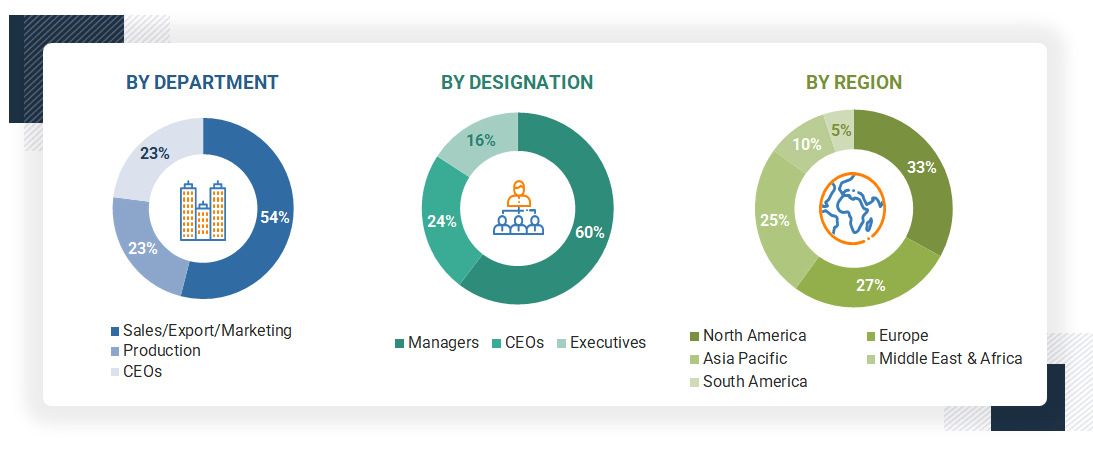
Note: Companies are classified based on their revenue–Tier 1 = >USD 7 billion, Tier 2 = USD 500 million to USD 7 billion, and Tier 3 = < USD 500 million.
Other designations include sales, marketing, and product managers.
To know about the assumptions considered for the study, download the pdf brochure
Market Size Estimation
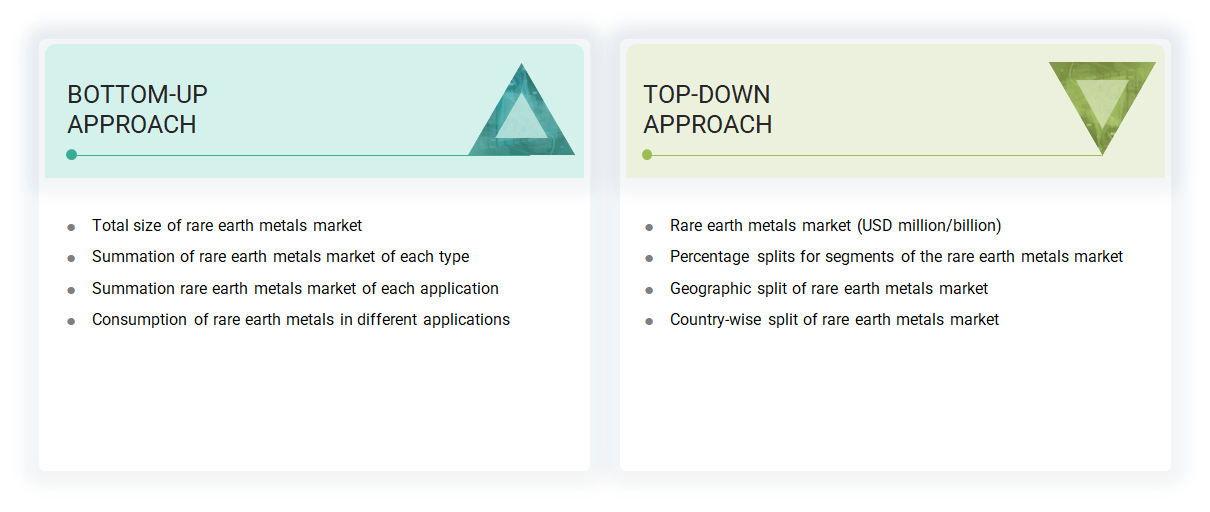
Both the top-down and bottom-up approaches were used to estimate and validate the global size of the rare earth metals market. These approaches were also used extensively to estimate the size of various dependent segments of the market. The research methodology used to estimate the market size included the following details:
- The key players were identified through extensive secondary research.
- The industry’s supply chain and market size, in terms of value, were determined through primary and secondary research processes.
- All percentage shares, splits, and breakdowns were determined using secondary sources and verified through primary sources.
- All possible parameters that affect the markets covered in this research study were accounted for, viewed in extensive detail, verified through primary research, and analyzed to obtain the final quantitative and qualitative data.
- The research includes the study of reports, reviews, and newsletters of key industry players, along with extensive interviews with key officials, such as directors and marketing executives.
Data Triangulation
After arriving at the overall market size from the estimation process explained above, the total market was split into several segments and subsegments. The data triangulation and market breakdown procedures were employed, wherever applicable, to complete the overall market engineering process and arrive at the exact statistics for all segments and subsegments of the rare earth metals market. The data was triangulated by studying various factors and trends from both the demand- and supply-side.
In addition, the market size was validated by using both the top-down and bottom-up approaches. Then, it was verified through interviews with experts. Hence, for every data segment, there are three sources—top-down approach, bottom-up approach, and interviews with experts. The data was assumed to be correct when the values arrived at from the three sources matched.
Market Definition
Rare earth elements are a group of mineral resources that, while found abundantly in the Earth's crust, are usually dispersed in small amounts and rarely in economic forms for mining. They are considered critical minerals due to their role in modern technology, limited alternatives, and potential risk of supply disruption. Extraction and processing of rare earth elements typically require large amounts of energy and water, causing environmental and logistical challenges. In addition, global supplies of rare earths are concentrated in a few countries, which creates vulnerability for industries, such as renewable energy, electronics, and advanced manufacturing to market or geopolitical fluctuations.
Stakeholders
- Rare Earth Metals Manufacturers
- Rare Earth Metals Distributors
- Raw Material Suppliers
- Research & Development Entities
- Industry Associations and Regulatory Bodies
- End Users
Report Objectives
- To estimate and forecast the rare earth metals market, in terms of value and volume
- To provide detailed information about the major factors (drivers, restraints, opportunities, and challenges) influencing market growth
- To define, describe, and forecast the market size, based on type, application, and region
- To forecast the market size along with segments and submarkets, in key regions: North America, Europe, Asia Pacific (APAC), Middle East & Africa (MEA), and South America along with their key countries
- To strategically analyze micromarkets, for individual growth trends, prospects, and their contribution to the total market
- To analyze growth opportunities in the market for stakeholders and provide details on the competitive landscape for market leaders
- To strategically profile key players and comprehensively analyze their market shares and core competencies
- To analyze competitive developments, such as mergers & acquisitions, expansions & investments, and agreements in the rare earth metals market
Get the Full Rare Earth Metals Market Report
Full forecast, segment splits, and company analysis for all Rare Earth Metals Market.
Need a Tailored Report?
Customize this report to your needs
Get 10% FREE Customization
Customize This Report
