
Malaysia Real-time Location Systems (RTLS) Market (2025-2030)

The Malaysia Real-time Location Systems (RTLS) Market was valued at $20.6 Million in 2025 and projected to reach to $47.3 Million by 2030, representing a compound annual growth rate of 18.0%. Malaysia's Real-time Location Systems market is poised for significant growth through 2030, driven by accelerating digital transformation across manufacturing, logistics, healthcare, and retail sectors.


| Market Size in | USD 26.32 MN |
| Market Forecast in | |
| CAGR | |
| Forecast Period | |
| Units Considered | Value (USD MN) |
Malaysia Real-time Location Systems (RTLS) Market Trends and Insights
- This represents an 18.0% compound annual growth rate, reflecting Malaysia's increasing adoption of location-based technologies across manufacturing, logistics, healthcare, and retail sectors.
- Malaysia's strategic position as a regional manufacturing and trade hub is driving demand for asset tracking and workforce management solutions. The growth trajectory in Malaysia is underpinned by rising investments in Industry 4.0 initiatives, digital supply chain modernization, and smart facility management.
- Malaysia's semiconductor and electronics manufacturing base is particularly receptive to RTLS deployment for inventory optimization and production floor visibility.
- Between 2025 and 2030, Malaysia is expected to capture significant market share within the Asia Pacific region as enterprises prioritize operational efficiency and real-time visibility across their operations. Key verticals driving Malaysia's RTLS adoption include semiconductor manufacturing, e-commerce logistics, and healthcare institutions.
- Malaysia's competitive labor market and emphasis on automation are accelerating the transition toward intelligent location tracking systems that enhance productivity and reduce operational costs..
Key Market Statistics
- CAGR (2025-2030) 18.0% CAGR
- Market Size, 2025 ~USD 20.6 Million
- Forecast, 2030 ~USD 47.3 Million
- Country Malaysia
Malaysia Real-time Location Systems (RTLS) Market Overview
Market Valuation Growth :
Malaysia's RTLS market is valued at USD 20.6 million in 2025 and is projected to grow to USD 47.3 million by 2030, representing a strong 18.0% CAGR driven by digital transformation initiatives across key industries.
Manufacturing & Logistics Adoption :
Malaysia's robust manufacturing and logistics sectors are increasingly deploying RTLS solutions for asset tracking, supply chain optimization, and warehouse management, positioning the country as a regional hub for location-based technology adoption.
Healthcare & Retail Expansion :
Healthcare facilities and retail enterprises in Malaysia are rapidly implementing RTLS for patient tracking, equipment management, and inventory control, reflecting growing awareness of operational efficiency benefits.
Regional Technology Hub Status :
Malaysia's strategic position in Southeast Asia, combined with government support for Industry 4.0 initiatives, creates favorable conditions for RTLS market expansion and attracts regional technology investments.
Malaysia Real-time Location Systems (RTLS) Market Dynamics
- The 18.0% CAGR reflects increasing enterprise recognition of RTLS value in optimizing operations, reducing costs, and enhancing visibility across supply chains.
- Government initiatives supporting Industry 4.0 adoption and Malaysia's role as a regional manufacturing and logistics hub further strengthen market fundamentals. Key growth catalysts include rising labor costs driving automation investments, expanding e-commerce logistics networks requiring advanced tracking capabilities, and healthcare sector modernization initiatives.
- As enterprises prioritize operational efficiency and real-time visibility, RTLS adoption will accelerate across mid-market and enterprise segments.
- The market's trajectory suggests Malaysia will emerge as a significant RTLS adopter within Southeast Asia, with localized solutions addressing regional industry-specific requirements..
Market Ecosystem
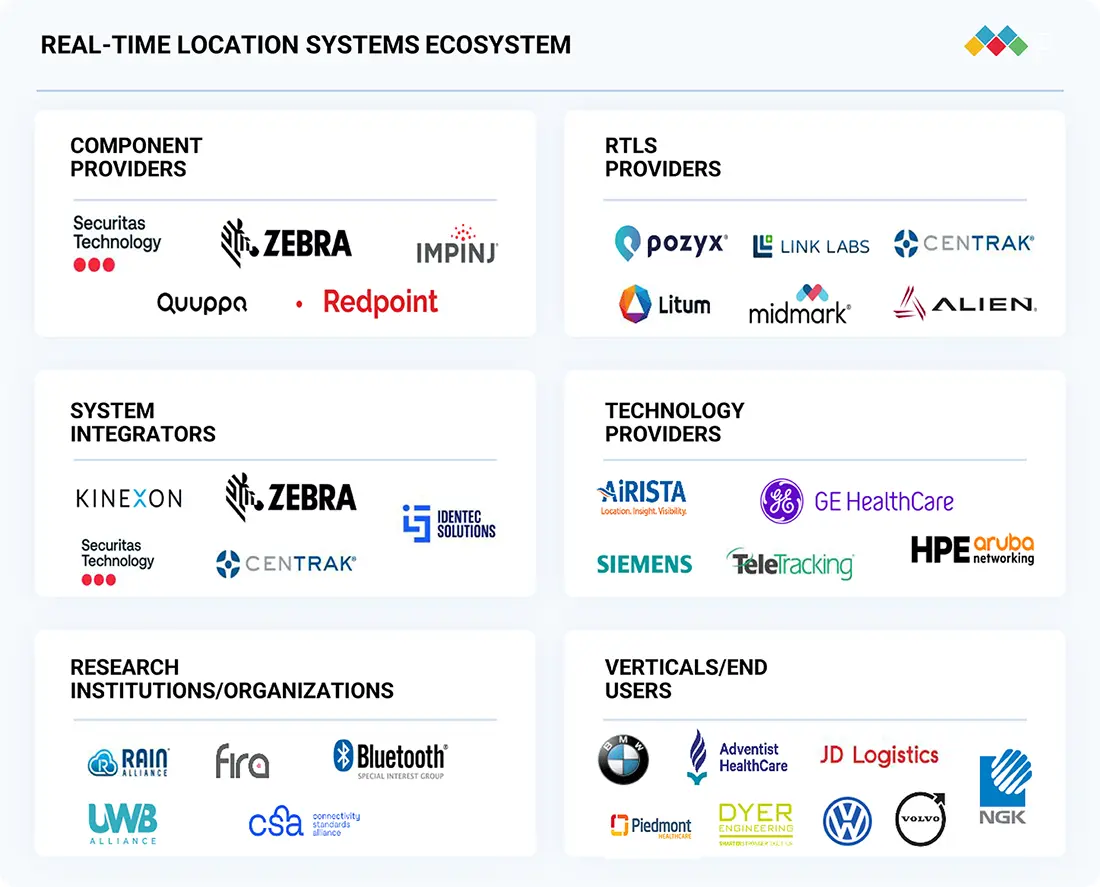
Real-time Location Systems (RTLS) Market: COMMERCIAL USE CASES ACROSS INDUSTRIES
| COMPANY | USE CASE DESCRIPTION | BENEFITS |
|---|---|---|
 |
RTLS solutions for healthcare asset tracking, staff workflow optimization, and patient safety | Improved operational efficiency, reduced equipment loss, enhanced patient care |
 |
RTLS systems for hospitals to track medical devices, monitor patients, and ensure staff safety | Increased patient safety, optimized asset utilization, compliance with healthcare standards |
 |
RTLS for smart manufacturing and logistics to enable automated workflows and supply chain visibility | Higher productivity, real-time insights, minimized downtime |
 |
RTLS platforms for automotive and aerospace assembly lines | Precision tracking, reduced production errors, improved process efficiency |
 |
RTLS for oil & gas, mining, and port operations | Enhanced worker safety, improved asset visibility, operational reliability in harsh environments |
Logos and trademarks shown above are the property of their respective owners. Their use here is for informational and illustrative purposes only.
Related Ecosystem
Electric Hybrid Vehicles
- Battery Electric Vehicle (BEV)
- Fuel Cell Electric Vehicle (FCEV)
- Light Commercial Vehicles (LCVs)
- Hybrid Electric Vehicle (HEV)
- Agricultural Tractors
- Visteon Corporation
- Byd company ltd.
- BOSCH LIMITED
- Tesla, Inc.
- FORD MOTOR COMPANY
Communication And Connectivity Technology
- Sensors
- Smart Card & Readers
- Cellular Network
- Femtocell
- Image Sensors
- Cisco Systems, Inc.
- HUAWEI TECHNOLOGIES CO LTD
- Lenovo
- CommScope Holding Company, Inc.
- Nokia corporation
Electronics System And Components
- Sensors
- Temperature Sensors
- Pressure Sensors
- Actuators
- Image Sensors
- Lenovo
- Samsung
- Texas Instruments Incorporated
- HONEYWELL INTERNATIONAL INC.
- Teledyne Technologies Incorporated
Key Takeaways
- Malaysia's RTLS market is valued at USD 20.6 million in 2025 and will grow to USD 47.3 million by 2030, representing 18.0% CAGR.
- Malaysia's semiconductor and electronics manufacturing sector is the primary driver of RTLS adoption for production optimization and asset visibility.
- Malaysia's logistics and e-commerce industries are increasingly deploying RTLS solutions to enhance supply chain transparency and warehouse efficiency.
- Malaysia's Industry 4.0 initiatives and digital transformation roadmap are accelerating enterprise investment in real-time location tracking technologies.
Real-time Location Systems (RTLS) Market Report Scope
| Report Metric | Details |
|---|---|
| Base Year | 2025 |
| Fastest Growing Segment | SUPPLY CHAIN MANAGEMENT & AUTOMATION (Application) |
| Forecast Period | 2025–2030 |
| Growth Rate | CAGR of 18.6% from 2025 to 2030 |
| Largest Segment | HEALTHCARE (Vertical) |
| Market Size Base Year (Billions) | ~USD 6.68 (2025) |
| Revenue Forecast (Billions) | ~USD 15.67 (2030) |
| Segments Covered | Offering, Type, Technology, Vertical, Application |
Malaysia Real-time Location Systems (RTLS) Market Report Segmentation
5 segment dimensions are covered across the global market.
By Offering
- Hardware
- Services
- Software
By Type
- Consulting
- Deployment & Integration
- Other Hardware Products
- Readers/Trackers/Access Points
- Support & Maintenance
- Tags/Badges
By Technology
- Ble
- Infrared
- Other Technologies
- Rfid
- Ultrasound
- Uwb
- Wi-Fi
By Vertical
- Education
- Government
- Healthcare
- Manufacturing & Automotive
- Oil & Gas And Mining
- Other Verticals
- Retail
- Sports & Entertainment
- Transportation & Logistics
By Application
- Access Control & Security
- Environmental Monitoring
- Inventory/Asset Tracking & Management
- Other Applications
- Personnel Locating & Monitoring
- Supply Chain Management & Automation
- Yard, Dock, Fleet & Warehouse Management & Monitoring
Target Audience
- RTLS Solution Providers : Vendors and technology companies need Malaysia-specific market data to develop localized offerings, identify customer segments, and establish competitive positioning in this high-growth market.
- Manufacturing & Logistics Enterprises : Operations leaders in Malaysia's manufacturing and logistics sectors require market insights to justify RTLS investments, benchmark against peers, and optimize asset tracking and supply chain visibility.
- Healthcare Facility Administrators : Hospital and healthcare network decision-makers need Malaysia market intelligence to understand RTLS adoption trends, ROI benchmarks, and best practices for patient and equipment tracking implementations.
- Investment & Private Equity Firms : Investors evaluating opportunities in Malaysia's technology and logistics sectors need comprehensive market data to assess RTLS market potential, growth drivers, and investment thesis viability.
- Government & Policy Makers : Malaysian government agencies and economic development bodies require market insights to evaluate RTLS sector growth, align with Industry 4.0 objectives, and support technology adoption initiatives.
Key Companies in the Malaysia Real-time Location Systems (RTLS) Market
| Company | HQ | Ownership | Strongest segments |
|---|---|---|---|
| FUGRO | United States | Public Company | Marine site characterization (geophysical, geotechnical, geo-consulting),Marine asset integrity (subscription signals, positioning, ROV, inspection & monitoring),Land site characterization (screening, onshore/nearshore investigations), |
| SENSTAR, INC. | Israel | Public Company | Fence-mounted and virtual fence sensors,Buried, concealed, and sub-surface intrusion sensors,Video management systems and video analytics software, |
| TRIMBLE INC | United States | Public Company | Construction lifecycle software and machine control,Positioning services (VRSNow, RTX, xFill, related),Transportation and logistics platforms (TMS, Transporeon, MAPS), |
| MEDALLIA INC | United States | Private Company | Customer Experience (CX) Platform & Analytics,Employee, Citizen, and Patient Experience Solutions,Professional Services (Design, Configuration, Deployment), |
| SECURITAS AB | Sweden | Public Company | On-site guarding & mobile security,Electronic security & remote video,Risk intelligence, advisory & corporate risk management, |
| HPE | United States | Public Company | Server,Hybrid Cloud (incl. Storage & GreenLake),Networking, |
| ZEBRA TECHNOLOGIES CORP. | United States | Public Company | Rugged and enterprise mobile computing,Barcode, card, and RFID printers and supplies,Scanning, machine vision, and fixed industrial systems, |
| IMPINJ, INC. | United States | Public Company | Endpoint ICs,Reader ICs, Readers, and Gateways,Software and Platform Services, |
| SIEMENS | Germany | Public Company | Digital Industries (automation, controls, industrial software),Smart Infrastructure (electrification, buildings, grid solutions),Mobility (rail systems, automation, services), |
| ALIEN TECHNOLOGY, LLC | United States | Private Company | UHF inlays, tags, and labels,RFID chips (UHF passive transceivers),Readers and antennas (fixed and mobile), |
| GE HEALTHCARE | United States | Public Company | Imaging,Advanced Visualization Solutions (AVS),Patient Care Solutions (PCS), |
| QORVO, INC. | United States | Public Company | Advanced Cellular Group (ACG) – cellular RF for smartphones and devices,High Performance Analog (HPA) – defense, aerospace, power, foundry,Connectivity and Sensors Group (CSG) – UWB, Matter, BLE, Zigbee, Thread, Wi-Fi, |
FUGRO
Fugro is a publicly traded company founded in 1962 with 9,062 employees based in the United States. The company operates in the geotechnical and survey services sector.
SENSTAR, INC.
Senstar, Inc. is an Israeli public company founded in 1981 with 132 employees. The company specializes in security and detection technology solutions.
TRIMBLE INC
Trimble Inc. is a publicly traded company founded in 1978 with 11,500 employees based in the United States. The company provides positioning, navigation, and mapping technology solutions.
MEDALLIA INC
Medallia Inc. is a private company founded in 2001 with 2,037 employees based in the United States. The company provides customer experience and feedback management software solutions.
SECURITAS AB
Securitas AB is a publicly traded company founded in 1934 with 322,000 employees based in Sweden. The company is a global leader in security services and solutions.
HPE
HPE is a publicly traded company founded in 1939 with 67,000 employees based in the United States. The company provides enterprise IT infrastructure, software, and services.
ZEBRA TECHNOLOGIES CORP.
Zebra Technologies Corp. is a publicly traded company founded in 1969 with 10,700 employees based in the United States. The company provides automatic identification, data capture, and mobile computing solutions.
IMPINJ, INC.
Impinj, Inc. is a publicly traded company founded in 2000 with 457 employees based in the United States. The company develops RFID and IoT connectivity platforms.
SIEMENS
Siemens is a publicly traded company founded in 1847 with 310,312 employees based in Germany. The company is a global conglomerate providing industrial automation, digitalization, and infrastructure solutions.
ALIEN TECHNOLOGY, LLC
Alien Technology, LLC is a private company founded in 1994 with 241 employees based in the United States. The company manufactures RFID inlays and tags for various applications.
GE HEALTHCARE
GE Healthcare is a publicly traded company founded in 2022 with 54,000 employees based in the United States. The company provides medical imaging, diagnostics, and healthcare IT solutions.
QORVO, INC.
Qorvo, Inc. is a publicly traded company founded in 1957 with 5,200 employees based in the United States. The company designs and manufactures RF semiconductors and connectivity solutions.
Reasons to Buy this Report
- Market-Specific Growth Projections : Access detailed Malaysia-focused forecasts showing 130% market expansion from 2025-2030, enabling accurate business planning and investment decisions tailored to local market dynamics.
- Sector-Specific Adoption Insights : Understand RTLS penetration rates and growth drivers across Malaysia's manufacturing, logistics, healthcare, and retail sectors to identify high-opportunity verticals for solution deployment.
- Competitive Landscape Analysis : Gain intelligence on local and regional RTLS vendors operating in Malaysia, their market positioning, and competitive strategies to inform partnership and go-to-market decisions.
- Regulatory & Government Support Context : Learn how Malaysia's Industry 4.0 initiatives and government policies are shaping RTLS adoption, helping stakeholders align strategies with national digital transformation priorities.
- Regional Expansion Strategy : Leverage Malaysia market insights as a foundation for broader Southeast Asia expansion, understanding how local success can be replicated across neighboring markets with similar growth trajectories.
Frequently asked questions
What is the current market size of RTLS in Malaysia?
Malaysia's RTLS market was valued at USD 20.6 million in 2025 and is projected to reach USD 47.3 million by 2030.
What is the expected growth rate for Malaysia's RTLS market?
Malaysia's RTLS market is expected to grow at a compound annual growth rate (CAGR) of 18.0% from 2025 to 2030.
Which industries in Malaysia are driving RTLS adoption?
Malaysia's semiconductor manufacturing, e-commerce logistics, healthcare, and retail sectors are the primary drivers of RTLS market growth.
Why is Malaysia's RTLS market growing faster than global average?
Malaysia's position as a regional manufacturing hub, combined with Industry 4.0 investments and digital supply chain modernization, is driving above-average RTLS adoption compared to global trends.
What technologies are most commonly deployed in Malaysia's RTLS solutions?
Malaysia's RTLS implementations primarily utilize UWB, RFID, BLE, and Wi-Fi-based positioning technologies for asset tracking and workforce management applications.
RESEARCH METHODOLOGY
The study involved four major activities in estimating the current size of the real-time location systems (RTLS) market. Exhaustive secondary research has been conducted to gather information on the market, adjacent markets, and the overall RTLS landscape. These findings, along with assumptions and projections, were validated through primary research involving interviews with industry experts and key stakeholders across the value chain. Both top-down and bottom-up approaches were utilized to estimate the overall market size. Subsequently, market breakdown and data triangulation techniques were applied to determine the sizes of various segments and subsegments. Two key sources, secondary and primary, were leveraged to conduct a comprehensive technical and commercial assessment of the RTLS market.
Secondary Research
Various secondary sources have been referred to in the secondary research process to identify and collect important information for this study. The secondary sources include annual reports, press releases, and investor presentations of companies; white papers; journals and certified publications; and articles from recognized authors, websites, directories, and databases. Secondary research has been conducted to obtain key information about the industry’s supply chain, the market’s value chain, the total pool of key players, market segmentation according to the industry trends (to the bottom-most level), regional markets, and key developments from market- and technology-oriented perspectives. The secondary data has been collected and analyzed to determine the overall market size, further validated by primary research.
Primary Research
Extensive primary research was conducted after gaining knowledge about the current scenario of the RTLS market through secondary research. Several primary interviews were conducted with experts from the demand and supply sides across four major regions: North America, Europe, Asia Pacific, and RoW. This primary data was collected through questionnaires, emails, and telephone interviews.
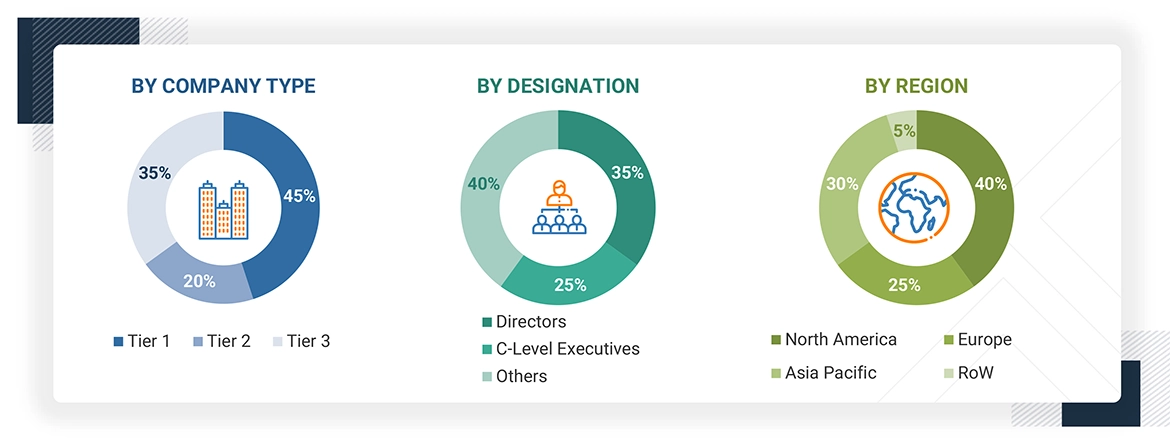
Three tiers of companies are defined based on their total revenue as of 2024: tier 3 = revenue less than USD 500 million; tier 2 = revenue between USD 500 million and USD 3 billion; and tier 1 = revenue more than USD 3 billion.
Other designations include sales managers, marketing managers, and product managers.
To know about the assumptions considered for the study, download the pdf brochure
Market Size Estimation
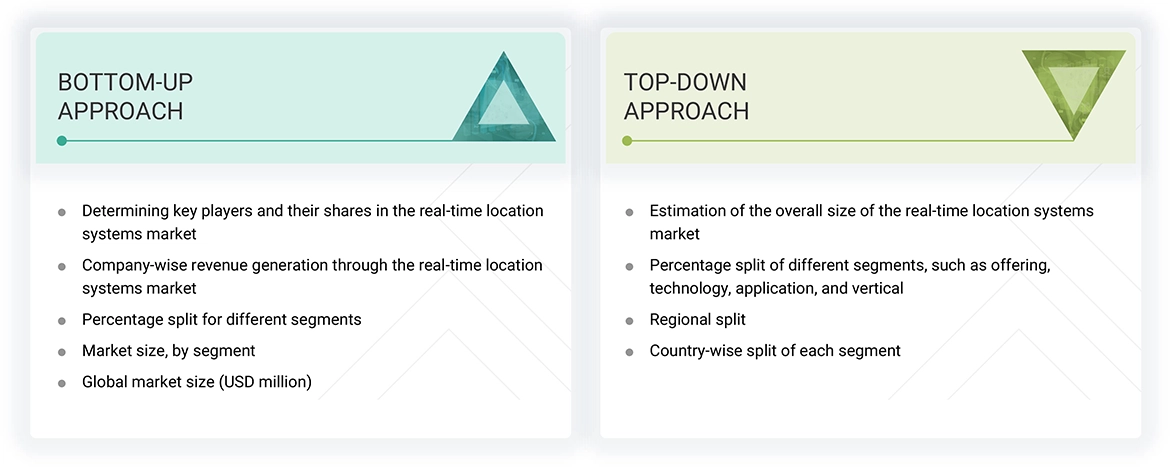
Both top-down and bottom-up approaches have been used to estimate and validate the total size of the RTLS market. These methods have also been used extensively to estimate the size of various subsegments in the market. The following research methodology has been used to estimate the market size:
- Major players in the industry and markets have been identified through extensive secondary research.
- The industry’s value chain and market size (in terms of value) have been determined through primary and secondary research processes.
- All percentage shares, splits, and breakdowns have been determined using secondary sources and verified through primary sources.
Real-time Location Systems (RTLS) Market : Top-Down and Bottom-Up Approach
Data Triangulation
After arriving at the overall size of the RTLS market from the market size estimation process explained above, the total market has been split into several segments and subsegments. Data triangulation and market breakdown procedures have been employed, wherever applicable, to complete the overall market engineering process and arrive at the exact statistics for all segments and subsegments of the market. The data has been triangulated by studying various factors and trends from both the demand and supply sides. Along with this, the market size has been validated using both top-down and bottom-up approaches.
Market Definition
A real-time location system (RTLS) is designed to automatically detect, identify, and track the position of objects, individuals, or targets within a defined area with high precision. These systems typically comprise location tags or badges affixed to assets or worn by personnel, a network of readers, sensors, or access points strategically deployed across the facility, and a centralized software platform that processes and visualizes location data in real time. RTLS components communicate wirelessly, leveraging a range of enabling technologies such as radio-frequency identification (RFID), Wi-Fi, ultrasound, infrared (IR), Bluetooth Low Energy (BLE), or global positioning systems (GPS) to accurately determine movement and positioning. The core objective of RTLS is to deliver continuous visibility and situational awareness across sectors, including healthcare, manufacturing, logistics, warehousing, and transportation. By providing real-time tracking of high-value assets and personnel, RTLS helps organizations improve operational efficiency, ensure safety compliance, prevent loss or theft, streamline workflow, and optimize resource utilization, making it a critical tool for data-driven decision-making in dynamic operational environments.
Key Stakeholders
- RTLS Hardware Providers
- RTLS Software Providers
- RTLS-related Service Providers
- Government Bodies and Policymakers
- Industry-standard Organizations, Forums, Alliances, and Associations
- Market Research and Consulting Firms
- Raw Material Suppliers and Distributors
- Research Institutes and Organizations
- Testing, Inspection, and Certification Providers
- Distributors and Resellers
- End Users
Report Objectives
- To define, describe, and forecast the RTLS market in terms of offering, technology, application, and vertical
- To describe and forecast the market, in terms of value, with regard to four main regions: North America, Europe, Asia Pacific, and Rest of the World (RoW), along with their respective countries
- To provide detailed information regarding major factors influencing the market growth (drivers, restraints, opportunities, and challenges)
- To provide a detailed overview of the value chain of the RTLS market
- To strategically analyze micromarkets with respect to individual growth trends, prospects, and contributions to the RTLS market
- To analyze opportunities for stakeholders by identifying high-growth segments of the RTLS market
- To strategically profile key players and comprehensively analyze their market position in terms of ranking and core competencies, along with detailing the competitive landscape for market leaders
- To analyze competitive strategies, such as product launches, expansions, mergers, and acquisitions, adopted by key market players in the RTLS market
Customization Options
With the given market data, MarketsandMarkets offers customizations according to the company’s specific needs. The following customization options are available for the report:
Company Information
- Detailed analysis and profiling of additional market players (up to 5)
Get the Full Real-time Location Systems (RTLS) Market Report
Full forecast, segment splits, and company analysis for all Real-time Location Systems (RTLS) Market.
- US Real-time Location Systems (RTLS) Market
- Canada Real-time Location Systems (RTLS) Market
- Mexico Real-time Location Systems (RTLS) Market
- Germany Real-time Location Systems (RTLS) Market
- UK Real-time Location Systems (RTLS) Market
- France Real-time Location Systems (RTLS) Market
- Spain Real-time Location Systems (RTLS) Market
- Italy Real-time Location Systems (RTLS) Market
- Rest Of Europe Real-time Location Systems (RTLS) Market
- China Real-time Location Systems (RTLS) Market
- Japan Real-time Location Systems (RTLS) Market
- India Real-time Location Systems (RTLS) Market
- South Korea Real-time Location Systems (RTLS) Market
- Australia Real-time Location Systems (RTLS) Market
- Singapore Real-time Location Systems (RTLS) Market
- Philippines Real-time Location Systems (RTLS) Market
- Rest Of Asia Pacific Real-time Location Systems (RTLS) Market
- GCC Countries Real-time Location Systems (RTLS) Market
- Rest Of Middle East Real-time Location Systems (RTLS) Market
Need a Tailored Report?
Customize this report to your needs
Get 10% FREE Customization
Customize This Report
