
Japan Refinery Catalysts Market (2026-2031)

The Japan Refinery Catalysts Market was valued at $221 Million in 2026 and projected to reach to $264.4 Million by 2031, representing a compound annual growth rate of CAGR 3.7%. Japan's refinery catalysts market is poised for steady growth driven by the need to maintain operational efficiency in existing refineries and compliance with increasingly stringent environmental standards.


| Market Size in | USD 26.32 MN |
| Market Forecast in | |
| CAGR | |
| Forecast Period | |
| Units Considered | Value (USD MN) |
Japan Refinery Catalysts Market Trends and Insights
- Japan maintains a mature and technologically advanced refining sector, with catalysts playing a critical role in optimizing crude oil processing efficiency and meeting stringent environmental regulations.
- The steady growth trajectory reflects Japan's commitment to upgrading refinery infrastructure and adopting next-generation catalyst technologies to enhance yield and reduce emissions. Japan's refinery catalysts market is driven by the nation's focus on sustainable refining practices and compliance with increasingly strict environmental standards.
- Japan's refineries are investing in advanced catalyst solutions to improve operational efficiency while minimizing environmental impact.
- The forecast period from 2026 to 2031 indicates moderate but consistent expansion, supported by Japan's strategic initiatives in energy security and refinery modernization.
- Japan's position as a leading industrial economy ensures continued demand for high-performance catalysts across hydrocracking, hydrotreating, and fluid catalytic cracking applications..
Key Market Statistics
- CAGR (2026-2031) CAGR 3.7%
- Market Size, 2026 ~USD 221 Million
- Forecast, 2031 ~USD 264.4 Million
- Country Japan
Japan Refinery Catalysts Market Overview
Market Size & Growth :
Japan's refinery catalysts market is valued at USD 221.0 million in 2026, expanding to USD 264.4 million by 2031 at a CAGR of 3.7%, reflecting steady demand in the mature refining sector.
Technological Advancement :
Japan maintains a technologically advanced refining infrastructure with catalysts essential for optimizing crude oil processing efficiency and maximizing yield in a competitive global market.
Regulatory Compliance :
Stringent environmental regulations in Japan drive continuous catalyst innovation to meet emissions standards, fuel quality specifications, and sustainability requirements in refinery operations.
Market Maturity :
As a mature market, Japan's refinery catalysts sector is characterized by stable demand, established supply chains, and focus on performance optimization rather than capacity expansion.
Japan Refinery Catalysts Market Dynamics
- The country's mature refining sector continues to invest in catalyst technology to enhance processing capabilities and reduce environmental impact.
- With a CAGR of 3.7% through 2031, growth will be supported by ongoing modernization initiatives and the transition toward cleaner fuel production.
- Japan's advanced technological base and commitment to sustainability position it as a stable market for premium catalyst solutions..
Market Ecosystem
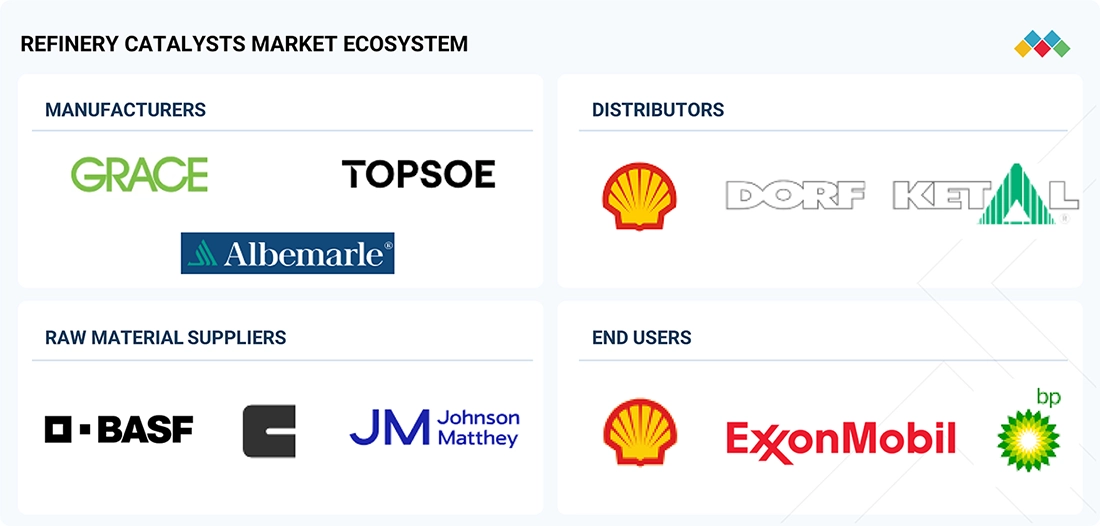
REFINERY CATALYSTS MARKET: COMMERCIAL USE CASES ACROSS INDUSTRIES
| COMPANY | USE CASE DESCRIPTION | BENEFITS |
|---|---|---|
 |
Refineries combine the processes of fluid catalytic cracking (FCC), hydroprocessing, and reforming, all of which rely on catalyst technology to convert crude oil into gasoline, diesel, and petrochemical feedstocks. The deployment of catalyst technology is essential throughout a refinery's cracking and upgrading units to improve the efficiency of converting crude oil to transportation fuels and meet fuel quality standards. | Catalysts used in the refining process can enhance yields of high-value fuels, improve the octane level of the fuels produced, and reduce the sulfur content of the fuels produced. They also serve to improve the overall efficiency of the refinery process and the reliability of refinery operations |
 |
Refineries use hydrocracking and hydrotreating catalysts to convert heavier crude oils into cleaner transportation fuels. The use of catalysts in the refinery process enables refineries to operate continuously and assists refineries in optimizing their product slate based on market demand | By utilizing catalyst technology in their processes, refineries can provide greater processing flexibility, increase compliance with stricter emission limits, reduce the level of impurities in transportation fuels, and increase throughput and profitability. |
 |
Refineries use advanced catalyst systems to optimize fuel production, improve hydrogen utilization, and support cleaner fuel manufacturing. Catalysts are integrated into upgrading units to maintain efficiency under high-temperature and high-pressure conditions | Catalysts enhance fuel quality, lower emissions, extend unit run length, and reduce operational costs by improving process stability and catalyst lifespan. |
Logos and trademarks shown above are the property of their respective owners. Their use here is for informational and illustrative purposes only.
Related Ecosystem
Speciality Chemicals
- Corrosion Inhibitors
- Polyetheretherketone (PEEK)
- Acrylonitrile Butadiene Styrene (ABS)
- Epoxy Resin
- Polycarbonate
- Basf se
- DOW CHEMICAL COMPANY
- Evonik industries ag
- Clariant ag.
- Solvay sa
Oil And Gas Solutions
- Alumina Ceramics
- Ceramic Coatings
- Epoxy Resin
- Hot Melt Process
- Monolithic Ceramics
- TotalEnergies SE
- ENEOS Holdings, Inc.
- Hess Corporation
- Mol group
- Baker Hughes Company
Industrial Gases
- Dry Cooling Tower
- HVAC System
- Heat Exchanger
- Hybrid Cooling Tower
- Industrial Refrigeration
- Linde plc
- Air Products and Chemicals, Inc.
- MESSER GROUP GMBH
- AIR LIQUIDE
- Iwatani Corporation
Key Takeaways
- Japan's refinery catalysts market is valued at USD 221.0 million in 2026 and will reach USD 264.4 million by 2031.
- Japan's market will grow at a CAGR of 3.7% over the 2026–2031 forecast period.
- Japan's refineries prioritize environmental compliance and operational efficiency through advanced catalyst adoption.
- Japan's mature refining infrastructure and technological leadership support steady, sustainable market expansion.
Refinery Catalysts Market Report Scope
| Report Metric | Details |
|---|---|
| Base Year | 2026 |
| Fastest Growing Segment | HYDROCRACKING CATALYSTS (Type) |
| Forecast Period | 2026–2031 |
| Growth Rate | CAGR of 4.5% from 2026 to 2031 |
| Largest Segment | METALS (Ingredient) |
| Market Size Base Year (Billions) | ~USD 6.2 (2026) |
| Revenue Forecast (Billions) | ~USD 7.73 (2031) |
| Segments Covered | Type, Ingredient |
Japan Refinery Catalysts Market Report Segmentation
2 segment dimensions are covered across the global market.
By Type
- Catalytic Reforming Catalysts
- Fcc Catalysts
- Hydrocracking Catalysts
- Hydrotreating Catalysts
- Other Types
By Ingredient
- Chemical Compounds
- Metals
- Zeolites
- –Natural Zeolites
- –Precious Metals
- –Rare Earth Metals
- –Synthetic Zeolites
- –Transition & Base Metals
Target Audience
- Refinery Operators & Processors : Japanese refineries need detailed market insights to optimize catalyst selection, improve processing efficiency, and ensure compliance with local environmental standards while maintaining competitiveness.
- Catalyst Manufacturers & Suppliers : Global and regional catalyst producers require Japan-specific market data to understand demand patterns, regulatory requirements, and competitive positioning to effectively serve this mature, technology-driven market.
- Chemical & Material Industry Investors : Investment firms and private equity groups need accurate Japan market forecasts and growth drivers to evaluate investment opportunities in the refinery catalysts sector and related chemical businesses.
- Government & Policy Makers : Japanese regulatory bodies and energy policy officials use market data to assess industry health, environmental compliance trends, and the effectiveness of sustainability initiatives in the refining sector.
- Strategic Consultants & Business Analysts : Management consulting firms and business intelligence providers require Japan-specific catalyst market data to support client strategy development, competitive analysis, and market entry planning.
Key Companies in the Japan Refinery Catalysts Market
| Company | HQ | Ownership | Strongest segments |
|---|---|---|---|
| HERAEUS GROUP | Germany | Private Company | Precious Metals (processing and trading),Materials and Technologies (high-tech industrial products),Sensors (steel, aluminum, foundry), |
| ALBEMARLE CORPORATION | United States | Public Company | Energy Storage (lithium carbonate, hydroxide, chloride),Specialties – bromine and advanced lithium solutions,Ketjen – clean fuels and performance catalysts, |
| W.R. GRACE & CO. | United States | Private Company | FCC catalysts and additives,Silica gels, colloidal silica, and precipitated silica,Zeolitic adsorbents, silica-aluminas, and fine chemical intermediates, |
| BASF | Germany | Public Company | Chemicals (Petrochemicals & Intermediates),Materials (Isocyanates, Polyamides, Inorganics),Industrial Solutions (Dispersions, Resins, Additives, Catalysts), |
| TOPSOE | Denmark | Private Company | Hydroprocessing and refinery catalysts,Ammonia, methanol, and hydrogen process licensing and catalysts,Low-carbon and energy transition solutions, |
| CLARIANT | Switzerland | Public Company | Care Chemicals,Catalysts,Adsorbents & Additives, |
| JOHNSON MATTHEY | United Kingdom | Public Company | Clean Air (emission-control catalysts),PGM Services (refining, recycling, trading, PGM products),Hydrogen Technologies (fuel cell and electrolyser components), |
| CHINA PETROLEUM & CHEMICAL CORPORATION (SINOPEC) | China | ||
| ARKEMA | France | Public Company | Advanced Materials (high performance polymers and performance additives),Adhesive Solutions,Coating Solutions (acrylics, coating resins, additives, decorative paints), |
| CHEVRON CORPORATION | United States | Public Company | Upstream oil and gas (incl. LNG, gas-to-liquids),Refining and marketing of fuels,Petrochemicals, plastics, additives, |
HERAEUS GROUP
Heraeus Group is a German private company founded in 1851 that employs 15,181 people. The company operates across multiple industrial sectors with a long-established history of innovation and manufacturing.
ALBEMARLE CORPORATION
Albemarle Corporation is a publicly traded U.S. company founded in 1887 with 7,800 employees. The company is a global leader in specialty chemicals and advanced materials.
W.R. GRACE & CO.
W.R. Grace & Co. is a private U.S. company founded in 1854 with 4,000 employees. The company specializes in specialty chemicals and materials for various industrial applications.
BASF
BASF is a German public company founded in 1865 with 106,428 employees, making it one of the world's largest chemical manufacturers. The company produces a wide range of chemicals, plastics, and performance products.
TOPSOE
Topsoe is a Danish private company founded in 1940 with 2,739 employees. The company specializes in catalysts and technology solutions for the chemical and energy industries.
CLARIANT
Clariant is a Swiss public company founded in 1886 with 9,998 employees. The company is a global specialty chemicals manufacturer serving diverse industries including catalysts, coatings, and care chemicals.
JOHNSON MATTHEY
Johnson Matthey is a British public company founded in 1817 with 10,037 employees. The company specializes in catalysts, precious metals, and specialty chemicals for industrial and environmental applications.
CHINA PETROLEUM & CHEMICAL CORPORATION (SINOPEC)
China Petroleum & Chemical Corporation (Sinopec) is a major Chinese energy and chemical company. The company is one of the world's largest integrated petroleum and petrochemical enterprises.
ARKEMA
Arkema is a French public company founded in 2003 with 20,700 employees. The company is a global specialty chemicals manufacturer producing materials for adhesives, coatings, and industrial applications.
CHEVRON CORPORATION
Chevron Corporation is a U.S. public company founded in 1879 with 43,039 employees. The company is a major integrated energy company engaged in oil and gas exploration, production, and refining.
Reasons to Buy this Report
- Market-Specific Sizing & Forecasts : Access precise market valuations for Japan (USD 221.0M in 2026, USD 264.4M in 2031) with country-specific CAGR of 3.7% to support accurate business planning and investment decisions.
- Regulatory & Compliance Insights : Understand Japan's stringent environmental regulations and their impact on catalyst demand, enabling you to align product development with local compliance requirements and market opportunities.
- Competitive Landscape Analysis : Gain intelligence on Japan's mature refining sector dynamics, established players, and technology preferences to identify competitive positioning and partnership opportunities in this stable market.
- Technology & Innovation Trends : Discover how Japan's advanced refining infrastructure drives demand for high-performance catalysts, including insights into efficiency optimization and sustainability-focused innovations.
- Strategic Market Entry & Expansion : Leverage Japan-specific data to develop targeted go-to-market strategies, identify key customer segments, and assess growth potential in this technologically sophisticated and regulated market.
Frequently asked questions
What is the current size of Japan's refinery catalysts market?
Japan's refinery catalysts market is estimated at USD 221.0 million in 2026.
What is the projected market size for Japan's refinery catalysts by 2031?
Japan's refinery catalysts market is forecast to reach USD 264.4 million by 2031.
What is the CAGR for Japan's refinery catalysts market?
Japan's refinery catalysts market is expected to grow at a CAGR of 3.7% from 2026 to 2031.
What factors drive growth in Japan's refinery catalysts market?
Japan's market growth is driven by environmental regulations, refinery modernization, energy security initiatives, and demand for high-performance catalyst technologies.
Which catalyst applications are most important in Japan?
Japan's refineries primarily utilize catalysts for hydrocracking, hydrotreating, and fluid catalytic cracking applications to optimize efficiency and reduce emissions.
RESEARCH METHODOLOGY
The study involves two major activities in estimating the current market size for the refinery catalysts market. Exhaustive secondary research was done to collect information on the market, peer market, and parent market. The next step was to validate these findings, assumptions, and sizing with industry experts across the value chain through primary research. Both top-down and bottom-up approaches were employed to estimate the complete market size. After that, market breakdown and data triangulation were used to estimate the market size of segments and subsegments.
Secondary Research
Secondary sources referred to for this research study include financial statements of companies offering refinery catalysts and information from various trade, business, and professional associations. Secondary research has been used to obtain critical information about the industry’s value chain, the total pool of key players, market classification, and segmentation according to industry trends to the bottom-most level and regional markets. The secondary data was collected and analyzed to arrive at the overall size of the refinery catalysts market, which was validated by primary respondents.
Primary Research
Extensive primary research was conducted after obtaining information regarding the refinery catalysts market scenario through secondary research. Several primary interviews were conducted with market experts from both the demand and supply sides across major countries of North America, Europe, Asia Pacific, the Middle East & Africa, and South America. Primary data was collected through questionnaires, emails, and telephonic interviews. The primary sources from the supply side included various industry experts, such as Chief X Officers (CXOs), Vice Presidents (VPs), Directors from business development, marketing, product development/innovation teams, and related key executives from refinery catalyst industry vendors, material providers, distributors, and key opinion leaders. Primary interviews were conducted to gather insights such as market statistics, data on revenue collected from the products and services, market breakdowns, market size estimations, market forecasting, and data triangulation. Primary research also helped in understanding the various trends related to product forms, functions, end-users, distribution channels, and regions. Stakeholders from the demand side, such as CIOs, CTOs, CSOs, and installation teams of the customer/end users who are seeking refinery catalyst, were interviewed to understand the buyer’s perspective on the suppliers, products, and their current usage of refinery catalyst and future outlook of their business, which will affect the overall market.
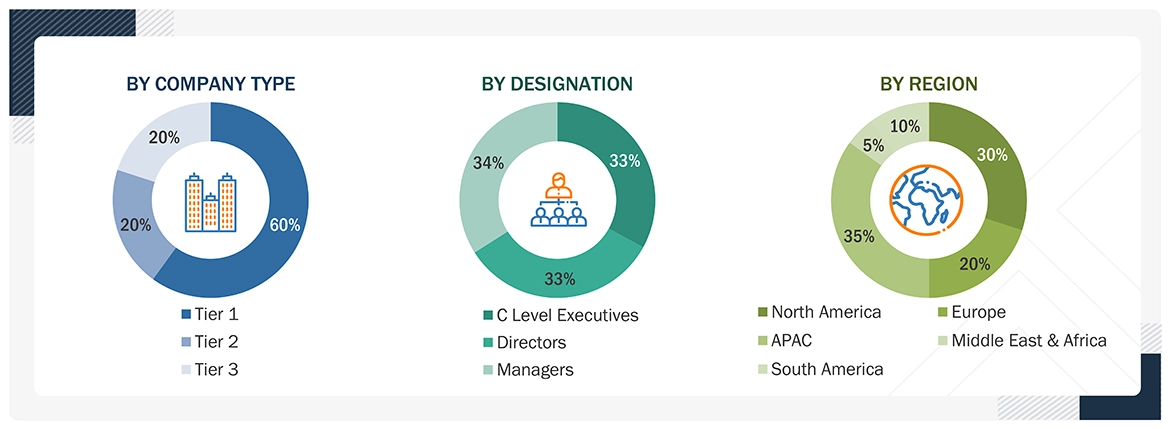
To know about the assumptions considered for the study, download the pdf brochure
Market Size Estimation
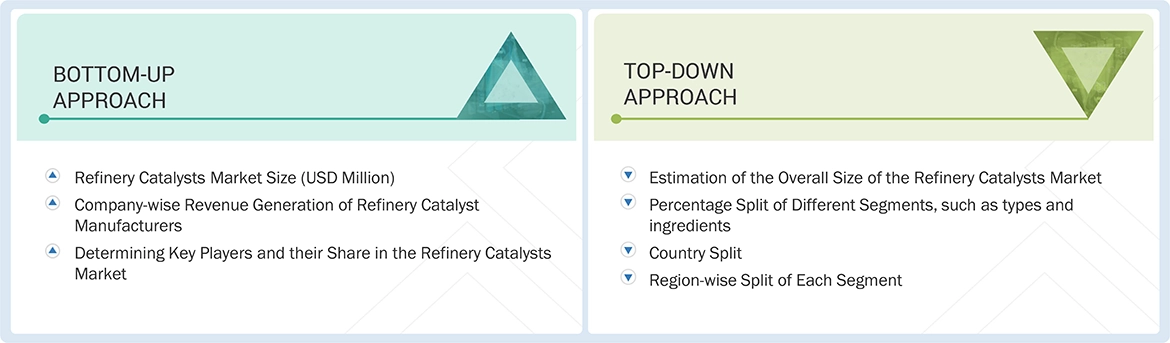
The research methodology used to estimate the size of the refinery catalysts market includes the following details. The market sizing was undertaken from the demand side. The market was upsized based on demand for refinery catalysts across different types at the regional level. Such procurements provide information on the demand aspects of the refinery catalyst industry for each type. For each type, all possible segments of the refinery catalysts market were integrated and mapped.
Data Triangulation
After arriving at the overall size from the market size estimation process explained above, the total market was split into several segments and subsegments. The data triangulation and market breakdown procedures explained below were implemented, wherever applicable, to complete the overall market engineering process and arrive at the exact statistics for various market segments and subsegments. The data was triangulated by studying various factors and trends from the demand and supply sides. Along with this, the market size was validated using both the top-down and bottom-up approaches.
Market Definition
Refinery catalysts are substances used in various refining processes for increasing the efficiency, quality and environmental performance of petroleum products. These catalysts accelerate chemical reactions, increasing the efficiency and speed of oil refining. Thus, ensuring higher productivity and lower energy consumption. Different refining processes, such as cracking, reforming, and hydrotreating, are performed using these catalysts to achieve desired results while reducing emissions & pollutants. An increasing number of environmental regulations also ensures the use of refinery catalysts in refining processes. Advanced materials and methodologies are being developed to increase the durability, activity, and selectivity of refinery catalysts.
Key Stakeholders
- Refinery Catalyst Manufacturers
- Refinery Catalyst Distributors and Suppliers
- Universities, Governments, and Research Organizations
- Associations and Industrial Bodies
- R&D Institutes
- Environmental Support Agencies
- Investment Banks and Private Equity Firms
- Research and Consulting Firms
Report Objectives
- To define, describe, and forecast the refinery catalysts market size in terms of volume and value
- To provide detailed information regarding the key factors, such as drivers, restraints, opportunities, and challenges influencing market growth
- To analyze and forecast the market by type, ingredient, and region
- To forecast the market size concerning five main regions (along with country-level data), namely, North America, Europe, Asia Pacific, Middle East & Africa, and South America, and analyze the significant region-specific trends
- To strategically analyze micromarkets with respect to individual growth trends, prospects, and contributions of the submarkets to the overall market
- To analyze the market opportunities and the competitive landscape for stakeholders and market leaders
- To assess recent market developments and competitive strategies, such as agreements, contracts, acquisitions, partnerships & collaboration and product developments/launches, to draw the competitive landscape
- To strategically profile the key market players and comprehensively analyze their core competencies
Available customizations:
MarketsandMarkets offers the following customizations for this market report:
- Additional country-level analysis of the refinery catalysts market
Product Analysis
- Product matrix, which provides a detailed comparison of the product portfolio of each company in its market
Get the Full Refinery Catalysts Market Report
Full forecast, segment splits, and company analysis for all Refinery Catalysts Market.
- US Refinery Catalysts Market
- Canada Refinery Catalysts Market
- Mexico Refinery Catalysts Market
- Germany Refinery Catalysts Market
- France Refinery Catalysts Market
- UK Refinery Catalysts Market
- Italy Refinery Catalysts Market
- Spain Refinery Catalysts Market
- Russia Refinery Catalysts Market
- China Refinery Catalysts Market
- India Refinery Catalysts Market
- Rest Of Asia Pacific Refinery Catalysts Market
- GCC Countries Refinery Catalysts Market
- –Rest Of GCC Countries Refinery Catalysts Market
- Rest Of South America Refinery Catalysts Market
- South Korea Refinery Catalysts Market
- Saudi Arabia Refinery Catalysts Market
- South Africa Refinery Catalysts Market
- Brazil Refinery Catalysts Market
- Argentina Refinery Catalysts Market
- South America Refinery Catalysts Market
- Rest Of Europe Refinery Catalysts Market
Need a Tailored Report?
Customize this report to your needs
Get 10% FREE Customization
Customize This Report
