
Canada Robotic Radiotherapy Market (2023-2028)

The Canada Robotic Radiotherapy Market was valued at $65.5 Million in 2023 and projected to reach to $108.3 Million by 2028, representing a compound annual growth rate of 11.0%. Canada's robotic radiotherapy market is positioned for sustained growth as the healthcare system prioritizes modernization of cancer treatment infrastructure.


| Market Size in | USD 26.32 MN |
| Market Forecast in | |
| CAGR | |
| Forecast Period | |
| Units Considered | Value (USD MN) |
Canada Robotic Radiotherapy Market Trends and Insights
- This growth reflects Canada's increasing adoption of advanced cancer treatment technologies and rising healthcare investments in precision oncology.
- Canada's healthcare system continues to prioritize modernization of radiotherapy infrastructure, driving demand for robotic systems that enhance treatment accuracy and patient outcomes. The Canadian market benefits from strong government healthcare funding, a growing aging population requiring cancer treatment, and increasing awareness of robotic radiotherapy's clinical advantages.
- Canada's position as a developed healthcare market with established reimbursement frameworks supports steady market expansion through 2028.
- Healthcare providers across Canada are investing in robotic radiotherapy platforms to improve operational efficiency and expand treatment capacity..
Key Market Statistics
- CAGR (2023-2028) 11.0% CAGR
- Market Size, 2023 ~USD 65.5 Million
- Forecast, 2028 ~USD 108.3 Million
- Country Canada
Canada Robotic Radiotherapy Market Overview
Market Valuation Growth :
Canada's robotic radiotherapy market reached $65.5 million in 2023 and is expected to expand to $108.3 million by 2028, representing a robust 11.0% CAGR driven by healthcare modernization initiatives.
Provincial Healthcare Investment :
Canadian provinces are increasingly allocating budgets toward precision oncology infrastructure, with major cancer centers in Ontario, British Columbia, and Alberta leading adoption of robotic radiotherapy systems.
Clinical Adoption Acceleration :
Canadian hospitals and specialized cancer treatment facilities are rapidly integrating robotic radiotherapy technologies to improve patient outcomes and reduce treatment times in complex tumor cases.
Regulatory Support & Reimbursement :
Health Canada's streamlined approval pathways and provincial health insurance coverage for advanced radiotherapy procedures are accelerating market penetration across Canadian healthcare networks.
Canada Robotic Radiotherapy Market Dynamics
- Provincial health authorities are investing in cutting-edge oncology technologies to enhance treatment precision and patient outcomes, particularly in major metropolitan areas.
- The convergence of aging population demographics, rising cancer incidence rates, and government commitment to precision medicine creates favorable conditions for market expansion through 2028. Key growth drivers include increased funding for cancer research centers, partnerships between academic institutions and medical device manufacturers, and growing physician adoption of robotic systems for complex cases.
- Canadian healthcare's emphasis on evidence-based treatment protocols and cost-effective care delivery positions robotic radiotherapy as a strategic investment, supporting the projected 11.0% CAGR over the forecast period..
Market Ecosystem
Related Ecosystem
Medical Devices
- Polymerase Chain Reaction (PCR)
- Magnetic Resonance Imaging (MRI)
- Disposable Autoinjectors
- Pulse Oximeters
- Blood Pressure Monitors
- Medtronic plc
- Abbott Laboratories
- Stryker Corporation
- Becton, Dickinson and Company
- CONMED Corporation
Key Takeaways
- Canada's robotic radiotherapy market is valued at $65.5 million in 2023 with projected growth to $108.3 million by 2028.
- Canada's market is expanding at an 11.0% CAGR, driven by healthcare modernization and precision oncology adoption.
- Canada's aging population and strong government healthcare funding support sustained demand for advanced radiotherapy technologies.
- Canadian healthcare providers are increasingly investing in robotic systems to enhance treatment precision and operational efficiency.
Robotic Radiotherapy Market Report Scope
| Report Metric | Details |
|---|---|
| Base Year | 2023 |
| Fastest Growing Segment | STEREOTACTIC RADIATION THERAPY (Technology) |
| Forecast Period | 2023-2028 |
| Growth Rate | CAGR of 11.9% from 2023 to 2028 |
| Largest Segment | HOSPITALS (End User) |
| Market Size Base Year (Billions) | ~USD 1.08 (2023) |
| Revenue Forecast (Billions) | ~USD 1.9 (2028) |
| Segments Covered | Product, Technology, Type, Application, End User |
Canada Robotic Radiotherapy Market Report Segmentation
5 segment dimensions are covered across the global market.
By Product
- 3D Cameras
- Other Products
- Radiotherapy Systems
- Software
By Technology
- Linacs
- Linear Accelerators
- Particle Therapy
- Stereotactic Radiation Therapy
By Type
- Conventional Linacs
- Cyberknife
- Gamma Knife
- Heavy Ion Therapy
- Mri Linacs
- Proton Beam Therapy
By Application
- Breast Cancer
- Colorectal Cancer
- Head & Neck Cancer
- Lung Cancer
- Other Cancers
- Prostate Cancer
By End User
- Hospitals
- Independent Radiotherapy Centers
Target Audience
- Medical Device Manufacturers : Manufacturers of robotic radiotherapy systems need Canada-specific market data to identify provincial procurement opportunities, understand competitive positioning, and develop localized go-to-market strategies.
- Healthcare Administrators & Hospital Networks : Canadian hospital executives and provincial health authority decision-makers require market intelligence to justify capital investments in robotic radiotherapy infrastructure and benchmark adoption against peer institutions.
- Investment & Private Equity Firms : Investors evaluating opportunities in Canadian healthcare technology need detailed market sizing, growth projections, and regulatory landscape analysis to assess risk-return profiles of oncology technology investments.
- Oncology Service Providers : Cancer treatment centers and specialized radiotherapy clinics need market insights to plan service expansion, understand competitive dynamics, and identify partnership opportunities with equipment manufacturers.
- Healthcare Consultants & Analysts : Consulting firms and research analysts advising Canadian healthcare stakeholders require comprehensive market data to support strategic planning, feasibility studies, and policy recommendations on precision oncology adoption.
Reasons to Buy this Report
- Provincial Market Segmentation : Detailed breakdown of robotic radiotherapy adoption across Canadian provinces, identifying high-growth regions and healthcare authority procurement patterns for targeted market entry strategies.
- Competitive Landscape Analysis : Comprehensive assessment of key players operating in Canada's robotic radiotherapy market, including market share distribution, partnership strategies, and competitive positioning within provincial healthcare systems.
- Reimbursement & Regulatory Insights : In-depth analysis of Health Canada regulations, provincial health insurance coverage policies, and reimbursement mechanisms that directly impact market accessibility and revenue potential for manufacturers and service providers.
- Clinical Adoption Metrics : Quantified data on hospital adoption rates, treatment volume trends, and clinical outcomes across Canadian cancer centers, enabling evidence-based investment and expansion decisions.
- Growth Opportunity Identification : Strategic insights into emerging opportunities within Canada's healthcare modernization agenda, including underserved regions, technology gaps, and partnership potential with provincial health authorities.
Frequently asked questions
What is the current size of Canada's robotic radiotherapy market?
Canada's robotic radiotherapy market was valued at $65.5 million in 2023 and is expected to reach $108.3 million by 2028.
What is the growth rate of Canada's robotic radiotherapy market?
Canada's robotic radiotherapy market is growing at a compound annual growth rate of 11.0% from 2023 to 2028.
What factors are driving growth in Canada's robotic radiotherapy market?
Growth in Canada is driven by healthcare system modernization, an aging population requiring cancer treatment, strong government funding, and increasing adoption of precision oncology technologies.
Which Canadian healthcare providers are adopting robotic radiotherapy?
Major Canadian hospitals and cancer treatment centers across provinces are investing in robotic radiotherapy platforms to improve treatment outcomes and operational capacity.
How does Canada's market compare to global robotic radiotherapy trends?
Canada's 11.0% CAGR reflects strong adoption of advanced radiotherapy technologies, supported by Canada's developed healthcare infrastructure and reimbursement frameworks.
RESEARCH METHODOLOGY
This study involved the extensive use of both primary and secondary sources. The research process involved the study of various factors affecting the industry to identify the segmentation types, industry trends, key players, competitive landscape, key market dynamics, and key player strategies.
Secondary Research
The secondary research process involves the widespread use of secondary sources, directories, databases (such as Bloomberg Businessweek, Factiva, and D&B Hoovers), white papers, annual reports, company house documents, investor presentations, and SEC filings of companies. Secondary research was used to identify and collect information useful for the extensive, technical, market-oriented, and commercial study of the robotic radiotherapy market. It was also used to obtain important information about the key players and market classification & segmentation according to industry trends to the bottom-most level and key developments related to market and technology perspectives. A database of the key industry leaders was also prepared using secondary research.
Primary Research
In the primary research process, various sources from both the supply and demand sides were interviewed to obtain qualitative and quantitative information for this report. The primary sources from the supply side include industry experts such as CEOs, vice presidents, marketing and sales directors, technology & innovation directors, and related key executives from various key companies and organizations in the robotic radiotherapy market. The primary sources from the demand side include medical OEMs, Analytical instrument OEMs, CDMOs, and service providers, among others. Primary research was conducted to validate the market segmentation, identify key players in the market, and gather insights on key industry trends & key market dynamics.
A breakdown of the primary respondents is provided below:
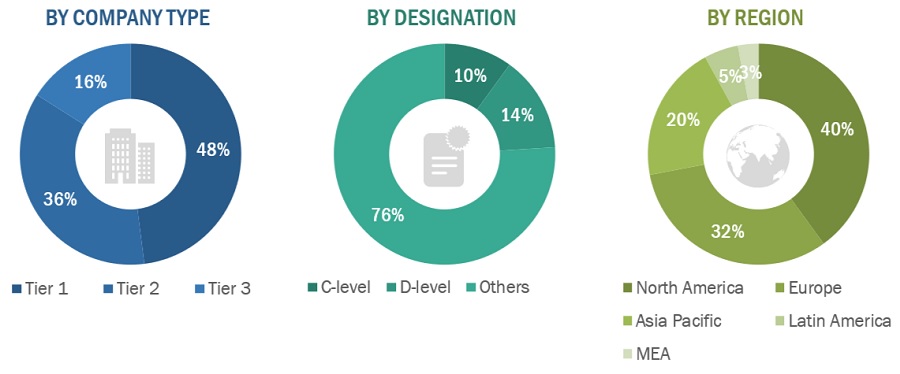
*Others include sales managers, marketing managers, business development managers, product managers, distributors, and suppliers.
Note: Companies are classified into tiers based on their total revenue. As of 2022, Tier 1 = >USD 10.00 billion, Tier 2 = USD 1.00 billion to USD 10.00 billion, and Tier 3 = <USD 1.00 billion.
To know about the assumptions considered for the study, download the pdf brochure
Market Estimation Methodology
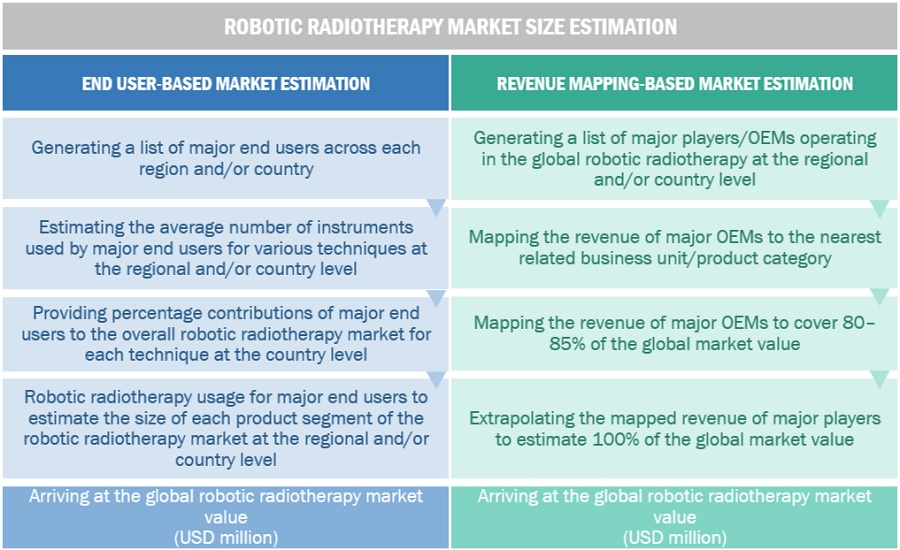
In this report, the global robotic radiotherapy market size was arrived at by using the revenue share analysis of leading players. For this purpose, key players in the market were identified, and their revenues from the robotic radiotherapy business were determined through various insights gathered during the primary and secondary research phases. Secondary research included the study of the annual and financial reports of the top market players. In contrast, primary research included extensive interviews with key opinion leaders, such as CEOs, directors, and key marketing executives.
To calculate the global market value, segmental revenues were calculated based on the revenue mapping of major solution/service providers. This process involved the following steps:
- Generating a list of major global players operating in the robotic radiotherapy market
- Mapping annual revenues generated by major global players from the robotic radiotherapy segment (or nearest reported business unit/product category)
- Revenue mapping of key players to cover a major share of the global market as of 2022
- Extrapolating the global value of the robotic radiotherapy industry
To know about the assumptions considered for the study, Request for Free Sample Report
Data Triangulation
After arriving at the overall market size from the market size estimation process explained above, the global robotic radiotherapy market was split into segments and subsegments. Data triangulation and market breakdown procedures were employed to complete the overall market engineering process and arrive at the exact statistics for all segments and subsegments. The data was triangulated by studying various factors and trends from both the demand and supply sides. Additionally, the robotic radiotherapy market was validated using both top-down and bottom-up approaches.
Market Definition
Robotic radiotherapy market is a segment of the radiotherapy industry that focuses on the development and supply of advanced technology for radiotherapy treatment. Robotic radiotherapy consists of several components, including advanced imaging technologies, treatment planning software, and robotic treatment delivery systems. These components work together to provide a fully automated, integrated radiation therapy solution and play a crucial role in modern cancer treatment by enabling precise, efficient, and safe delivery of radiation therapy to patients.
Key Market Stakeholders
- Radiotherapy product manufacturing companies
- Distributors, suppliers, and commercial service providers
- Healthcare service providers
- Clinical research organizations (CROs)
- Radiotherapy service providers
- Radiotherapy product distributors
- Medical research laboratories
- Cancer care centers
- Cancer research organizations
- Academic medical centers and universities
- Market research and consulting firms
Objectives of the Study
- To define, describe, and forecast the robotic radiotherapy market on the basis of product, technology, application, end user, and region
- To provide detailed information regarding the major factors influencing the growth potential of the global robotic radiotherapy market (drivers, restraints, opportunities, challenges, and trends).
- To analyze the micro markets with respect to individual growth trends, future prospects, and contributions to the global robotic radiotherapy market.
- To analyze key growth opportunities in the global robotic radiotherapy market for key stakeholders and provide details of the competitive landscape for market leaders.
- To forecast the size of market segments and/or subsegments with respect to four major regions, namely, North America (US and Canada), Europe (Germany, France, the UK, Italy, Spain, and the RoE), Asia Pacific (Japan, China, India, Australia, South Korea, ASEAN region and the RoAPAC), and Rest of the world.
- To profile the key players in the global robotic radiotherapy market and comprehensively analyze their market shares and core competencies.
- To track and analyze the competitive developments undertaken in the global robotic radiotherapy market, such as product launches, agreements, expansions, and & acquisitions.
Available Customizations
With the given market data, MarketsandMarkets offers customizations as per the company’s specific needs. The following customization options are available for the present global robotic radiotherapy market report:
Product Analysis
- Product matrix, which gives a detailed comparison of the product portfolios of the top fifteen companies
Company Information
- Detailed analysis and profiling of additional market players (up to 15)
Geographic Analysis
- Further breakdown of the Rest of Europe's robotic radiotherapy market into Russia, Belgium, the Netherlands, Switzerland, Austria, Finland, Sweden, Poland, and Portugal, among other
- Further breakdown of the Rest of Asia Pacific robotic radiotherapy market into Singapore, Taiwan, New Zealand, Philippines, Malaysia, and other APAC countries.
Get the Full Robotic Radiotherapy Market Report
Full forecast, segment splits, and company analysis for all Robotic Radiotherapy Market.
- US Robotic Radiotherapy Market
- Germany Robotic Radiotherapy Market
- France Robotic Radiotherapy Market
- UK Robotic Radiotherapy Market
- Italy Robotic Radiotherapy Market
- Spain Robotic Radiotherapy Market
- China Robotic Radiotherapy Market
- Japan Robotic Radiotherapy Market
- India Robotic Radiotherapy Market
- Australia Robotic Radiotherapy Market
- South Korea Robotic Radiotherapy Market
- Rest Of Europe Robotic Radiotherapy Market
- Rest Of Asia Pacific Robotic Radiotherapy Market
Need a Tailored Report?
Customize this report to your needs
Get 10% FREE Customization
Customize This Report
