
Rest Of Asia Pacific Rocket and Missile Market (2024-2029)

The Rest Of Asia Pacific Rocket and Missile Market was valued at $80.4 Million in 2024 and projected to reach to $97.1 Million by 2029, representing a compound annual growth rate of CAGR 3.9%. The Rest Of Asia Pacific rocket and missile market is positioned for steady growth through 2029, supported by regional security dynamics and defence modernization initiatives.


| Market Size in | USD 26.32 MN |
| Market Forecast in | |
| CAGR | |
| Forecast Period | |
| Units Considered | Value (USD MN) |
Rest Of Asia Pacific Rocket and Missile Market Trends and Insights
- Rest Of Asia Pacific represents a strategically important segment within the broader Asia Pacific aerospace and defence sector, driven by modernization initiatives and regional security considerations.
- The market in Rest Of Asia Pacific reflects steady demand for advanced missile systems and launch capabilities across emerging defence economies. Rest Of Asia Pacific's growth trajectory is supported by increasing defence budgets and technological advancement in neighbouring regions.
- The forecast period through 2029 indicates that Rest Of Asia Pacific will continue to capture investment in indigenous rocket and missile development programmes.
- Rest Of Asia Pacific's market expansion is tempered compared to global growth (6.4% CAGR), reflecting the region's developing industrial base and selective procurement cycles relative to mature defence markets..
Key Market Statistics
- CAGR (2024-2029) CAGR 3.9%
- Market Size, 2024 ~USD 80.4 Million
- Forecast, 2029 ~USD 97.1 Million
- Country Rest Of Asia Pacific
Rest Of Asia Pacific Rocket and Missile Market Overview
Market Valuation :
Rest Of Asia Pacific rocket and missile market valued at USD 80.4 million in 2024, demonstrating significant growth potential within the region's aerospace and defence sector.
Growth Trajectory :
Projected to reach USD 97.1 million by 2029 with a CAGR of 3.9%, reflecting steady expansion driven by regional modernization and security investments across emerging economies.
Regional Modernization :
Rest Of Asia Pacific countries are prioritizing defence capability upgrades and indigenous missile development programs, supporting sustained market growth and technology advancement.
Strategic Importance :
The region represents a critical growth segment within Asia Pacific, driven by geopolitical considerations, border security concerns, and increased defence spending among smaller nations.
Rest Of Asia Pacific Rocket and Missile Market Dynamics
- Emerging economies in the region are increasingly investing in indigenous missile capabilities and upgrading existing defence systems, creating opportunities for both domestic manufacturers and international suppliers.
- Government procurement programs and strategic partnerships are expected to drive market expansion. Key growth drivers include rising geopolitical tensions, border security requirements, and technology transfer agreements with established defence powers.
- The region's smaller nations are prioritizing cost-effective solutions and domestically-developed systems, while infrastructure investments in aerospace manufacturing continue to strengthen.
- Market growth will be tempered by budget constraints and regulatory complexities, but long-term defence spending trends remain positive..
Market Ecosystem
Related Ecosystem
Defence Platforms And Systems
- Sensors
- Unmanned Ground Vehicles (UGV)
- Fighter Aircraft
- Special Mission Aircraft
- Antennas
- BAE Systems plc
- Thales group
- LOCKHEED MARTIN CORPORATION
- Northrop Grumman Corporation
- L3Harris Technologies, Inc.
Key Takeaways
- Rest Of Asia Pacific rocket and missile market valued at USD 80.4 million in 2024, growing to USD 97.1 million by 2029.
- Rest Of Asia Pacific exhibits a 3.9% CAGR, below the global average of 6.4%, indicating measured regional growth.
- Rest Of Asia Pacific's market is driven by defence modernization and indigenous capability development programmes.
- Rest Of Asia Pacific represents emerging opportunities within the broader Asia Pacific aerospace and defence landscape.
Rocket and Missile Market Report Scope
| Report Metric | Details |
|---|---|
| Base Year | 2024 |
| Fastest Growing Segment | SCRAMJET (Propulsion) |
| Forecast Period | 2024-2029 |
| Growth Rate | CAGR of 6.4% from 2024 to 2029 |
| Largest Segment | GUIDED (Guidance Mechanism) |
| Market Size Base Year (Billions) | ~USD 62.49 (2024) |
| Revenue Forecast (Billions) | ~USD 85.22 (2029) |
| Segments Covered | Product, Type, Range, Speed, Propulsion, Launch Mode, Guidance Mechanism |
Rest Of Asia Pacific Rocket and Missile Market Report Segmentation
7 segment dimensions are covered across the global market.
By Product
- Missiles
- Rocket Artilleries
- Torpedoes
By Type
- Ballistic Missiles
- Cruise Missiles
- Interceptor Missiles
By Range
- Intercontinental Ballistic Missiles
- Intermediate-Range Ballistic Missiles
- Long-Range Cruise Missiles
- Medium-Range Ballistic Missiles
- Medium-Range Cruise Missiles
- Short-Range Ballistic Missiles
- Short-Range Cruise Missiles
By Speed
- Hypersonic
- Subsonic
- Supersonic
By Propulsion
- Hybrid
- Liquid
- Ramjet
- Scramjet
- Solid
- Turbojet
By Launch Mode
- Air-To-Air
- Air-To-Surface
- Subsea-To-Surface
- Surface-To-Air
- Surface-To-Surface
By Guidance Mechanism
- Guided
- Unguided
Target Audience
- Defence Contractors & Manufacturers : Require region-specific market data to identify procurement opportunities, assess competitive landscapes, and develop localized strategies for Rest Of Asia Pacific defence modernization programs.
- Government & Military Agencies : Need market intelligence on regional defence capabilities, technology trends, and spending patterns to inform procurement decisions and strategic defence planning within Rest Of Asia Pacific.
- Investment & Private Equity Firms : Seek detailed market forecasts and growth drivers specific to Rest Of Asia Pacific to evaluate investment opportunities in aerospace and defence companies operating in emerging regional markets.
- Aerospace & Defence Consultants : Utilize region-specific data to advise clients on market entry strategies, competitive positioning, and growth opportunities unique to Rest Of Asia Pacific's rocket and missile sector.
- Technology & Supply Chain Partners : Need insights into regional demand patterns, regulatory requirements, and modernization timelines to align product offerings and establish strategic partnerships with Rest Of Asia Pacific defence stakeholders.
Reasons to Buy this Report
- Regional Market Specificity : Gain detailed insights exclusive to Rest Of Asia Pacific, excluding major markets like China, India, and Japan, enabling precise targeting of emerging defence economies and untapped growth opportunities.
- Accurate Forecasting : Access validated projections showing growth from USD 80.4M to USD 97.1M by 2029, providing reliable data for strategic planning, investment decisions, and market entry strategies in the region.
- Competitive Intelligence : Understand regional modernization initiatives, indigenous development programs, and procurement patterns specific to Rest Of Asia Pacific nations, identifying competitive advantages and partnership opportunities.
- Investment Decision Support : Make informed capital allocation decisions with region-specific CAGR analysis (3.9%) and market dynamics, supporting business expansion and resource planning in emerging defence markets.
- Strategic Market Positioning : Identify niche segments and underserved countries within Rest Of Asia Pacific, enabling targeted product development, localization strategies, and supply chain optimization for maximum market penetration.
Frequently asked questions
What is the current market size of Rest Of Asia Pacific rocket and missile sector?
Rest Of Asia Pacific's rocket and missile market is valued at USD 80.4 million in 2024.
What is the projected market size for Rest Of Asia Pacific by 2029?
Rest Of Asia Pacific's market is forecast to reach USD 97.1 million by 2029.
What is the CAGR for Rest Of Asia Pacific rocket and missile market?
Rest Of Asia Pacific is expected to grow at a CAGR of 3.9% from 2024 to 2029.
How does Rest Of Asia Pacific growth compare to global market trends?
Rest Of Asia Pacific's 3.9% CAGR is below the global CAGR of 6.4%, reflecting a more conservative regional growth trajectory.
What factors drive growth in Rest Of Asia Pacific rocket and missile market?
Rest Of Asia Pacific growth is driven by defence modernization initiatives, increasing defence budgets, and indigenous capability development programmes.
RESEARCH METHODOLOGY
The research study conducted on the Rocket and missile market involved extensive use of secondary sources, including directories, databases of articles, journals on rockets and missiles, company newsletters, and information portals such as Arms Control Association, Bloomberg, and Factiva to identify and collect information useful for this extensive, technical, market-oriented, and commercial study of the rocket and missile market. Primary sources are several industry experts from the core and related industries, alliances, organizations, Original Equipment Manufacturers (OEMs), vendors, suppliers, and technology developers. These sources relate to all segments of the value chain of the rocket and missile industry. In-depth interviews were conducted with various primary respondents, including key industry participants, subject-matter experts, C-level executives of key market players, and industry consultants, among others, to obtain and verify critical qualitative and quantitative information and to assess future prospects of the market.
Secondary Research
In the secondary research process, various secondary sources were referred to identify and collect information for this study on the rocket and missile market. Secondary sources included annual reports, press releases, and investor presentations of companies; white papers and certified publications; articles from recognized authors; manufacturer's associations; directories; and databases. Secondary research was mainly used to obtain key information about the supply chain of the Rocket and missile industry, the monetary chain of the market, the total pool of key players, market classification and segmentation according to the industry trends to the bottom-most level, regional markets, and key developments from both market- and technology-oriented perspectives.
Primary Research
Extensive primary research has been conducted after obtaining information regarding the rocket and missile market scenario through secondary research. Several primary interviews have been conducted with market experts from both the demand and supply sides across major countries of North America, Europe, Asia Pacific, Middle East, Africa, and Latin America. Primary data has been collected through questionnaires, emails, and telephonic interviews. These interviews have been conducted to gather insights such as market statistics, data on revenue collected from the products and services, market breakdowns, market size estimations, market size forecasting, and data triangulation. It has also helped analyze the product, speed, launch mode, propulsion type, and guidance mechanism segments of the market for five key regions.
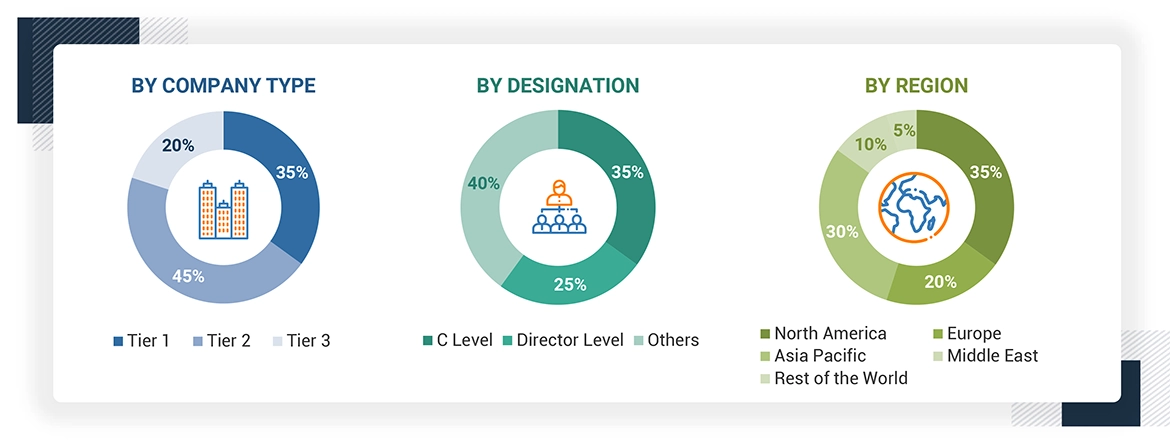
Note: Others include aircraft upholsterers, upholsterer technicians, and aircraft cabin modification industry experts. Tiers of companies are based on their revenue in 2023. Tier 1: company revenue greater than USD 1 billion; tier 2: company revenue between USD 100 million and USD 1 billion; and tier 3: company revenue less than USD 100 million.
About the assumptions considered for the study, To know download the pdf brochure
Market Size Estimation
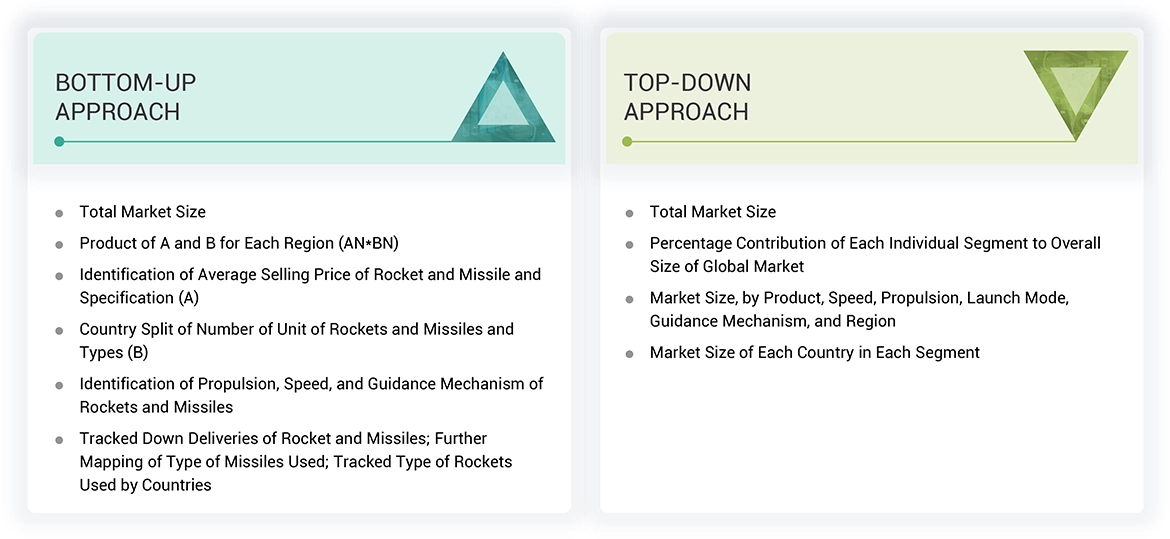
The top-down and bottom-up approaches have been used to estimate and validate the size of the rocket and missile market. The research methodology used to estimate the market size includes the following details.
- The top-down and bottom-up approaches have been used to estimate and validate the size of the rocket and missile market. The research methodology used to estimate the market size also includes the following details.
- The key players have been identified through secondary research, and their market ranking has been determined through primary and secondary research. This includes a study of the annual and financial reports of the top market players and extensive interviews of leaders, including chief executive officers (CEO), directors, and marketing executives.
- All percentage shares, splits, and breakdowns have been determined using secondary sources and verified through primary sources. All possible parameters that affect the markets covered in this research study have been accounted for, viewed in extensive detail, verified through primary research, and analyzed to obtain the final quantitative and qualitative data. This data has been consolidated and enhanced with detailed inputs, analyzed by MarketsandMarkets, and presented in this report.
Rocket and Missile Market : Top-Down and Bottom-Up Approach
Data Triangulation
After arriving at the overall size of the rocket and missile market from the market size estimation process explained above, the total market has been split into several segments and subsegments. To complete the overall market engineering process and arrive at the exact statistics for various market segments and subsegments, the data triangulation and market breakdown procedures explained below have been implemented wherever applicable. The data has been triangulated by studying various factors and trends from both the demand and supply sides. Along with this, the market size has been validated using the top-down and bottom-up approaches.
Market Definition
Rockets and missiles are munitions fired by militaries to engage moving and stationary targets in air, land, and sea. Rockets are smaller than missiles and are mainly used for land warfare operations. Missiles are versatile weapons that can travel at hypersonic speed and engage targets thousands of kilometers away. Most missiles contain some guidance and control mechanisms and are often referred to as guided missiles. An unguided military missile and any launch vehicle used in the upper atmosphere or a satellite in space are usually called a rocket. Missiles can be propelled by liquid-fueled or solid-fueled rocket engines. Solid fuel is preferred for military uses because it is less likely to explode and is kept ready-loaded for quick launch.
Key Stakeholders
- Rocket and Missile Manufacturers
- Technology Support Providers
- System and Subsystem Providers
- Government Agencies
- Military Organizations
- Investors and Financial Community Professionals
- Research Organizations
Report Objectives
- To define, segment, and forecast the size of the rocket and missile market in terms of value based on product, speed, propulsion, launch mode, guidance mechanism, and region from 2024 to 2029
- To forecast the size of market segments with respect to major regions, namely North America, Europe, Asia Pacific, the Middle East, and the Rest of the World (RoW), which comprises Africa and Latin America
- To identify and analyze key drivers, restraints, opportunities, and challenges influencing market growth
- To strategically analyze micromarkets with respect to individual growth trends, prospects, and their contribution to the rocket and missile market
- To analyze opportunities for stakeholders in the market by identifying key market trends
- To analyze competitive developments such as contracts, expansions, acquisitions, agreements, joint ventures, partnerships, product launches, and research and development (R&D) activities in the rocket and missile market
- To provide a detailed competitive landscape of the market, in addition to an analysis of business and corporate strategies adopted by leading market players
- To strategically profile key market players and comprehensively analyze their core competencies
Available Customizations
Along with the market data, MarketsandMarkets offers customizations as per the specific needs of companies. The following customization options are available for the report:
Product Analysis
- Product matrix, which gives a detailed comparison of the product portfolio of each company
Regional Analysis
- Further breakdown of the market segments at country-level
Company Information
- Detailed analysis and profiling of additional market players (up to 5)
Get the Full Rocket and Missile Market Report
Full forecast, segment splits, and company analysis for all Rocket and Missile Market.
- Canada Rocket and Missile Market
- US Rocket and Missile Market
- UK Rocket and Missile Market
- Germany Rocket and Missile Market
- France Rocket and Missile Market
- Italy Rocket and Missile Market
- Russia Rocket and Missile Market
- China Rocket and Missile Market
- India Rocket and Missile Market
- Japan Rocket and Missile Market
- Australia Rocket and Missile Market
- South Korea Rocket and Missile Market
- Saudi Arabia Rocket and Missile Market
- Kuwait Rocket and Missile Market
- Israel Rocket and Missile Market
- Turkey Rocket and Missile Market
- Rest Of Europe Rocket and Missile Market
- Rest Of Middle East Rocket and Missile Market
Need a Tailored Report?
Customize this report to your needs
Get 10% FREE Customization
Customize This Report
