
Asia Pacific RTLS Market for Healthcare (2024-2029)

The Asia Pacific RTLS Market for Healthcare was valued at $449.6 Million in 2024 and projected to reach to $1391.4 Million by 2029, representing a compound annual growth rate of 25.3%. The Asia Pacific RTLS healthcare market is positioned for exceptional growth through 2029, driven by accelerating digital transformation initiatives and increasing healthcare expenditure across the region.


| Market Size in | USD 26.32 MN |
| Market Forecast in | |
| CAGR | |
| Forecast Period | |
| Units Considered | Value (USD MN) |
Asia Pacific RTLS Market for Healthcare Trends and Insights
- Asia Pacific's healthcare sector is increasingly adopting real-time location systems to enhance operational efficiency, patient safety, and asset management across hospitals and clinics.
- The region's strong growth trajectory, driven by digital transformation initiatives and rising healthcare infrastructure investments, positions Asia Pacific as a critical growth engine for the global RTLS healthcare market. Asia Pacific's 25.3% compound annual growth rate significantly outpaces the global average of 19.6%, reflecting accelerating demand for location-based healthcare solutions.
- Key markets within Asia Pacific, including China, Japan, India, and Southeast Asia, are deploying RTLS technologies to optimize patient workflows, track medical equipment, and improve emergency response capabilities.
- The region's expanding middle class, aging population demographics, and government healthcare modernization programs are fueling sustained investment in RTLS infrastructure throughout the forecast period..
Key Market Statistics
- CAGR (2024-2029) 25.3% CAGR
- Market Size, 2024 ~USD 449.6 Million
- Forecast, 2029 ~USD 1391.4 Million
- Geography Asia Pacific
Asia Pacific RTLS Market for Healthcare Overview
Rapid Market Expansion :
Asia Pacific RTLS healthcare market is projected to grow from $449.6 million in 2024 to $1,391.4 million by 2029, representing a robust 25.3% CAGR, significantly outpacing the global growth rate of 19.6%.
Digital Healthcare Transformation :
The region's healthcare providers are increasingly investing in real-time location systems to streamline operations, improve patient safety protocols, and optimize asset tracking across hospitals and medical facilities.
Regional Growth Drivers :
Asia Pacific's expansion is fueled by rising healthcare infrastructure investments, growing patient volumes, increasing adoption of IoT technologies, and government initiatives supporting digital health modernization across the region.
Operational Efficiency Focus :
Healthcare institutions across Asia Pacific are leveraging RTLS solutions to reduce equipment downtime, enhance staff workflow management, and improve emergency response times in clinical settings.
Asia Pacific RTLS Market for Healthcare Dynamics
- Major economies including China, India, Japan, and Southeast Asian nations are prioritizing modernization of healthcare infrastructure, creating substantial opportunities for RTLS adoption in patient tracking, asset management, and operational optimization. The region's competitive landscape is intensifying as both established technology providers and emerging local players expand their presence.
- Healthcare facilities are recognizing RTLS as critical infrastructure for improving patient outcomes and operational efficiency.
- Continued investment in healthcare IT, coupled with rising awareness of real-time location benefits, will sustain the market's strong growth trajectory through the forecast period..
Market Ecosystem
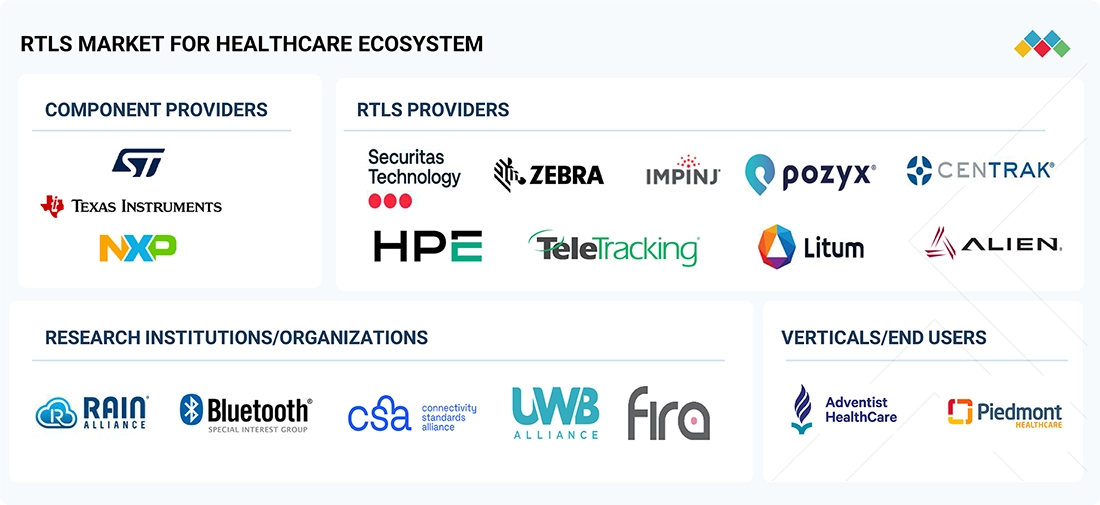
RTLS MARKET FOR HEALTHCARE SIZE, SHARE & TRENDS: COMMERCIAL USE CASES ACROSS INDUSTRIES
| COMPANY | USE CASE DESCRIPTION | BENEFITS |
|---|---|---|
 |
Provides comprehensive RTLS platforms for asset tracking, patient flow optimization, staff visibility, and nurse call automation across hospitals and long-term care facilities. | Improves operational efficiency, enhances patient safety, reduces equipment search time, and supports better staff allocation through real-time insights. |
 |
Delivers RFID- and Wi-Fi-based RTLS solutions for equipment tracking, patient identification, workflow monitoring, and specimen tracking in clinical environments. | Improves asset visibility, enhances patient identification accuracy, streamlines clinical workflows, reduces manual tracking errors, and supports faster decision-making across healthcare operations. |
 |
Offers Wi-Fi/BLE-based indoor positioning for asset and patient tracking, contact tracing, and staff workflow optimization using Aruba Access Points and Meridian platforms. | Enhances hospital navigation, improves patient throughput, strengthens infection control, and reduces bottlenecks through real-time location data. |
 |
Provides RAIN RFID solutions enabling automated equipment tracking, inventory management, and supply chain visibility for medical devices and consumables. | Reduces inventory shrinkage, increases asset utilization, improves supply availability, and lowers operational costs through automated tracking. |
 |
Specializes in real-time patient flow, bed management, and capacity optimization using RTLS-enabled operational platforms for hospitals. | Boosts patient throughput, reduces wait times, improves bed turnover efficiency, and enhances overall hospital capacity management. |
Logos and trademarks shown above are the property of their respective owners. Their use here is for informational and illustrative purposes only.
Related Ecosystem
Healthcare It
- Computed Tomography (CT)
- Machine Learning
- Magnetic Resonance Imaging (MRI)
- Natural Language Processing (NLP)
- Predictive Analytics
- CERNER CORPORATION
- PHILIPS HEALTHCARE
- Oracle Corporation
- GE HealthCare Technologies Inc.
- Siemens healthineers
Electronics System And Components
- Sensors
- Temperature Sensors
- Pressure Sensors
- Actuators
- Image Sensors
- Lenovo
- Samsung
- Texas Instruments Incorporated
- HONEYWELL INTERNATIONAL INC.
- Teledyne Technologies Incorporated
Internet Of Things And M2M
- Sensors
- Cellular Network
- Digital Signal Processor (DSP)
- Global Positioning System (GPS)
- Image Sensors
- MITSUI ELECTRONICS INC
- INTEL CORPORATION
- MICROSOFT CORPORATION
- Amazon.com, Inc.
Key Takeaways
- Asia Pacific RTLS healthcare market will grow from $449.6M (2024) to $1,391.4M (2029), representing a 25.3% CAGR that exceeds global growth rates.
- Asia Pacific's healthcare modernization initiatives and digital transformation investments are primary drivers accelerating RTLS adoption across the region.
- Aging demographics and expanding middle-class populations in Asia Pacific are increasing demand for advanced patient tracking and asset management solutions.
- Asia Pacific represents the fastest-growing regional market for healthcare RTLS, outpacing North America and Europe in growth velocity.
RTLS Market for Healthcare Report Scope
| Report Metric | Details |
|---|---|
| Base Year | 2024 |
| Fastest Growing Segment | BLE (Technology) |
| Forecast Period | 2024–2029 |
| Growth Rate | CAGR of 19.6% from 2024 to 2029 |
| Largest Segment | WI-FI (Technology) |
| Market Size Base Year (Billions) | ~USD 2.33 (2024) |
| Revenue Forecast (Billions) | ~USD 5.7 (2029) |
| Segments Covered | Offering, Type, Technology |
Asia Pacific RTLS Market for Healthcare Report Segmentation
3 segment dimensions are covered across the global market.
By Offering
- Hardware
- Services
- Software
By Type
- Consulting
- Deployment & Integration
- Other Hardware Products
- Readers/Trackers/Access Points
- Support & Maintenance
- Tags/Badges
By Technology
- Ble
- Infrared
- Other Technologies
- Rfid
- Ultrasound
- Uwb
- Wi-Fi
Target Audience
- Healthcare Technology Vendors : RTLS solution providers need Asia Pacific-specific market data to identify growth opportunities, understand regional customer requirements, and develop competitive strategies for this high-growth region.
- Healthcare Facility Operators : Hospital administrators and healthcare network leaders require market insights to evaluate RTLS investment decisions, benchmark against regional peers, and understand implementation best practices in Asia Pacific.
- Investment & Private Equity Firms : Investors targeting healthcare technology in Asia Pacific need detailed market analysis to assess portfolio opportunities, evaluate growth potential, and make informed funding decisions in the region.
- Healthcare IT Consultants : Consulting firms advising healthcare organizations on digital transformation need Asia Pacific market intelligence to provide clients with regional benchmarks and technology recommendations.
- Government & Healthcare Policy Makers : Regional health authorities and policy makers require market data to inform healthcare digitalization initiatives, infrastructure planning, and technology adoption policies across Asia Pacific.
Key Companies in the Asia Pacific RTLS Market for Healthcare
| Company | HQ | Ownership | Strongest segments |
|---|---|---|---|
| KORE WIRELESS GROUP | United States | Public Company | IoT connectivity-as-a-service (including SIMs and location-based services),Connectivity enablement-as-a-service and device management,Managed and professional services, |
| PCTEL, INC. | United States | Private Company | Precision antennas,Industrial IoT devices,RF test and measurement, |
| WNS GLOBAL SERVICES | India | Private Company | Banking, Financial Services & Insurance BPM,Travel, Shipping, Logistics & Utilities BPM,Manufacturing, Retail, CPG, Media, Telecom & Hi-tech/Professional Services, |
| LENOVO | China | Public Company | Commercial SFF PCs and media players for signage,Thin clients and embedded controllers,Tablets and smart devices used as kiosks/PoS displays, |
| GENERAL ELECTRIC | United States | Public Company | Commercial Engines & Services,Defense & Propulsion Technologies,Additive, Components, and Other Aero Systems, |
| ZEBRA TECHNOLOGIES CORP. | United States | Public Company | Rugged and enterprise mobile computing,Barcode and RFID printers, supplies, and card printers,Barcode scanners, imagers, and fixed industrial scanners, |
| IMPINJ, INC. | United States | Public Company | Endpoint ICs (tags and item connectivity),Readers, reader ICs, and gateways,Software and platform services, |
| ADVANTECH CO., LTD. | Taiwan | Public Company | Embedded boards, COMs, and SBCs,Industrial and box IPC, rackmount IPC, and edge servers,IoT automation, controllers, gateways, and remote I/O, |
| ALIEN TECHNOLOGY, LLC | United States | Private Company | UHF RFID inlays, tags, and labels,RFID chips and transceivers,RFID readers and antennas, |
| GE HEALTHCARE | United States | Public Company | Imaging,Advanced Visualization Solutions (AVS),Patient Care Solutions (PCS), |
| INFOR | United States | Private Company | Data Integration & Engineering,API & Application Integration,Data Quality & Observability, |
| QORVO, INC. | United States | Public Company | Advanced Cellular Group (ACG) – smartphone and cellular RF,High Performance Analog (HPA) – defense, aerospace, power, and infrastructure,Connectivity and Sensors Group (CSG) – UWB, Wi-Fi, Matter, BLE, Zigbee, Thread, |
KORE WIRELESS GROUP
KORE Wireless Group is a publicly traded company founded in 2002 in the United States with 403 employees.
PCTEL, INC.
PCTEL, Inc. is a private company founded in 1994 in the United States with 213 employees.
WNS GLOBAL SERVICES
WNS Global Services is a private company founded in 1998 in India with 66,085 employees.
LENOVO
Lenovo is a publicly traded company founded in 1984 in China.
GENERAL ELECTRIC
General Electric is a publicly traded company founded in 1892 in the United States with 57,000 employees.
ZEBRA TECHNOLOGIES CORP.
Zebra Technologies Corp. is a publicly traded company founded in 1969 in the United States with 10,700 employees.
IMPINJ, INC.
Impinj, Inc. is a publicly traded company founded in 2000 in the United States with 457 employees.
ADVANTECH CO., LTD.
Advantech Co., Ltd. is a publicly traded company founded in 1981 in Taiwan with 2,526 employees.
ALIEN TECHNOLOGY, LLC
Alien Technology, LLC is a private company founded in 1994 in the United States with 241 employees.
GE HEALTHCARE
GE Healthcare is a publicly traded company founded in 2022 in the United States with 54,000 employees.
INFOR
Infor is a private company founded in 1993 in the United States with 5,200 employees.
QORVO, INC.
Qorvo, Inc. is a publicly traded company founded in 1957 in the United States with 5,200 employees.
Countries within Asia Pacific - compare and drill down
| Country | 2025 size (native) |
|---|
Country market size visualization
Reasons to Buy this Report
- Regional Market Intelligence : Gain comprehensive insights specific to Asia Pacific's RTLS healthcare landscape, including market size, growth projections, and regional dynamics that differ significantly from global trends.
- Competitive Positioning Strategy : Understand Asia Pacific's unique competitive environment, identify key players, and develop targeted strategies for market entry or expansion across the region's diverse healthcare markets.
- Investment Decision Support : Access detailed forecasts and growth drivers specific to Asia Pacific to support capital allocation decisions, partnership opportunities, and resource planning for healthcare technology investments.
- Country-Level Opportunities : Identify high-growth markets within Asia Pacific including China, India, Japan, and Southeast Asia with tailored insights for localized business development and market penetration strategies.
- Technology Adoption Trends : Understand Asia Pacific healthcare providers' specific adoption patterns, implementation challenges, and technology preferences to align product development and go-to-market strategies effectively.
Frequently asked questions
What is the projected market size for RTLS in Asia Pacific healthcare by 2029?
Asia Pacific's RTLS healthcare market is projected to reach $1,391.4 million by 2029, growing from $449.6 million in 2024.
What is the CAGR for Asia Pacific's RTLS healthcare market?
Asia Pacific's RTLS healthcare market is expected to grow at a compound annual growth rate of 25.3% between 2024 and 2029.
Why is Asia Pacific's RTLS market growing faster than the global average?
Asia Pacific's 25.3% CAGR exceeds the global 19.6% rate due to rapid healthcare digitalization, government modernization programs, and demographic shifts driving demand for advanced location tracking solutions.
Which countries in Asia Pacific are leading RTLS healthcare adoption?
China, Japan, India, and Southeast Asian nations are among the leading markets in Asia Pacific driving RTLS healthcare adoption through significant infrastructure investments and digital transformation initiatives.
What are the primary applications of RTLS in Asia Pacific healthcare facilities?
Asia Pacific healthcare providers are deploying RTLS for patient tracking, medical equipment management, staff workflow optimization, and emergency response coordination across hospitals and clinics.
RESEARCH METHODOLOGY
The study involved four major activities in estimating the current size of the RTLS market for healthcare. Exhaustive secondary research has been done to collect information on the market, peer, and parent markets. The next step has been to validate these findings, assumptions, and sizing with industry experts across the value chain through primary research. Both top-down and bottom-up approaches have been employed to estimate the total market size. After that, market breakdown and data triangulation methods were used to estimate the market size of segments and subsegments. Two sources of information—secondary and primary—have been used to identify and collect information for an extensive technical and commercial study of the RTLS market for healthcare.
Secondary Research
Secondary sources include company websites, magazines, industry news, associations, and databases (Factiva and Bloomberg). These secondary sources include annual reports, press releases, investor presentations of companies, white papers, certified publications, articles by recognized authors, regulatory bodies, trade directories, and databases.
Primary Research
Primary sources mainly consist of several experts from the core and related industries, along with preferred RTLS providers, distributors, alliances, standards, and certification organizations related to various segments of this industry’s value chain.
In the primary research process, various primary sources from both the supply and demand sides were interviewed to obtain qualitative and quantitative information on the market. The primary sources from the supply side included various industry experts such as Chief Experience Officers (CXOs), Vice Presidents (VPs), and Directors from business development, marketing, product development/innovation teams, and related key executives from RTLS providers, such as Securitas Healthcare LLC (US), Zebra Technologies Corp. (US), HPE Aruba Networking (US), Impinj, Inc. (US), and TeleTracking Technologies, Inc. (US); research organizations, distributors, industry associations, and key opinion leaders. Following is the breakdown of primary respondents.
The breakdown of primary respondents is provided below.

To know about the assumptions considered for the study, download the pdf brochure
Market Size Estimation
Both top-down and bottom-up approaches have been used to estimate and validate the total size of the RTLS market for healthcare. These methods have also been used extensively to estimate the size of various subsegments in the market. The following research methodology has been used to estimate the market size:
- Major players in the industry and markets have been identified through extensive secondary research.
- The industry’s value chain and market size (in terms of value) have been determined through primary and secondary research processes.
- All percentage shares, splits, and breakdowns have been determined using secondary sources and verified through primary sources.
In the top-down approach, the overall market size has been used to estimate the size of the individual market segments (mentioned in market segmentation) through percentage splits from secondary and primary research. For specific market segments, the size of the most appropriate immediate parent market has been used to implement the top-down approach. The bottom-up approach has also been implemented for data obtained from secondary research to validate the market size of various segments.
The bottom-up approach has been used to arrive at the overall size of the RTLS market for healthcare from the revenues of the key players and their market shares. Calculations based on revenues of key companies identified in the market led to the estimation of their overall Industry size.
RTLS Market for Healthcare: Bottom-up Approach and Top-Down Approach

Data Triangulation
After arriving at the overall market size from the estimation process explained above, the overall market has been split into several segments and subsegments. The market breakdown and data triangulation procedures have been employed, wherever applicable, to complete the overall Industry engineering process and arrive at the exact statistics for all segments and subsegments. The data has been triangulated by studying various factors and trends from both the demand and supply sides. The market has also been validated using both top-down and bottom-up approaches.
Market Definition
Real-time location systems (RTLS) are local positioning and tracking systems used to locate and identify objects/people/targets automatically in real-time, usually for indoor applications such as within buildings or other contained areas. RTLS tags/badges/sensors attached to objects or worn by people communicate wirelessly with readers/trackers/access points installed in the vicinity. An RTLS solution may use different technologies for communication between tags and receivers, depending on the application/use case requirement. Various technologies, such as Radio-Frequency Identification (RFID), Wireless Fidelity (Wi-Fi), Ultrasound, Infrared, Ultra-Wideband (UWB), and Bluetooth Low Energy (BLE), are used for precise locating or tracking applications in real-time.
Key Stakeholders
- RTLS hardware providers
- RTLS software providers
- RTLS-related service providers
- RTLS-related associations, organizations, forums, and alliances
- OEM/ODMs, foundries, and semiconductor component suppliers
- RTLS distributors and sales firms
- RTLS end users
- Government bodies, such as regulating authorities and policymakers
- Venture capitalists, private equity firms, and start-up companies
- Research institutes, organizations, and consulting companies
Report Objectives
- To define and forecast the RTLS market for healthcare regarding offering, technology, facility type and application.
- To describe and forecast the RTLS market for healthcare and its value segments for four regions—North America, Europe, Asia Pacific, and the Rest of the World (RoW), along with their respective countries.
- To provide detailed information regarding the drivers, restraints, opportunities, and challenges influencing the growth of the market
- To strategically analyze micro-markets concerning individual growth trends, prospects, and contributions to the overall market
- To study the complete value chain of the RTLS market for healthcare market
- To analyze opportunities in the market for stakeholders by identifying high-growth segments of the market
- To strategically profile key players and comprehensively analyze their market position regarding ranking and core competencies, along with a detailed market competitive landscape.
- To analyze strategic approaches such as agreements, collaborations, and partnerships in the RTLS market for healthcare
- To provide an analysis of the recession impact on the growth of the market and its segments
Available Customizations
Based on the given market data, MarketsandMarkets offers customizations in the reports according to the client’s specific requirements. The available customization options are as follows:
Company Information
- Detailed analysis and profiling of additional market players (up to 5)
Get the Full RTLS Market for Healthcare Report
Full forecast, segment splits, and company analysis for all RTLS Market for Healthcare.
Need a Tailored Report?
Customize this report to your needs
Get 10% FREE Customization
Customize This Report
