
Rest Of Europe Satellite Ground Station Market (2025-2030)

The Rest Of Europe Satellite Ground Station Market was valued at $1951.5 Million in 2025 and projected to reach to $4117 Million by 2030, representing a compound annual growth rate of 16.1%. Rest of Europe's satellite ground station market is positioned for exceptional growth through 2030, driven by strategic government investments in space infrastructure and the expansion of commercial satellite operations.


| Market Size in | USD 26.32 MN |
| Market Forecast in | |
| CAGR | |
| Forecast Period | |
| Units Considered | Value (USD MN) |
Rest Of Europe Satellite Ground Station Market Trends and Insights
- This 16.1% compound annual growth rate reflects strong regional demand driven by increased satellite communications infrastructure investment, government space initiatives, and commercial satellite operator expansion across Eastern and Central European nations.
- Rest Of Europe is positioning itself as a critical hub for satellite operations, supported by strategic geographic location and growing digital connectivity requirements. The market dynamics in Rest Of Europe are shaped by rising adoption of satellite-based Earth observation, telecommunications, and navigation services.
- Rest Of Europe's growth trajectory outpaces the global average, indicating accelerating regional investment in ground station modernization and new facility deployment.
- Key drivers include EU space policy initiatives, private sector satellite constellation launches, and enhanced demand for broadband connectivity in underserved regions.
- Rest Of Europe's competitive landscape is becoming increasingly attractive to both established aerospace players and emerging technology providers seeking to capitalize on the region's expanding satellite ecosystem..
Key Market Statistics
- CAGR (2025-2030) 16.1% CAGR
- Market Size, 2025 ~USD 1951.5 Million
- Forecast, 2030 ~USD 4117 Million
- Country Rest Of Europe
Rest Of Europe Satellite Ground Station Market Overview
Rapid Market Expansion :
Rest of Europe's satellite ground station market is growing at 16.1% CAGR, outpacing the global average of 15.1%, driven by increased investment in satellite communications infrastructure and government space programs across Eastern and Central European nations.
Substantial Market Valuation :
The market is valued at USD 1,951.5 million in 2025 and is projected to more than double to USD 4,117.0 million by 2030, reflecting strong regional demand and commercial satellite operator expansion throughout the Rest of Europe region.
Government Space Initiatives :
European governments outside major Western markets are increasingly investing in domestic space capabilities and satellite communications infrastructure, creating significant opportunities for ground station development and deployment across the region.
Commercial Satellite Growth :
Commercial satellite operators are expanding their presence in Rest of Europe, requiring new ground station facilities and modernized infrastructure to support growing satellite communications services and Earth observation applications.
Rest Of Europe Satellite Ground Station Market Dynamics
- The region's increasing focus on digital connectivity, Earth observation capabilities, and independent space programs is creating substantial demand for advanced ground station technologies.
- Eastern and Central European countries are prioritizing satellite communications to enhance broadband coverage and support emerging space industries. The forecast period will see accelerated adoption of next-generation ground station systems, including automated tracking facilities and multi-band reception capabilities.
- Investment in regional space agencies and public-private partnerships will further stimulate market growth.
- The 16.1% CAGR reflects both infrastructure modernization and new facility deployments, positioning Rest of Europe as a dynamic growth market within the broader European aerospace and defense sector..
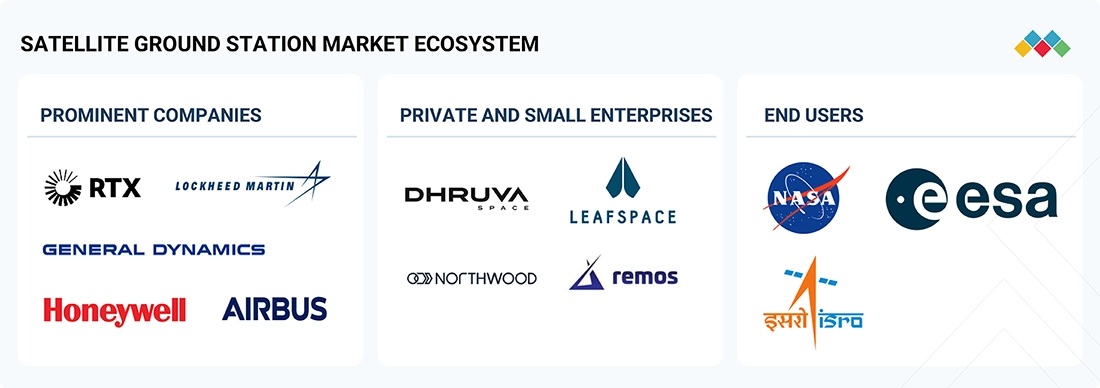
Market Ecosystem
Satellite Ground Station Market: COMMERCIAL USE CASES ACROSS INDUSTRIES
| COMPANY | USE CASE DESCRIPTION | BENEFITS |
|---|---|---|
 |
Provides secure TT&C and mission-control systems for national security satellites | Ensures resilient satellite operations with hardened ground infrastructure for defense users |
 |
Delivers integrated ground networks, SATCOM gateways, and protected TT&C architectures | Enhances mission assurance with high-availability, multi-orbit ground systems for critical missions |
 |
Supplies advanced RF, antenna, and command-and-control systems for government satellite programs | Improves signal reliability and operational agility across surveillance and communication missions |
 |
Builds and integrates end-to-end ground segments for EO, navigation, and communication satellites | Enables fast data acquisition and seamless satellite operations through unified ground control |
 |
Develops ground architectures supporting defense satellites, missile-warning systems, and multi-orbit operations | Strengthens operational resilience by providing secure, scalable ground infrastructure for complex missions |
Logos and trademarks shown above are the property of their respective owners. Their use here is for informational and illustrative purposes only.
Related Ecosystem
Cns Systems
- C-Band
- Ka-Band
- Antennas
- Unmanned Ground Vehicles (UGV)
- Rotary Wing Aircraft
- L3Harris Technologies, Inc.
- Thales group
- HONEYWELL INTERNATIONAL INC.
- Northrop Grumman Corporation
- LOCKHEED MARTIN CORPORATION
Space
- C-Band
- Small Satellite
- Antennas
- Ka-Band
- Microsatellite
- AIRBUS
- L3Harris Technologies, Inc.
- Thales group
- Northrop Grumman Corporation
- LOCKHEED MARTIN CORPORATION
Key Takeaways
- Rest Of Europe's satellite ground station market will nearly double from USD 1,951.5M (2025) to USD 4,117.0M (2030), driven by 16.1% CAGR.
- Rest Of Europe is experiencing accelerated investment in satellite communications infrastructure to support EU digital and space policy objectives.
- Rest Of Europe's strategic geographic position and growing broadband demand are attracting major satellite operators and ground station developers.
- Rest Of Europe's market growth outpaces global averages, reflecting strong regional momentum in commercial and government satellite operations.
Satellite Ground Station Market Report Scope
| Report Metric | Details |
|---|---|
| Base Year | 2025 |
| Fastest Growing Segment | GROUND STATION AS A SERVICE (Solution) |
| Forecast Period | 2025–2030 |
| Growth Rate | CAGR of 15.1% from 2025 to 2030 |
| Largest Segment | FIXED (Platform) |
| Market Size Base Year (Billions) | ~USD 40.95 (2025) |
| Revenue Forecast (Billions) | ~USD 82.72 (2030) |
| Segments Covered | Platform, Type, Solution, Hardware, Function, End User, Frequency, Orbit |
Rest Of Europe Satellite Ground Station Market Report Segmentation
8 segment dimensions are covered across the global market.
By Platform
- Fixed
- Mobile
- Portable
By Type
- Airborne
- Container/Trailer-Mounted
- Groundborne
- Shipborne
- Vehicle-Mounted
By Solution
- Ground Station As A Service
- Hardware
- Software
By Hardware
- Antenna Systems
- Baseband & Recording Hardware
- Power & Racks
- Rf Systems
- Storage & Networking Units
By Function
- Communication
- Earth Observation
- Navigation
- Other Functions
- Space Research
By End User
- Air Force
- Army
- Commercial
- Defense
- Government
- Navy
- Public Safety & Civil Agencies
- Space Agencies & Research Centers
By Frequency
- C-Band
- Ku And Ka-Band
- L-Band
- Optical/Laser
- Other Frequency Bands
- S-Band
- Uhf/Vhf/Hf-Band
- X-Band
By Orbit
- Geo
- Leo
- Meo
- Other Orbits
Target Audience
- Ground Station Equipment Manufacturers : Manufacturers need regional market data to identify growth opportunities, plan production capacity, and develop products tailored to Rest of Europe's specific technical requirements and regulatory standards for satellite communications infrastructure.
- Satellite Operators & Service Providers : Commercial and government satellite operators require detailed market intelligence to plan ground station network expansion, assess infrastructure investment needs, and identify optimal locations for facility deployment across Rest of Europe.
- Government & Space Agencies : National space agencies and government bodies need comprehensive market analysis to inform space program development, budget allocation, and strategic partnerships for building independent satellite communications capabilities in the region.
- Infrastructure & Construction Companies : Engineering and construction firms need market forecasts and regional demand data to bid on ground station facility projects, plan resource allocation, and identify emerging infrastructure development opportunities across Rest of Europe.
- Investment & Private Equity Firms : Investors require detailed market sizing and growth projections to evaluate investment opportunities in satellite ground station companies, infrastructure funds, and space technology ventures operating in the Rest of Europe region.
Key Companies in the Rest Of Europe Satellite Ground Station Market
| Company | HQ | Ownership | Strongest segments |
|---|---|---|---|
| RTX | United States | Public Company | Collins Aerospace (avionics, interiors, mission systems, aftermarket),Pratt & Whitney (commercial and military engines, APU, MRO),Raytheon (sensors, command and control, software), |
| GENERAL DYNAMICS CORPORATION | United States | Public Company | Aerospace (Gulfstream and services),Marine Systems (submarines, surface combatants, lifecycle support),Combat Systems (land combat vehicles, weapons, munitions), |
| AIRBUS | Netherlands | Public Company | Commercial aircraft (Airbus segment),Helicopters,Defence and Space, |
| L3HARRIS TECHNOLOGIES, INC. | United States | Public Company | Communications & Spectrum Dominance (tactical and public safety comms),Space & Mission Systems (sensing, ISR, missile warning payloads),Missile Solutions (propulsion, hypersonics, advanced missile tech), |
| LOCKHEED MARTIN CORPORATION | United States | Public Company | Aeronautics,Missiles and Fire Control,Rotary and Mission Systems, |
| KONGSBERG | Norway | Public Company | Air and missile defense, naval strike and air-to-surface missiles,Naval combat systems, sonars, navigation, and C2,Remote weapon stations and land systems, |
| ELBIT SYSTEMS LTD. | Israel | Public Company | Aerospace (airborne platforms, UAVs, avionics, training),C4I and Cyber,ISTAR and Electronic Warfare, |
| BOEING | United States | Public Company | Commercial Airplanes,Defense, Space & Security,Global Services, |
| NORTHROP GRUMMAN | United States | Public Company | Aeronautics Systems,Defense Systems,Mission Systems, |
| BAE SYSTEMS | United Kingdom | Public Company | Air,Electronic Systems,Maritime, |
RTX
RTX is a United States-based public company founded in 1934 with 180,000 employees. The company operates as a major aerospace and defense contractor.
GENERAL DYNAMICS CORPORATION
General Dynamics Corporation is a United States-based public company founded in 1899 with 117,000 employees. The company operates in the aerospace and defense sectors.
AIRBUS
Airbus is a Netherlands-based public company founded in 1998 with 166,876 employees. The company is a major aerospace manufacturer.
L3HARRIS TECHNOLOGIES, INC.
L3Harris Technologies, Inc. is a United States-based public company founded in 1895 with 45,000 employees. The company operates in the aerospace and defense industries.
LOCKHEED MARTIN CORPORATION
Lockheed Martin Corporation is a United States-based public company founded in 1912 with 123,000 employees. The company is a leading aerospace and defense contractor.
KONGSBERG
Kongsberg is a Norway-based public company founded in 1814 with 7,586 employees. The company operates in the aerospace and defense sectors.
ELBIT SYSTEMS LTD.
Elbit Systems Ltd. is an Israel-based public company founded in 1966 with 20,000 employees. The company operates in the aerospace and defense industries.
BOEING
Boeing is a United States-based public company founded in 1916 with 182,000 employees. The company is a major aerospace and defense manufacturer.
NORTHROP GRUMMAN
Northrop Grumman is a United States-based public company founded in 1939 with 95,000 employees. The company operates as a major aerospace and defense contractor.
BAE SYSTEMS
BAE Systems is a United Kingdom-based public company founded in 1979 with 111,400 employees. The company is a leading aerospace and defense contractor.
Reasons to Buy this Report
- Regional Market Specificity : Gain detailed insights exclusive to Rest of Europe's satellite ground station market, including country-level dynamics, regulatory environments, and regional growth drivers that differ significantly from Western European markets.
- Investment Decision Support : Make informed capital allocation decisions with precise market sizing (USD 1,951.5M in 2025) and growth projections (USD 4,117.0M by 2030), enabling strategic planning for facility expansion and technology deployment across the region.
- Competitive Positioning : Understand the competitive landscape specific to Rest of Europe, including emerging local players, government procurement preferences, and market consolidation trends to identify partnership and acquisition opportunities.
- Government Program Alignment : Identify and align with government space initiatives and public funding opportunities across Eastern and Central European nations, including EU-backed programs and national space agency projects driving infrastructure investment.
- Commercial Expansion Strategy : Develop targeted go-to-market strategies for commercial satellite operators expanding into Rest of Europe, with insights into customer requirements, infrastructure gaps, and emerging demand for advanced ground station capabilities.
Frequently asked questions
What is the current market size of satellite ground stations in Rest Of Europe?
Rest Of Europe's satellite ground station market was valued at USD 1,951.5 million in 2025.
What is the projected market size for Rest Of Europe by 2030?
Rest Of Europe's satellite ground station market is forecast to reach USD 4,117.0 million by 2030.
What is the CAGR for Rest Of Europe's satellite ground station market?
Rest Of Europe's satellite ground station market is expected to grow at a compound annual growth rate of 16.1% from 2025 to 2030.
What factors are driving growth in Rest Of Europe's satellite ground station market?
Rest Of Europe's market growth is driven by EU space policy initiatives, commercial satellite constellation expansion, increased Earth observation demand, and broadband connectivity requirements in underserved regions.
How does Rest Of Europe's growth compare to the global satellite ground station market?
Rest Of Europe's 16.1% CAGR exceeds the global market CAGR of 15.1%, indicating stronger regional momentum and investment acceleration in satellite ground infrastructure.
RESEARCH METHODOLOGY
This research study involves the use of extensive secondary sources, directories, and databases (e.g., Hoovers, Bloomberg Business, Factiva, and OneSource) to identify and collect information useful for this technical, market-oriented, and commercial study of the satellite ground station market. Primary sources include several industry experts from the core and related industries and preferred suppliers, manufacturers, distributors, technology developers, IP vendors, standards, and organizations related to all the segments of this industry’s value chain. In-depth interviews have been conducted with various primary respondents, including key industry participants, subject matter experts (SMEs), C-level executives of key market players, and industry consultants to obtain and verify critical qualitative and quantitative information, as well as to assess the prospects.
Secondary Research
In the secondary research process, various secondary sources were referred to for identifying and collecting information for this study. The secondary sources included annual reports, press releases, and investor presentations of companies; white papers, journals, and certified publications; articles from recognized authors; and websites, directories, and databases. Secondary research was mainly used to obtain key information about the industry’s supply chain, the market’s value chain, major players, market classification, and segmentation according to the industry trends to the bottommost level, geographic markets, and key developments from both market- and technology-oriented perspectives. The secondary data was collected and analyzed to arrive at the overall market size, which was further validated by primary research.
Primary Research
Extensive primary research was conducted after obtaining information about the current scenario of the satellite ground station market through secondary research. Several primary interviews were conducted with market experts from the demand and supply sides across North America, Europe, the Asia Pacific, the Middle East, and the Rest of the World. This primary data was collected through questionnaires, emails, and telephonic interviews.
Breakdown of Primaries
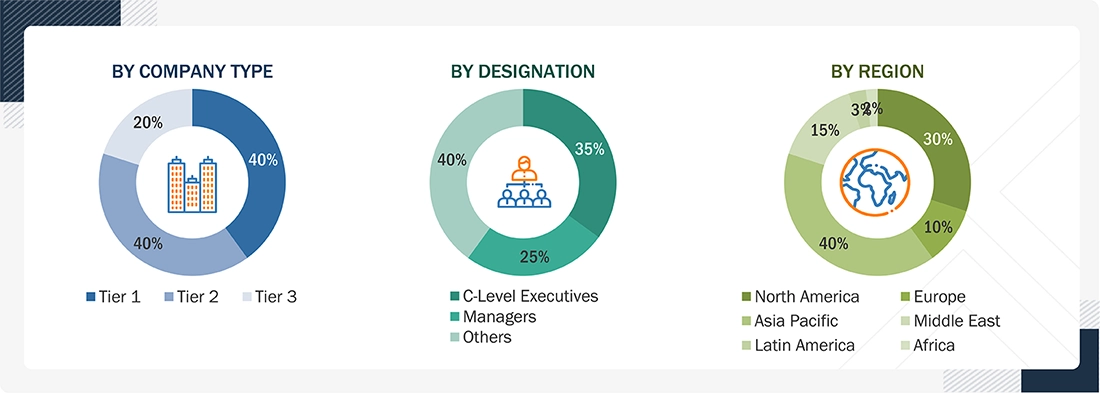
Note: Tiers of companies are based on their revenue in 2024. Tier 1: company revenue greater than USD 1 billion; Tier 2: company revenue between USD 100 million and USD 1 billion; and Tier 3: company revenue less than USD 100 million.
To know about the assumptions considered for the study, download the pdf brochure
Market Size Estimation
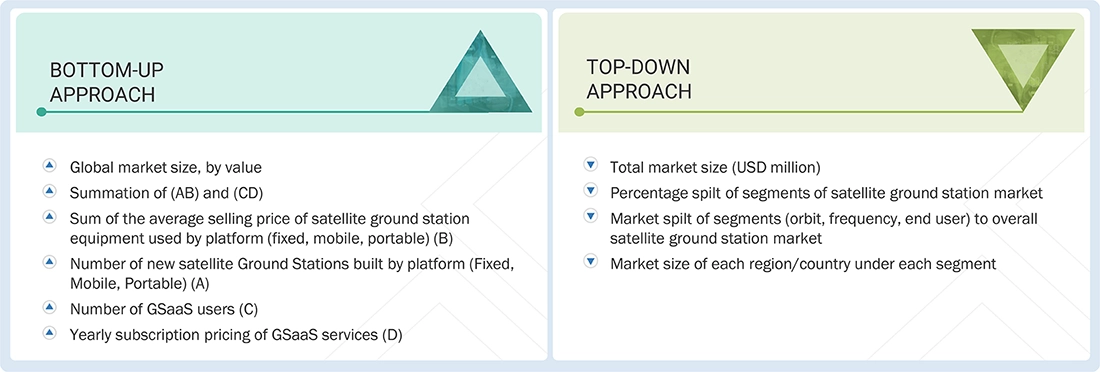
Both the top-down and bottom-up approaches were used to estimate and validate the size of the satellite ground station market.
The research methodology used to estimate the market size also included the following details:
- Key players in the market were identified through secondary research, and their market ranking was determined through primary and secondary research. This included a study of annual and financial reports of the top market players and extensive interviews with industry experts who are knowledgeable about satellite ground stations.
- The top-down and bottom-up approaches were used to estimate and validate the size of the global market and the dependent submarkets in the overall market.
Market Size Estimation Methodology: Bottom-up Approach and Top-down Approach
Data Triangulation
After arriving at the overall size of the satellite ground station market from the estimation process explained above, the total market was split into several segments and subsegments. The data triangulation and market breakdown procedures explained below were implemented, wherever applicable, to complete the overall market engineering process and arrive at the exact statistics for various market segments and subsegments. The data was triangulated by studying various factors and trends from the demand and supply sides. Along with this, the satellite ground station market size was validated using the top-down and bottom-up approaches.
Market Definition
A satellite ground station is a facility equipped with antennas, receivers, transmitters, and control systems that enable communication between satellites in orbit and systems on Earth. It serves as the terrestrial interface for sending commands to satellites, receiving data such as imagery or telemetry, and routing signals to end users or networks. They are widely used to collect and process data for a wide range of applications, such as television broadcasting, communication, mapping & navigation, surveillance & security, scientific research & exploration, and space observation, among others, across defense, civil, commercial, and government verticals.
Stakeholders
- Satellite Ground Station Manufacturers
- Satellite Ground Station Service Providers
- Government and Civil Organizations
- Satellite Ground Station Operators
- Meteorological Organizations
- Component Suppliers
- Technologists
- Research Institutions
Report Objectives
- To define, describe, segment, and forecast the size of the satellite ground station market based on platform, function, solution, orbit, frequency, end user, and region
- To forecast sizes of various segments of the market with respect to major regions: North America, Europe, the Asia Pacific, the Middle East, and the Rest of the World, along with major countries in each of these regions
- To identify and analyze key drivers, restraints, opportunities, and challenges influencing the growth of the market across the globe
- To identify industry trends, market trends, and technology trends that are currently prevailing in the market
- To provide an overview of the regulatory landscape with respect to satellite ground station regulations across regions
- To analyze micro markets with respect to individual growth trends, prospects, and their contribution to the overall market
- To analyze opportunities in the market for stakeholders by identifying key market trends
- To profile key market players and comprehensively analyze their market shares and core competencies
- To analyze the degree of competition in the market by identifying key growth strategies, such as acquisitions, product launches, contracts, and partnerships, adopted by leading market players
- To identify detailed financial positions, key products, and unique selling points of leading companies in the market
- To provide a detailed competitive landscape of the market, along with market share analysis and revenue analysis of key players
Get the Full Satellite Ground Station Market Report
Full forecast, segment splits, and company analysis for all Satellite Ground Station Market.
- Canada Satellite Ground Station Market
- US Satellite Ground Station Market
- Russia Satellite Ground Station Market
- UK Satellite Ground Station Market
- Germany Satellite Ground Station Market
- France Satellite Ground Station Market
- China Satellite Ground Station Market
- India Satellite Ground Station Market
- Japan Satellite Ground Station Market
- Singapore Satellite Ground Station Market
- Australia Satellite Ground Station Market
- UAE Satellite Ground Station Market
- Saudi Arabia Satellite Ground Station Market
- Rest Of Asia Pacific Satellite Ground Station Market
- Rest Of Middle East Satellite Ground Station Market
Need a Tailored Report?
Customize this report to your needs
Get 10% FREE Customization
Customize This Report
