
US Satellite NTN Market (2025-2030)

The US Satellite NTN Market was valued at $295.2 Million in 2025 and projected to reach to $1359.4 Million by 2030, representing a compound annual growth rate of 35.7%. The US Satellite NTN market is poised for exceptional growth through 2030, driven by substantial government investment in defense communication infrastructure and the critical need for resilient, integrated connectivity solutions.


| Market Size in | USD 26.32 MN |
| Market Forecast in | |
| CAGR | |
| Forecast Period | |
| Units Considered | Value (USD MN) |
US Satellite NTN Market Trends and Insights
- In 2025, the US market is estimated at $295.2 million, driven by increasing demand for integrated satellite-terrestrial connectivity solutions and government investment in advanced communication infrastructure.
- By 2030, the US market is forecast to reach $1,359.4 million, representing a compound annual growth rate of 35.7%. The US dominates North America's satellite NTN landscape, supported by strong regulatory frameworks, substantial defense spending, and leadership in space technology innovation.
- US enterprises and government agencies are prioritizing non-terrestrial networks to enhance coverage, resilience, and spectrum efficiency across critical applications.
- The forecast period (2025–2030) reflects accelerating adoption of 5G/6G satellite integration, IoT connectivity, and emergency response systems. Key drivers include US military modernization initiatives, commercial space expansion, and the need for ubiquitous broadband coverage in underserved regions.
- The US market's growth trajectory significantly outpaces global averages, positioning the country as a primary engine for satellite NTN innovation and deployment..
Key Market Statistics
- CAGR (2025-2030) 35.7% CAGR
- Market Size, 2025 ~USD 295.2 Million
- Forecast, 2030 ~USD 1359.4 Million
- Country US
US Satellite NTN Market Overview
Market Size Growth :
The US Satellite NTN market is projected to grow from $295.2 million in 2025 to $1,359.4 million by 2030, representing a robust 35.7% CAGR and demonstrating strong domestic demand for non-terrestrial network solutions.
Government Investment Drive :
US federal initiatives and defense spending are accelerating adoption of integrated satellite-terrestrial connectivity solutions, with agencies prioritizing advanced communication infrastructure for national security and resilience.
Integrated Connectivity Solutions :
The US market is increasingly focused on seamless integration between satellite and terrestrial networks, enabling continuous coverage for critical applications in defense, emergency response, and remote operations.
Aerospace & Defence Leadership :
US aerospace and defense contractors are leading NTN technology development, positioning the country as a primary market for satellite-based communication systems and next-generation network infrastructure.
US Satellite NTN Market Dynamics
- Federal agencies and private sector defense contractors are prioritizing satellite-terrestrial network integration to enhance operational capabilities and ensure continuous coverage across diverse geographic regions.
- The 35.7% CAGR reflects strong momentum in technology adoption and infrastructure modernization initiatives.
- By 2030, the market's expansion to $1.36 billion underscores the strategic importance of NTN solutions in maintaining US technological superiority and addressing emerging security challenges in an increasingly connected defense landscape..
Market Ecosystem
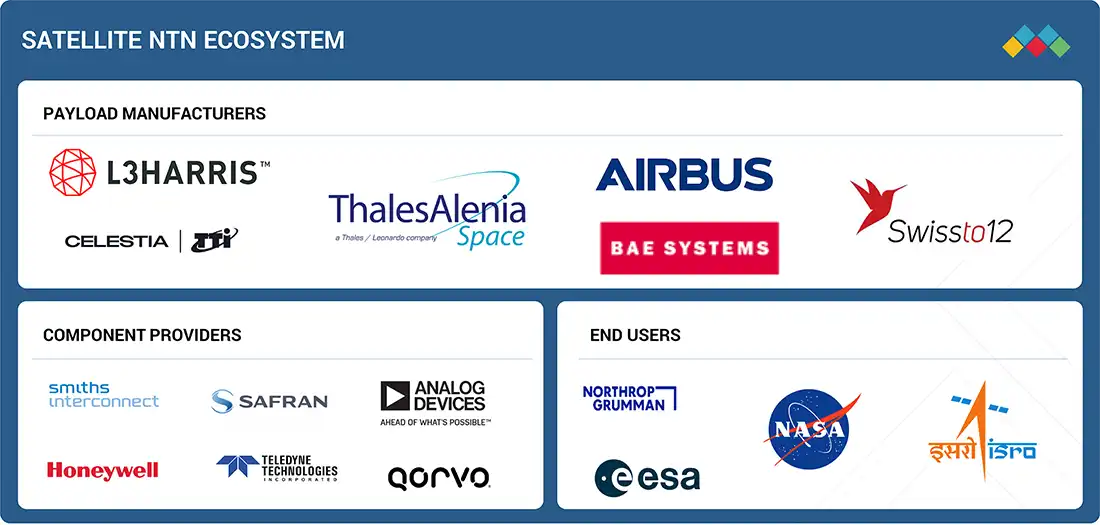
satellite NTN market: COMMERCIAL USE CASES ACROSS INDUSTRIES
| COMPANY | USE CASE DESCRIPTION | BENEFITS |
|---|---|---|
 |
Integrated NTN into Snapdragon Satellite for direct-to-device messaging | Global SMS in no-coverage zones; emergency-ready |
 |
Used LEO satellites for rural/remote UK connectivity | Broadband for underserved areas, schools, farms, emergency services |
 |
Hybrid GEO-LEO NTN for enterprise networking/SCADA | QoS with secure IoT telemetry, tracking, and surveillance |
 |
Space-based broadband for 4G/5G smartphones | Direct connectivity without towers; rural/maritime coverage |
 |
LEO IoT NTN for agriculture, mining, and logistics | Low-power, long-battery IoT data transfer, and remote monitoring |
 |
LEO constellation for broadband services | Affordable high-speed global internet with AWS integration |
Logos and trademarks shown above are the property of their respective owners. Their use here is for informational and illustrative purposes only.
Related Ecosystem
Space
- C-Band
- Small Satellite
- Antennas
- Ka-Band
- Microsatellite
- AIRBUS
- L3Harris Technologies, Inc.
- Thales group
- Northrop Grumman Corporation
- LOCKHEED MARTIN CORPORATION
Key Takeaways
- The US Satellite NTN market is valued at $295.2 million in 2025 and is projected to grow to $1,359.4 million by 2030, representing a 35.7% CAGR.
- US government defense spending and space modernization programs are primary catalysts driving satellite NTN adoption and infrastructure investment.
- The US leads North America in satellite NTN technology development, regulatory innovation, and commercial deployment of integrated terrestrial-satellite networks.
- 5G/6G integration, IoT expansion, and critical communications resilience are key growth drivers accelerating US market expansion through 2030.
Satellite NTN Market Report Scope
| Report Metric | Details |
|---|---|
| Base Year | 2025 |
| Fastest Growing Segment | DEFENSE (End Use Sector) |
| Forecast Period | 2025–2030 |
| Growth Rate | CAGR of 38% from 2025 to 2030 |
| Largest Segment | COMMERCIAL (End Use Sector) |
| Market Size Base Year (Billions) | ~USD 0.56 (2025) |
| Revenue Forecast (Billions) | ~USD 2.79 (2030) |
| Segments Covered | Orbit, Frequency, End Use Sector, Technology, Hardware, Application |
US Satellite NTN Market Report Segmentation
6 segment dimensions are covered across the global market.
By Orbit
- Geo
- Leo
By Frequency
- C-Band
- Hf/Vhf/Uhf-Bands
- Ku- & Ka-Band
- L-Band
- S-Band
By End Use Sector
- Commercial
- Defense
- Government
By Technology
- IoT Ntn
- Nr Ntn
By Hardware
- Antenna
- Onboard Processor Unit
- Rf Front End
By Application
- Embb
- Mmtc
- Urllc
Target Audience
- Defense Contractors & Aerospace OEMs : US-based defense and aerospace companies need detailed market intelligence to develop NTN-integrated solutions, secure government contracts, and maintain competitive advantage in satellite communication systems.
- Government & Military Agencies : US Department of Defense, federal agencies, and military branches require market data to inform procurement strategies, technology roadmaps, and investment decisions for next-generation communication infrastructure.
- Satellite Operators & Telecom Providers : US satellite and telecommunications companies need market forecasts and adoption trends to guide network expansion, service offerings, and partnerships in the growing NTN connectivity market.
- Private Equity & Investment Firms : Investors targeting the aerospace and defense sector require comprehensive US market analysis to identify acquisition targets, assess portfolio company growth potential, and evaluate emerging NTN technology opportunities.
- Technology Vendors & System Integrators : Software, hardware, and integration solution providers need US-specific market insights to develop competitive offerings, identify customer segments, and plan market entry or expansion strategies.
Key Companies in the US Satellite NTN Market
| Company | HQ | Ownership | Strongest segments |
|---|---|---|---|
| AIRBUS | United States | Public Company | NR NTN (5G/6G-oriented payloads and systems),IoT NTN (narrowband and messaging payloads),RF Front End hardware, |
| THALES ALENIA SPACE | France | ||
| NEC CORPORATION | Japan | ||
| KONGSBERG | Norway | ||
| ANALOG DEVICES, INC. | United States | Public Company | RF Front End,Onboard Processors and Data Converters,Power Management and Reference ICs, |
| LOCKHEED MARTIN CORPORATION | United States | ||
| SAFRAN | France | ||
| HONEYWELL INTERNATIONAL INC. | United States | ||
| L3HARRIS TECHNOLOGIES | United States | ||
| TELEDYNE TECHNOLOGIES | United States | ||
| QORVO, INC | United States | ||
| MERCURY SYSTEMS, INC. | United States | ||
| BAE SYSTEMS | United Kingdom |
AIRBUS
Airbus is a major aerospace and defense company founded in 1998 and headquartered in the United States. With 166,876 employees, it operates as a public company serving the global aviation and defense industries.
THALES ALENIA SPACE
Thales Alenia Space is a French aerospace company specializing in space technology and satellite systems.
NEC CORPORATION
NEC Corporation is a Japanese multinational technology company providing IT solutions, telecommunications, and electronic equipment.
KONGSBERG
Kongsberg is a Norwegian technology and defense company offering systems and solutions across multiple industrial sectors.
ANALOG DEVICES, INC.
Analog Devices, Inc. is a semiconductor company founded in 1965 and headquartered in the United States. As a public company with 24,500 employees, it designs and manufactures analog, mixed-signal, and digital signal processing integrated circuits.
LOCKHEED MARTIN CORPORATION
Lockheed Martin Corporation is a major United States-based aerospace, defense, and security company.
SAFRAN
Safran is a French multinational aerospace, defense, and security company providing propulsion and equipment solutions.
HONEYWELL INTERNATIONAL INC.
Honeywell International Inc. is a United States-based diversified technology and manufacturing company serving aerospace, building, and industrial markets.
L3HARRIS TECHNOLOGIES
L3Harris Technologies is a United States defense contractor providing advanced defense and commercial technologies.
TELEDYNE TECHNOLOGIES
Teledyne Technologies is a United States-based company specializing in digital imaging, instrumentation, and aerospace electronics.
QORVO, INC
Qorvo, Inc. is a United States semiconductor company designing and manufacturing RF semiconductors and connectivity solutions.
MERCURY SYSTEMS, INC.
Mercury Systems, Inc. is a United States company providing secure processing solutions and components for defense and aerospace applications.
BAE SYSTEMS
BAE Systems is a United Kingdom-based multinational defense, aerospace, and security company.
Reasons to Buy this Report
- Strategic Market Sizing : Obtain precise US market valuation data ($295.2M in 2025) and detailed 5-year forecasts to support investment decisions, competitive positioning, and resource allocation in the high-growth Satellite NTN sector.
- Government Spending Insights : Understand federal defense and infrastructure investment patterns driving NTN adoption across US agencies, enabling vendors to align product development and sales strategies with government procurement priorities.
- Competitive Landscape Analysis : Identify key US aerospace and defense players, emerging competitors, and market consolidation trends to benchmark performance and develop effective go-to-market strategies in this rapidly expanding segment.
- Technology Adoption Trends : Gain insights into integrated satellite-terrestrial connectivity adoption patterns, use cases, and implementation timelines specific to US defense and commercial applications for informed product roadmap planning.
- Growth Opportunity Quantification : Leverage the 35.7% CAGR projection and $1.36B 2030 forecast to identify high-potential market segments, geographic hotspots, and customer verticals for targeted expansion and partnership development.
Frequently asked questions
What is the current size of the US Satellite NTN market in 2025?
The US Satellite NTN market is estimated at $295.2 million in 2025, representing a significant portion of North American aerospace and defence communications infrastructure investment.
What is the projected size of the US Satellite NTN market by 2030?
The US Satellite NTN market is forecast to reach $1,359.4 million by 2030, reflecting a 35.7% compound annual growth rate over the forecast period.
What are the primary drivers of growth in the US Satellite NTN market?
Key growth drivers include US military modernization, 5G/6G satellite integration, IoT connectivity expansion, government broadband initiatives, and the need for resilient critical communications infrastructure.
How does the US Satellite NTN market compare to global growth rates?
The US market CAGR of 35.7% significantly exceeds the global average of 38%, demonstrating the US as a leading market with sustained high-growth momentum and substantial investment capacity.
Which sectors are driving US Satellite NTN adoption?
Primary sectors include defense and military communications, commercial space operators, telecommunications providers, emergency response systems, and government agencies requiring ubiquitous connectivity solutions.
RESEARCH METHODOLOGY
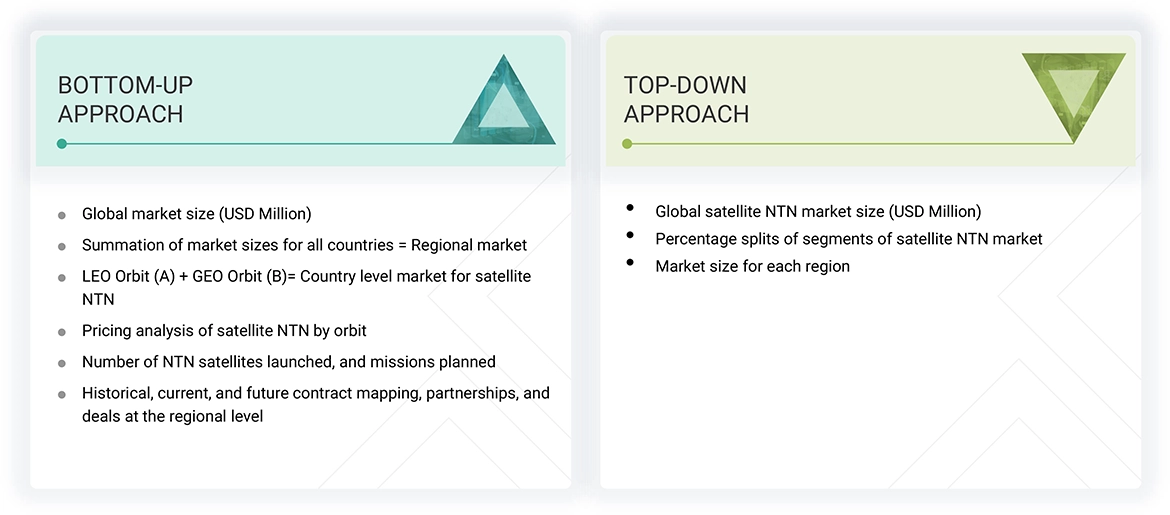
This research study extensively used secondary sources, directories, and databases, such as D&B Hoovers, Bloomberg Businessweek, and Factiva, to identify and collect useful information on the satellite NTN market. Secondary sources included the space library and leading satellite NTN component providers’ product brochures. Primary sources included experts from core and related industries, preferred suppliers, manufacturers, solution providers, technology developers, alliances, and organizations related to all segments of the industry’s value chain. All primary sources were interviewed to obtain and verify critical qualitative and quantitative information and assess the prospects of the satellite NTN market. The deductive approach, also known as the bottom-up approach, combined with the top-down approach, was used to forecast the market size of different market segments.
Secondary Research
The ranking of companies in the satellite NTN market was carried out using secondary data from paid and unpaid sources and by analyzing their product portfolios and service offerings. These companies were rated based on the performance and quality of products. Primary sources further validated the data points.
Secondary sources referred to for this research study included the European Space Agency (ESA); the National Aeronautics and Space Administration (NASA); the United Nations Conference on Trade and Development (UNCTAD); the Satellite Industry Association (SIA); annual reports; investor presentations; and financial statements of trade, business, and professional associations. The secondary data was collected and analyzed to determine the market’s overall size, which primary respondents validated.
Primary Research
Extensive primary research was conducted after obtaining information about the current scenario of the satellite NTN market through secondary research. Several primary interviews were conducted with market experts from the demand and supply sides across four regions: North America, Europe, Asia Pacific, and the Rest of the World. The primary data was collected through questionnaires, emails, and telephonic interviews. These interviews were conducted to gather insights such as market statistics, data on revenue collected from the products and services, market breakdowns, market size estimations, market size forecasting, and data triangulation. They also helped analyze the market based on technology, hardware, orbit, end use sector, application, and frequency, for the regions mentioned above.
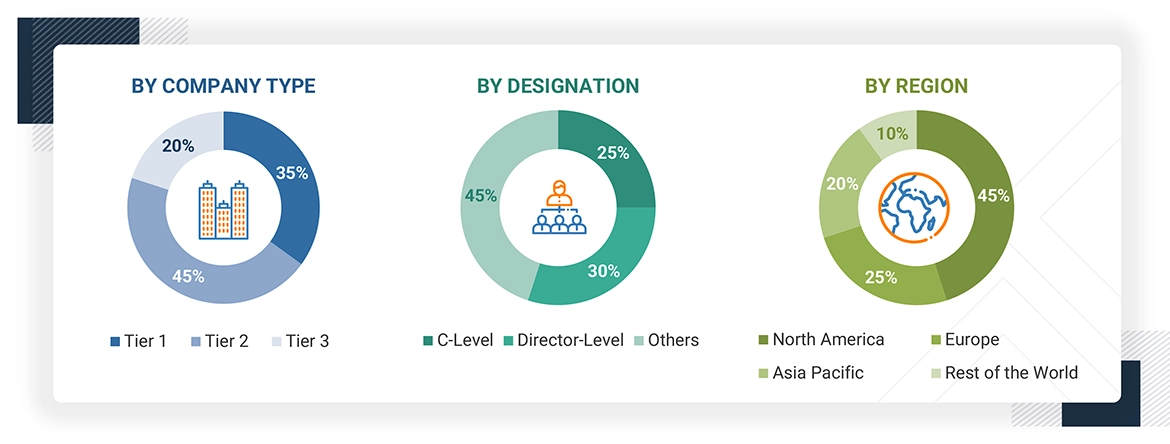
Note 1: The tier of companies has been defined based on their total revenue as of 2024.
Note 2: Tier 1 = > USD 1 billion, Tier 2 = USD 100 million to USD 1 billion, and Tier 3 = < USD 100 million
Note 3: C-level designations include CEO, COO, and CTO.
Note 4: Others include sales, marketing, and product managers.
To know about the assumptions considered for the study, download the pdf brochure
Market Size Estimation
The top-down and bottom-up approaches were used to estimate and validate the market size. The research methodology used to estimate the market size included the following details:
- Key players were identified through secondary research, and their market ranking was determined through primary and secondary research. This included a study of annual and financial reports of the top market players and extensive interviews of leaders, including CEOs, directors, and marketing executives.
- All percentage shares, splits, and breakdowns were determined using secondary sources and verified through primary sources.
- All possible parameters that affect the market covered in this research study were accounted for, viewed in extensive detail, verified through primary research, and analyzed to obtain the final quantitative and qualitative data. This data was consolidated, enhanced with detailed inputs, analyzed by MarketsandMarkets, and presented in this report.
Satellite NTN Market : Top-Down and Bottom-Up Approach
Data Triangulation
After arriving at the overall size of the NTN satellite market from the market size estimation process explained above, the total market was split into several segments and subsegments. The data triangulation and market breakdown procedures described below were implemented, wherever applicable, to complete the overall market engineering process and arrive at the exact statistics for various segments and sub-segments of the market. The data was triangulated by studying various factors and trends from the demand and supply sides. The market size was validated using the top-down and bottom-up approaches.
Market Definition
Satellite Non-terrestrial Network (NTN) is a communication system where satellites in low, medium, and geostationary orbits provide connectivity services to people and devices on the ground, in the air, and at sea. The 3rd-generation Partnership Project has standardized the system.
Satellite NTN allows direct communication links between user devices, such as smartphones and IoT sensors, satellites, or through relay stations on the ground. It supports services like internet access, phone calls, data transfer for IoT applications, and emergency communications in remote or hard-to-reach places.
Key Stakeholders
- Satellite Communication System Manufacturers
- Satellite Payload Component Suppliers (RF Modules, Antennas, Onboard Processors)
- Satellite Integrators and Prime Contractors
- NTN Ground Infrastructure Providers (Gateways, Hubs, SDN Orchestrators)
- Semiconductor and SoC/RFIC Vendors
- Network Service Providers and Telecom Operators
- Research and Standards Bodies (e.g., 3GPP, ETSI, ITU)
- Government Agencies and Regulatory Authorities
- Satellite Constellation Operators (LEO/MEO/GEO)
- End Use Sectors (Defense, Maritime, Aviation, Rural Broadband, IoT Providers)
Report Objectives
- To define, describe, and forecast the satellite NTN market based on orbit, frequency, technology, payload component, hardware, end use sector, and region
- To forecast the size of various segments of the market across North America, Europe, Asia Pacific, and the Rest of the World
- To identify and analyze the drivers, restraints, opportunities, and challenges influencing the growth of the market
- To identify industry trends, market trends, and technology trends currently prevailing in the satellite NTN market
- To provide an overview of the regulatory landscape with respect to satellite NTN regulations across regions
- To analyze micromarkets1 with respect to individual growth trends, prospects, and their contribution to the overall market
- To analyze opportunities in the market for stakeholders by identifying key market trends
- To profile key market players and comprehensively analyze their market share and core competencies
- To evaluate the degree of competition in the market by analyzing recent developments, such as contracts, agreements, and acquisitions adopted by leading market players
- To identify detailed financial positions, key products, and unique selling points of leading companies in the market
- To provide a detailed competitive landscape of the market, along with market share analysis and revenue analysis of key players
Customization Options
MarketsandMarkets also offers customizations to meet the specific needs of companies. The following customization options are available for the report:
Product Analysis
- Product matrix, which gives a detailed comparison of the product portfolio of each company
Regional Analysis
- Further breakdown of the market segments at the country level
Company Information
- Detailed analysis and profiling of additional market players (up to 5)
Get the Full Satellite NTN Market Report
Full forecast, segment splits, and company analysis for all Satellite NTN Market.
- Canada Satellite NTN Market
- France Satellite NTN Market
- Germany Satellite NTN Market
- Italy Satellite NTN Market
- Spain Satellite NTN Market
- Switzerland Satellite NTN Market
- Australia Satellite NTN Market
- China Satellite NTN Market
- Japan Satellite NTN Market
- South Korea Satellite NTN Market
- Luxembourg Satellite NTN Market
Need a Tailored Report?
Customize this report to your needs
Get 10% FREE Customization
Customize This Report
