
North America Satellites Market (2025-2030)

The North America Satellites Market was valued at $6010.1 Million in 2025 and projected to reach to $13631.2 Million by 2030, representing a compound annual growth rate of 14.6%. North America's satellites market is positioned for sustained expansion through 2030, driven by the proliferation of mega-constellations for global broadband coverage and the increasing adoption of satellite-based IoT and 5G integration.


| Market Size in | USD 26.32 MN |
| Market Forecast in | |
| CAGR | |
| Forecast Period | |
| Units Considered | Value (USD MN) |
North America Satellites Market Trends and Insights
- This 14.6% compound annual growth rate reflects North America's leadership in satellite technology, driven by increased demand for communications, Earth observation, and navigation services.
- North America benefits from a mature aerospace and defence ecosystem, substantial government investment, and a concentration of leading satellite manufacturers and operators. The region's growth trajectory outpaces many global markets due to North America's strategic focus on space infrastructure modernization and commercial satellite expansion.
- North America is home to major satellite operators and launch providers, positioning the region as a critical hub for innovation in low Earth orbit (LEO) constellations and advanced satellite systems.
- Between 2025 and 2030, North America's market expansion will be underpinned by rising defence spending, commercial broadband initiatives, and emerging applications in IoT and autonomous systems..
Key Market Statistics
- CAGR (2025-2030) 14.6% CAGR
- Market Size, 2025 ~USD 6010.1 Million
- Forecast, 2030 ~USD 13631.2 Million
- Geography North America
North America Satellites Market Overview
Market Leadership Position :
North America commands the largest share of the global satellites market, with the US alone representing $11,597 million in 2025, establishing the region as the dominant hub for satellite innovation and deployment.
Strong Growth Trajectory :
The North American satellites market is projected to nearly double from $6,010.1 million in 2025 to $13,631.2 million by 2030, driven by accelerating demand for LEO constellations, 5G connectivity, and advanced Earth observation capabilities.
Mature Aerospace Ecosystem :
North America benefits from an established aerospace and defense infrastructure, including leading satellite manufacturers, launch providers, and government agencies that fuel continuous technological advancement and market expansion.
Diverse Application Demand :
Growth is fueled by expanding use cases across communications, broadband connectivity, Earth observation, weather monitoring, and national security applications, creating sustained demand across commercial and government sectors.
North America Satellites Market Dynamics
- Government investments in space infrastructure, coupled with private sector innovation from companies like SpaceX, Amazon, and established defense contractors, will accelerate market growth.
- The region's technological leadership and regulatory framework create competitive advantages that support the 14.6% CAGR. Key growth catalysts include rising demand for high-resolution Earth observation for climate monitoring and disaster management, enhanced satellite communications for remote areas, and strategic defense applications.
- North America's mature supply chain, skilled workforce, and access to capital position the region to capture emerging opportunities in next-generation satellite technologies, including advanced propulsion systems and autonomous operations..
Market Ecosystem
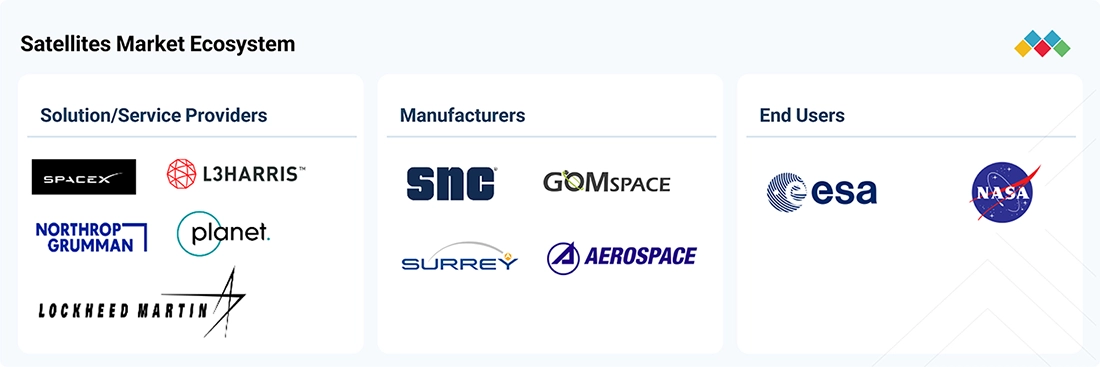
SATELLITES MARKET SIZE, SHARE & GROWTH TRENDS: COMMERCIAL USE CASES ACROSS INDUSTRIES
| COMPANY | USE CASE DESCRIPTION | BENEFITS |
|---|---|---|
 |
Airlines, maritime operators, remote enterprises, and government agencies need dependable, high-bandwidth connectivity in areas where terrestrial infrastructure is limited or unavailable, including rural, maritime, and aeronautical environments. | Provides reliable high-speed broadband coverage, supports mission-critical communications, boosts operational efficiency, and enables digital services for aircraft, vessels, and remote users without depending on ground-based networks. |
 |
Government and civil authorities require timely, high-resolution Earth observation data to respond to natural disasters, monitor environmental changes, and manage land and infrastructure assets, especially where traditional monitoring systems lack coverage and revisit frequency. | Provides quick-access, high-resolution imagery with frequent revisits, enhances situational awareness, supports faster decision-making during emergencies, and enables long-term environmental monitoring and asset management. |
 |
Critical sectors such as aviation, maritime transport, telecommunications, finance, and defense rely on precise, continuous, and globally accessible positioning and timing services to ensure safe operations and system synchronization. | Enables precise global navigation and timing, enhances safety and reliability, supports civilian and military uses, and underpins vital infrastructure like transportation, communications, financial networks, and defense systems. |
Logos and trademarks shown above are the property of their respective owners. Their use here is for informational and illustrative purposes only.
Related Ecosystem
Defence Platforms And Systems
- Sensors
- Unmanned Ground Vehicles (UGV)
- Fighter Aircraft
- Special Mission Aircraft
- Antennas
- BAE Systems plc
- Thales group
- LOCKHEED MARTIN CORPORATION
- Northrop Grumman Corporation
- L3Harris Technologies, Inc.
Space
- C-Band
- Small Satellite
- Antennas
- Ka-Band
- Microsatellite
- AIRBUS
- L3Harris Technologies, Inc.
- Thales group
- Northrop Grumman Corporation
- LOCKHEED MARTIN CORPORATION
Key Takeaways
- North America's satellites market will more than double from $6,010.1M (2025) to $13,631.2M (2030), representing a 14.6% CAGR.
- North America dominates global satellite manufacturing and operations, with established supply chains and regulatory frameworks supporting rapid commercialization.
- Defence and government spending in North America drives sustained demand for military communications, reconnaissance, and strategic space capabilities.
- North America's LEO constellation initiatives and commercial broadband expansion create new revenue streams and competitive advantages through 2030.
Satellites Market Report Scope
| Report Metric | Details |
|---|---|
| Base Year | 2025 |
| Fastest Growing Segment | SMALL SATELLITES (1-1200 KG) (Satellite Mass) |
| Forecast Period | 2025-2030 |
| Growth Rate | CAGR of 16.9% from 2025 to 2030 |
| Largest Segment | ELECTRIC (Propulsion Technology) |
| Market Size Base Year (Billions) | ~USD 18.33 (2025) |
| Revenue Forecast (Billions) | ~USD 40.03 (2030) |
| Segments Covered | Satellite Mass, Subsystem, Satellite Bus, Attitude And Orbital Control System, Sensor, Command And Data Handling System, Electrical Power System, Battery, Propulsion System, Thermal System, Payload, Satellite Antenna, Wire Antenna, Reflector Antenna, Application, Customer Type, Frequency, Propulsion Technology |
North America Satellites Market Report Segmentation
18 segment dimensions are covered across the global market.
By Satellite Mass
- Large Satellites (Above 2000 Kg)
- Medium Satellites (1201-2000 Kg)
- Small Satellites (1-1200 Kg)
By Subsystem
- Payloads
- Satellite Antenna
- Satellite Bus
- Solar Panels
By Satellite Bus
- Attitude And Orbital Control Systems (Adcs)
- Command And Data Handling Systems (C&Dh)
- Electrical Power Systems (Eps)
- Propulsion Systems
- Structures
- Telemetry, Tracking And Command (Tt&C)
- Thermal Systems
By Attitude And Orbital Control System
- Actuators
- Control Electronics
- Reaction Wheels
- Sensors
By Sensor
- Magnetometers
- Sun Sensors
By Command And Data Handling System
- Memory
- Microcontroller
- On-Board Charger (Obc) Adaptor
- Onboard Computer
- Processor
- Router
- Solid State Recorder
By Electrical Power System
- Battery
- Power Converter
- Power Management Device
By Battery
- Primary
- Secondary
By Propulsion System
- Propellant Feed Plumbing
- Propellant Tank
- Thrusters
By Thermal System
- Heaters
- Insulation
- Temperature Sensors
- Thermostats
By Payload
- Software-Defined Payloads
- Traditional Payloads
By Satellite Antenna
- Array Antennas
- Horn Antennas
- Reflector Antennas
- Wire Antennas
By Wire Antenna
- Dipole Antennas
- Monopole Antennas
By Reflector Antenna
- Double Reflectors
- Parabolic Reflectors
By Application
- Communication Satellites
- Earth Observation Satellites
- Navigation Satellites
By Customer Type
- Commercial
- Defense
- Government & Civil
By Frequency
- C-Band
- Hf/Vhf/Uhf-Band
- Ka-Band
- Ku-Band
- L-Band
- Laser/Optical Band
- Q/V/E-Band
- S-Band
- X-Band
By Propulsion Technology
- Chemical
- Electric
- Other Technologies
Target Audience
- Satellite Manufacturers & OEMs : Understand North American demand patterns, customer preferences, and competitive positioning to optimize product development, pricing strategies, and market entry approaches in the region.
- Launch Service Providers : Leverage regional market insights to forecast launch demand, identify growth segments (LEO, GEO, deep space), and align capacity planning with North America's expanding constellation deployment needs.
- Government & Defense Agencies : Access market intelligence to inform procurement strategies, budget allocation, and technology roadmaps for national security, communications, and Earth observation satellite programs.
- Investment & Private Equity Firms : Evaluate investment opportunities in North American satellite companies, identify acquisition targets, and assess market growth potential to guide capital deployment and portfolio decisions.
- Telecom & Broadband Operators : Understand satellite connectivity market trends in North America to evaluate partnerships, service offerings, and competitive positioning in emerging satellite-based broadband and IoT markets.
Countries within North America - compare and drill down
| Country | 2025 size (native) |
|---|---|
| US | USD 11597 Million |
| Canada | USD 66 Million |
Country market size visualization
Reasons to Buy this Report
- Regional Market Sizing & Forecasts : Obtain precise market valuations for North America and country-level breakdowns (US and Canada) with detailed 2025-2030 projections to support strategic planning and investment decisions.
- Competitive Landscape Analysis : Understand the positioning of North American satellite manufacturers, launch providers, and operators within the global market, identifying key players and emerging competitors shaping the region's future.
- Growth Driver Identification : Gain insights into North America-specific factors driving 14.6% CAGR, including government spending, commercial demand, technological innovation, and regulatory developments unique to the region.
- Investment & Partnership Opportunities : Identify high-potential segments, emerging technologies, and market gaps in North America's satellites ecosystem to guide M&A, venture capital, and strategic partnership decisions.
- Risk & Regulatory Intelligence : Access North America-specific regulatory frameworks, export controls, spectrum allocation policies, and geopolitical factors affecting satellite market dynamics and business operations.
Frequently asked questions
What is the projected market size for satellites in North America by 2030?
North America's satellites market is forecast to reach $13,631.2 million by 2030, up from $6,010.1 million in 2025, representing a 14.6% CAGR.
What factors are driving growth in North America's satellites market?
North America's satellites market growth is driven by increased defence spending, commercial broadband initiatives, LEO constellation expansion, Earth observation demand, and emerging IoT applications.
How does North America's satellites market compare to global growth rates?
North America's 14.6% CAGR is slightly below the global average of 16.9%, reflecting the region's mature market position and established infrastructure base.
Which segments are most significant in North America's satellites market?
North America's market is dominated by communications satellites, military/government systems, Earth observation platforms, and emerging commercial LEO constellations for broadband and IoT services.
What role do government and defence contracts play in North America's satellites market?
Government and defence contracts represent a substantial portion of North America's satellites market, supporting military communications, reconnaissance, and strategic space infrastructure investments.
RESEARCH METHODOLOGY
This study involved four major activities in estimating the current size of the satellites market. Exhaustive secondary research was carried out to collect information on the satellites market, its adjacent markets, and its parent market. The next step involved validating these findings, assumptions, and sizing with industry experts across the value chain through primary research. Demand-side analysis was conducted to estimate the overall market size. After that, market breakdown and data triangulation procedures were employed to estimate the sizes of various segments and subsegments within the satellites market.
Secondary Research
During the secondary research process, various sources were consulted to identify and collect information for this study. The secondary sources included government sources, such as SIPRI; corporate filings, including annual reports, press releases, and investor presentations from companies; white papers, journals, and certified publications; and articles from recognized authors, directories, and databases.
Primary Research
Extensive primary research was conducted after acquiring information regarding the satellites market scenario through secondary research. Several primary interviews were conducted with market experts from the demand and supply sides across major countries of North America, Europe, Asia Pacific, the Middle East, and the Rest of the world. Primary data was collected through questionnaires, emails, and telephonic interviews.
Breakdown of Primary Interviews
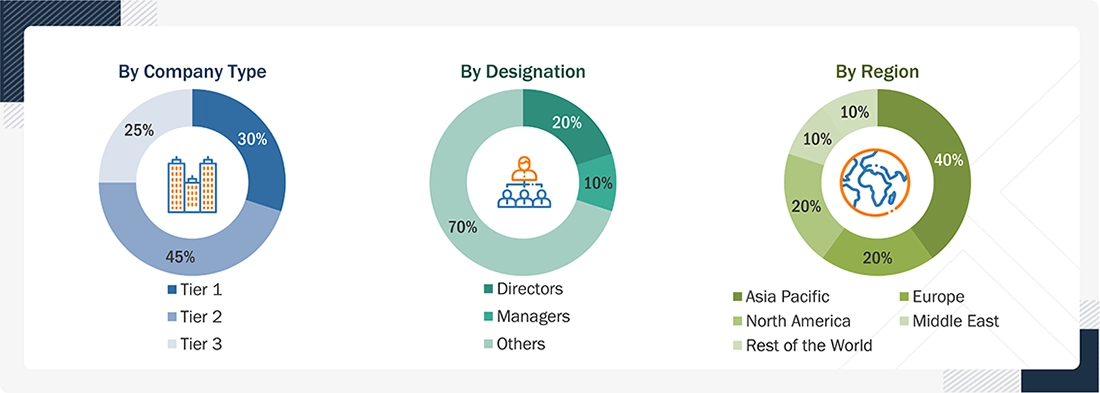
To know about the assumptions considered for the study, download the pdf brochure
Market Size Estimation
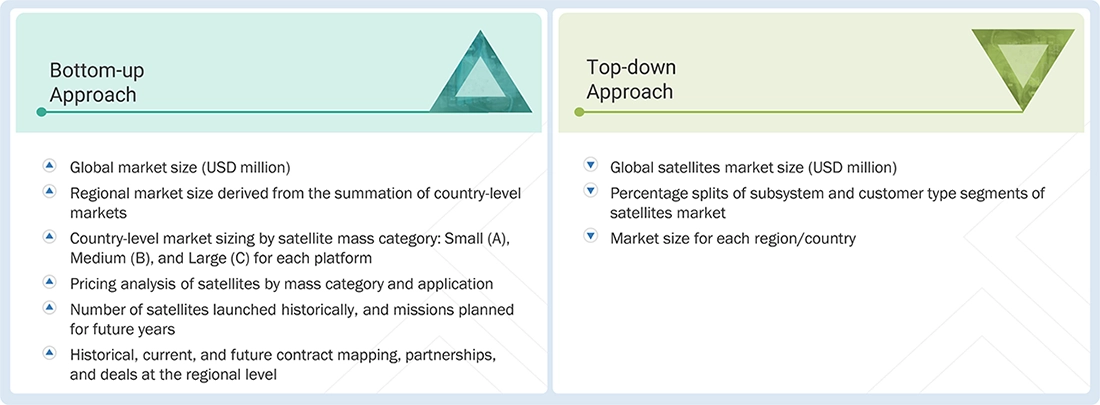
The top-down and bottom-up approaches were used to estimate and validate the size of the satellites market. The research methodology used to estimate the size of the market included the following details:
- Key players in the satellites market were identified through secondary research, and their market shares were determined through a combination of primary and secondary research. This included a study of the annual and financial reports of the top market players, as well as extensive interviews with leaders, including directors, engineers, marketing executives, and other key stakeholders of leading companies operating in the market.
- All percentage shares, splits, and breakdowns were determined using secondary sources and verified through primary sources.
- All possible parameters that affect the markets covered in this research study were accounted for, viewed in extensive detail, verified through primary research, and analyzed to obtain the final quantitative and qualitative data on the satellites market. This data was consolidated, enhanced with detailed inputs, analyzed by MarketsandMarkets, and presented in this report.
Satellites Market: Bottom-up & Top-down Approaches
Data Triangulation
After determining the overall market size, the total market was divided into several segments and subsegments. The data triangulation and market breakdown procedures explained below were implemented, wherever applicable, to complete the overall market engineering process and arrive at the estimated market numbers for the market segments and subsegments. The data was triangulated by studying various factors and trends from the demand and supply sides. Additionally, the market size was validated using top-down and bottom-up approaches.
Market Definition
A satellite is an artificial object placed in orbit around a planet or celestial body to perform specific functions, such as communication, Earth observation, navigation, or scientific research. It collects and transmits data to the Earth, enabling various studies and research. Depending on mass, satellites can be categorized as small, medium, or large. They leverage advancements in the miniaturization of technology. Satellites are launched independently or as secondary payloads, allowing cost-effective access to space and opportunities for high-frequency mission updates and constellation deployment.
Key Stakeholders
- Satellite Operators and Constellation Owners
- Satellite Manufacturers and Prime Contractors
- Payload and Mission Equipment Providers
- Component and Subsystem Suppliers
- Ground Segment and Network Infrastructure Providers
- Launch and Mission Support Providers
- Service and Data Providers
- Regulatory, Standards, and Certification Bodies
- Defense, Government, and Commercial End Users
- Research and Technology Institutions
Report Objectives
- To define, describe, segment, and forecast the size of the satellites market based on satellite mass, orbit, application, customer type, subsystem, frequency, propulsion technology, and region
- To forecast the size of market segments with respect to five regions: North America, Europe, Asia Pacific, the Middle East, and the Rest of the World, along with major countries in each region
- To identify and analyze key drivers, restraints, opportunities, and challenges influencing market growth
- To analyze micro markets with respect to individual growth trends, prospects, and their contribution to the overall market
- To analyze opportunities in the market for stakeholders by identifying key market trends
- To profile key market players and comprehensively analyze their market shares and core competencies
- To analyze the degree of competition in the market by identifying key growth strategies, such as acquisitions, agreements, contracts, joint ventures, and partnerships, adopted by key market players
- To identify detailed financial positions, key products, and unique selling points of leading companies in the market
- To provide a detailed competitive landscape of the market, along with market share analysis and revenue analysis of key players
Available customizations:
MarketsandMarkets offers the following customizations for this market report:
- Additional country-level analysis of the satellites market
- Profiling of other market players (up to five)
Product Analysis
- Product matrix, which provides a detailed comparison of the product portfolio of each company in the satellites market
Get the Full Satellites Market Report
Full forecast, segment splits, and company analysis for all Satellites Market.
- US Satellites Market
- Canada Satellites Market
- China Satellites Market
- India Satellites Market
- Japan Satellites Market
- South Korea Satellites Market
- Australia Satellites Market
- Germany Satellites Market
- France Satellites Market
- Italy Satellites Market
- Russia Satellites Market
- UK Satellites Market
- Saudi Arabia Satellites Market
- UAE Satellites Market
- Rest Of Middle East Satellites Market
Need a Tailored Report?
Customize this report to your needs
Get 10% FREE Customization
Customize This Report
