
US Security Screening Market (2025-2030)

The US Security Screening Market was valued at $2351 Million in 2025 and projected to reach to $3258 Million by 2030, representing a compound annual growth rate of 6.7%. The US security screening market is poised for sustained growth through 2030, driven by heightened regulatory scrutiny and supply chain vulnerabilities in the semiconductor and electronics sectors.


| Market Size in | USD 26.32 MN |
| Market Forecast in | |
| CAGR | |
| Forecast Period | |
| Units Considered | Value (USD MN) |
US Security Screening Market Trends and Insights
- The US market benefits from stringent regulatory requirements in the semiconductor and electronics sectors, where security screening has become critical for supply chain integrity and product authentication.
- Driven by increasing counterfeiting concerns and government mandates, the US continues to lead adoption of advanced screening technologies across manufacturing and distribution networks..
Key Market Statistics
- CAGR (2025-2030) 6.7% CAGR
- Market Size, 2025 ~USD 2351 Million
- Forecast, 2030 ~USD 3258 Million
- Country US
US Security Screening Market Overview
Market Valuation :
The US security screening market is valued at $2,351 million in 2025, with strong growth trajectory driven by semiconductor manufacturing and electronics supply chain demands.
Regulatory Compliance Pressure :
Stringent US regulatory requirements in semiconductor and electronics sectors mandate security screening for supply chain integrity, product authentication, and counterfeiting prevention.
Growth Momentum :
The US market is projected to reach $3,258 million by 2030, representing a 6.7% CAGR, outpacing global average growth and reflecting strong domestic demand.
Supply Chain Security Focus :
Increasing emphasis on securing US semiconductor supply chains and protecting critical electronics infrastructure is driving adoption of advanced security screening technologies.
US Security Screening Market Dynamics
- Federal initiatives to strengthen domestic manufacturing and reduce reliance on foreign components are accelerating security screening adoption across production facilities.
- The market benefits from increasing counterfeiting threats and the need for product authentication throughout the electronics value chain. Key growth drivers include stricter compliance mandates, rising cybersecurity concerns, and investments in advanced screening technologies.
- US manufacturers are prioritizing security screening as a competitive differentiator and risk mitigation strategy.
- The convergence of regulatory pressure, supply chain reshoring, and technological innovation positions the US market for consistent expansion, with particular strength in semiconductor manufacturing hubs and critical electronics production..
Market Ecosystem
Related Ecosystem
Aviation
- Narrow Body Aircraft
- Wide Body Aircraft
- Military Helicopters
- Special Mission Aircraft
- Fighter Aircraft
- HONEYWELL INTERNATIONAL INC.
- COLLINS AEROSPACE
- Thales group
- Safran group
- HEICO Corporation
Cyber Security
- Cloud Security
- Biometric Systems
- Data Loss Prevention (DLP)
- Multi-Factor Authentication
- Security Analytics
- International Business Machines Corporation
- MITSUI BUSSAN SECURE DIRECTIONS INC
- Cisco Systems, Inc.
- MICROSOFT CORPORATION
- Allot Ltd.
Public Safety
- Face Recognition
- Cloud Security
- Surveillance System
- Voice Recognition
- Biometric Security and Authentication System
- Zensar Technologies Limited
- International Business Machines Corporation
- Allot Ltd.
- Cisco Systems, Inc.
- MICROSOFT CORPORATION
Key Takeaways
- The US security screening market will expand from $2,351M (2025) to $3,258M (2030) at a steady 6.7% CAGR.
- US regulatory frameworks and supply chain security initiatives are primary growth catalysts for the market.
- The US semiconductor and electronics industries drive demand for advanced authentication and anti-counterfeiting solutions.
- US market growth is supported by increasing investment in critical infrastructure protection and compliance requirements.
Security Screening Market Report Scope
| Report Metric | Details |
|---|---|
| Base Year | 2025 |
| Fastest Growing Segment | TRANSPORTATION (Vertical) |
| Forecast Period | 2025–2030 |
| Growth Rate | CAGR of 6.8% from 2025 to 2030 |
| Largest Segment | BAGGAGE & CARGO SCREENING (Application) |
| Market Size Base Year (Billions) | ~USD 9.93 (2025) |
| Revenue Forecast (Billions) | ~USD 13.8 (2030) |
| Segments Covered | System Type, Type, Application, Vertical |
US Security Screening Market Report Segmentation
4 segment dimensions are covered across the global market.
By System Type
- Biometric Systems
- Biometrics
- Electromagnetic Metal Detection
- Electromagnetic Metal Detector
- Other System Types
- Spectrometry & Spectroscopy
- Spectrometry & Spectroscopy Systems
- X-Ray Screening
- X-Ray Screening Systems
By Type
- Baggage Scanner
- Body Scanners
- Cabinet X-Ray Systems
- Face Recognition
- Fingerprint Recognition
- Handheld Metal Detectors
- Handheld Screening Systems
- Iris Recognition
- Walkthrough Metal Detectors
By Application
- Baggage & Cargo Screening
- People Screening
- Vehicle Inspection
By Vertical
- Commercial
- Education
- Government
- Hospitality
- Industrial
- Other Verticals
- Retail
- Transportation
Target Audience
- Semiconductor Manufacturers : US-based semiconductor producers need market insights to implement compliant security screening processes, protect intellectual property, and ensure supply chain integrity in competitive domestic markets.
- Electronics OEMs : Original equipment manufacturers require US market data to understand regulatory compliance requirements and security screening adoption rates critical for product authentication and counterfeiting prevention.
- Security Technology Vendors : Solution providers targeting the US market need detailed market sizing and growth forecasts to develop go-to-market strategies and identify high-potential customer segments in semiconductor and electronics.
- Supply Chain & Procurement Teams : Supply chain professionals need US-specific market intelligence to evaluate security screening vendors, understand compliance mandates, and optimize procurement strategies for electronics components.
- Investment & Strategy Consultants : Consultants advising US electronics and semiconductor clients require accurate market data and forecasts to develop strategic recommendations and identify emerging opportunities in security screening.
Key Companies in the US Security Screening Market
| Company | HQ | Ownership | Strongest segments |
|---|---|---|---|
| MORPHO SAS | Germany | Private Company | Oncology therapeutics and programs,Autoimmune and inflammatory disease programs,Rare disease and specialty metabolic programs, |
| GODREJ GROUP | India | Private Company | Home & Commercial Appliances,Locks, Security & Architectural Hardware,Industrial & Process Equipment (incl. compressors, turbines, tooling), |
| ZENSAR TECHNOLOGIES LTD | India | Public Company | Digital and Application Services,Cloud Infrastructure and Security Services,Brand, Creative, and Consulting Services, |
| OSI SYSTEMS, INC. | United States | Public Company | Security (Rapiscan + S2 turnkey solutions),Healthcare (Spacelabs patient monitoring and connected care),Optoelectronics devices and flex circuits, |
| LEIDOS | United States | Public Company | National Security & Digital,Defense Systems,Health & Civil, |
| BRUKER | United States | Public Company | BSI BioSpin (NMR/EPR and preclinical imaging),BSI CALID (mass spectrometry, molecular diagnostics, automation),BSI Nano (X-ray, AFM, EM analytics, optical microscopy), |
| ANALOGIC CORPORATION | United States | Private Company | Imaging and detection systems and subsystems,Security systems for aviation and industrial automation,Power technologies (RF and gradient power amplifiers), |
| WESTMINSTER GROUP PLC | United Kingdom | Private Company | Managed Services (airports, ports, infrastructure operations),Technology Security Solutions (surveillance, detection, screening, interception),Manpower, Manned Guarding, and Mobile Patrols, |
MORPHO SAS
MORPHO SAS is a German private company founded in 1992 with 446 employees.
GODREJ GROUP
GODREJ GROUP is an Indian private company founded in 1897 with 13,316 employees.
ZENSAR TECHNOLOGIES LTD
ZENSAR TECHNOLOGIES LTD is an Indian public company founded in 1963 with 10,066 employees.
OSI SYSTEMS, INC.
OSI SYSTEMS, INC. is a United States-based public company founded in 1987 with 7,337 employees.
LEIDOS
LEIDOS is a United States-based public company founded in 1969 with 50,000 employees.
BRUKER
BRUKER is a United States-based public company founded in 1960 with 11,085 employees.
ANALOGIC CORPORATION
ANALOGIC CORPORATION is a United States-based private company founded in 1967 with 1,510 employees.
WESTMINSTER GROUP PLC
WESTMINSTER GROUP PLC is a United Kingdom-based private company founded in 2000 with 236 employees.
Reasons to Buy this Report
- Market Size & Growth Data : Access precise US market valuation ($2,351M in 2025) and forecast projections through 2030, enabling accurate financial planning and investment decisions specific to the American market.
- Regulatory Landscape Insights : Understand US-specific regulatory drivers and compliance requirements shaping the security screening market, critical for manufacturers and solution providers operating in domestic semiconductor and electronics sectors.
- Competitive Positioning : Benchmark your organization against US market trends and identify growth opportunities within the 6.7% CAGR expansion, helping you capture market share in this high-growth segment.
- Supply Chain Strategy : Leverage US-focused market intelligence to optimize supply chain security investments and align procurement strategies with domestic manufacturing trends and regulatory expectations.
- Investment & Expansion Planning : Make informed decisions on facility investments, technology adoption, and market entry strategies using comprehensive US market data and growth forecasts through 2030.
Frequently asked questions
What is the current size of the US security screening market?
The US security screening market is estimated at $2,351 million in 2025.
What is the projected size of the US security screening market by 2030?
The US security screening market is forecast to reach $3,258 million by 2030.
What is the CAGR for the US security screening market?
The US security screening market is expected to grow at a compound annual growth rate of 6.7% from 2025 to 2030.
Which industries drive the US security screening market?
The semiconductor and electronics industries are the primary drivers of the US security screening market, requiring robust authentication and anti-counterfeiting measures.
What factors are accelerating growth in the US security screening market?
Regulatory compliance requirements, supply chain security concerns, counterfeiting prevention, and government mandates are key factors accelerating growth in the US market.
RESEARCH METHODOLOGY
The study involved four major activities in estimating the current size of the security screening market. Exhaustive secondary research was conducted to gather information on the market, adjacent markets, and the overall security screening landscape. These findings, along with assumptions and projections, were validated through primary research involving interviews with industry experts and key stakeholders across the value chain. Both top-down and bottom-up approaches were utilized to estimate the overall market size. Subsequently, market breakdown and data triangulation techniques were applied to determine the sizes of various segments and subsegments. Two key sources, secondary and primary, were leveraged to conduct a comprehensive technical and commercial assessment of the security screening market.
Secondary Research
The secondary research process referred to various secondary sources to identify and collect necessary information for this study. The secondary sources included annual reports, press releases, and investor presentations of companies; white papers; journals and certified publications; and articles from recognized authors, websites, directories, and databases. Secondary research was conducted to obtain key information about the industry’s supply chain, the market’s value chain, the total pool of key players, market segmentation according to the industry trends (to the bottom-most level), regional markets, and key developments from market- and technology-oriented perspectives. The secondary data was collected and analyzed to determine the overall market size, further validated by primary research.
Primary Research
Extensive primary research was conducted after gaining knowledge about the current scenario of the security screening market through secondary research. Several primary interviews were conducted with experts from the demand and supply sides across four major regions—North America, Europe, Asia Pacific, and RoW. This primary data was collected through questionnaires, emails, and telephonic interviews.
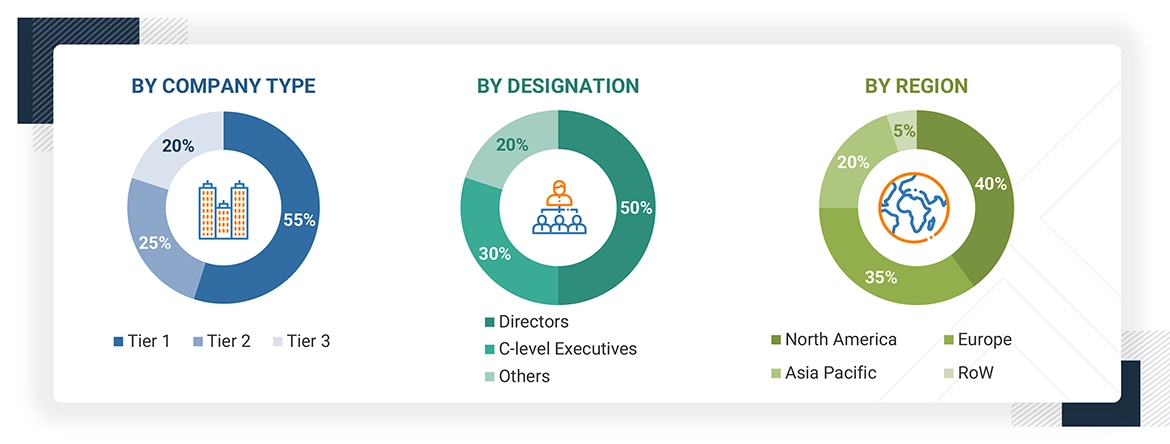
Note: The three tiers of the companies are defined based on their total revenue in 2024: Tier 1 - revenue greater than or equal to USD 1 billion; Tier 2 - revenue between USD 100 million and USD 1 billion; and Tier 3 revenue less than or equal to USD 100 million. Other designations include sales, marketing, and product managers.
To know about the assumptions considered for the study, download the pdf brochure
Market Size Estimation
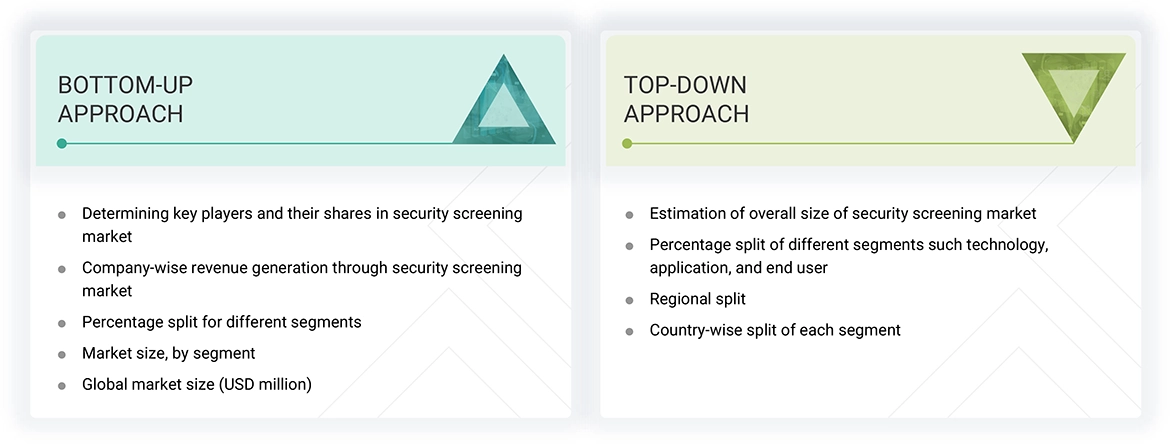
Both top-down and bottom-up approaches were used to estimate and validate the total size of the security screening market. These methods have also been used extensively to estimate the size of various subsegments in the market. The following research methodology was used to estimate the market size:
- Major players in the industry and markets were identified through extensive secondary research.
- The industry’s value chain and market size (in terms of value) were determined through primary and secondary research processes.
- All percentage shares, splits, and breakdowns were determined using secondary sources and verified through primary sources.
Security Screening Market : Top-Down and Bottom-Up Approach
Data Triangulation
After arriving at the overall size of the security screening market using the market size estimation process explained above, the total market was split into several segments and subsegments. Data triangulation and market breakdown procedures were employed, wherever applicable, to complete the overall market engineering process and arrive at the exact statistics for all segments and subsegments of the market. The data was triangulated by studying various factors and trends from both the demand and supply sides. The market size was also validated using both top-down and bottom-up approaches.
Market Definition
The security screening market encompasses various technologies and solutions to detect prohibited items, threats, or illicit materials carried by people, baggage, cargo, and vehicles across multiple entry points and high-security environments. It includes X-ray screening, electromagnetic metal detection, biometric verification, spectrometry and spectroscopy, and trace detection technologies. These solutions are widely deployed in transportation hubs, government facilities, commercial buildings, retail spaces, industrial sites, and public venues to ensure safety, prevent unauthorized access, and enhance operational efficiency. Rising global security concerns, regulatory mandates, and the increasing need for advanced, automated, and non-intrusive screening methods drive the market.
Key Stakeholders
- Raw material and manufacturing equipment suppliers
- Semiconductor wafer manufacturers and suppliers
- Original equipment manufacturers (OEMs)
- Original design manufacturers (ODMs) and OEM solutions providers
- Government and financial institutions
- Distributors and retailers
- Research organizations
- Technology standards organizations, forums, alliances, and associations
- Technology investors
- End users (transportation hubs, government organizations, retail stores and malls, hospitality facilities, commercial and industrial facilities, educational institutes, event venues, and sports clubs)
Report Objectives
- To define, describe, and forecast the security screening market, in terms of system type, application, vertical, and region, in terms of value
- To forecast the market, by system type, in terms of volume
- To describe and forecast the market, in terms of value, with regard to four main regions: North America, Europe, Asia Pacific, and Rest of the World (RoW), along with their respective countries
- To provide detailed information regarding major factors such as drivers, restraints, opportunities, and challenges influencing the market growth
- To provide a detailed overview of the security screening value chain
- To strategically analyze micromarkets with respect to individual growth trends, prospects, and contributions to the security screening market
- To analyze opportunities in the market for stakeholders by identifying high-growth segments of the security screening market
- To strategically profile key players and comprehensively analyze their market position in terms of ranking and core competencies, along with detailing the competitive landscape for market leaders
- To analyze competitive strategies, such as product launches, expansions, and mergers and acquisitions, adopted by key players in the security screening market
Available Customizations:
With the given market data, MarketsandMarkets offers customizations according to the company’s specific needs. The following customization options are available for the report:
Company Information:
- Detailed analysis and profiling of additional market players (up to 5)
Get the Full Security Screening Market Report
Full forecast, segment splits, and company analysis for all Security Screening Market.
Need a Tailored Report?
Customize this report to your needs
Get 10% FREE Customization
Customize This Report
