
North America Semi-Trailer Market (2026-2031)

The North America Semi-Trailer Market was valued at $12006.7 Million in 2026 and projected to reach to $17204.3 Million by 2031, representing a compound annual growth rate of 5.3%. The North America semi-trailer market is positioned for steady growth, expanding from $12,006.7 million in 2026 to $17,204.3 million by 2031 at a 5.3% CAGR.


| Market Size in | USD 26.32 MN |
| Market Forecast in | |
| CAGR | |
| Forecast Period | |
| Units Considered | Value (USD MN) |
North America Semi-Trailer Market Trends and Insights
- North America's semi-trailer sector is driven by robust freight transportation demand, e-commerce expansion, and infrastructure modernization across the United States, Canada, and Mexico.
- The region's mature logistics networks and regulatory frameworks continue to support steady market expansion through 2031. North America's semi-trailer market benefits from strong demand in last-mile delivery, intermodal transportation, and specialized hauling applications.
- The region's focus on fleet electrification and sustainability initiatives is reshaping product development, with North America increasingly adopting advanced telematics and lightweight materials.
- Between 2026 and 2031, North America is expected to maintain its position as a key growth market, supported by rising consumer spending and supply chain resilience investments..
Key Market Statistics
- CAGR (2026-2031) 5.3% CAGR
- Market Size, 2026 ~USD 12006.7 Million
- Forecast, 2031 ~USD 17204.3 Million
- Geography North America
North America Semi-Trailer Market Overview
Strong E-Commerce Growth Driver :
North America's booming e-commerce sector is significantly increasing demand for semi-trailers, with last-mile delivery networks requiring expanded freight capacity across the US, Canada, and Mexico.
Infrastructure Modernization Initiatives :
Government investments in transportation infrastructure across North America are spurring fleet upgrades and new semi-trailer purchases to meet evolving logistics standards and efficiency requirements.
Cross-Border Trade Expansion :
USMCA trade agreements and increased cross-border commerce between the US, Canada, and Mexico are driving sustained demand for semi-trailers in regional freight transportation networks.
Mature Logistics Ecosystem :
North America's established logistics infrastructure and high freight volumes support consistent semi-trailer market growth, with mature supply chains requiring regular fleet modernization and capacity expansion.
North America Semi-Trailer Market Dynamics
- This growth trajectory reflects sustained freight transportation demand driven by e-commerce proliferation, supply chain resilience investments, and infrastructure modernization across the United States, Canada, and Mexico.
- The region's mature logistics ecosystem and established distribution networks provide a stable foundation for market expansion. Key growth catalysts include increasing consumer demand for faster delivery services, regulatory compliance requirements for fleet modernization, and cross-border trade intensification under USMCA.
- Fleet operators are investing in advanced semi-trailer technologies to enhance fuel efficiency and operational capacity.
- While the 5.3% regional CAGR trails the global 6.6% rate, North America's market maturity and high absolute values position it as a critical revenue generator for manufacturers and logistics service providers..
Market Ecosystem
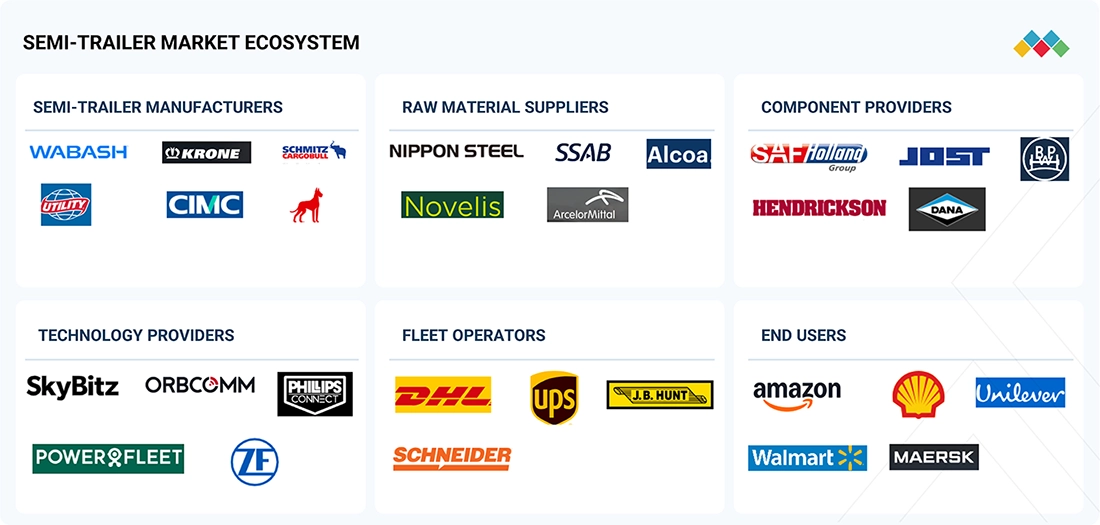
SEMI-TRAILER MARKET: COMMERCIAL USE CASES ACROSS INDUSTRIES
| COMPANY | USE CASE DESCRIPTION | BENEFITS |
|---|---|---|
 |
Provides flatbed, lowbed, tanker, and vehicle transport semi-trailers for logistics, construction, infrastructure, energy, and bulk cargo transportation. The company offers more than 300 specialty vehicle models addressing diverse freight transportation requirements | Supports multiple cargo types through a broad product portfolio, improves transport efficiency, and enables fleet operators to serve diverse end markets with standardized trailer platforms |
 |
Supplies dry van, refrigerated van, platform, and tank trailers for commercial transport, food and beverage distribution, pharmaceutical logistics, chemical transportation, and energy sector applications; offers thermally efficient refrigerated trailers for cold chain operations | Reduces total cost of ownership, improves freight protection, enhances cold chain integrity, and supports specialized transportation requirements across industries |
 |
Provides curtainsider, refrigerated, dry freight, tipper, and container chassis semi-trailers for pharmaceutical transport, food distribution, construction materials, courier and parcel services, agricultural products, bulk transport, and multimodal logistics; integrated TrailerConnect telematics used for freight visibility and fleet monitoring | Improves cargo security, enables temperature compliance, increases fleet visibility, supports regulatory compliance in pharmaceutical logistics, and enhances transport efficiency across multiple freight categories |
 |
Manufactures curtain side trailers, refrigerated trailers, dry freight trailers, container chassis, and specialized trailers for pharmaceutical products, frozen foods, flowers, paper rolls, steel coils, and general cargo transportation; Cool Liner range supports multi-temperature transport operations | Provides application-specific transport solutions, improves load protection, enables multi-temperature logistics, and increases flexibility for specialized freight operators |
 |
Supplies refrigerated trailers, dry freight vans, flatbeds, and aerodynamic transportation equipment for grocery distribution, food logistics, retail freight movement, and general cargo transportation. Utility's refrigerated trailer portfolio supports temperature-controlled freight movement across long-haul and regional networks. | Preserves product quality during transport, improves payload efficiency, supports cold chain operations, and reduces operating costs through durable trailer designs. |
Logos and trademarks shown above are the property of their respective owners. Their use here is for informational and illustrative purposes only.
Related Ecosystem
Logistics And Transportation
- Internal Combustion Engine (ICE)
- Crawler Excavator
- Fuel Cell
- Light Commercial Vehicles (LCVs)
- Sensors
- Siemens ag
- Alstom s.a.
- Hitachi, Ltd.
- Godrej Industries Limited
- Toshiba Corporation
On Highway Off Highway Vehicles
- Internal Combustion Engine (ICE)
- Agricultural Tractors
- Crawler Excavator
- Battery Electric Vehicle (BEV)
- Excavators
- Visteon Corporation
- Deere & Company
- AB VOLVO PENTA
- Honda Motor Co., Ltd.
- LIEBHERR-INTERNATIONAL AG
Key Takeaways
- North America's semi-trailer market will grow from $12.0B (2026) to $17.2B (2031) at a 5.3% CAGR.
- North America's e-commerce and last-mile delivery sectors are primary growth catalysts for semi-trailer demand.
- North America is increasingly adopting electrified and lightweight semi-trailers to meet sustainability and efficiency standards.
- North America's mature logistics infrastructure and regulatory environment support consistent market expansion through 2031.
Semi-Trailer Market Report Scope
| Report Metric | Details |
|---|---|
| Base Year | 2026 |
| Fastest Growing Segment | HEALTHCARE (End-Use) |
| Forecast Period | 2026-2031 |
| Growth Rate | CAGR of 6.6% from 2026 to 2031 |
| Largest Segment | ABOVE 45 FEET (Length) |
| Market Size Base Year (Billions) | ~USD 34.61 (2026) |
| Revenue Forecast (Billions) | ~USD 47.64 (2031) |
| Segments Covered | Type, Tonnage, Length, Number Of Axles, End-Use |
North America Semi-Trailer Market Report Segmentation
5 segment dimensions are covered across the global market.
By Type
- Dry Van
- Flatbed
- Lowboy
- Refrigerated
- Tanker
By Tonnage
- 25-50 T
- 51-100 T
- Above 100 T
- Below 25 T
By Length
- Above 45 Feet
- Up To 45 Feet
By Number Of Axles
- 3-4 Axles
- <3 Axles
- >4 Axles
By End-Use
- Automotive
- Chemical
- Fmcg
- Healthcare
- Heavy Industry
- Logistics
- Oil & Gas
Target Audience
- Semi-Trailer Manufacturers : Manufacturers need North America-specific market data to optimize production capacity, identify regional demand trends, and develop product strategies aligned with US, Canadian, and Mexican customer requirements.
- Fleet Operators & Logistics Companies : Fleet operators require market forecasts to plan capital expenditures, assess fleet modernization timelines, and evaluate semi-trailer acquisition strategies across North American operations.
- Supply Chain & Procurement Managers : Procurement professionals need regional market insights to negotiate supplier contracts, forecast transportation costs, and optimize semi-trailer sourcing decisions for North American distribution networks.
- Investment & Private Equity Firms : Investors evaluating North American logistics and transportation assets require detailed market sizing, growth projections, and competitive landscape data to assess investment opportunities and valuations.
- Government & Policy Makers : Transportation and infrastructure policy makers need market data to inform regulatory decisions, infrastructure investments, and trade policies affecting the North American semi-trailer and freight sectors.
Countries within North America - compare and drill down
| Country | 2025 size (native) |
|---|---|
| US | USD 371052 Million |
| Canada | USD 27813 Million |
| Mexico | USD 48758 Million |
Country market size visualization
Reasons to Buy this Report
- Regional Market Segmentation : Gain detailed insights into the US, Canadian, and Mexican semi-trailer markets with country-specific data, enabling targeted business strategies for each North American market segment.
- E-Commerce Impact Analysis : Understand how e-commerce expansion is reshaping semi-trailer demand across North America, with forecasts through 2031 to inform inventory and capacity planning decisions.
- Cross-Border Trade Opportunities : Identify growth opportunities in USMCA-driven cross-border freight transportation, with market projections to support expansion into Canadian and Mexican logistics networks.
- Infrastructure Investment Tracking : Monitor government infrastructure modernization initiatives across North America and their impact on semi-trailer fleet upgrades, replacement cycles, and technology adoption rates.
- Competitive Positioning Data : Access comprehensive North American market data to benchmark performance, identify competitive gaps, and develop region-specific go-to-market strategies for semi-trailer manufacturers and logistics providers.
Frequently asked questions
What is the projected size of the North America semi-trailer market in 2031?
North America's semi-trailer market is projected to reach $17,204.3 million by 2031, up from $12,006.7 million in 2026.
What is the CAGR for North America's semi-trailer market?
North America's semi-trailer market is expected to grow at a compound annual growth rate of 5.3% between 2026 and 2031.
What are the main drivers of growth in North America's semi-trailer market?
North America's semi-trailer market growth is driven by e-commerce expansion, increased freight transportation demand, supply chain modernization, and sustainability initiatives.
How is North America addressing sustainability in the semi-trailer market?
North America is adopting electrified semi-trailers, lightweight composite materials, and advanced telematics systems to improve fuel efficiency and reduce emissions.
Which countries in North America are driving semi-trailer market growth?
The United States, Canada, and Mexico are the primary markets driving North America's semi-trailer sector, with the U.S. representing the largest share due to its extensive logistics network.
RESEARCH METHODOLOGY
The research study involves extensive use of secondary sources, such as company annual reports/presentations, industry association publications, automotive magazine articles, directories, technical handbooks, the World Economic Outlook, trade websites, technical articles, and databases, to identify and collect information on the semi-trailer market. Primary interviews have been conducted to obtain and verify critical qualitative and quantitative information, as well as assess the prospects of the industry. Primary sources include experts from core and related industries, suppliers, manufacturers, distributors, service providers, technology developers, and organizations related to various segments of the semi-trailer market value chain. Detailed interviews have been conducted with various primary respondents, including key industry participants, subject matter experts (SMEs), C-level executives of key market players, and industry consultants.
Secondary Research
Secondary sources referred for this research study include automotive industry organizations such as the, Truck Trailer Manufacturers Association (TTMA), European Automobile Manufacturers' Association (ACEA), International Organization of Motor Vehicle Manufacturers (OICA), International Road Transport Union (IRU), Federal Motor Carrier Safety Administration (FMCSA) among others; corporate filings such as annual reports, investor presentations, and financial statements; and trade, business, and automotive associations. Secondary data has been collected and analyzed to arrive at the overall market size, which is further validated by primary research.
Primary Research
Extensive primary research has been conducted after acquiring an understanding of the semi-trailer market scenario through secondary research. Several primary interviews were conducted with market experts from the semi-trailer OEMs (semi-trailer manufacturers), fleet operators, and end users (logistics companies and private fleet owners) across three major regions, namely, North America, Europe, and the Asia Pacific. Approximately 80% and 20% of the primary interviews were conducted with the semi-trailer manufacturers and end users, respectively. Primary data has been collected through questionnaires, emails, and telephonic interviews. Various departments within organizations, including sales, operations, and administration, have been contacted to provide a holistic viewpoint in reports while canvassing primaries. After interacting with industry participants, some brief sessions have been conducted with experienced independent consultants to reinforce the findings from the primaries. This, along with the opinions of in-house subject matter experts, led to the findings delineated in the rest of this report.
Primary interviews have been conducted to gather insights, including semi-trailer market sizing estimation and forecast, future trends, and upcoming technologies in the semi-trailer market. Data triangulation of all these points has been done using the information gathered from secondary research and model mapping. Stakeholders from the demand and supply sides have been interviewed to understand their views on the aforementioned points.
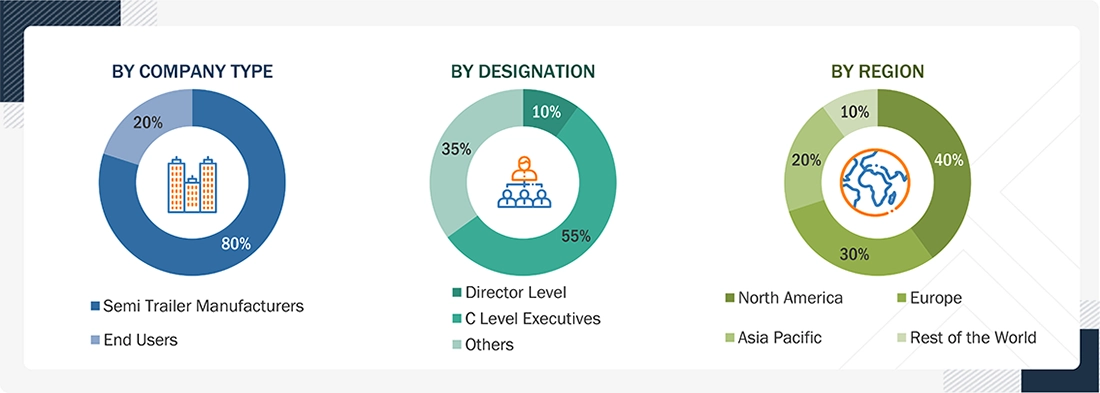
Note: Others include sales, marketing, and product managers.
Company tiers are based on the value chain; revenue of the company is not considered.
OEMs: Semi-trailer manufacturers
Tier I: Component suppliers
To know about the assumptions considered for the study, download the pdf brochure
Market Size Estimation
A detailed market estimation approach has been followed to estimate and validate the value and volume of the semi-trailer market and other dependent submarkets, as mentioned below:
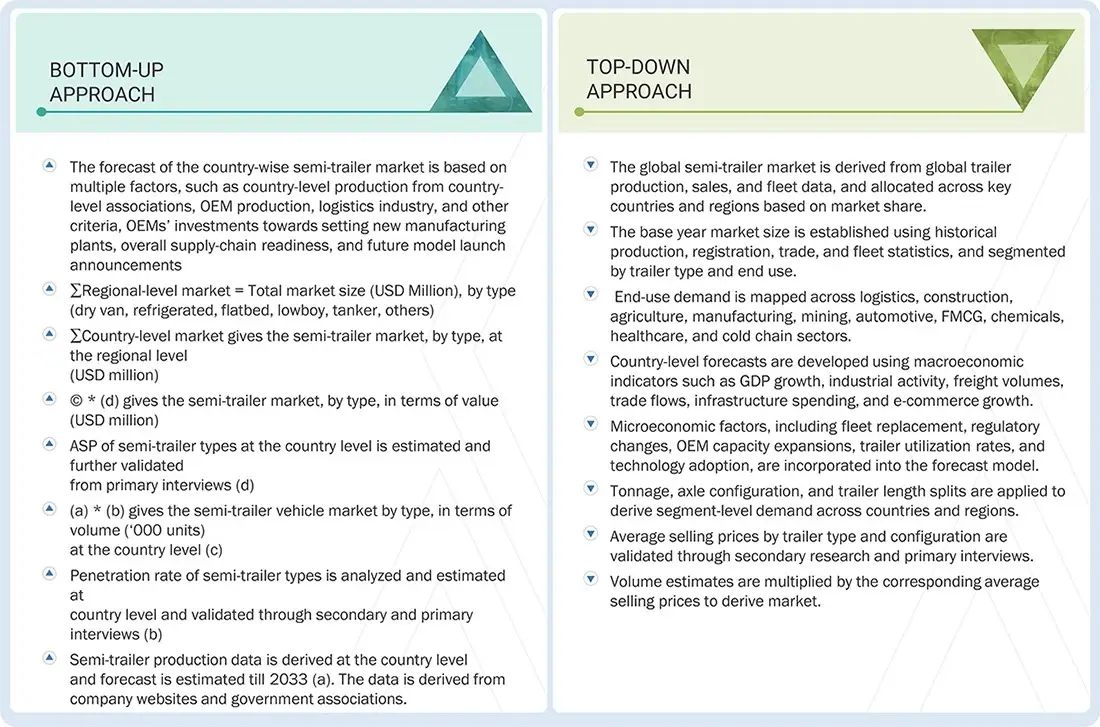
- Bottom-up approach: The bottom-up approach has been used to estimate and validate the size of the global semi-trailer market. Market sizing has been conducted at the country level by analyzing the production volumes of semi-trailers across key countries. The base-year market has been established using OEM production data, trailer registrations, trade statistics, and industry association databases, and was further segmented by trailer type. Historical demand trends, fleet replacement cycles, and application wise adoption patterns have been assessed to derive country level market volumes, while forecasts were developed using country specific macroeconomic factors such as GDP growth, industrial output, freight movement, trade activity, infrastructure investments, and e-commerce expansion, along with microeconomic factors, including fleet modernization, regulatory changes, trailer utilization rates, OEM capacity expansions, and technology adoption. The market size by value has been calculated by multiplying the average selling price of each trailer type by its corresponding volume, and country-level estimates have been aggregated to derive regional and global market sizes.
- Top-down approach: The top-down approach has been used to estimate and validate the size of the global semi-trailer market by deriving the market from global trailer production, sales, fleet, and commercial vehicle industry data. The base year market size has been established using historical production, registration, and trade statistics, and allocated across key countries and regions based on their relative market shares. The market has been further segmented by trailer type and major end-use industries, including logistics, construction, agriculture, manufacturing, mining, automotive, FMCG, chemicals, healthcare, and cold chain transportation. Historical demand patterns and trailer penetration across these industries have been analyzed to establish segment-level splits, while forecasts have been developed using country-specific macroeconomic factors such as GDP growth, industrial production, freight activity, trade volumes, infrastructure investments, and e-commerce expansion, along with microeconomic factors, including fleet replacement demand, regulatory developments, OEM capacity expansions, trailer utilization trends, and technology adoption. Tonnage, axle configuration, and trailer length distributions have been applied to derive detailed market segmentation. Market value has been calculated by applying average selling prices for each trailer type and configuration to the corresponding volume estimates, and country-level results have been aggregated to derive regional and global market sizes.
- Key players in the global semi-trailer market have been identified through secondary research, and their global market shares have been determined through primary and secondary research.
- The research methodology included the study of the annual and quarterly financial reports & regulatory filings of major market players, as well as interviews with industry experts for detailed market insights.
- All major penetration rates, percentage shares, splits, and breakdowns for the global semi-trailer market have been determined by using secondary sources and verified through primary sources.
- All key macroindicators affecting the revenue growth of the market segments and subsegments have been accounted for, viewed in extensive detail, verified through primary research, and analyzed to get the validated and verified quantitative & qualitative data.
- The market data gathered has been consolidated and added with detailed inputs, analyzed, and presented in this report.
Data Triangulation
All percentage shares, splits, and breakdowns have been determined using secondary sources and verified by primary sources. All parameters that are said to affect the markets covered in this research study have been accounted for, viewed in extensive detail, and analyzed to obtain the final quantitative and qualitative data.
Market Definition
Semi-trailer: A semi-trailer is an unpowered unit comprising rear axle(s), which is used for the transportation of freight when combined with a tractor unit through a fifth wheel coupling. Types of semi-trailers include dry vans, flatbeds, lowboys, and refrigerated vans, among others.
Dry Van: A dry van is a type of semi-trailer that’s fully enclosed to protect shipments from outside elements. Designed to carry palletized, boxed, or loose freight. Dry vans can be used for a variety of less-than-truckload (LTL) and truckload shipments.
Refrigerated: A refrigerated trailer or ‘reefer’ has a refrigeration unit at the front, which can heat or cool the load depending on the ambient temperature. It allows for temperature-sensitive goods to be transported long distances.
Flatbed: The flatbed trailer is a kind of semi-trailer that is designed to carry bulk cargo and containers between shipping facilities and terminals. By simple definition, this is a long flat platform of either 20ft, 40ft, 48ft or 53ft length used for carrying shipping containers. The flatbed trailer has no roof or walls on the sides. It is a bare platform on which different container sizes are secured using container locks, ready for transportation. It is primarily used for the transportation of bulk cargo.
Lowboy: A lowboy truck and trailer is a kind of specialized haul equipment. It can be used to transport all kinds of oversize and heavy loads. Large construction equipment like bulldozers and excavators travel to job sites on lowboy trucks and trailers. Lowbed trailers have different capacities, such as 20 T, 30 T, 50 T, 70 T, 80 T, 100 T, 120 T, and 150 T. Each type use different number of axles, from 2, 3, 4 axles to 7, 8 axles.
Tanker: Tankers are elliptical and typically transport gasoline or other flammable liquids. The insulated compartment tanks typically come in 3-compartment, 4-compartment, or 5-compartment configurations. Tankers have one or more domes or hatches and dome covers, generally one hatch per compartment in the tank.
Key Stakeholders
- Semi-trailer Manufacturers
- Semi-trailer Component & Raw Material Suppliers
- Truck Manufacturers (Truck OEMs)
- Fleet Operators & Logistics Companies
- Trailer Leasing & Rental Companies
- Technology Providers
- Refrigeration Unit Suppliers
- Legal and Regulatory Authorities
- Industry Associations
Report Objectives
- To define, describe, and forecast the size of the semi-trailer market in terms of value (USD million) and volume (thousand units) between 2026 and 2033 based on the following segments:
- By type (flatbed, lowboy, dry van, refrigerated, tanker, and others)
- By length (up to 45 feet and above 45 feet)
- By tonnage (below 25 T, 25 T-50 T, 51 T-100 T, and above 100 T)
- By number of axles (<3 axles, 3-4 axles, and >4 axles)
- By end use (heavy industry, FMCG, chemical, automotive, oil & gas, healthcare, logistics, and others)
- By region (Asia Pacific, Europe, North America, Rest of the World)
- To identify and analyze key drivers, restraints, opportunities, and challenges influencing the market
- To strategically profile key players and analyze their market shares and core competencies
- To analyze recent developments, including product launches, deals, and expansions, by key market players
- To study the following with respect to the market
- Trends/Disruptions Impacting Customer Business
- Ecosystem Analysis
- Technology Analysis
- Supply Chain Analysis
- Patent Analysis
- OEM Analysis
- Total Cost of Ownership
- Regulatory Landscape
- Case Study Analysis
- Key Stakeholders and Buying Criteria
- Key Conferences and Events
- Trade Analysis
- Pricing Analysis
- Impact of AI/Generative AI
- Fleet Lifecycle, Utilization Efficiency, and Profitability Assessment
- Impact of EU-India FTA
- Impact of Israel-Iran War
Available customizations:
MarketsandMarkets offers the following customizations for this market report:
-
-
Semi-Trailer Market, By Number of Axles, at country level
- <3 Axles
- 3-4 Axles
- >4 Axles
-
Semi-Trailer Market, By Number of Axles, at country level
Note: The semi-trailer market can be offered for the number of axles at the country level.
-
-
Semi-Trailer Market, By tonnage, at country level
- Below 25 T
- 25 T-50 T
- 51 T-100 T
- Above 100T
-
Semi-Trailer Market, By tonnage, at country level
Get the Full Semi-Trailer Market Report
Full forecast, segment splits, and company analysis for all Semi-Trailer Market.
- Rest Of Europe Semi-Trailer Market
- Rest Of Asia Pacific Semi-Trailer Market
- China Semi-Trailer Market
- India Semi-Trailer Market
- Japan Semi-Trailer Market
- South Korea Semi-Trailer Market
- Canada Semi-Trailer Market
- Mexico Semi-Trailer Market
- US Semi-Trailer Market
- Germany Semi-Trailer Market
- UK Semi-Trailer Market
- France Semi-Trailer Market
- Spain Semi-Trailer Market
- Poland Semi-Trailer Market
- Italy Semi-Trailer Market
- Brazil Semi-Trailer Market
- Russia Semi-Trailer Market
Need a Tailored Report?
Customize this report to your needs
Get 10% FREE Customization
Customize This Report
