
South Korea Medical Sensors Market (2025-2030)

The South Korea Medical Sensors Market was valued at $46.1 Million in 2025 and projected to reach to $72.5 Million by 2030, representing a compound annual growth rate of 9.5%. South Korea's medical sensors market is poised for sustained expansion, growing from $46.1 million in 2025 to $72.5 million by 2030.


| Market Size in | USD 26.32 MN |
| Market Forecast in | |
| CAGR | |
| Forecast Period | |
| Units Considered | Value (USD MN) |
South Korea Medical Sensors Market Trends and Insights
- This 9.5% compound annual growth rate reflects South Korea's strong healthcare infrastructure, advanced manufacturing capabilities, and increasing adoption of digital health technologies.
- South Korea's position as a global leader in electronics and semiconductor innovation positions the country favorably for medical sensor development and deployment. The South Korea medical sensors market is driven by rising healthcare expenditure, an aging population, and government initiatives promoting smart healthcare solutions.
- South Korea's healthcare system increasingly integrates wearable and implantable sensors for remote patient monitoring and chronic disease management.
- Between 2025 and 2030, South Korea is expected to see accelerated adoption across hospitals, clinics, and home healthcare settings, supported by strong regulatory frameworks and technological expertise..
Key Market Statistics
- CAGR (2025-2030) 9.5% CAGR
- Market Size, 2025 ~USD 46.1 Million
- Forecast, 2030 ~USD 72.5 Million
- Country South Korea
South Korea Medical Sensors Market Overview
Strong CAGR Outpacing Global Growth :
South Korea's medical sensors market is growing at 9.5% CAGR, significantly exceeding the global rate of 7.9%, driven by government healthcare digitalization initiatives and private sector innovation.
Electronics Manufacturing Excellence :
Leveraging its world-class semiconductor and electronics industry, South Korea is positioned as a key hub for medical sensor production, with companies like Samsung and LG expanding into healthcare technology.
Digital Health Adoption Leadership :
South Korea's advanced healthcare infrastructure and high digital literacy rates are accelerating adoption of wearable sensors, remote monitoring devices, and IoT-enabled medical equipment across hospitals and clinics.
Aging Population Driving Demand :
With a rapidly aging demographic, South Korea faces increasing demand for chronic disease monitoring, fall detection, and elderly care sensors, creating sustained market expansion opportunities through 2030.
South Korea Medical Sensors Market Dynamics
- The country's competitive advantage stems from its robust electronics manufacturing ecosystem, government support for healthcare innovation, and high adoption rates of digital health solutions.
- Major drivers include aging population demographics, increased prevalence of chronic diseases, and integration of AI and IoT technologies in medical devices. The market will benefit from South Korea's strategic investments in smart healthcare infrastructure and the emergence of local startups specializing in wearable and implantable sensors.
- Partnerships between technology giants and healthcare providers are accelerating product development cycles.
- Additionally, regulatory frameworks supporting medical device innovation and export opportunities position South Korea as a regional leader in medical sensor manufacturing and deployment..
Market Ecosystem
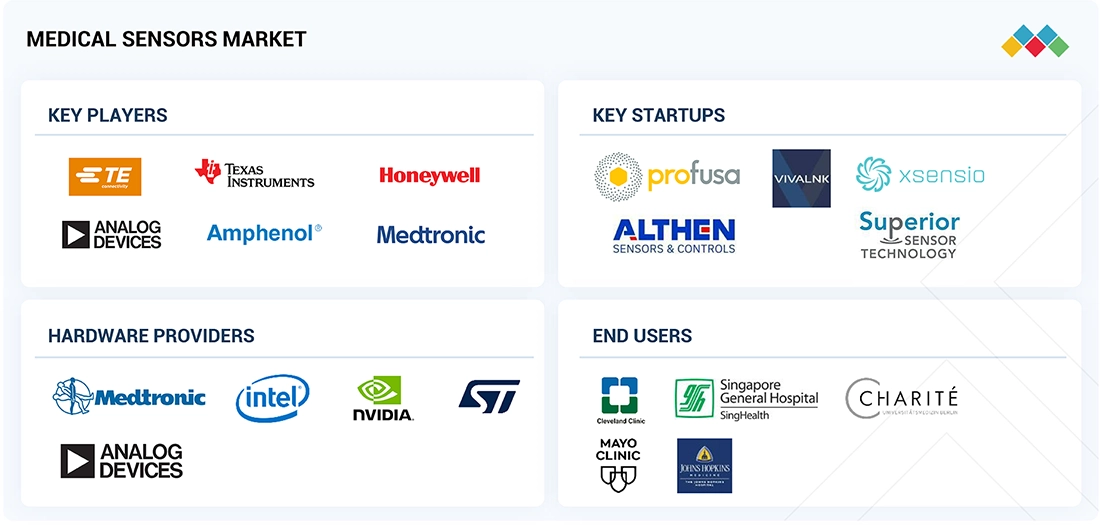
MEDICAL SENSORS MARKET: COMMERCIAL USE CASES ACROSS INDUSTRIES
| COMPANY | USE CASE DESCRIPTION | BENEFITS |
|---|---|---|
 |
Integration of miniaturized temperature and pressure sensors in patient monitoring systems | Enables real-time vital tracking, improves diagnostic accuracy, and enhances patient safety |
 |
Use of implantable glucose and pressure sensors in chronic disease management devices | Provides continuous monitoring, supports timely intervention, and improves disease control |
 |
Development of biopotential and motion sensors for wearable ECG and activity tracking | Ensures accurate biosignal capture, supports preventive care, and enhances user comfort |
 |
Use of pressure and airflow sensors in ventilators and respiratory care devices | Improves respiratory monitoring precision, ensures patient safety, and boosts device reliability |
 |
Integration of low-power analog front-end chips in wearable biosensors | Enables extended battery life, real-time health tracking, and seamless connectivity |
Logos and trademarks shown above are the property of their respective owners. Their use here is for informational and illustrative purposes only.
Related Ecosystem
Medical Devices
- Polymerase Chain Reaction (PCR)
- Magnetic Resonance Imaging (MRI)
- Disposable Autoinjectors
- Pulse Oximeters
- Blood Pressure Monitors
- Medtronic plc
- Abbott Laboratories
- Stryker Corporation
- Becton, Dickinson and Company
- JOHNSON & JOHNSON
Digitalization And Iot
- Sensors
- Remote Monitoring
- Supply Chain Management
- Passenger Information System (PIS)
- Platform as A Service (PaaS)
- International Business Machines Corporation
- Cisco Systems, Inc.
- MICROSOFT CORPORATION
- Oracle Corporation
- SAP SE
Sensors And Control
- Sensors
- Image Sensors
- Temperature Sensors
- Pressure Sensors
- Flow Sensors
- BAUMER ELECTRIC AG
- HONEYWELL INTERNATIONAL INC.
- Stmicroelectronics
- Lenovo
- Texas Instruments Incorporated
Key Takeaways
- South Korea's medical sensors market will grow from $46.1M (2025) to $72.5M (2030) at a 9.5% CAGR.
- South Korea's advanced electronics and semiconductor industry provides competitive advantages in sensor manufacturing and innovation.
- South Korea's aging demographic and rising healthcare spending are primary drivers of medical sensor adoption through 2030.
- South Korea's government-backed digital health initiatives and regulatory support accelerate market expansion and technology integration.
Medical Sensors Market Report Scope
| Report Metric | Details |
|---|---|
| Base Year | 2025 |
| Fastest Growing Segment | BIOCHEMICAL SENSORS (Sensor Type) |
| Forecast Period | 2025–2030 |
| Growth Rate | CAGR of 7.9% from 2025 to 2030 |
| Largest Segment | CLASS II MEDICAL SENSORS (Medical Device Classification) |
| Market Size Base Year (Billions) | ~USD 3.06 (2025) |
| Revenue Forecast (Billions) | ~USD 4.48 (2030) |
| Segments Covered | Sensor Type, Type, Product Type, Medical Device Classification, Application, Connectivity/Integration, Technology, End User |
South Korea Medical Sensors Market Report Segmentation
8 segment dimensions are covered across the global market.
By Sensor Type
- Biochemical Sensors
- Biophysical Sensors
- Biopotential Sensors
- Flow Sensors
- Image Sensors
- Motion/Position Sensors
- Other Sensor Types
By Type
- Accelerometers
- Blood Glucose Sensors
- Blood Oxygen Sensors
- Blood Pressure Sensors
- Ecg Sensors
- Eeg Sensors
- Emg Sensors
- Enzyme-Based Sensors
- Gyroscopes
- Infrared Sensors
- Intracranial Pressure Sensors
- Mri Sensors
- Other Biopotential Sensors
- Other Pressure Sensors
- Other Temperature Sensors
- Pressure Sensors
- Temperature Sensors
- Thermistors
- Ultrasound Sensors
- X-Ray Sensors
By Product Type
- External (Non-Invasive) Sensors
- Implantable Sensors
- Ingestible Sensors
- Other Sensors
By Medical Device Classification
- Class I Medical Sensors
- Class Ii Medical Sensors
- Class Iii Medical Sensors
By Application
- Diagnostics
- Monitoring
- Other Applications
- Therapeutics
By Connectivity/Integration
- Wired Sensors
- Wireless Sensors
By Technology
- Complementary Metal-Oxide Semiconductor
- Complementary Metal-Oxide Semiconductor (Cmos)
- Fiber-Optic Sensors
- Micro-Electro-Mechanical Systems (MEMS)
- Nano/Graphene-Based Sensors
- Other Technologies
- Piezoelectric Sensors
By End User
- Hospitals & Clinics
- Nursing Homes, Assisted Living, Long-Term Care Centers, And Home Care Settings
- Other End Users
Target Audience
- Medical Device Manufacturers : Companies seeking to establish or expand operations in South Korea need detailed market sizing, competitive benchmarking, and growth forecasts to justify investments in manufacturing facilities and R&D centers.
- Healthcare Technology Investors : Venture capital and private equity firms evaluating opportunities in South Korea's medical sensors ecosystem require market validation, growth trajectory data, and insights into emerging local startups and acquisition targets.
- Hospital & Healthcare Providers : South Korean healthcare institutions planning digital transformation initiatives need market intelligence on available sensor technologies, vendor landscapes, and adoption trends to optimize procurement decisions.
- Government & Policy Makers : South Korean health ministry and economic development agencies require market data to inform healthcare digitalization policies, incentive programs, and strategic initiatives supporting the medical sensors industry.
- Distribution & Channel Partners : Medical device distributors and healthcare IT integrators in South Korea need market forecasts and competitive analysis to identify growth segments, negotiate supplier relationships, and plan inventory strategies.
Key Companies in the South Korea Medical Sensors Market
| Company | HQ | Ownership | Strongest segments |
|---|---|---|---|
| HENRY SCHEIN | United States | Public Company | Global Distribution and Value-Added Services,Global Specialty Products,Global Technology, |
| HILL-ROM HOLDINGS, INC. | United States | Private Company | Patient Support Systems (beds, surfaces, mobility, IT, services),Front Line Care (exam, diagnostics, monitoring, respiratory health),Surgical Solutions (tables, lights, pendants, positioning), |
| JABIL | United States | Public Company | Regulated Industries (Healthcare, Automotive, Packaging),Intelligent Infrastructure (5G, Cloud, Industrial, Networking),Connected Living & Digital Commerce, |
| EPCOS AG | Germany | Private Company | EMC filters and suppression components,Capacitors for EMC and power quality,Sensors and protection devices, |
| HALMA PLC | United Kingdom | Public Company | Safety,Environmental & Analysis,Healthcare, |
| X-FAB | Belgium | Public Company | Analog/mixed-signal CMOS ICs,Power (SiC and GaN),MEMS and sensors, |
| COCHLEAR LIMITED | Australia | Public Company | Cochlear implant systems (Nucleus implants + processors),Sound processor upgrades and accessories,Bone conduction systems (Baha 6 Max and implants), |
| TOWER SEMICONDUCTOR LTD | Israel | Public Company | Analog & Mixed-Signal (SiGe, RF CMOS, mixed-signal CMOS),CMOS Image Sensors & Non-Imaging Sensors,Power Management & Integrated Power Platforms, |
| LENOVO | China | Public Company | Commercial PCs and small form factor controllers,Thin clients and dedicated media players,Tablets and smart devices for kiosks/PoS, |
| TE CONNECTIVITY | Ireland | Public Company | Transportation Solutions (automotive, commercial and industrial vehicles, autosport, e-mobility),Industrial Solutions (automation and control, intelligent buildings, energy, rail, aerospace, defense, space),Communications, data center, and personal electronics connectivity, |
| MEDTRONIC | Ireland | Public Company | Cardiovascular Portfolio,Neuroscience Portfolio,Medical Surgical Portfolio (incl. Diabetes), |
| ANALOG DEVICES, INC. | United States | Public Company | Data converters,Power management and power ICs,Amplifiers and linear signal chain, |
| HONEYWELL INTERNATIONAL INC. | United States | Public Company | Industrial Automation,Building Automation,Energy and Sustainability Solutions (UOP and related), |
| TEXAS INSTRUMENTS INCORPORATED | United States | Public Company | Analog – Power,Analog – Signal Chain,Embedded Processing, |
| AMPHENOL CORPORATION | United States | Public Company | Communications Solutions (high-speed, RF, fiber, antennas, network interconnects),Harsh Environment Solutions (automotive, aerospace, defense, industrial connectors),Interconnect and Sensor Systems (cable assemblies, harnesses, sensors, PCBs), |
| SENSIRION AG | Switzerland | Public Company | Environmental sensors (humidity, temperature, VOC, CO2, particulate),Gas and liquid flow sensors,Differential pressure and gas leakage sensors, |
| STMICROELECTRONICS | Netherlands | Public Company | Power and Discrete products (P&D),Embedded Processing (EMP),Analog products, MEMS and Sensors Group (AM&S), |
| AMS-OSRAM AG | Austria | Public Company | Opto Semiconductors (OS),CMOS Sensors & ASICs (CSA),Lamps & Systems (L&S), |
| NXP SEMICONDUCTORS | Netherlands | Public Company | Microcontrollers,Application & Communication Processors,Wireless Connectivity (NFC, UWB, BLE, Wi-Fi), |
| SEMICONDUCTOR COMPONENTS INDUSTRIES, LLC | United States | Private Company | SiC discrete power devices (diodes, MOSFETs),SiC power modules,SiC wafers and epi (internal and limited external sales), |
| OMNIVISION | United States | Private Company | Mobile and consumer (smartphones, tablets, entertainment, notebook, webcam),Automotive imaging,Security and surveillance, |
| NIHON KOHDEN CORPORATION | Japan | Public Company | Patient monitors & clinical information systems,Physiological measuring equipment (EEG, ECG, EMG, cath lab polygraphs),Defibrillators, AEDs, ventilators, and emergency/critical care devices, |
HENRY SCHEIN
Henry Schein is a publicly traded United States-based company founded in 1932 that employs 25,000 people.
HILL-ROM HOLDINGS, INC.
Hill-Rom Holdings, Inc. is a privately held United States company established in 1915 with 10,000 employees.
JABIL
Jabil is a publicly traded United States manufacturer founded in 1966 with 135,000 employees.
EPCOS AG
EPCOS AG is a privately held German company founded in 1989 with 23,619 employees.
HALMA PLC
Halma PLC is a publicly traded United Kingdom company founded in 1894 with 9,000 employees.
X-FAB
X-FAB is a publicly traded Belgian semiconductor company founded in 1992 with 4,300 employees.
COCHLEAR LIMITED
Cochlear Limited is a publicly traded Australian company founded in 1981 with 5,500 employees.
TOWER SEMICONDUCTOR LTD
Tower Semiconductor Ltd is a publicly traded Israeli company founded in 1993 with 5,613 employees.
LENOVO
Lenovo is a publicly traded Chinese technology company founded in 1984.
TE CONNECTIVITY
TE Connectivity is a publicly traded Irish company founded in 1941 with 80,000 employees.
MEDTRONIC
Medtronic is a publicly traded Irish company founded in 1949 with 95,000 employees.
ANALOG DEVICES, INC.
Analog Devices, Inc. is a publicly traded United States semiconductor company founded in 1965 with 24,500 employees.
HONEYWELL INTERNATIONAL INC.
Honeywell International Inc. is a publicly traded United States company founded in 1885 with 101,000 employees.
TEXAS INSTRUMENTS INCORPORATED
Texas Instruments Incorporated is a publicly traded United States semiconductor company founded in 1930 with 33,000 employees.
AMPHENOL CORPORATION
Amphenol Corporation is a publicly traded United States company founded in 1932 with 170,000 employees.
SENSIRION AG
Sensirion AG is a publicly traded Swiss sensor company founded in 1998 with 1,128 employees.
STMICROELECTRONICS
STMicroelectronics is a publicly traded Netherlands-based semiconductor company founded in 1987 with 48,000 employees.
AMS-OSRAM AG
AMS-OSRAM AG is a publicly traded Austrian company founded in 1981 with 18,500 employees.
NXP SEMICONDUCTORS
NXP Semiconductors is a publicly traded Netherlands-based company founded in 2006 with 32,169 employees.
SEMICONDUCTOR COMPONENTS INDUSTRIES, LLC
Semiconductor Components Industries, LLC is a privately held United States company founded in 1999 with 9,570 employees.
OMNIVISION
OmniVision is a privately held United States company founded in 1995 with 2,176 employees.
NIHON KOHDEN CORPORATION
Nihon Kohden Corporation is a publicly traded Japanese company founded in 1951 with 6,116 employees.
Reasons to Buy this Report
- Market Size & Growth Validation : Obtain precise valuation data for South Korea's medical sensors market ($46.1M in 2025) with verified 9.5% CAGR forecasts through 2030, enabling accurate business planning and investment decisions.
- Competitive Landscape Intelligence : Understand South Korea's unique competitive positioning relative to global markets, identifying local manufacturers, technology leaders, and partnership opportunities in the electronics-healthcare convergence.
- Demographic & Healthcare Trends : Access insights into South Korea's aging population dynamics, chronic disease prevalence, and digital health adoption rates that directly influence medical sensor demand and product development priorities.
- Regulatory & Export Opportunities : Gain clarity on South Korea's medical device regulatory environment, government incentives for healthcare innovation, and export pathways to regional and global markets.
- Strategic Market Entry Planning : Develop informed go-to-market strategies for South Korea with data on distribution channels, healthcare provider preferences, reimbursement models, and technology adoption timelines specific to the region.
Frequently asked questions
What is the current size of South Korea's medical sensors market?
South Korea's medical sensors market is valued at $46.1 million in 2025 and is projected to reach $72.5 million by 2030.
What is the expected growth rate for South Korea's medical sensors market?
South Korea's medical sensors market is expected to grow at a compound annual growth rate (CAGR) of 9.5% from 2025 to 2030.
What factors are driving growth in South Korea's medical sensors market?
Key drivers include South Korea's aging population, rising healthcare expenditure, government digital health initiatives, and the country's leadership in electronics and semiconductor manufacturing.
Which applications are most prominent in South Korea's medical sensors market?
South Korea's medical sensors market includes wearable sensors, implantable devices, remote patient monitoring systems, and chronic disease management solutions integrated across hospitals and home healthcare settings.
How does South Korea's medical sensors market compare to global trends?
South Korea's 9.5% CAGR outpaces the global medical sensors market CAGR of 7.9%, reflecting the country's technological advantages and healthcare system modernization efforts.
RESEARCH METHODOLOGY
The study involved five key activities to estimate the current size of the medical sensors market. Extensive secondary research was conducted to gather information on the market and its various subsegments. The next step was to validate these findings, assumptions, and estimates with industry experts across the value chain through primary research. Both top-down and bottom-up approaches were used to determine the overall market size. Afterward, market segmentation and data triangulation procedures were employed to estimate the market size of the segments and subsegments.
Secondary Research
This research involved extensive use of secondary sources, including directories and databases such as Dun & Bradstreet, Bloomberg Business, and Factiva; white papers, annual reports, and companies’ house documents; investor presentations; and SEC filings. The market for companies offering medical sensor solutions was assessed using secondary data from both paid and free sources. This entailed analyzing the product portfolios of leading industry players and evaluating these companies based on their performance and quality. Multiple resources were utilized in the secondary research process to gather information, including annual reports, press releases, investor presentations, white papers, academic journals, certified publications, articles by recognized authors, directories, and databases. The secondary research process involved referring to various sources to identify and collect relevant information related to the study. These sources included annual reports, press releases, investor presentations from medical sensor vendors, forums, certified publications, and white papers. This research was used to obtain key insights into the industry’s value chain, the overall pool of major players, market classification, and segmentation based on perspectives on market and technology trends.
Primary Research
In the primary research process, various sources from both the supply and demand sides were interviewed to gather qualitative and quantitative information for this report. Primary sources mainly include industry experts from core and related industries, preferred suppliers, manufacturers, distributors, technology developers, researchers, and organizations involved in all segments of this industry’s value chain. In-depth interviews were conducted with different primary respondents, such as key industry participants, subject-matter experts (SMEs), C-level executives of major market players, and industry consultants, among others, to obtain and verify critical qualitative and quantitative information, as well as to assess prospects.
Primary research was conducted to identify segmentation types, industry trends, key players, and important market dynamics such as drivers, restraints, opportunities, challenges, and strategies adopted by key stakeholders.
After completing the market engineering process, which includes calculations for market statistics, market breakdown, size estimations, forecasting, and data triangulation, extensive primary research was conducted. This research aimed to gather information and verify the critical numbers obtained during the market analysis. Additionally, primary research was carried out to identify different types of market segmentation, analyze industry trends, evaluate the competitive landscape of medical sensor solutions offered by various players, and understand key market dynamics such as drivers, restraints, opportunities, challenges, industry trends, and strategies employed by key market participants.
In the overall market engineering process, the top-down and bottom-up approaches, along with several data triangulation methods, were extensively used to conduct market estimation and forecasting for the entire market segments and subsegments listed in this report. Extensive qualitative and quantitative analysis was performed throughout the complete market engineering process to identify key information and insights for the report.
Breakdown of Primary Respondents:
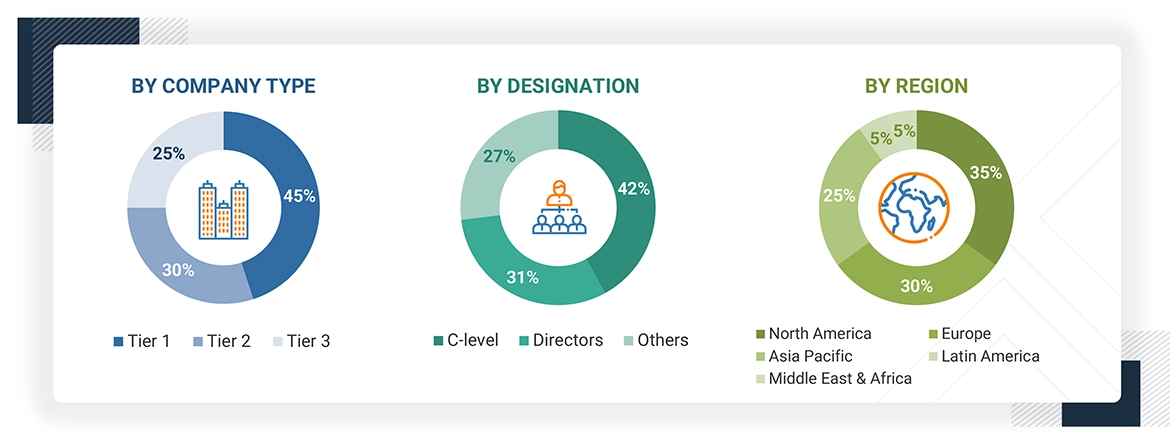
Note 1: Others include sales managers, marketing managers, and product managers.
Note 2: Tiers are defined based on a company’s total revenue, as of 2022: Tier 1 = >USD 1 billion, Tier 2 = USD 500 million to USD 1 billion, and Tier 3 = < USD 500 million
To know about the assumptions considered for the study, download the pdf brochure
Market Size Estimation
The market size estimates and forecasts provided in this study are derived through a combination of the bottom-up approach (revenue share analysis of leading players) and the top-down approach (assessment of utilization, adoption, and penetration trends by sensor type, product type, medical device classification, application, connectivity/integration, technology, end user, and region).
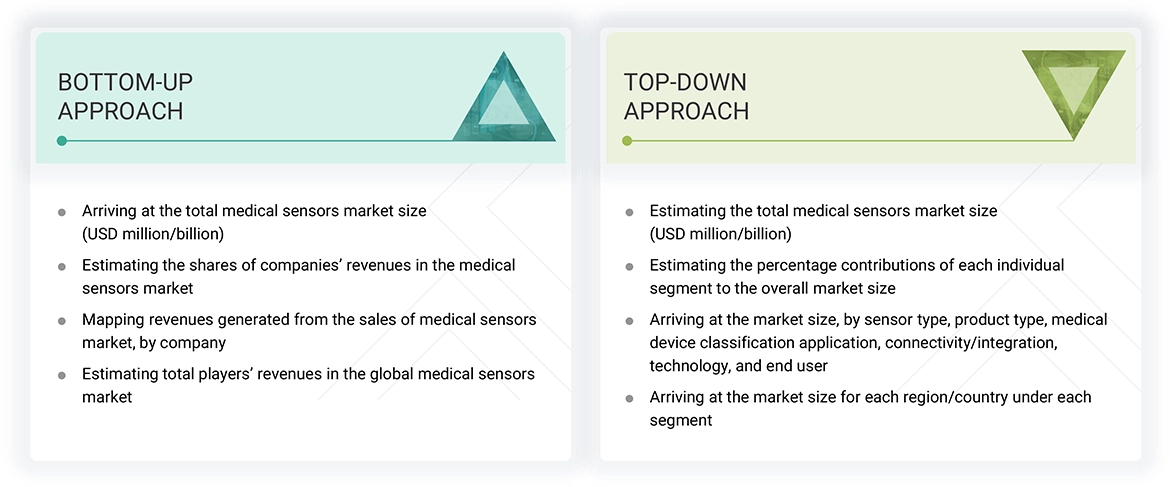
Data Triangulation
After determining the overall market size using market estimation methods, the market was divided into several segments and subsegments. Data triangulation and market breakdown techniques were used when applicable to complete the full market analysis and obtain precise statistics for each segment and subsegment. The data was triangulated by examining various factors and trends from both the demand and supply sides in the medical sensors market.
Market Definition
Medical sensors detect electrical or optical signals and offer a way to measure and record these signals. The physical properties measurable with these sensors include temperature, pressure, vibration, flow rates of liquids and gases, amplitudes of electrical and magnetic signals, and concentrations of various substances. The medical sensors market is expected to experience significant growth due to the rising demand for advanced and connected medical devices. Increased investments by governments and private organizations in healthcare have enabled device manufacturers to develop more advanced medical devices for better patient monitoring and diagnosis. The integration of technologies like IoT into medical devices has heightened the demand for medical sensors.
Stakeholders
- Research Institutes and Organizations
- Medical Sensors Vendors
- Government Bodies
- Sensor Component Manufacturers
- Wearable/Consumer Health Companies
- Startups & Innovators
- Healthcare Associations/Institutes
- Venture Capitalists
- Distributors and Resellers
- Maintenance and Support Service Providers
- Integration Service Providers
- Advocacy Groups
- Investors and Financial Institutions
- Industry Associations and Trade Groups
Report Objectives
- To define, describe, and forecast the global medical sensors market, by sensor type, product type, medical device classification application, connectivity/integration, technology, end user, and region
- To provide detailed information regarding the major factors influencing the growth of the market (such as drivers, restraints, opportunities, and challenges)
- To analyze micromarkets with respect to individual growth trends, prospects, and contributions to the overall medical sensors market
- To assess the medical sensors market with regard to Porter’s Five Forces, regulatory landscape, value chain, ecosystem map, patent protection, and key stakeholders & buying criteria
- To analyze opportunities in the market for stakeholders and provide details of the competitive landscape for market leaders
- To forecast the size of the medical sensors market with respect to five main regions, namely, North America, Europe, the Asia Pacific, Latin America, and the Middle East & Africa
- To profile the key players in the medical sensors market and comprehensively analyze their core competencies and market shares
- To track and analyze competitive developments such as agreements, partnerships, and acquisitions; expansions; product launches and enhancements; and R&D activities in the medical sensors market.
Get the Full Medical Sensors Market Report
Full forecast, segment splits, and company analysis for all Medical Sensors Market.
- Canada Medical Sensors Market
- US Medical Sensors Market
- UK Medical Sensors Market
- Germany Medical Sensors Market
- France Medical Sensors Market
- Italy Medical Sensors Market
- Spain Medical Sensors Market
- Japan Medical Sensors Market
- China Medical Sensors Market
- India Medical Sensors Market
- Australia Medical Sensors Market
- Brazil Medical Sensors Market
- Mexico Medical Sensors Market
- Saudi Arabia Medical Sensors Market
- UAE Medical Sensors Market
Need a Tailored Report?
Customize this report to your needs
Get 10% FREE Customization
Customize This Report
