
Australia Service Robotics Market (2024-2029)

The Australia Service Robotics Market was valued at $728 Million in 2024 and projected to reach to $1644.1 Million by 2029, representing a compound annual growth rate of CAGR 17.7%. Australia's service robotics market is poised for accelerated expansion through 2029, driven by demographic pressures, technological advancement, and increasing labor costs.


| Market Size in | USD 26.32 MN |
| Market Forecast in | |
| CAGR | |
| Forecast Period | |
| Units Considered | Value (USD MN) |
Australia Service Robotics Market Trends and Insights
- This represents a compound annual growth rate of 17.7%, significantly outpacing global trends.
- Australia's advanced manufacturing capabilities, strong technology adoption, and aging population are driving demand for automation solutions across healthcare, logistics, and hospitality sectors. The Australian market benefits from substantial government investment in robotics innovation and a mature digital infrastructure ecosystem.
- Australia's service robotics adoption is accelerating as enterprises seek to address labor shortages and improve operational efficiency.
- Between 2024 and 2029, Australia is positioned to capture increasing market share within the Asia Pacific region, driven by rising consumer acceptance and declining robotics costs. Australia's competitive advantage lies in its skilled workforce, research institutions, and regulatory frameworks supporting autonomous systems deployment.
- The market trajectory reflects Australia's commitment to Industry 4.0 transformation and strategic positioning as a regional technology hub..
Key Market Statistics
- CAGR (2024-2029) CAGR 17.7%
- Market Size, 2024 ~USD 728 Million
- Forecast, 2029 ~USD 1644.1 Million
- Country Australia
Australia Service Robotics Market Overview
Market Valuation & Growth :
Australia's service robotics market is valued at USD 728.0 million in 2024, with a projected CAGR of 17.7% through 2029, reaching USD 1,644.1 million. This growth rate significantly exceeds the global average of 15.9%, positioning Australia as a high-growth market in the Asia-Pacific region.
Aging Population Driving Demand :
Australia's demographic shift toward an aging population is accelerating adoption of service robots in healthcare, aged care, and domestic assistance sectors. This structural trend creates sustained demand for automation solutions that address labor shortages and improve quality of care.
Advanced Manufacturing & Technology Adoption :
Australia's strong manufacturing base and high technology adoption rates support rapid integration of service robotics across industrial, commercial, and consumer segments. The nation's skilled workforce and innovation ecosystem facilitate deployment of sophisticated robotic solutions.
Key Application Sectors :
Primary growth drivers include healthcare robotics, hospitality automation, logistics and warehouse operations, and domestic cleaning solutions. Australia's service sector dominance and labor cost pressures create ideal conditions for robotics implementation across these verticals.
Australia Service Robotics Market Dynamics
- The nation's aging population creates urgent demand for robotic solutions in aged care and healthcare settings, while strong economic fundamentals support capital investment in automation across commercial sectors. Government initiatives promoting advanced manufacturing and digital transformation, combined with Australia's high technology adoption rates, will further catalyze market growth.
- Investment in robotics research and development, coupled with increasing partnerships between local technology firms and global robotics manufacturers, will enhance market competitiveness and drive innovation in service robotics applications tailored to Australian market needs..
Market Ecosystem
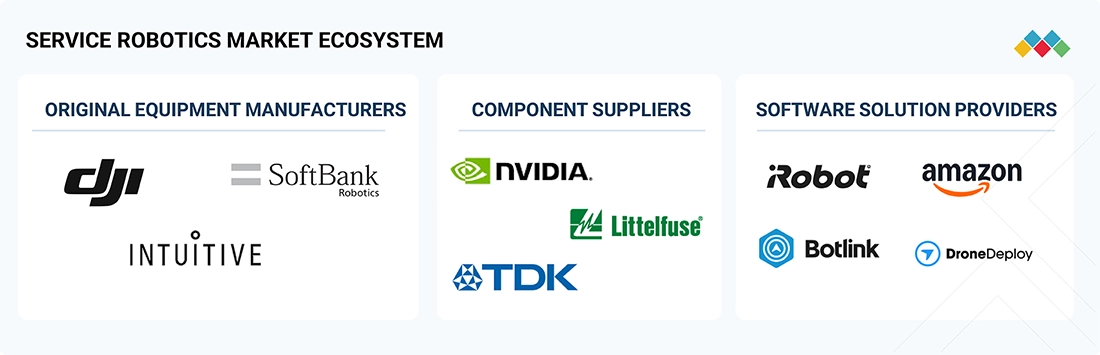
SERVICE ROBOTICS MARKET SIZE, SHARE AND TRENDS: COMMERCIAL USE CASES ACROSS INDUSTRIES
| COMPANY | USE CASE DESCRIPTION | BENEFITS |
|---|---|---|
 |
DJI’s Agras T40 drones were deployed by rice farmers in Brazil to automate spraying operations, enabling precise application of pesticides and fertilizers while addressing long-standing pest management challenges. | The drones improved farming efficiency by reducing time, chemical usage, and operational costs, resulting in more uniform crop treatment, higher yields, and improved profitability for farmers. |
 |
PAL Robotics integrated its TIAGO robot into the SANDRO project to assist elderly care centers in Spain by automating routine daily tasks and supporting caregiving workflows. | The solution eased caregiver workload, improved task efficiency, and enabled staff to dedicate more time to personalized patient care, enhancing overall service quality in elderly care facilities. |
 |
Nippon Dining adopted SoftBank’s Keenbot robot to streamline food delivery and dish-return operations across long distances within the restaurant. | By automating repetitive carrying tasks, the restaurant reduced staffing needs, improved service focus, and increased revenue through better customer attention. |
Logos and trademarks shown above are the property of their respective owners. Their use here is for informational and illustrative purposes only.
Related Ecosystem
Drones And Robotics
- Sensors
- Articulated Robots
- Cartesian Robots
- Scara Robots
- Actuators
- ABB India Limited
- KUKA AG
- MOMENTIVE PERFORMANCE MATERIALS INC.
- Fanuc Corporation
- STAUBLI INTERNATIONAL AG
Key Takeaways
- Australia's service robotics market will more than double from USD 728.0M (2024) to USD 1,644.1M (2029), growing at 17.7% CAGR.
- Australia's aging demographics and labor shortages are primary catalysts driving service robotics adoption across healthcare and aged care.
- Australia's strong regulatory environment and R&D infrastructure position the country as a leader in autonomous systems innovation within Asia Pacific.
- Australia's service robotics market growth outpaces the global average, reflecting accelerating enterprise digital transformation initiatives.
Service Robotics Market Report Scope
| Report Metric | Details |
|---|---|
| Base Year | 2024 |
| Fastest Growing Segment | RESEARCH & SPACE EXPLORATION (Application) |
| Forecast Period | 2024–2029 |
| Growth Rate | CAGR of 15.9% from 2024 to 2029 |
| Largest Segment | PROFESSIONAL (Type) |
| Market Size Base Year (Billions) | ~USD 47.17 (2024) |
| Revenue Forecast (Billions) | ~USD 98.65 (2029) |
| Segments Covered | Environment, Type, Component, Component Type, Application Type, Robot Type, Vehicle Type, Application |
Australia Service Robotics Market Report Segmentation
8 segment dimensions are covered across the global market.
By Environment
- Aerial
- Ground
- Marine
By Type
- Personal & Domestic
- Professional
By Component
- Hardware
- Software
By Component Type
- Actuators
- Airframe
- Airframes
- Cameras
- Control Systems
- Navigation Systems
- Other Hardware
- Power Supply
- Power Supply Systems
- Propulsion Systems
- Sensors
By Application Type
- Commercial Drones
- Consumer Drones
- Government & Law Enforcement
By Robot Type
- Agricultural Robots
- Automated Guided Vehicles
- Autonomous Harvesting Systems
- Autonomous Underwater Vehicles (Auvs)
- Cleaning Robots
- Entertainment And Leisure Robots
- Hobby Systems
- Humanoid Robots
- Inspection Robots
- Milking Robots
- Other Ground Robots
- Personal Cleaning Robots
- Powered Exoskeletons
- Professional Cleaning Robots
- Remotely Operated Vehicles (Rovs)
- Surgical Robots
- Telepresence Robots
- Toy Robots
- Unmanned Surface Vehicles (Usvs)
By Vehicle Type
- Assembly Line Vehicles
- Delivery Robots
- Disinfection Robots
- Forklift Trucks
- Other Agvs
- Pallet Trucks
- Tow Vehicles
- Unit Load Carriers
By Application
- Construction & Demolition
- Defense, Rescue & Security
- Domestic
- Entertainment, Education & Personal
- Field
- Inspection & Maintenance
- Inspection And Maintenance
- Logistics
- Maritime
- Medical
- Public Relation
- Research & Space Exploration
Target Audience
- Robotics Manufacturers & Suppliers : Global and regional robotics companies need Australia-specific market data to prioritize product development, localization strategies, and distribution partnerships. Understanding local demand patterns and competitive positioning is critical for market penetration and revenue growth.
- Healthcare & Aged Care Operators : Australian healthcare providers and aged care facilities require market intelligence on available robotic solutions, implementation costs, and ROI projections. This data supports procurement decisions and strategic planning for automation investments addressing labor shortages.
- Private Equity & Investment Firms : Investors targeting Australia's high-growth robotics sector need comprehensive market analysis to identify acquisition targets, assess growth potential, and evaluate exit opportunities. Market forecasts and trend analysis inform investment thesis development and portfolio strategy.
- Government & Policy Makers : Australian government agencies and policymakers require market data to develop supportive regulations, funding programs, and innovation initiatives. Understanding market growth trajectories informs strategic planning for advanced manufacturing and digital transformation initiatives.
- Technology Integrators & System Providers : Local systems integrators and technology consultants need Australia-specific market insights to advise clients on robotics adoption, identify emerging opportunities, and develop service offerings. Market data supports competitive positioning and business development strategies.
Key Companies in the Australia Service Robotics Market
| Company | HQ | Ownership | Strongest segments |
|---|---|---|---|
| QINETIQ GROUP PLC | United Kingdom | Public Company | Test and Training,Mission Support and Operations,Research and Development, |
| JABIL | United States | Public Company | Regulated Industries (healthcare, automotive, industrial, semi-cap),Intelligent Infrastructure (5G, wireless, cloud, networking, storage),Connected Living & Digital Commerce, |
| AARTI INDUSTRIES LTD | India | Public Company | Benzene-based chlorination and nitration intermediates,Agrochemical and polymer intermediates,Pharma and specialty intermediates, |
| FUJISOFT INCORPORATED | Japan | Private Company | Enterprise IT services (cloud integration, data warehousing, outsourcing, contact center),Embedded, mobile, and information appliance development (FSMobile, embedded technologies),Digital broadcasting and video solutions (FSDTV middleware, digital living video, IPTV), |
| LENOVO | China | Public Company | Small form factor PCs and embedded signage controllers,Thin clients and dedicated media players,Tablets and smart devices for kiosks/POS displays, |
| VOITH | Germany | Private Company | Voith Hydro (turbines, generators, services),Voith Paper (machinery, components, services),Voith Turbo (drives, couplings, braking systems), |
| DAIFUKU CO., LTD. | Japan | Public Company | Warehouse storage, transport, sorting, picking systems,Cleanroom transport and storage (semiconductor, flat panel),Automobile production line systems, |
| JD.COM, INC. | China | Public Company | Home appliances and 3C electronics (mobile, computers, office equipment),General merchandise (furniture, household, apparel, cosmetics, pet, luxury),FMCG, food, fresh produce, maternal and childcare, |
| IROBOT CORPORATION | United States | Private Company | Roomba robot vacuums,Roomba robot vacuum and mop combos,Robot vacuum accessories, |
| SAMSUNG ELECTRONICS CO., LTD. | South Korea | Public Company | Smartphones, tablets, wearables, and accessories,TVs, audio, and digital signage,Home appliances and air solutions, |
| KONGSBERG | Norway | Public Company | Air and Naval Defense Systems (air defense, combat systems, C2, missiles),Remote Weapon Stations and Land Systems,Subsea, Autonomy, and Uncrewed Platforms, |
| NORTHROP GRUMMAN | United States | Public Company | Aeronautics Systems,Defense Systems,Mission Systems, |
| KUKA AG | Germany | Private Company | Industrial robots and controllers,Turnkey production systems and cells,Mobile robots, AGVs, and warehouse automation, |
| STRYKER | United States | Public Company | Orthopaedic Implants (hip, knee, shoulder, ankle, trauma, extremities),MedSurg Equipment and Patient Handling,Endoscopy, Navigation, and Communications Systems, |
| GENERAL ELECTRIC COMPANY | United States | Public Company | Commercial Engines & Services,Defense & Propulsion Technologies,Additive and Specialized Components, |
| LG ELECTRONICS | South Korea | Public Company | Home Appliance & Air Solution,Home Entertainment,Vehicle Component Solutions, |
QINETIQ GROUP PLC
QinetiQ Group PLC is a British public company established in 2001 with 7,378 employees. It provides defense, security, and technology services to government and commercial clients.
JABIL
Jabil is an American public company founded in 1966 with 135,000 employees. It provides electronics manufacturing services, supply chain solutions, and engineering services to global clients across multiple industries.
AARTI INDUSTRIES LTD
Aarti Industries Ltd is an Indian public company established in 1984 with 5,868 employees. It is a leading manufacturer of specialty chemicals and pharmaceutical intermediates.
FUJISOFT INCORPORATED
Fujisoft Incorporated is a Japanese private company founded in 1970 with 19,689 employees. It provides IT services, software development, and system integration solutions to enterprise clients.
LENOVO
Lenovo is a Chinese public company founded in 1984. It is a global technology leader specializing in personal computers, servers, and enterprise solutions.
VOITH
Voith is a German private company founded in 1867 with 23,224 employees. It provides drive solutions, paper technology, and digital services to industrial and energy sectors worldwide.
DAIFUKU CO., LTD.
Daifuku Co., Ltd. is a Japanese public company established in 1937 with 11,417 employees. It manufactures automated material handling systems and warehouse automation solutions.
JD.COM, INC.
JD.com, Inc. is a Chinese public company founded in 2006 with 900,000 employees. It is a leading e-commerce platform and logistics provider serving customers across China and internationally.
IROBOT CORPORATION
iRobot Corporation is an American private company established in 1990 with 541 employees. It designs and manufactures robotic vacuum cleaners and other consumer robotics products.
SAMSUNG ELECTRONICS CO., LTD.
Samsung Electronics Co., Ltd. is a South Korean public company founded in 1969 with 128,735 employees. It is a global leader in consumer electronics, semiconductors, and display technology.
KONGSBERG
Kongsberg is a Norwegian public company established in 1814 with 7,586 employees. It provides advanced technology solutions in maritime, aerospace, and defense sectors.
NORTHROP GRUMMAN
Northrop Grumman is an American public company founded in 1939 with 95,000 employees. It is a leading defense and aerospace contractor providing systems and services to government and commercial customers.
KUKA AG
KUKA AG is a German private company established in 1898 with 14,985 employees. It is a leading manufacturer of industrial robots and automation systems for manufacturing and logistics.
STRYKER
Stryker is an American public company founded in 1941 with 56,000 employees. It manufactures medical devices and equipment for orthopedic, surgical, and neurotechnology applications.
GENERAL ELECTRIC COMPANY
General Electric Company is an American public company founded in 1892 with 57,000 employees. It operates across multiple sectors including power, renewable energy, aviation, and healthcare technology.
LG ELECTRONICS
LG Electronics is a South Korean public company established in 1958 with 34,884 employees. It manufactures consumer electronics, home appliances, displays, and mobile devices globally.
Reasons to Buy this Report
- Market-Specific Growth Intelligence : Gain detailed insights into Australia's 17.7% CAGR trajectory, significantly outpacing global trends. Understand the unique drivers propelling the market from USD 728M to USD 1,644.1M by 2029, enabling strategic investment decisions tailored to Australian market dynamics.
- Demographic & Labor Trend Analysis : Access comprehensive analysis of Australia's aging population impact on service robotics demand. Understand labor shortage pressures and cost dynamics driving adoption in healthcare, aged care, and domestic sectors specific to the Australian context.
- Sector-Specific Opportunity Mapping : Identify high-growth application segments within Australia including healthcare automation, hospitality solutions, logistics optimization, and domestic robotics. Understand which sectors offer the highest ROI potential for market entrants and existing players.
- Competitive Landscape & Entry Strategy : Evaluate Australia's manufacturing capabilities, technology adoption infrastructure, and innovation ecosystem. Develop market entry strategies informed by local competitive dynamics, regulatory environment, and partnership opportunities with Australian technology firms.
- Investment & Expansion Planning : Support capital allocation decisions with market sizing, growth forecasts, and trend analysis specific to Australia. Identify optimal timing for expansion, acquisition targets, and product development priorities aligned with Australian market demand trajectories.
Frequently asked questions
What is the projected market size for service robotics in Australia by 2029?
Australia's service robotics market is projected to reach USD 1,644.1 million by 2029, up from USD 728.0 million in 2024.
What is the CAGR for Australia's service robotics market?
Australia's service robotics market is expected to grow at a compound annual growth rate of 17.7% between 2024 and 2029.
Which sectors are driving service robotics demand in Australia?
Healthcare, aged care, logistics, hospitality, and manufacturing are the primary sectors driving service robotics adoption in Australia.
How does Australia's market growth compare to global trends?
Australia's 17.7% CAGR significantly exceeds the global service robotics market CAGR of 15.9%, reflecting stronger regional adoption momentum.
What factors support Australia's service robotics market expansion?
Australia's aging population, labor shortages, advanced digital infrastructure, government innovation support, and strong R&D ecosystem are key growth enablers.
RESEARCH METHODOLOGY
The study involved four major activities in estimating the current size of the service robotics market —exhaustive secondary research collected information on the market and its peer and parent markets. The next step was to validate these findings, assumptions, and sizing with industry experts across the value chain through primary research. Both top-down and bottom-up approaches were employed to estimate the total market size. After that, market breakdown and data triangulation were used to estimate the market size of segments and subsegments.
Secondary Research
Various secondary sources have been referred to in the secondary research process for identifying and collecting information important for this study. These secondary sources include service robotics technology journals and magazines, annual reports, press releases, investor presentations of companies, white papers, certified publications and articles from recognized authors, and directories and databases such as Factiva, Hoovers, and OneSource.
Primary Research
Various primary sources from both supply and demand sides have been interviewed in the primary research process to obtain qualitative and quantitative information important for this report. The primary sources from the supply side included industry experts such as CEOs, VPs, marketing directors, technology and innovation directors, and related executives from key companies and organizations operating in the service robotics market. After complete market engineering (including calculations regarding market statistics, market breakdown, market size estimations, market forecasting, and data triangulation), extensive primary research was conducted to gather information as well as to verify and validate the critical numbers arrived at.
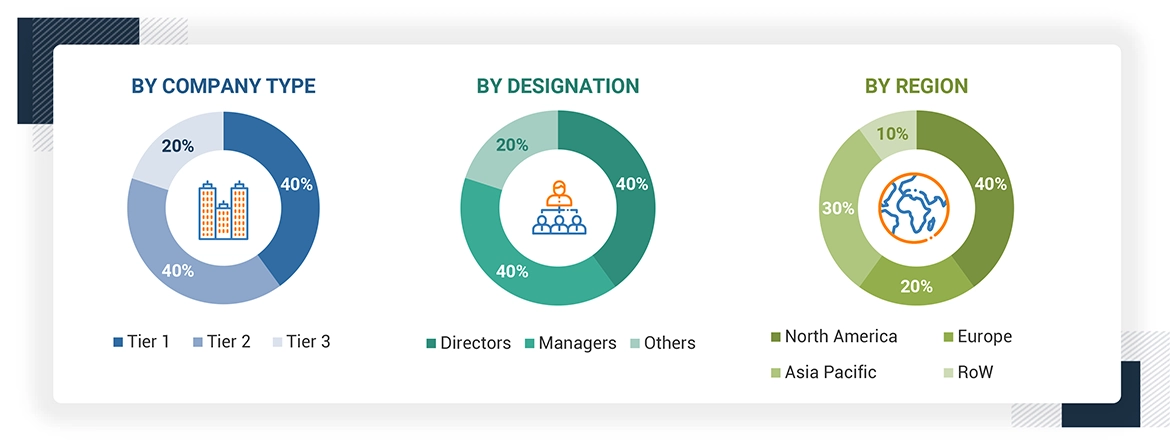
Note: Other designations include sales, marketing, and product managers. Tier 1 = USD 1 billion, Tier 2 = USD 0.5–1.0 billion, and Tier 3 = USD 0.5 billion.
To know about the assumptions considered for the study, download the pdf brochure
Market Size Estimation
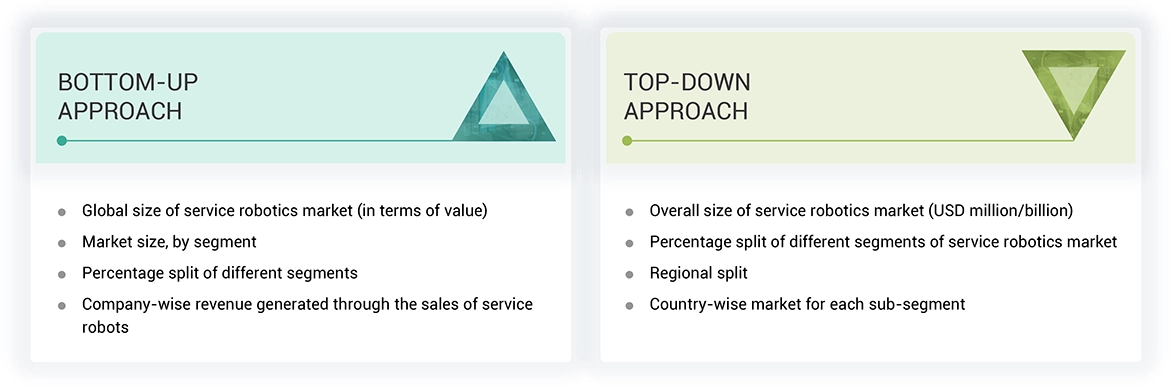
In the complete market engineering process, both top-down and bottom-up approaches have been implemented, along with several data triangulation methods, to estimate and validate the size of the service robotics market and other dependent submarkets listed in this report.
- Extensive secondary research has identified key players in the industry and market.
- In terms of value, the industry’s supply chain and market size have been determined through primary and secondary research processes.
- All percentage shares, splits, and breakdowns have been determined using secondary sources and verified through primary sources.
Service Robotics Market : Top-Down and Bottom-Up Approach
Data Triangulation
After arriving at the overall market size from the estimation process explained above, the global market has been split into several segments and subsegments. Market breakdown and data triangulation procedures have been employed wherever applicable to complete the overall market engineering process and arrive at exact statistics for all segments and subsegments. The data has been triangulated by studying various factors and trends identified from both the demand and supply sides.
Market Definition
A service robot operates with partial assistance or full autonomy to perform services for the well-being of humans or equipment, excluding manufacturing operations. A service robot used for noncommercial tasks is called a personal/domestic robot. This includes robotic vacuum cleaners and elderly assistance robots. A service robot used for commercial tasks and usually operated by a properly trained operator is called a professional robot. This includes surgical robots and automated guided vehicles (AGVs). The scope of the report also includes drones (commercial and consumer) and marine robots [remotely operated vehicles (ROVs), autonomous underwater vehicles (AUVs), and unmanned surface vehicles (USVs)].
Key Stakeholders
- Original equipment manufacturers (OEMs)
- OEM technology solution providers
- Research institutes
- Market research and consulting firms
- Forums, alliances, and associations
- Technology investors
- Governments and financial institutions
- Analysts and strategic business planners
- Existing and prospective end users
Report Objectives
The following are the primary objectives of the study.
- To forecast the size of the service robotics market, by environment, type, component, application, and region, in terms of value
- To define, describe, and forecast the service robotics market size, by type, in terms of volume
- To describe and forecast the market for various segments across four main regions: North America, Asia Pacific, Europe, and the Rest of the World (RoW), in terms of value
- To provide detailed information regarding the drivers, restraints, opportunities, and challenges influencing the growth of the service robotics market
- To study the complete value chain and related industry segments and conduct a value chain analysis of the service robotics market landscape
- To strategically analyze the ecosystem, regulatory landscape, patent landscape, Porter’s Five Forces, import and export scenarios, Gen AI/AI impact, macroeconomic outlook, and case studies pertaining to the market under study
- To strategically analyze micromarkets1 with respect to individual growth trends, prospects, and their contributions to the overall market
- To analyze opportunities for stakeholders by identifying high-growth segments in the market
- To strategically profile the key players and provide a detailed competitive landscape of the service robotics market
- To analyze strategic approaches adopted by leading players in the market, including product launches/developments, mergers, expansions, contracts, and acquisitions
Available Customizations
With the given market data, MarketsandMarkets offers customizations according to a company’s specific needs. The following customization options are available for the report:
Company Information:
- Detailed analysis and profiling of additional market players (up to 5)
Get the Full Service Robotics Market Report
Full forecast, segment splits, and company analysis for all Service Robotics Market.
- US Service Robotics Market
- Canada Service Robotics Market
- Mexico Service Robotics Market
- UK Service Robotics Market
- Germany Service Robotics Market
- France Service Robotics Market
- Italy Service Robotics Market
- Spain Service Robotics Market
- China Service Robotics Market
- Japan Service Robotics Market
- South Korea Service Robotics Market
- India Service Robotics Market
Need a Tailored Report?
Customize this report to your needs
Get 10% FREE Customization
Customize This Report
