
China Simulation Software Market (2024-2029)

The China Simulation Software Market was valued at $1571.2 Million in 2024 and projected to reach to $3158 Million by 2029, representing a compound annual growth rate of 12.3%. China's simulation software market is positioned for sustained growth through 2029, driven by the nation's commitment to manufacturing excellence and technological self-sufficiency.


| Market Size in | USD 26.32 MN |
| Market Forecast in | |
| CAGR | |
| Forecast Period | |
| Units Considered | Value (USD MN) |
China Simulation Software Market Trends and Insights
- This 12.3% compound annual growth rate reflects China's accelerating digital transformation across manufacturing, automotive, aerospace, and defense sectors.
- China's investment in advanced technologies and Industry 4.0 initiatives is driving widespread adoption of simulation tools for product design, testing, and optimization. The Chinese market benefits from strong government support for technological innovation and a rapidly expanding base of engineering professionals.
- China's simulation software adoption is particularly pronounced in automotive and semiconductor industries, where virtual prototyping reduces time-to-market and development costs.
- Between 2024 and 2029, China is expected to capture significant market share within Asia Pacific, supported by increasing R&D spending and the proliferation of cloud-based simulation platforms tailored to Chinese enterprises..
Key Market Statistics
- CAGR (2024-2029) 12.3% CAGR
- Market Size, 2024 ~USD 1571.2 Million
- Forecast, 2029 ~USD 3158 Million
- Country China
China Simulation Software Market Overview
Rapid Market Expansion :
China's simulation software market is growing at 12.3% CAGR, significantly outpacing the global rate of 10.4%, driven by aggressive digital transformation initiatives and Industry 4.0 adoption across manufacturing and automotive sectors.
Manufacturing & Aerospace Dominance :
China's aerospace, defense, and automotive industries are primary adopters of simulation software, leveraging advanced modeling tools to optimize production efficiency, reduce time-to-market, and enhance product quality in competitive global markets.
Government-Backed Digital Initiatives :
Strategic government policies supporting advanced manufacturing and technological innovation are accelerating simulation software adoption, with state-owned enterprises and private manufacturers increasingly investing in digital engineering capabilities.
Market Valuation Growth :
The market is projected to double from USD 1,571.2 million in 2024 to USD 3,158.0 million by 2029, reflecting strong demand for computational modeling, virtual prototyping, and process optimization solutions across industrial sectors.
China Simulation Software Market Dynamics
- The 12.3% CAGR reflects increasing adoption among large-scale manufacturers, automotive OEMs, and aerospace companies seeking to enhance product development cycles and reduce physical prototyping costs.
- Government initiatives promoting Industry 4.0 and digital twin technologies are creating favorable conditions for market expansion. The forecast trajectory to USD 3,158 million by 2029 indicates robust investment in advanced engineering tools and computational capabilities.
- Key growth drivers include rising labor costs incentivizing automation, competitive pressures in global markets, and regulatory requirements for product safety and performance validation.
- Chinese software vendors are also emerging as competitive alternatives, offering localized solutions tailored to regional manufacturing needs and compliance standards..
Market Ecosystem
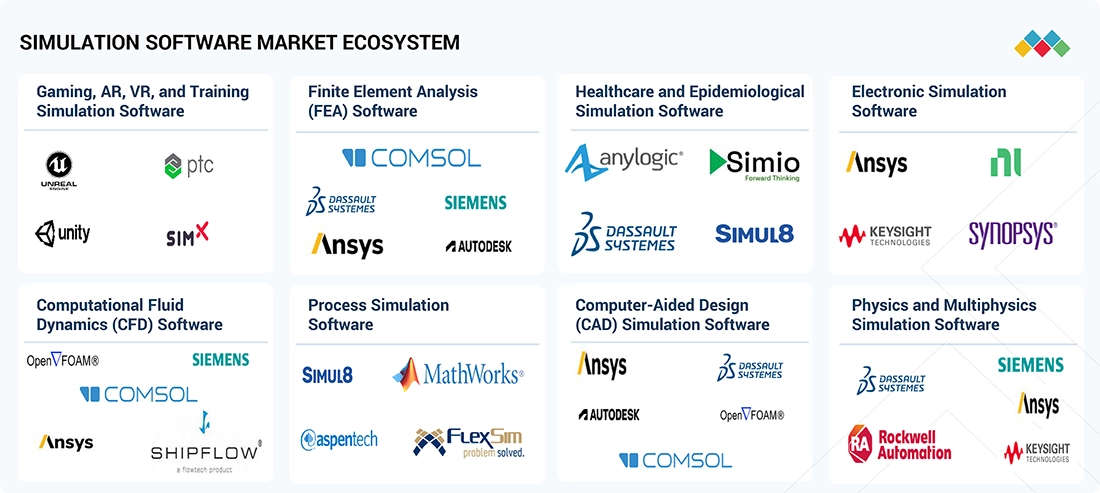
SIMULATION SOFTWARE MARKET: COMMERCIAL USE CASES ACROSS INDUSTRIES
| COMPANY | USE CASE DESCRIPTION | BENEFITS |
|---|---|---|
 |
Altair provided automated FEA post-processing to help NGSC calculate combined stresses from complex NASTRAN outputs efficiently. | Enabled faster, error-free stress calculations, improved collaboration, streamlined engineering workflows, and ensured consistent, repeatable results across multiple structural models. |
 |
Dassault Systèmes supplied EM simulation tools enabling Anywaves to design and optimize miniature satellite antennas for harsh space conditions. | Improved antenna precision, reduced electromagnetic interference, enhanced reliability and performance, and enabled efficient creation of complex 3D-printed ceramic antenna shapes.. |
 |
Siemens delivered 3D CAD and integrated simulation tools to help GEA streamline machinery design, reduce prototypes, and accelerate development. | Lower manufacturing costs, improved product quality and performance, enhanced collaboration, and significantly faster design turnaround using integrated CAD and simulation. |
 |
Ansys provided Fluent and Twin Builder simulation tools to help Wärtsilä build an advanced, integrated battery energy storage model. | Reduced CFD simulation time, improved battery behavior prediction, enhanced design decisions with long-term insights, and validated system performance across development stages. |
 |
Autodesk delivered Moldflow Simulation enabling Napino to improve handle switch case design, minimize defects, and resolve dimensional inaccuracies. | Improved product quality, reduced part warpage, accelerated development, and enabled better confidence and efficiency in resolving complex mold and manufacturing challenges. |
Logos and trademarks shown above are the property of their respective owners. Their use here is for informational and illustrative purposes only.
Related Ecosystem
Software And Services
- Natural Language Processing (NLP)
- Machine Learning
- Supply Chain Management
- Predictive Analytics
- Image Sensors
- International Business Machines Corporation
- MICROSOFT CORPORATION
- Oracle Corporation
- SAP SE
- Amazon.com, Inc.
Space
- C-Band
- Small Satellite
- Antennas
- Ka-Band
- Microsatellite
- AIRBUS
- L3Harris Technologies, Inc.
- Thales group
- Northrop Grumman Corporation
- LOCKHEED MARTIN CORPORATION
Unmanned Systems
- Rotary Wing Aircraft
- Fixed-Wing Drones
- Sensors
- Fuel Cell
- Fixed Wing Aircraft
- LOCKHEED MARTIN CORPORATION
- Northrop Grumman Corporation
- ISRAEL AEROSPACE INDUSTRIES LTD
- Thales group
- BAE Systems plc
Key Takeaways
- China's simulation software market will double from USD 1,571.2M (2024) to USD 3,158.0M (2029), growing at 12.3% CAGR.
- China's automotive and semiconductor sectors are primary drivers of simulation software adoption and investment.
- Government support for Industry 4.0 and digital transformation initiatives accelerates simulation technology deployment across China.
- Cloud-based and localized simulation solutions are gaining traction in China's enterprise market.
Simulation Software Market Report Scope
| Report Metric | Details |
|---|---|
| Base Year | 2024 |
| Fastest Growing Segment | SMES (Enterprise Size) |
| Forecast Period | 2024-2029 |
| Growth Rate | CAGR of 10.4% from 2024 to 2029 |
| Largest Segment | LARGE ENTERPRISES (Organization Size) |
| Market Size Base Year (Billions) | ~USD 20 (2024) |
| Revenue Forecast (Billions) | ~USD 32.81 (2029) |
| Segments Covered | Offering, Software Type, Deployment Mode, Organization Size, Application, Vertical, Enterprise Size, Industry, Component, Deployment Type, Industry Vertical |
China Simulation Software Market Report Segmentation
11 segment dimensions are covered across the global market.
By Offering
- Professional Services
- Software
By Software Type
- Cad Simulation Software
- Cfd
- Computational Fluid Dynamics Software
- Computer-Aided Design Simulation Software
- Electromagnetic Simulation Software
- Electronic Simulation Software
- Fea
- Finite Element Analysis Software
- Gaming, Ar, Vr, And Training Simulation Software
- Healthcare & Epidemiological Simulation Software
- Manufacturing Simulation Software
- Other Software Types
- Physics & Multiphysics Simulation Software
- Process Simulation Software
By Deployment Mode
- Cloud
- On-Premises
By Organization Size
- Large Enterprises
- Smes
By Application
- Automotive & Vehicle Simulation
- Business Optimization
- Engineering, Research, Modeling, And Simulated Testing
- Gamification, Vr, Ar, And Immersive Experience
- Healthcare & Medical Device Simulation
- Inventory Management
- Manufacturing & Process Optimization
- Other Application
- Other Applications
- Performance Monitoring
- Predictive Maintenance
- Product Design & Development
- Supply Chain, Logistics Management, And Transportation
- Urban Planning
By Vertical
- Aerospace & Defense
- Automotive
- Chemicals
- Construction
- Electrical & Electronics
- Gaming
- Healthcare & Pharmaceuticals
- Oil, Gas, And Mining
- Other Verticals
- Shipbuilding & Marine Engineering
By Enterprise Size
- Large Enterprises
- Smes
By Industry
- Aerospace
- Agriculture
- Automotive & Transportation
- Energy & Utilities
- Healthcare
- Infrastructure
- Oil & Gas
- Other Industries
- Retail
- Telecommunications
By Component
- Services
- Solutions
By Deployment Type
- Cloud
- On-Premises
By Industry Vertical
- Aerospace And Defense
- Automotive
- Energy And Utilities
- High-Tech
- Industrial Equipment
- Medical Devices And Components
- Others*
CHINA: SIMULATION SOFTWARE MARKET, BY APPLICATION, 2024–2030
| Segment | 2024 | 2025 | 2026 | 2027 | 2028 | 2029 | 2030 | CAGR (%) |
|---|---|---|---|---|---|---|---|---|
| AUTOMOTIVE & VEHICLE SIMULATION | 327.8 | 369.8 | 416.5 | 468.4 | 526.1 | 589.7 | 657.8 | 12.3 |
| ENGINEERING, RESEARCH, MODELING, AND SIMULATED TESTING | 490.1 | 541.5 | 597.1 | 657.4 | 723 | 793.5 | 866.7 | 10 |
| GAMIFICATION, VR, AR, AND IMMERSIVE EXPERIENCE | 253.3 | 290.2 | 331.9 | 379.1 | 432.4 | 492.2 | 557.5 | 14.1 |
| HEALTHCARE & MEDICAL DEVICE SIMULATION | 167.7 | 195.3 | 226.9 | 263.3 | 305.2 | 353.1 | 406.4 | 15.9 |
| MANUFACTURING & PROCESS OPTIMIZATION | 118.2 | 134.7 | 153.1 | 173.8 | 197.1 | 223.1 | 251.2 | 13.4 |
| OTHER APPLICATIONS | 90.5 | 102.7 | 115.6 | 129.2 | 143.5 | 158.1 | 172.3 | 11.3 |
| SUPPLY CHAIN, LOGISTICS MANAGEMENT, AND TRANSPORTATION | 81.3 | 90.4 | 100.4 | 111.4 | 123.4 | 136.4 | 150 | 10.8 |
| URBAN PLANNING | 42.4 | 48.8 | 56 | 64.3 | 73.7 | 84.3 | 96 | 14.6 |
| TOTAL | 1571.2 | 1773.4 | 1997.5 | 2247 | 2524.4 | 2830.5 | 3158 | 12.3 |
Target Audience
- Software Vendors & Technology Providers : Simulation software companies need China-specific market data to assess market size, growth potential, and competitive positioning, informing product localization, pricing strategies, and sales resource allocation decisions.
- Manufacturing & Industrial Enterprises : Chinese manufacturers and OEMs require market insights to benchmark simulation software adoption rates, identify best-in-class solutions, and justify capital investments in digital engineering capabilities for competitive advantage.
- Investment & Private Equity Firms : Investors evaluating opportunities in China's technology sector need detailed market forecasts and growth drivers to assess portfolio companies, identify acquisition targets, and evaluate market entry timing and valuation multiples.
- Aerospace & Defense Contractors : Chinese aerospace and defense organizations need market intelligence on simulation software adoption trends, regulatory requirements, and technology standards to optimize procurement decisions and supplier selection.
- Management Consultants & Analysts : Consulting firms advising clients on digital transformation and Industry 4.0 initiatives require China-specific market data to develop evidence-based strategies, validate business cases, and support client recommendations.
Reasons to Buy this Report
- Market Size & Growth Validation : Obtain precise market valuation data for China (USD 1,571.2M in 2024) with verified 12.3% CAGR projections through 2029, enabling accurate financial forecasting and investment decision-making for regional expansion strategies.
- Sector-Specific Opportunity Identification : Understand which Chinese industries—manufacturing, automotive, aerospace, and defense—are driving simulation software adoption, allowing targeted product positioning and go-to-market strategies for maximum revenue impact.
- Competitive Landscape Intelligence : Benchmark against global growth rates (10.4%) to identify China's market acceleration drivers, competitive advantages, and emerging local vendors, informing strategic partnerships and market entry approaches.
- Investment & Resource Allocation : Leverage market forecasts projecting USD 3,158M by 2029 to justify R&D investments, sales team expansion, and localization efforts in China's high-growth simulation software segment.
- Policy & Regulatory Context : Gain insights into government-backed digital initiatives and Industry 4.0 policies shaping China's market dynamics, enabling compliance-aligned product development and strategic alignment with national technology priorities.
Frequently asked questions
What is the current size of China's simulation software market?
China's simulation software market was valued at USD 1,571.2 million in 2024.
What is the projected market size for China's simulation software by 2029?
China's simulation software market is forecast to reach USD 3,158.0 million by 2029.
What is the growth rate of China's simulation software market?
China's simulation software market is expected to grow at a compound annual growth rate (CAGR) of 12.3% from 2024 to 2029.
Which industries are driving simulation software adoption in China?
China's automotive, semiconductor, aerospace, and defense sectors are the primary drivers of simulation software adoption and investment.
What factors are supporting growth in China's simulation software market?
Government support for Industry 4.0, increasing R&D spending, digital transformation initiatives, and the rise of cloud-based solutions are key growth factors in China.
RESEARCH METHODOLOGY
Secondary research was conducted to collect information useful for this technical, market-oriented, and commercial study of the global simulation software market. The next step was to validate these findings, assumptions, and sizing with industry experts across the value chain using primary research. Different approaches, such as top-down and bottom-up, were employed to estimate the total market size. After that, the market breakup and data triangulation procedures were used to estimate the market size of the segments and subsegments of the market.
Secondary Research
In the secondary research process, various secondary sources were referred to identify and collect information related to the study. Secondary sources included simulation software news, simulation software foundations, annual reports, press releases, investor presentations of simulation software vendors, forums, certified publications, and whitepapers. The secondary research was used to obtain software segmentation from the market and technology-oriented perspectives.
Primary Research
In the primary research process, various primary sources from the supply and demand sides of the simulation software market were interviewed to obtain qualitative and quantitative information for the study. The primary sources from the supply side included industry experts, such as Chief Executive Officers (CEOs), Vice Presidents (VPs), marketing directors, technology and innovation directors, and related key executives of various vendors providing simulation software solutions, tools and applications, associated service providers, and system integrators operating in the targeted regions. All possible parameters that affect the market covered in this research study have been accounted for, viewed in extensive detail, verified through primary research, and analyzed to obtain the final quantitative and qualitative data.
After the complete market engineering process (including calculations for market statistics, market breakups, market size estimations, market forecasting, and data triangulation), extensive primary research was conducted to gather information and verify and validate the critical numbers arrived at. The primary research helped identify and validate the segmentation types, industry trends, key players, a competitive landscape of simulation software solutions, tools, and applications offered by several market vendors, and fundamental market dynamics, such as drivers, restraints, opportunities, challenges, industry trends, and key strategies.
In the complete market engineering process, the bottom-up and top-down approaches and several data triangulation methods were extensively used to estimate and forecast the overall market segments and subsegments listed in this report. An extensive qualitative and quantitative analysis was performed on the complete market engineering process to list the key information/insights throughout the report.
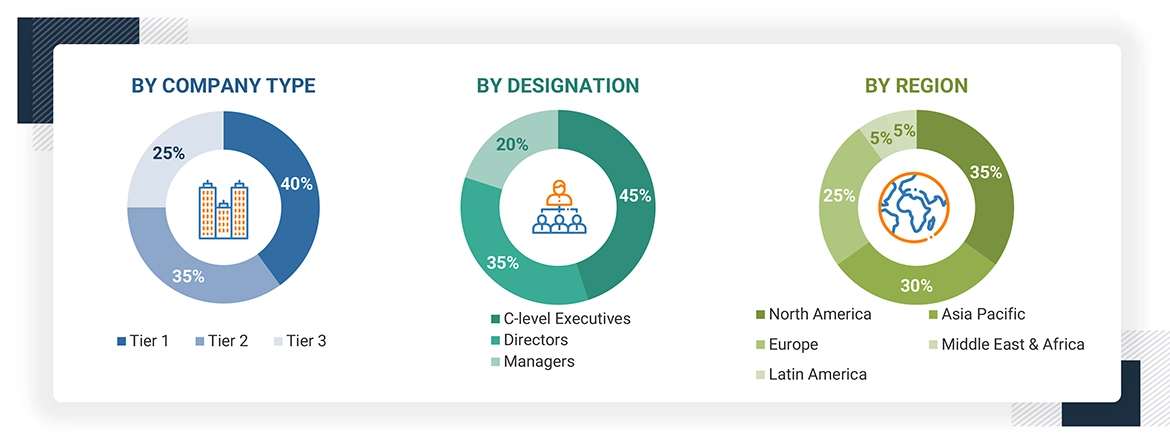
Note: Other levels include sales, marketing, and product managers.
Tier 1 companies receive revenues higher than USD 10 billion; Tier 2 companies' revenues range between USD 1 and 10 billion; and Tier 3 companies' revenues range between USD 500 million and USD 1 billion.
Source: Industry Experts
To know about the assumptions considered for the study, download the pdf brochure
Market Size Estimation
Top-down and bottom-up approaches were used to estimate and validate the simulation software market's size and various other dependent sub-segments in the overall simulation software market. The research methodology used to estimate the market size includes the following details: key players in the market were identified through secondary research, and their market shares in the respective regions were determined through primary and secondary research. This entire procedure included the study of the annual and financial reports of the top market players, and extensive interviews were conducted for key insights from the industry leaders, such as CEOs, VPs, directors, and marketing executives.
All percentage splits and breakdowns were determined using secondary sources and verified through primary sources. All possible parameters that affect the market covered in this research study have been accounted for, viewed in extensive detail, verified through primary research, and analyzed to get the final quantitative and qualitative data. This data is consolidated and added to detailed inputs and analysis from MarketsandMarkets.
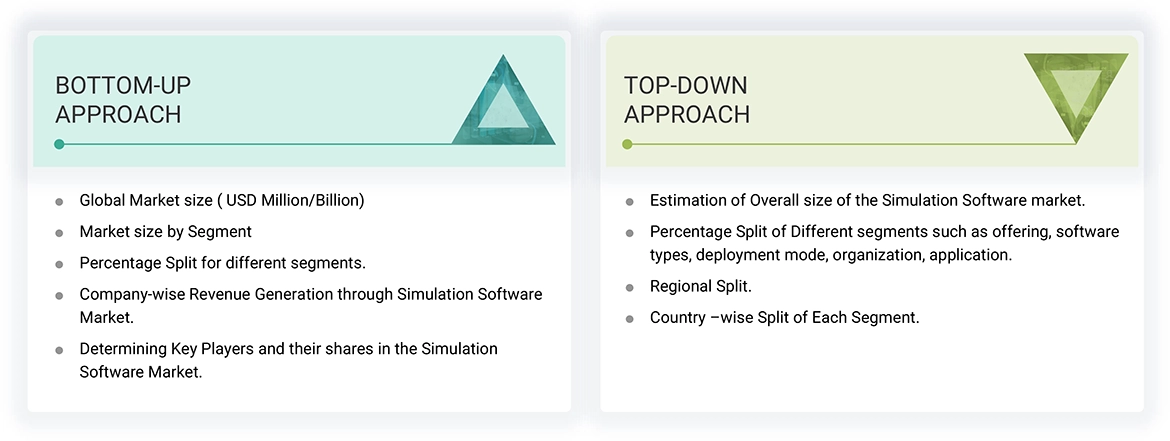
Data Triangulation
After arriving at the overall market size using the market size estimation processes explained above, the market was split into several segments and subsegments. The data triangulation and market breakup procedures were employed, wherever applicable, to complete the overall market engineering process and arrive at the exact statistics of each market segment and subsegment. The data was triangulated by studying various factors and trends from both the demand and supply sides.
Market Definition
Simulation software refers to a tool that models real-world environments to predict system behavior under various conditions, such as mechanical stress, thermal changes, or fluid dynamics. By utilizing mathematical models expressed as diagrams or code, it evaluates new designs, diagnoses existing issues, and tests scenarios that are difficult to reproduce. The software breaks down complex geometries into discrete structures, calculating how these elements interact with real-world forces. Additionally, it features visualization tools, such as data displays and 3D animations, to monitor the simulation process and enhance understanding of the system's performance over time.
Stakeholders
- Chief technology and data officers
- Simulation service professionals
- Business analysts
- Information Technology (IT) professionals
- Investors and venture capitalists
- Third-party providers
- Consultants/Consultancies/Advisory firms
- Product designers/Computer-aided software engineers
- System integrators
- Value-added Resellers (VARs)
Report Objectives
- To describe and forecast the global Simulation Software market based on offering, software type, deployment mode, organization size, application, vertical, and region
- To provide detailed information about the major factors (drivers, opportunities, restraints, and challenges) influencing the growth of the market
- To analyze the opportunities for stakeholders by identifying the high-growth segments of the market
- To forecast the size of the market segments with respect to five regions: North America, Europe, Middle East & Africa, Asia Pacific and Latin America
- To analyze subsegments of the market with respect to individual growth trends, prospects, and contributions to the overall market
- To profile the key players and comprehensively analyze their market sizes and core competencies
- To track and analyze competitive developments such as product enhancements and new product launches, acquisitions, and partnerships and collaborations in the market globally
Available Customizations
With the given market data, MarketsandMarkets offers customizations based on company-specific needs. The following customization options are available for the report:
Geographic Analysis
- Further breakup of the Asia Pacific market into countries contributes to the rest of the regional market size.
- Further breakup of the North American market into countries contributes to the rest of the regional market size.
- Further breakup of the Latin American market into countries contributes to the rest of the regional market size.
- Further breakup of the Middle East & African market into countries contributing to the rest of the regional market size
- Further breakup of the European market into countries contributes to the rest of the regional market size.
Company Information
- Detailed analysis and profiling of additional market players (up to 5)
Get the Full Simulation Software Market Report
Full forecast, segment splits, and company analysis for all Simulation Software Market.
- Canada Simulation Software Market
- US Simulation Software Market
- UK Simulation Software Market
- Germany Simulation Software Market
- France Simulation Software Market
- Italy Simulation Software Market
- Japan Simulation Software Market
- India Simulation Software Market
- Singapore Simulation Software Market
- UAE Simulation Software Market
- South Africa Simulation Software Market
- Brazil Simulation Software Market
- Mexico Simulation Software Market
- Rest Of Europe Simulation Software Market
- Rest Of Asia Pacific Simulation Software Market
- Rest Of Latin America Simulation Software Market
- GCC Countries Simulation Software Market
- Ksa Simulation Software Market
- Rest Of GCC Countries Simulation Software Market
Need a Tailored Report?
Customize this report to your needs
Get 10% FREE Customization
Customize This Report
