
South Korea Single-use Bioprocessing Market (2025-2030)

The South Korea Single-use Bioprocessing Market was valued at $194 Million in 2025 and projected to reach to $385.2 Million by 2030, representing a compound annual growth rate of 14.7%. South Korea's single-use bioprocessing market is poised for accelerated growth through 2030, driven by the country's expanding biopharmaceutical sector and increasing adoption of single-use technologies in manufacturing.


| Market Size in | USD 26.32 MN |
| Market Forecast in | |
| CAGR | |
| Forecast Period | |
| Units Considered | Value (USD MN) |
South Korea Single-use Bioprocessing Market Trends and Insights
- This represents a compound annual growth rate of 14.7%, outpacing global averages and reflecting South Korea's strengthening position in biopharmaceutical manufacturing.
- South Korea's advanced healthcare infrastructure, coupled with increasing investments in biologics production, is driving adoption of single-use technologies that offer cost efficiency and operational flexibility. The market growth in South Korea is underpinned by rising demand for monoclonal antibodies, vaccines, and cell-based therapies.
- South Korea's biopharmaceutical sector is leveraging single-use bioprocessing systems to accelerate time-to-market and reduce capital expenditure.
- Between 2025 and 2030, South Korea is expected to see significant expansion in contract manufacturing organizations (CMOs) and contract development and manufacturing organizations (CDMOs) adopting single-use platforms. South Korea's regulatory environment and skilled workforce continue to attract both domestic and international biotech companies seeking manufacturing partnerships.
- The country's emphasis on innovation and quality standards positions South Korea as a key hub for single-use bioprocessing adoption in the Asia Pacific region..
Key Market Statistics
- CAGR (2025-2030) 14.7% CAGR
- Market Size, 2025 ~USD 194 Million
- Forecast, 2030 ~USD 385.2 Million
- Country South Korea
South Korea Single-use Bioprocessing Market Overview
Market Valuation & Growth :
South Korea's single-use bioprocessing market is valued at $194.0 million in 2025, with a robust CAGR of 14.7% through 2030, significantly outpacing the global growth rate of 13.3%.
Biopharmaceutical Manufacturing Hub :
South Korea is establishing itself as a key biopharmaceutical manufacturing center in Asia-Pacific, leveraging advanced healthcare infrastructure and government support for biotech innovation and contract manufacturing services.
Regulatory & Infrastructure Advantages :
Strong regulatory frameworks, world-class GMP facilities, and government incentives for biotech development position South Korea as an attractive destination for single-use bioprocessing technology adoption and investment.
Projected Market Expansion :
The market is forecast to nearly double from $194.0 million (2025) to $385.2 million (2030), driven by increased biopharmaceutical production capacity, cell therapy development, and vaccine manufacturing initiatives.
South Korea Single-use Bioprocessing Market Dynamics
- Government initiatives supporting biotech innovation, combined with rising demand for cost-effective and flexible manufacturing solutions, are propelling market expansion.
- The country's advanced healthcare infrastructure and skilled workforce create a competitive advantage for contract manufacturing organizations (CMOs) and biopharmaceutical companies seeking to establish or expand production capabilities. Key growth catalysts include the rising prevalence of chronic diseases, increased investment in cell and gene therapy development, and South Korea's strategic positioning as a regional manufacturing hub.
- The shift toward single-use systems—driven by reduced contamination risk, lower capital expenditure, and faster time-to-market—is accelerating adoption across biopharmaceutical manufacturers.
- With continued government support and private sector investment, South Korea is expected to capture significant market share in Asia-Pacific's bioprocessing landscape..
Market Ecosystem
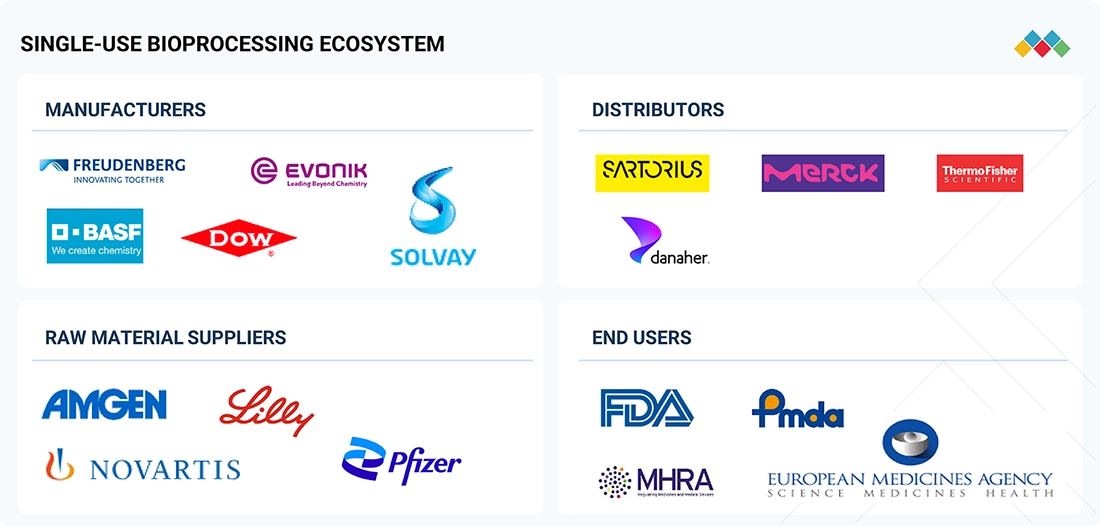
single use bioprocessing market: COMMERCIAL USE CASES ACROSS INDUSTRIES
| COMPANY | USE CASE DESCRIPTION | BENEFITS |
|---|---|---|
 |
Implemented a 100% closed single-use cell-culture facility, scalable 50–2,000 L single-use equipment, designed and started up within ~18 months; included process simulation, full USP/DSP design, and automation (DCU/MFCS) | Faster startup (18 months from ground-breaking)| 62% lower equipment investment vs stainless | Water/steam savings per batch (≈141,000 L WFI; 205,500 L purified water; 148 kg steam) | Multi-product flexibility meeting US/EU/China cGMP standards |
 |
Transferred an antibody production process onto Cytiva Xcellerex (XDR) single-use bioreactors across development and production scales; executed risk assessments (film, agitation, gassing), ran 200 L engineering runs with in-process monitoring (e.g., CO2), and benchmarked against commercial-scale (2,000 L) operations | Achieved process comparability on viable cell density, viability, integral viable cell count, and titer| Established a second qualified SUB platform to enhance capacity and supply resilience | Demonstrated ability to operate multiple 2,000 L XDRs in parallel (aggregate working volume to ~12,000 L) without compromising product quality |
 |
Partnered with Sartorius to deliver a flexible mammalian SUB facility for mAbs/recombinant proteins/ADCs in ~18 months, centered on Biostat STR and related single-use technologies | High reliability and scalability of SUB platform | Reported 100% cell-culture success rate with 0% contamination post-startup | Flexible, multi-product cGMP capacity aligned to US/EU/China requirements and “just-in-time” batch scheduling |
Logos and trademarks shown above are the property of their respective owners. Their use here is for informational and illustrative purposes only.
Related Ecosystem
Biotechnology
- Reagents
- Polymerase Chain Reaction (PCR)
- Stem Cells
- Assay Kits
- Flow Cytometers
- Thermo Fisher Scientific Inc.
- Merck KGaA
- Danaher Corporation
- Agilent Technologies, Inc.
- Bio-Rad Laboratories, Inc.
Key Takeaways
- South Korea's single-use bioprocessing market will nearly double from $194.0M (2025) to $385.2M (2030) at a 14.7% CAGR.
- South Korea's biopharmaceutical sector is increasingly adopting single-use technologies to reduce manufacturing costs and accelerate product development.
- South Korea's CMOs and CDMOs are expanding single-use bioprocessing capacity to meet growing demand for biologics manufacturing.
- South Korea's regulatory framework and skilled workforce position the country as a competitive hub for single-use bioprocessing in Asia Pacific.
Single-use Bioprocessing Market Report Scope
| Report Metric | Details |
|---|---|
| Base Year | 2025 |
| Fastest Growing Segment | CONSUMABLES (Product) |
| Forecast Period | 2025–2030 |
| Growth Rate | CAGR of 13.3% from 2025 to 2030 |
| Largest Segment | CONSUMABLES (Product) |
| Market Size Base Year (Billions) | ~USD 18.03 (2025) |
| Revenue Forecast (Billions) | ~USD 33.67 (2030) |
| Segments Covered | Product, Type, Scale Range, Scale |
South Korea Single-use Bioprocessing Market Report Segmentation
4 segment dimensions are covered across the global market.
By Product
- Consumables
- Equipment
By Type
- 2D Bags & Containers
- 3D Bags & Containers
- Bag Assemblies
- Bottle Assemblies
- Filtration Assemblies
- Mixing System Assemblies
- Other Assemblies
- Other Single-Use Consumables
- Other Single-Use Equipment
- Single-Use Assemblies
- Single-Use Bags & Containers
- Single-Use Bioreactors
- Single-Use Chromatography Columns
- Single-Use Chromatography Systems
- Single-Use Filters
- Single-Use Filtration Systems
- Single-Use Mixing Systems
- Single-Use Sensors
By Scale Range
- 101–500 L Bioreactors
- 11–100 L Bioreactors
- 501–1,500 L Bioreactors
- >1,500 L Bioreactors
- =10 L Bioreactors
By Scale
- Manufacturing-Scale Filtration Systems
- Manufacturing-Scale Mixing Systems
- Pilot-Scale Filtration Systems
- Pilot-Scale Mixing Systems
- R&D-Scale Filtration Systems
- R&D-Scale Mixing Systems
Target Audience
- Biopharmaceutical Manufacturers : South Korean and international biopharmaceutical companies seeking to optimize manufacturing operations, reduce costs, and scale production using single-use bioprocessing technologies and local CMO partnerships.
- Contract Manufacturing Organizations (CMOs) : CMOs operating in or expanding into South Korea need market intelligence to identify growth opportunities, benchmark capacity utilization, and understand demand drivers for single-use bioprocessing services.
- Equipment & Technology Suppliers : Manufacturers of single-use bioprocessing equipment, consumables, and software solutions require South Korea-specific market data to develop localized strategies and identify key customer segments.
- Private Equity & Venture Capital Investors : Investment firms evaluating biotech and manufacturing opportunities in South Korea need detailed market sizing, growth projections, and competitive landscape analysis to inform investment decisions.
- Government & Policy Organizations : South Korean government agencies and industry associations require market intelligence to develop biotech policies, allocate resources, and support the country's positioning as a regional manufacturing hub.
Reasons to Buy this Report
- Market-Specific Growth Intelligence : Gain detailed insights into South Korea's 14.7% CAGR trajectory and understand the unique drivers accelerating market expansion faster than global averages, enabling strategic investment and expansion decisions.
- Competitive Positioning Analysis : Identify opportunities to establish or expand manufacturing operations in South Korea's growing biopharmaceutical ecosystem, with detailed analysis of regulatory advantages and infrastructure capabilities.
- Technology Adoption Trends : Understand South Korea-specific adoption patterns for single-use bioprocessing technologies across CMOs, biopharmaceutical companies, and emerging cell/gene therapy manufacturers in the region.
- Investment & Partnership Opportunities : Discover high-potential partnerships, acquisition targets, and investment opportunities within South Korea's rapidly expanding biotech sector and contract manufacturing landscape.
- Regulatory & Market Entry Strategy : Access South Korea-specific regulatory insights, compliance requirements, and market entry strategies to accelerate commercialization and operational launch in this high-growth market.
Frequently asked questions
What is the current market size of single-use bioprocessing in South Korea?
South Korea's single-use bioprocessing market was valued at $194.0 million in 2025 and is projected to grow to $385.2 million by 2030.
What is the growth rate of South Korea's single-use bioprocessing market?
South Korea's single-use bioprocessing market is growing at a compound annual growth rate (CAGR) of 14.7% from 2025 to 2030.
Which sectors are driving single-use bioprocessing adoption in South Korea?
South Korea's biopharmaceutical sector, particularly monoclonal antibody, vaccine, and cell-based therapy manufacturers, is driving single-use bioprocessing adoption.
Why is South Korea a key market for single-use bioprocessing?
South Korea's advanced healthcare infrastructure, skilled workforce, supportive regulatory environment, and growing CMO/CDMO sector make it a strategic hub for single-use bioprocessing in Asia Pacific.
What are the main advantages of single-use bioprocessing systems in South Korea?
Single-use bioprocessing systems in South Korea offer reduced capital expenditure, faster time-to-market, improved operational flexibility, and lower contamination risk compared to traditional stainless steel systems.
RESEARCH METHODOLOGY
This research study involved the extensive use of secondary sources, directories, and databases to identify and collect valuable information to analyze the global single-use bioprocessing market. In-depth interviews were conducted with various primary respondents, including key industry participants, subject-matter experts (SMEs), C-level executives of key market players, and industry consultants, to obtain and verify critical qualitative and quantitative information and assess the growth prospects of the market. The global market size estimated through secondary research was then triangulated with inputs from primary research to arrive at the final market size.
Secondary Research
Secondary research was used mainly to identify and collect information for the extensive, technical, market-oriented, and commercial study of the single-use bioprocessing market. The secondary sources used for this study include the World Health Organization (WHO), the National Institutes of Health (NIH), the United States Food and Drug Administration (US FDA), the National Institute for Bioprocessing Research and Training (NIBRT), the Society for Biological Engineering (SBE), Bio-Process Systems Alliance (BPSA), the European Patent Office (EPO), Pharmaceuticals Export Promotion Council of India (Pharmexcil), India Brand Equity Foundation (IBEF), Biotechnology Innovation Organization (BIO), the National Center for Biotechnology Information (NCBI), BioPharm International, EvaluatePharma, ScienceDirect, BioProcess International, Journal of Bioprocessing and Biotechni ques, BioPlan Associates, Eurostat, and Factiva, research journals; corporate filings, such as annual reports, SEC filings, investor presentations, and financial statements; press releases; trade, business, professional associations and among others. These sources were also used to obtain key information about major players, market classification, and segmentation according to industry trends, regional/country-level markets, market developments, and technology perspectives.
Primary Research
After acquiring foundational knowledge about the global single-use bioprocessing market through secondary research, extensive primary research was conducted. Multiple interviews were held with market experts from the demand side, including representatives from pharmaceutical and biotechnology companies, contract manufacturing organizations (CMOs) & contract research organizations (CROs), and academic & research institutes. Additionally, experts from the supply side were interviewed, including C-level and D-level executives, product managers, and marketing and sales managers from key manufacturers, distributors, and channel partners.
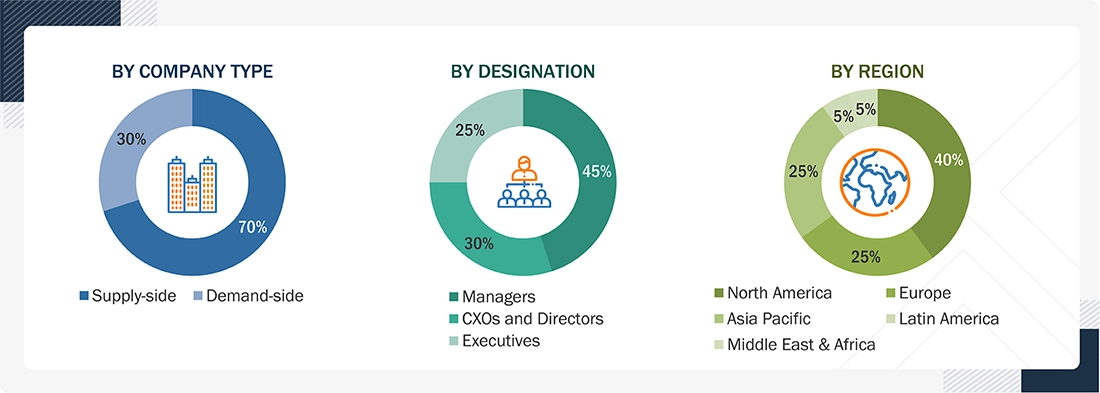
These interviews spanned five major regions: North America, Europe, Asia Pacific, Latin America, the Middle East, and Africa. Approximately 70% of the primary interviews were conducted with supply-side participants, while the remaining 30% were with demand-side participants. The primary data was collected through various methods, including questionnaires, emails, online surveys, personal interviews, and telephone interviews.
The following is a breakdown of the primary respondents:
To know about the assumptions considered for the study, download the pdf brochure
Market Size Estimation
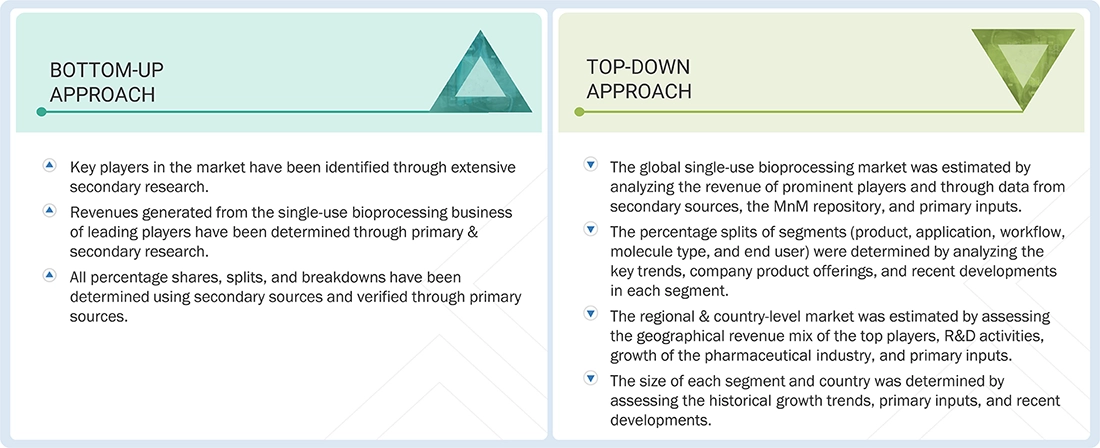
Both top-down and bottom-up approaches were used to estimate and validate the total size of the single-use bioprocessing market. These methods were also used extensively to estimate the size of various subsegments in the market. The research methodology used to estimate the market size includes the following:
After arriving at the overall market size from the estimation process, the total market was split into several segments and subsegments.
Data Triangulation
After arriving at the market size from the estimation process explained above, the total market was divided into several segments and subsegments. To complete the overall market engineering process and arrive at the exact statistics for all segments and subsegments, data triangulation and market breakdown procedures were employed, wherever applicable. The data was triangulated by studying various factors and trends from both the demand and supply sides.
Market Definition
Single-use bioprocessing refers to the use of disposable, pre-sterilized equipment and consumables in the production of biopharmaceutical products. Single-use technologies (SUTs) include a range of products, such as bioreactors, mixers, filters, tubing, connectors, and storage bags, all designed for one-time use. Key benefits of single-use bioprocessing include reduced risk of cross-contamination, low capital and operational costs, faster turnaround times, and greater flexibility in manufacturing. These advantages make single-use systems particularly attractive to produce biologics, vaccines, and personalized medicines, where flexibility, speed, and sterility are paramount.
Stakeholders
- Single-use bioprocessing equipment and consumables manufacturing companies
- Single-use bioprocessing equipment and consumables distributors
- Pharmaceutical and biotechnology companies
- Contract manufacturing companies (CMOs)
- Contract research organizations (CROs)
- Academic and research institutes
- Life science companies
- Market research and consulting firms
- Venture capitalists and investors
- Government organizations
- Private research firms
Report Objectives
- To define, describe, and forecast the single-use bioprocessing market, by product, application, workflow, molecule type, and end user, in terms of value
- To forecast the size of the market segments with respect to six main regions: North America, Europe, Asia Pacific, Latin America, the Middle East, and Africa, in terms of value
- To provide detailed information regarding the major factors influencing market growth, such as drivers, restraints, opportunities, and challenges
- To strategically analyze micromarkets with respect to individual growth trends, prospects, and contributions to the overall single-use bioprocessing market
- To analyze opportunities in the market for stakeholders and provide details of the competitive landscape for market leaders
- To profile key players in the single-use bioprocessing market and comprehensively analyze their product portfolios, market positions, and core competencies
- To track and analyze competitive developments in the single-use bioprocessing market, such as acquisitions, product launches, expansions, agreements, partnerships, and collaborations
- To benchmark players within the single-use bioprocessing market using the ‘Company Evaluation Matrix’ framework, which analyzes market players based on various parameters within the broad categories of business strategy and product strategy
Get the Full Single-use Bioprocessing Market Report
Full forecast, segment splits, and company analysis for all Single-use Bioprocessing Market.
- Germany Single-use Bioprocessing Market
- UK Single-use Bioprocessing Market
- France Single-use Bioprocessing Market
- Italy Single-use Bioprocessing Market
- Spain Single-use Bioprocessing Market
- China Single-use Bioprocessing Market
- Japan Single-use Bioprocessing Market
- India Single-use Bioprocessing Market
- Australia Single-use Bioprocessing Market
- Brazil Single-use Bioprocessing Market
- Mexico Single-use Bioprocessing Market
- UAE Single-use Bioprocessing Market
- Canada Single-use Bioprocessing Market
- US Single-use Bioprocessing Market
Need a Tailored Report?
Customize this report to your needs
Get 10% FREE Customization
Customize This Report
