
Middle East Single-Use Bioreactors Market (2026-2031)

The Middle East Single-Use Bioreactors Market was valued at $94.1 Million in 2026 and projected to reach to $135.1 Million by 2031, representing a compound annual growth rate of 7.5%. The Middle East single-use bioreactors market is positioned for steady growth as regional biopharmaceutical manufacturers prioritize operational efficiency and contamination control.


| Market Size in | USD 26.32 MN |
| Market Forecast in | |
| CAGR | |
| Forecast Period | |
| Units Considered | Value (USD MN) |
Middle East Single-Use Bioreactors Market Trends and Insights
- The Middle East's biopharmaceutical sector is increasingly adopting single-use bioreactor technology to enhance manufacturing flexibility and reduce contamination risks.
- This growth trajectory reflects the Middle East's commitment to developing advanced biotech capabilities and reducing dependency on imported biologics. Driving this expansion, the Middle East is witnessing rising investments in biomanufacturing infrastructure and government initiatives supporting pharmaceutical innovation.
- The Middle East's regulatory environment is becoming more conducive to cell and gene therapy production, attracting both regional and international biotech companies.
- By 2031, the Middle East is expected to solidify its position as a key hub for single-use bioreactor adoption in the broader MENA region..
Key Market Statistics
- CAGR (2026-2031) 7.5% CAGR
- Market Size, 2026 ~USD 94.1 Million
- Forecast, 2031 ~USD 135.1 Million
- Geography Middle East
Middle East Single-Use Bioreactors Market Overview
Market Valuation Growth :
The Middle East single-use bioreactors market is valued at $94.1 million in 2026 and is projected to reach $135.1 million by 2031, representing a robust 7.5% CAGR over the forecast period.
Biopharmaceutical Sector Expansion :
The Middle East's biopharmaceutical industry is increasingly adopting single-use bioreactor technology to enhance manufacturing flexibility, reduce contamination risks, and accelerate time-to-market for biologics and biosimilars.
Regional Investment in Biotech Infrastructure :
Saudi Arabia and the UAE are leading regional investments in advanced biomanufacturing facilities, driving demand for single-use bioreactor systems that support cost-effective and scalable production capabilities.
Competitive Advantage vs. Global Market :
While the Middle East grows at 7.5% CAGR, the global market expands at 12% CAGR, indicating significant untapped potential and opportunities for market penetration and technology adoption in the region.
Middle East Single-Use Bioreactors Market Dynamics
- Government initiatives in Saudi Arabia and the UAE to develop domestic biotech capabilities are accelerating adoption of single-use technologies, which offer reduced capital expenditure and faster facility setup compared to traditional stainless-steel systems. Over the 2026-2031 forecast period, the market will benefit from increasing investments in GMP-compliant manufacturing facilities, rising demand for personalized medicine production, and growing partnerships with global biopharmaceutical companies.
- The region's strategic focus on becoming a biotech hub will continue to drive single-use bioreactor adoption, though growth rates remain below the global average, reflecting the market's emerging maturity and infrastructure development stage..
Market Ecosystem
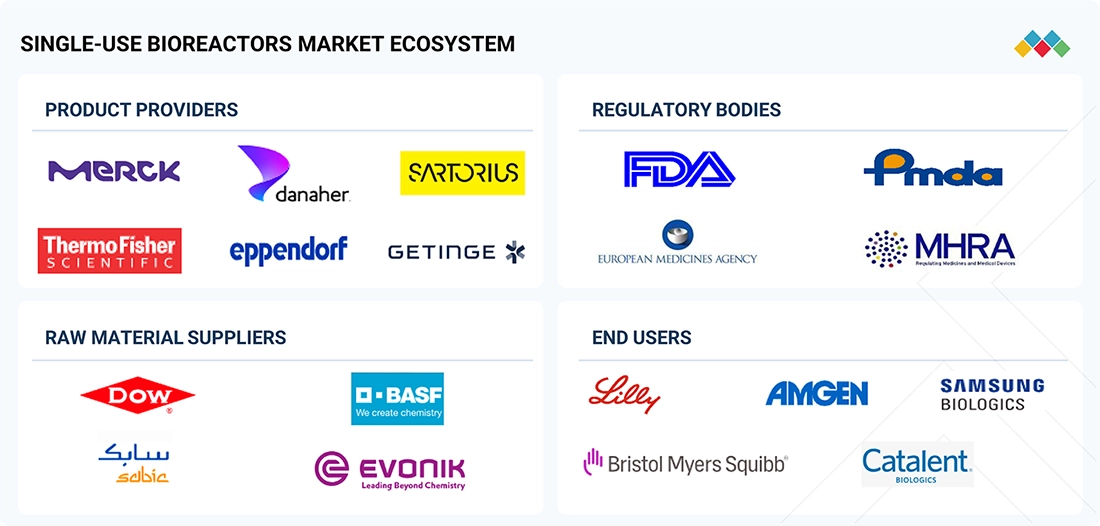
SINGLE-USE BIOREACTORS MARKET: COMMERCIAL USE CASES ACROSS INDUSTRIES
| COMPANY | USE CASE DESCRIPTION | BENEFITS |
|---|---|---|
 |
Deployed six 4,000 L ABEC CSR single-use bioreactors at its Pune facility to support large-scale manufacturing of Novavax’s NVX-CoV2373 vaccine. | Established 24,000 L of single-use production capacity | The 4,000 L systems doubled productivity per unit of floor space, supported accelerated facility startup, and reduced manufacturing cost per dose. |
 |
Implemented Cytiva Xcellerex Disposable Reactors (XDR) for mAb and bispecific antibody production. | Demonstrated that XDR bioreactors can be used effectively for antibody production | The system met all benchmarks for viable cell density, viability, integral viable cell count (IVC), and titer | The real-time CO2 monitoring proved effective, allowing maintenance of optimal culture conditions. |
 |
Implemented Sartorius Ambr and BIOSTAT STR platforms, ranging from process-development systems to 500 L and 2,000 L single-use bioreactors, at its San Diego biologics facility. | Enabled consistent scale-up from development to GMP production, improved process-data continuity, and supported seamless technology transfer for Phase I through commercial biologics manufacturing. |
Logos and trademarks shown above are the property of their respective owners. Their use here is for informational and illustrative purposes only.
Related Ecosystem
Biotechnology
- Reagents
- Polymerase Chain Reaction (PCR)
- Stem Cells
- Assay Kits
- Flow Cytometers
- Thermo Fisher Scientific Inc.
- Merck KGaA
- Danaher Corporation
- Agilent Technologies, Inc.
- Bio-Rad Laboratories, Inc.
Key Takeaways
- The Middle East single-use bioreactors market is valued at $94.1 million in 2026 and will reach $135.1 million by 2031, representing a 7.5% CAGR.
- The Middle East is investing heavily in biomanufacturing infrastructure to support local production of biologics and reduce import dependency.
- The Middle East's regulatory framework is increasingly supportive of advanced therapies, driving adoption of single-use bioreactor technology.
- The Middle East is emerging as a regional hub for contract manufacturing organizations (CMOs) leveraging single-use bioreactor platforms.
Single-Use Bioreactors Market Report Scope
| Report Metric | Details |
|---|---|
| Base Year | 2026 |
| Fastest Growing Segment | CELL & GENE THERAPY (Molecule Type) |
| Forecast Period | 2026-2031 |
| Growth Rate | CAGR of 12% from 2026 to 2031 |
| Largest Segment | BIOPRODUCTION (Application) |
| Market Size Base Year (Billions) | ~USD 5.44 (2026) |
| Revenue Forecast (Billions) | ~USD 9.58 (2031) |
| Segments Covered | Product, Scale Range, Type, Molecule Type, Cell Type, Application, Process Mode, End User |
Middle East Single-Use Bioreactors Market Report Segmentation
8 segment dimensions are covered across the global market.
By Product
- Other Products
- Single-Use Assemblies
- Single-Use Bags
- Single-Use Bioreactor Systems
By Scale Range
- 101-500 L Bioreactors
- 11-100 L Bioreactors
- 501-1,500 L Bioreactors
- >1,500 L Bioreactors
- <=10 L Bioreactors
By Type
- 101-500 L Bioreactors
- 11-100 L Bioreactors
- 2D Single-Use Bags
- 3D Single-Use Bags
- 501-1,500 L Bioreactors
- >1,500 L Bioreactors
- Bubble-Column Single-Use Bioreactors
- Fixed-Bed Single-Use Bioreactors
- Other Single-Use Bioreactors
- Stirred-Tank Single-Use Bioreactors
- Wave-Induced Single-Use Bioreactors
- <=10 L Bioreactors
By Molecule Type
- Cell & Gene Therapy
- Monoclonal Antibodies
- Therapeutic Proteins & Peptides
- Vaccines
By Cell Type
- Bacterial Cells
- Mammalian Cells
- Other Cells
- Yeast Cells
By Application
- Bioproduction
- Process Development
- Research & Development
By Process Mode
- Batch Process Mode
- Feb-Batch Process Mode
- Fed-Batch Process Mode
- Perfusion/Continuous Process Mode
By End User
- Academic & Research Institutes
- Cros & Cmos
- Pharmaceutical & Biotechnology Companies
Target Audience
- Biopharmaceutical Manufacturers : Middle Eastern biotech and pharma companies seeking to adopt single-use bioreactor technology for cost-effective, scalable production of biologics, biosimilars, and personalized medicines.
- Equipment & Technology Suppliers : Global and regional bioreactor manufacturers and suppliers evaluating market entry, expansion, and sales strategies in the Middle East's growing biopharmaceutical sector.
- Healthcare & Government Agencies : Saudi Arabia's Vision 2030 and UAE biotech initiatives require market intelligence to guide infrastructure investments, regulatory policies, and support for domestic biomanufacturing capabilities.
- Investment & Private Equity Firms : Investors analyzing biotech opportunities in the Middle East need regional market data to assess growth potential, identify acquisition targets, and evaluate portfolio companies' competitive positioning.
- Contract Manufacturing Organizations (CMOs) : Regional and international CMOs expanding operations in the Middle East require market insights to justify capital investments in single-use bioreactor facilities and service offerings.
Countries within Middle East - compare and drill down
| Country | 2025 size (native) |
|---|---|
| Saudi Arabia (KSA) | USD 15.1 Million |
| United Arab Emirates (UAE) | USD 7.7 Million |
| GCC Countries | USD 2.1 Million |
| Rest Of GCC Countries | USD 5.5 Million |
| Rest Of Middle East | USD 2.4 Million |
Country market size visualization
Reasons to Buy this Report
- Regional Market Sizing & Forecasts : Obtain precise market valuations for the Middle East ($94.1M in 2026, $135.1M in 2031) with country-level breakdowns for Saudi Arabia, UAE, and GCC nations to support strategic planning and investment decisions.
- Competitive Landscape Analysis : Understand market dynamics specific to the Middle East, including key players, technology adoption rates, and competitive positioning to identify partnership and expansion opportunities in the region.
- Growth Driver Identification : Gain insights into region-specific factors driving 7.5% CAGR growth, including government biotech initiatives, manufacturing facility investments, and regulatory developments unique to Middle Eastern markets.
- Investment & Expansion Strategy : Leverage detailed market intelligence to develop targeted go-to-market strategies, identify high-potential customer segments, and prioritize resource allocation across Middle Eastern countries.
- Regulatory & Compliance Insights : Access region-specific regulatory frameworks, GMP requirements, and compliance standards for single-use bioreactor deployment in Saudi Arabia, UAE, and other GCC countries to mitigate market entry risks.
Frequently asked questions
What is the current market size of single-use bioreactors in the Middle East?
The Middle East single-use bioreactors market was valued at $94.1 million in 2026 and is expected to grow to $135.1 million by 2031.
What is the projected growth rate for the Middle East single-use bioreactors market?
The Middle East single-use bioreactors market is projected to grow at a compound annual growth rate (CAGR) of 7.5% from 2026 to 2031.
Why is the Middle East adopting single-use bioreactor technology?
The Middle East is adopting single-use bioreactors to enhance manufacturing flexibility, reduce contamination risks, lower capital expenditure, and support local biopharmaceutical production capabilities.
Which sectors in the Middle East are driving single-use bioreactor demand?
The Middle East's biopharmaceutical, cell and gene therapy, and contract manufacturing organization (CMO) sectors are primary drivers of single-use bioreactor adoption.
What government initiatives are supporting the Middle East bioreactor market?
The Middle East governments are implementing policies and investments to develop biomanufacturing infrastructure, attract biotech companies, and establish regional pharmaceutical innovation hubs.
RESEARCH METHODOLOGY
This research study relied extensively on secondary sources, directories, and databases to identify and collect valuable information for the analysis of the global single-use bioreactors market. In-depth interviews were conducted with various primary respondents, including key industry participants, subject-matter experts (SMEs), C-level executives at major market players, and industry consultants, to gather and validate critical qualitative and quantitative information and assess the market's growth prospects. The global market size estimated through secondary research was then triangulated with primary research inputs to arrive at the final market size.
Secondary Research
Secondary research was used mainly to identify and collect information for the extensive, technical, market-oriented, and commercial study of the single-use bioreactors market. The secondary sources used for this study include National Institutes of Health (NIH), National Institute for Bioprocessing Research and Training (NIBRT), Society for Biological Engineering (SBE), Bio-Process Systems Alliance (BPSA), Biotechnology Innovation Organization (BIO), BioProcess International, BioPharm International, BioPlan Associates, Organisation for Economic Co-operation and Development (OECD) R&D Expenditure, National Center for Biotechnology Information (NCBI), World Health Organization (WHO), Food and Drug Administration (FDA); corporate filings such as annual reports, SEC filings, investor presentations, and financial statements; press releases; and trade, business, and professional associations, among others. These sources were also used to obtain key information on major players, market classification and segmentation aligned with industry trends, regional/country-level markets, market developments, and technology perspectives.
Primary Research
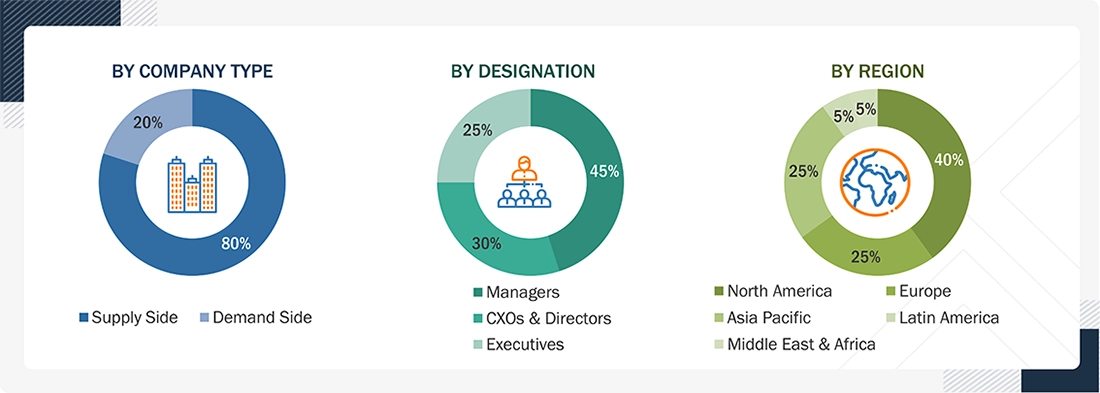
In-depth interviews were conducted with various primary respondents, including key industry participants, subject-matter experts (SMEs), C-level executives of key market players, and industry consultants, among others, to obtain and verify critical qualitative and quantitative information and to assess the market's future prospects. Various primary sources from both the supply and demand sides of the market were interviewed to obtain qualitative and quantitative information. The following is a breakdown of the primary respondents:
To know about the assumptions considered for the study, download the pdf brochure
Market Size Estimation
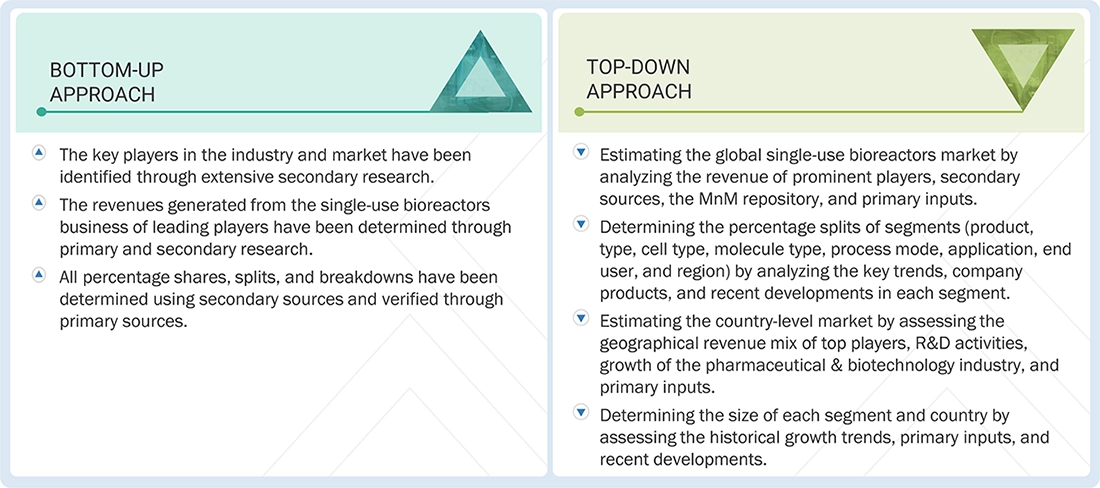
Both top-down and bottom-up approaches were used to estimate and validate the total size of the single-use bioreactors market. These methods were also used extensively to estimate the size of various market subsegments. The research methodology used to estimate the market size includes the following:
Data Triangulation
After arriving at the market size from the market size estimation process explained above, the total market was divided into several segments and subsegments. To complete the overall market engineering process and obtain precise statistics for all segments and subsegments, data triangulation and market breakdown procedures were employed where applicable. The data was triangulated by studying various factors and trends from both the demand and supply sides.
Market Definition
Single-use bioreactors (SUBs) or disposable bioreactors consist of a disposable bag instead of a typical stainless steel or glass culture vessel. SUBs are based on single-use technology, which uses disposable components to manufacture biopharmaceutical products. The key benefits of single-use bioreactors include reduced risk of cross-contamination, lower capital and operational costs, faster turnaround times, and greater manufacturing flexibility. These advantages make single-use systems particularly attractive for producing biologics, vaccines, and personalized medicines, where flexibility, speed, and sterility are paramount.
The report presents the market size for single-use bioreactor systems, single-use bags, single-use assemblies, and other products that can be incorporated with single-use bioreactors.
Key Stakeholders
- Manufacturers of single-use bioreactors and associated products
- Distributors of single-use bioreactors and related products
- Pharmaceutical and biotechnology companies
- Contract manufacturing companies (CMOs)
- Contract research organizations (CROs)
- Academic and research institutes
- Life sciences companies
- Market research and consulting firms
- Venture capitalists and investors
- Government organizations
- Medical institutes and universities
- Private research firms
Report Objectives
- To define, describe, and forecast the global single-use bioreactors market based on product, type, cell type, process mode, molecule type, application, end user, and region
- To provide detailed information regarding the major factors influencing the growth of the market (such as drivers, restraints, opportunities, and challenges)
- To strategically analyze micromarkets with respect to individual growth trends, future prospects, and contributions to the overall single-use bioreactors market
- To analyze opportunities in the market for stakeholders and provide details of the competitive landscape for market leaders
- To forecast the size of the market segments with respect to six main regions, namely, North America, Europe, Asia Pacific, Latin America, the Middle East, and Africa
- To strategically profile the key players and comprehensively analyze their product portfolios, market positions, and core competencies
- To track and analyze competitive developments such as acquisitions, product launches, expansions, and R&D activities in the single-use bioreactors market
- To analyze and provide funding & investment activities, brand/product comparative analysis, and vendor valuation & financial metrics of the single-use bioreactors market
Available customizations:
Based on the given market data, MarketsandMarkets offers customization to meet the company’s specific needs. The following customization options are available for this report:
Portfolio Assessment- Product Matrix, which gives a detailed comparison of the product portfolios of the top four companies.
Company Information
- Detailed analysis and profiling of additional market players (up to five).
Geographical Analysis
- A further breakdown of the Rest of Europe single-use bioreactors market, by country
- A further breakdown of the Rest of Asia Pacific single-use bioreactors market, by country
- A further breakdown of the Rest of Latin America single-use bioreactors market, by country
Get the Full Single-Use Bioreactors Market Report
Full forecast, segment splits, and company analysis for all Single-Use Bioreactors Market.
- Canada Single-Use Bioreactors Market
- US Single-Use Bioreactors Market
- Germany Single-Use Bioreactors Market
- UK Single-Use Bioreactors Market
- France Single-Use Bioreactors Market
- Italy Single-Use Bioreactors Market
- Spain Single-Use Bioreactors Market
- China Single-Use Bioreactors Market
- South Korea Single-Use Bioreactors Market
- Japan Single-Use Bioreactors Market
- India Single-Use Bioreactors Market
- Australia Single-Use Bioreactors Market
- Brazil Single-Use Bioreactors Market
- Mexico Single-Use Bioreactors Market
- Rest Of Europe Single-Use Bioreactors Market
- Rest Of Asia Pacific Single-Use Bioreactors Market
- Rest Of Latin America Single-Use Bioreactors Market
- Rest Of GCC Countries Single-Use Bioreactors Market
- Saudi Arabia (Ksa) Single-Use Bioreactors Market
- United Arab Emirates (UAE) Single-Use Bioreactors Market
- GCC Countries Single-Use Bioreactors Market
- Rest Of Middle East Single-Use Bioreactors Market
Need a Tailored Report?
Customize this report to your needs
Get 10% FREE Customization
Customize This Report
