
Australia Smart Agriculture Market (2024-2029)

The Australia Smart Agriculture Market was valued at $859.7 Million in 2024 and projected to reach to $1360.7 Million by 2029, representing a compound annual growth rate of 9.6%. Australia's smart agriculture market is positioned for sustained expansion as farmers embrace digital transformation to address productivity challenges and sustainability goals.


| Market Size in | USD 26.32 MN |
| Market Forecast in | |
| CAGR | |
| Forecast Period | |
| Units Considered | Value (USD MN) |
Australia Smart Agriculture Market Trends and Insights
- Australia is leveraging advanced semiconductor and electronics technologies to modernize farming operations, driven by increasing adoption of precision agriculture, IoT sensors, and data analytics platforms.
- The market in Australia reflects strong demand from large-scale agricultural producers seeking to optimize crop yields and resource efficiency across diverse climatic regions. The 9.6% compound annual growth rate in Australia underscores the country's commitment to agricultural innovation and digital transformation.
- Australia's smart agriculture sector benefits from favorable government policies, substantial investment in agritech infrastructure, and a mature farming industry eager to adopt cutting-edge solutions.
- Between 2024 and 2029, Australia will see accelerated deployment of connected devices, automated irrigation systems, and AI-powered farm management platforms tailored to local agricultural challenges..
Key Market Statistics
- CAGR (2024-2029) 9.6% CAGR
- Market Size, 2024 ~USD 859.7 Million
- Forecast, 2029 ~USD 1360.7 Million
- Country Australia
Australia Smart Agriculture Market Overview
Market Valuation Growth :
Australia's smart agriculture market is valued at USD 859.7 million in 2024, with a projected CAGR of 9.6% through 2029, reaching USD 1,360.7 million by forecast end.
Precision Agriculture Adoption :
Australian farmers are increasingly adopting precision agriculture technologies, including IoT sensors, drones, and automated irrigation systems to optimize crop yields and reduce resource consumption.
Data Analytics Integration :
Data-driven decision-making is transforming Australian agricultural operations, with analytics platforms enabling real-time monitoring of soil conditions, weather patterns, and livestock health metrics.
Semiconductor Technology Demand :
Growing reliance on advanced semiconductor and electronics components in farm equipment, sensors, and connectivity solutions is driving innovation across Australia's agricultural sector.
Australia Smart Agriculture Market Dynamics
- The 9.6% CAGR reflects strong investment in IoT infrastructure, sensor networks, and cloud-based farm management systems tailored to Australia's unique climate and landscape conditions.
- Government initiatives promoting agricultural innovation and increasing labor costs are accelerating technology adoption across both large-scale operations and regional farms.
- By 2029, the market will be characterized by deeper integration of AI-powered analytics, autonomous farming equipment, and real-time environmental monitoring solutions..
Market Ecosystem
Related Ecosystem
Precision Agriculture
- Sensors
- Global Positioning System (GPS)
- Camera Systems
- Data Services
- Platform as A Service (PaaS)
- MITSUBISHI AGRICULTURAL MACHINERY
- MSK FARM MACHINERY CORPORATION
- MITSUBISHI CHEMICAL AGRI DREAM
- Trimble Inc.
- Deere & Company
Drones And Robotics
- Sensors
- Articulated Robots
- Cartesian Robots
- Scara Robots
- Actuators
- ABB India Limited
- KUKA AG
- MOMENTIVE PERFORMANCE MATERIALS INC.
- STAUBLI INTERNATIONAL AG
- Fanuc Corporation
Electronics System And Components
- Sensors
- Temperature Sensors
- Pressure Sensors
- Actuators
- Image Sensors
- Lenovo
- Samsung
- Texas Instruments Incorporated
- HONEYWELL INTERNATIONAL INC.
- Teledyne Technologies Incorporated
Key Takeaways
- Australia's smart agriculture market will grow from USD 859.7M (2024) to USD 1,360.7M (2029) at a 9.6% CAGR.
- Australia is adopting precision agriculture and IoT technologies to address water scarcity and optimize resource management.
- Large-scale agricultural producers in Australia are driving demand for data analytics and automated farm management solutions.
- Australia's favorable regulatory environment and agritech investment support sustained market expansion through 2029.
Smart Agriculture Market Report Scope
| Report Metric | Details |
|---|---|
| Base Year | 2024 |
| Fastest Growing Segment | SOFTWARE (Offering) |
| Forecast Period | 2024-2029 |
| Growth Rate | CAGR of 10.2% from 2024 to 2029 |
| Largest Segment | HARDWARE (Offering) |
| Market Size Base Year (Billions) | ~USD 14.39 (2024) |
| Revenue Forecast (Billions) | ~USD 23.38 (2029) |
| Segments Covered | Farm Size, Agriculture Type, Offering, Hardware Type, Device Type, Sensor Type, Software Deployment Type, Service Type, Technology, Type, Farm Type, Service Type 2024-2029, Sub-Type, Deployment Type, Application, Sub-Application |
Australia Smart Agriculture Market Report Segmentation
16 segment dimensions are covered across the global market.
By Farm Size
- Large
- Large (>10 Ha)
- Large (>200 Animals)
- Large (>500 Ha)
- Medium
- Medium (100 To 200 Animals)
- Medium (5 To 10 Ha)
- Medium (50 To 500 Ha)
- Small
- Small (<100 Animals)
- Small (<5 Ha)
- Small (<50 Ha)
By Agriculture Type
- Livestock Monitoring
- Other Agriculture Type
- Other Agriculture Types
- Precision Aquaculture
- Precision Farming
- Precision Forestry
- Smart Greenhouse
By Offering
- Hardware
- Services
- Software
By Hardware Type
- Automation And Control Systems
- Cameras
- Cameras Systems
- Control Systems
- Gps
- Harvester & Forwarder
- Hvac Systems
- Irrigation Systems
- Led Grow Lights
- Material Handling Equipment
- Monitoring Devices
- Other Hardware Types
- Rfid Tags & Reader
- Sensing And Monitoring Devices
- Sensors
- Sensors & Cameras
- Sensors And Rfid
- Transmitters & Mounting Equipment
- Uavs/Drones
- Valves & Pumps
- Variable Rate Controller
By Device Type
- Climate Sensors
- Display
- Drones/Uavs
- Flow And Application Control Devices
- Gps/Gnss
- Guidance & Steering
- Handheld Mobile Devices/Handheld Computers
- Irrigation Controller
- Other Device Types
- Soil Sensors
- Water Sensors
- Yield Monitors
By Sensor Type
- Moisture Sensor
- Nutrient Sensor
- Temperature Sensor
By Software Deployment Type
- On-Cloud
- On-Premise
By Service Type
- Assisted Professional Service
- Connectivity Service
- Maintenance & Support
- Maintenance And Support
- Managed Service
- System Integration & Consulting
By Technology
- Cut-To-Length (Ctl)
- Fire Detection
- Geospatial
- Guidance Technology
- Remote Sensing
- Variable Rate Technology
By Type
- Gis-Based
- Gps/Gnss-Based
- Ground Based/Airborne Sensors
- Map-Based
- Satellite
- Sensor-Based
By Farm Type
- Dairy Farm
- Other Farm Types
- Poultry Farm
- Swine Farm
By Service Type 2024-2029
- Assisted Professional Service
- Connectivity Service
- Maintenance & Support
- Managed Service
- System Integration & Consulting
By Sub-Type
- Cannabis
- Horticulture
- Hydroponic
- Non-Hydroponic
- Orchids
By Deployment Type
- On-Cloud
- On-Premise
By Application
- Livestock Monitoring
- Other Applications
- Precision Aquaculture
- Precision Farming
- Precision Forestry
- Smart Greenhouse
By Sub-Application
- Animal Comfort Management
- Behavior Monitoring & Control
- Breeding Management
- Crop Scouting
- Farm Labor Management
- Feeding Management
- Field Mapping
- Financial Management
- Genetics And Nurseries
- Harvesting Management
- Heat Stress Management
- Hvac Management
- Inventory And Logistics Management
- Inventory Management
- Milk Harvesting Management
- Monitoring, Control, And Surveillance
- Silviculture And Fire Management
- Variable Rate Application
- Water & Fertilizer Management
- Weather Tracking & Forecasting
- Yield Monitoring
- Yield Monitoring & Harvesting
Target Audience
- Agricultural Technology Vendors : Manufacturers and suppliers of IoT sensors, farm management software, and automation equipment need Australia-specific market data to tailor products and develop localized go-to-market strategies.
- Semiconductor & Electronics Manufacturers : Component suppliers require insights into Australian agricultural demand for semiconductors, sensors, and connectivity solutions to forecast production and identify growth opportunities.
- Investment & Private Equity Firms : Investors evaluating agritech opportunities in Australia need validated market sizing, growth projections, and regional trends to make informed funding and acquisition decisions.
- Government & Policy Makers : Australian agricultural and technology policy leaders use market research to design support programs, subsidies, and regulations that foster smart farming adoption and innovation.
- Farm Operators & Agricultural Cooperatives : Large-scale farmers and regional cooperatives need market intelligence on available technologies, ROI benchmarks, and adoption trends to guide digital transformation investments.
Reasons to Buy this Report
- Market Size & Growth Validation : Confirm Australia's smart agriculture market valuation (USD 859.7M in 2024) and validate 9.6% CAGR projections to 2029 for strategic planning and investment decisions.
- Regional Competitive Intelligence : Understand Australia-specific market dynamics, key players, and technology adoption patterns to identify competitive advantages and market entry opportunities in the region.
- Technology Trend Analysis : Gain insights into which semiconductor and electronics technologies are gaining traction in Australian agriculture, including IoT, sensors, and data analytics platforms.
- Investment & Expansion Planning : Use Australia-focused market data to evaluate expansion feasibility, assess regional demand for smart agriculture solutions, and prioritize resource allocation.
- Stakeholder Alignment : Present credible, country-specific market research to investors, partners, and internal teams to support business cases and strategic initiatives in the Australian market.
Frequently asked questions
What is the current size of Australia's smart agriculture market?
Australia's smart agriculture market was valued at USD 859.7 million in 2024 and is expected to reach USD 1,360.7 million by 2029.
What is the projected growth rate for smart agriculture in Australia?
Australia's smart agriculture market is projected to grow at a compound annual growth rate (CAGR) of 9.6% from 2024 to 2029.
Which technologies are driving Australia's smart agriculture adoption?
Australia is adopting IoT sensors, precision agriculture systems, data analytics platforms, automated irrigation, and AI-powered farm management solutions.
What are the key challenges in Australia's smart agriculture market?
Australia faces challenges including high implementation costs, digital literacy gaps among farmers, and the need for robust connectivity infrastructure in remote agricultural regions.
Who are the primary adopters of smart agriculture in Australia?
Large-scale agricultural producers, grain farmers, and livestock operators in Australia are the primary adopters seeking to optimize yields and resource efficiency.
RESEARCH METHODOLOGY
The study involved major activities in estimating the current market size for the smart agriculture market. Exhaustive secondary research was done to collect information on the smart agriculture industry. The next step was to validate these findings, assumptions, and sizing with industry experts across the value chain using primary research. Different approaches, such as top-down and bottom-up, were employed to estimate the total market size. After that, the market breakup and data triangulation procedures were used to estimate the market size of the segments and subsegments of the smart agriculture market.
Secondary Research
The market for the companies offering smart agriculture solutions and services is arrived at by secondary data available through paid and unpaid sources, analysing the offering portfolios of the major companies in the ecosystem, and rating the companies by their performance and quality. Various sources were referred to in the secondary research process to identify and collect information for this study. The secondary sources include annual reports, press releases, investor presentations of companies, white papers, journals, certified publications, and articles from recognized authors, directories, and databases. In the secondary research process, various secondary sources have been referred to for identifying and collecting information required for this study. The secondary sources include annual reports, press releases, and investor presentations of companies, white papers, and articles from recognized authors. Secondary research has been mainly done to obtain key information about the market’s value chain, the pool of key market players, market segmentation according to industry trends, regional outlook and developments from both market and technology perspectives
Primary Research
In primary research, various primary sources from both supply and demand sides have been interviewed to obtain qualitative and quantitative insights required for this report. Primary sources from supply side include experts such as CEOs, vice presidents, marketing directors, manufacturers, technology and innovation directors, end users and related executives from multiple key companies and organizations operating in the smart agriculture market ecosystem.
After market engineering that includes calculations for market statistics, market breakdown, market size estimations, market forecasting, and data triangulation, extensive primary research has been conducted to verify and validate critical market numbers.
Primary research has also been conducted to identify segmentation types, industry trends, key players, and analyze the competitive landscape and key factors affecting the market dynamics, such as drivers, restraints, opportunities, industry trends, and key growth strategies. In the market engineering process, both the top-down and bottom-up approaches have been extensively used along with data triangulation methods to estimate and forecast the size of the smart agriculture market, including the overall market segments and subsegments as listed in the report. Extensive qualitative and quantitative analysis has been done on the complete market engineering process to include important information and insights throughout the report.
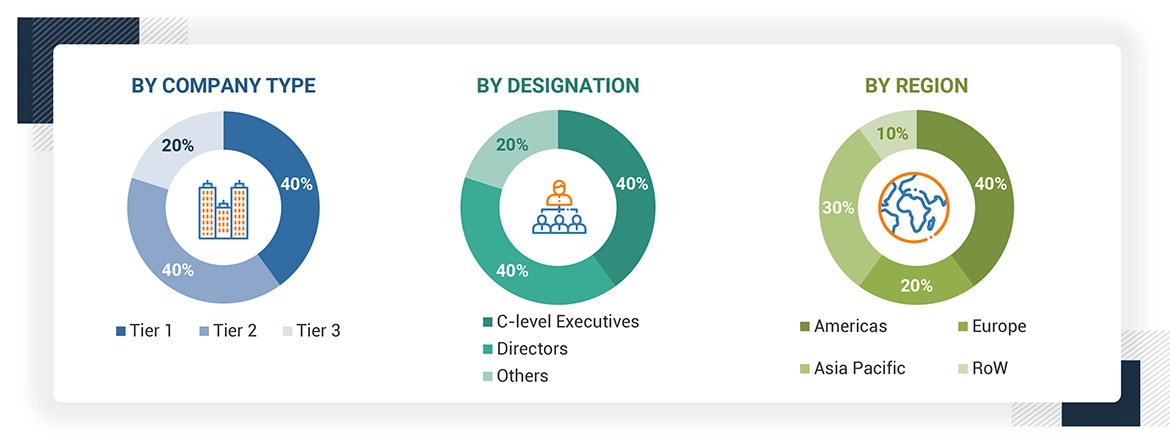
Note: “Others” includes sales, marketing, and product managers
To know about the assumptions considered for the study, download the pdf brochure
Market Size Estimation
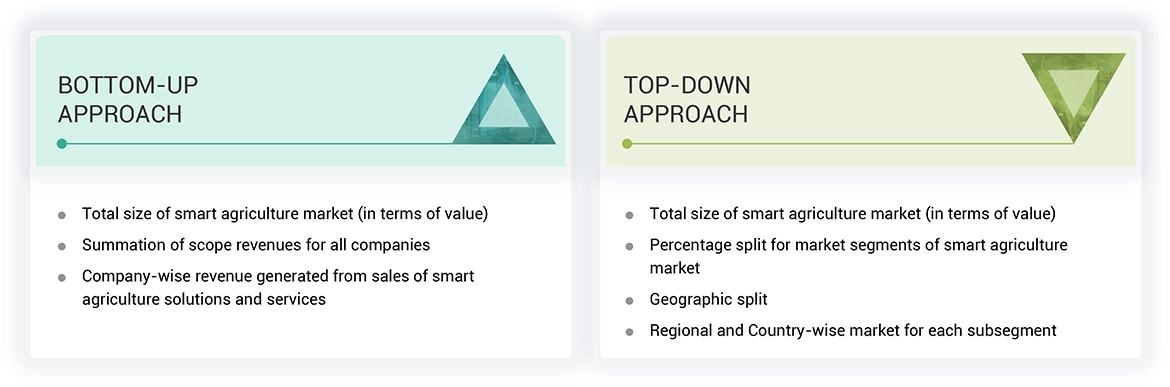
Top-down and bottom-up approaches have been used to estimate and validate the size of the smart agriculture market. The key players in the market have been identified through secondary research, and their market shares in respective regions have been determined through primary and secondary research. This entire research methodology includes the study of key insights by top players, as well as interviews with experts (such as CXOs, vice presidents, directors, and marketing executives) for quantitative and qualitative key insights. All percentage shares, splits, and breakdowns have been determined using secondary sources and verified through primary sources. All parameters that affect markets covered in this research study were accounted for, viewed in detail, verified through primary research, and analyzed to obtain the final quantitative and qualitative data. This data has been competitive and supplemented with detailed inputs and analysis from the MarketsandMarkets data repository and presented in this report.
Smart Agriculture Market : Top-Down and Bottom-Up Approach
Data Triangulation
After arriving at the overall market size by the market size estimation process explained in the earlier section, the overall smart agriculture market has been divided into several segments and subsegments. To complete the overall market engineering process and arrive at the exact statistics for all segments, the data triangulation and market breakdown procedures have been used, wherever applicable. The data has been triangulated by studying various factors and trends from both the demand and supply side perspectives. Along with data triangulation and market breakdown, the market has been validated by top-down and bottom-up approaches.
Market Definition
Smart agriculture leverages advanced technologies such as the Internet of Things (IOT), sensors, location tracking systems, robotics, and artificial intelligence (Al) to enable agricultural processes and reduce the manual labour and other resources. This approach aims on improving both the quality and quantity of crop yields while minimizing operational expenses. Moreover, data gathered from these advanced devices delivers valuable insights, that supports farmers to make informed and efficient decisions towards farm management.
Key Stakeholders
- Agriculture Equipment Component Suppliers
- Electronics Component and Device Manufacturers
- Original Equipment Manufacturers (OEMs)
- Product Manufacturers
- Agriculture Component and Device Suppliers and Distributors
- Software, Service, and Technology Providers
- Standardization and Testing Firms
- Government Bodies such as Regulatory Authorities and Policymakers
- Research Institutes and Organizations
- Market Research and Consulting Firms
- Agri-food Buyers
Report Objectives
- To define, analyze and forecast the smart agriculture market size, by agriculture type, offering, farm size, and application in terms of value
- To define, analyze and forecast the market size, by application, in terms of volume
- To forecast the market size for various segments with respect to four main regions, namely, Americas, Europe, Asia Pacific, and Rest of the World (RoW)
- To provide detailed information regarding the major drivers, restraints, opportunities, and challenges influencing the growth of the smart agriculture market
- To study the complete value chain and related industry segments for the market
- To strategically analyze the micromarkets with respect to individual growth trends, prospects, and contributions to the total market
- To analyze the value chain, market ecosystem; trends/disruptions impacting customer’s business; technology analysis; pricing analysis; Porter’s five forces model; key stakeholders & buying criteria; investment and funding; impact of Gen AI/AI; case study analysis; trade analysis; patent analysis; key conferences & events, 2024–2025; regulations related to the smart agriculture market; and investment and funding scenario.
- To analyze opportunities in the market for various stakeholders by identifying the high-growth segments of the market.
- To strategically profile the key players and comprehensively analyze their market position in terms of ranking, core competencies, company valuation and financial metrics and product/brand comparison; along with detailing the competitive landscape for the market leaders.
- To analyze competitive developments such as product launches, brand launches, product developments, collaborations, joint ventures, partnerships, agreements, contracts, acquisitions, expansions and research and development (R&D) activities carried out by players in the smart agriculture market.
Available Customizations
With the given market data, MarketsandMarkets offers customizations according to the specific requirements of companies. The following customization options are available for the report:
- Detailed analysis and profiling of additional market players (up to 5)
- Detailed analysis of additional countries (up to 5)
- Detailed analysis of smart agriculture solutions and services
Get the Full Smart Agriculture Market Report
Full forecast, segment splits, and company analysis for all Smart Agriculture Market.
- China Smart Agriculture Market
- India Smart Agriculture Market
- Japan Smart Agriculture Market
- Rest Of Asia Pacific Smart Agriculture Market
- South Korea Smart Agriculture Market
- Argentina Smart Agriculture Market
- Brazil Smart Agriculture Market
- Rest Of South America Smart Agriculture Market
- GCC Countries Smart Agriculture Market
- Rest Of Middle East Smart Agriculture Market
- Canada Smart Agriculture Market
- Mexico Smart Agriculture Market
- US Smart Agriculture Market
- France Smart Agriculture Market
- Germany Smart Agriculture Market
- Italy Smart Agriculture Market
- Netherlands Smart Agriculture Market
- Rest Of Europe Smart Agriculture Market
- UK Smart Agriculture Market
Need a Tailored Report?
Customize this report to your needs
Get 10% FREE Customization
Customize This Report
