
India Smart Appliances Market (2025-2030)

The India Smart Appliances Market was valued at $2889.6 Million in 2025 and projected to reach to $6131.8 Million by 2030, representing a compound annual growth rate of CAGR 16.2%. India's smart appliances market is poised for exceptional growth, expanding from USD 2,889.6 million in 2025 to USD 6,131.8 million by 2030.


| Market Size in | USD 26.32 MN |
| Market Forecast in | |
| CAGR | |
| Forecast Period | |
| Units Considered | Value (USD MN) |
India Smart Appliances Market Trends and Insights
- This accelerated expansion significantly outpaces the global average of 11% CAGR, positioning India as a high-growth market within the Asia Pacific region.
- India's rising middle class, increasing disposable incomes, and growing urbanization are driving widespread adoption of connected home devices across residential and commercial segments. The smart appliances market in India is fueled by rapid digital transformation, government initiatives promoting smart cities, and declining costs of IoT-enabled devices.
- India's young demographic and tech-savvy consumer base are increasingly embracing smart refrigerators, washing machines, air conditioners, and kitchen appliances that offer convenience and energy efficiency.
- Between 2025 and 2030, India is expected to witness substantial investments from both domestic and international manufacturers seeking to capitalize on the country's expanding consumer base and favorable regulatory environment..
Key Market Statistics
- CAGR (2025-2030) CAGR 16.2%
- Market Size, 2025 ~USD 2889.6 Million
- Forecast, 2030 ~USD 6131.8 Million
- Country India
India Smart Appliances Market Overview
Exceptional Growth Trajectory :
India's smart appliances market is growing at 16.2% CAGR, significantly outpacing the global average of 11%, driven by rapid urbanization and digital adoption across tier-2 and tier-3 cities.
Rising Middle Class Expansion :
India's expanding middle class with increasing disposable income is fueling demand for connected home solutions, smart kitchen appliances, and IoT-enabled devices across urban and semi-urban households.
Government Digital Initiatives :
Government programs promoting smart cities, digital infrastructure, and Make in India initiatives are accelerating smart appliance adoption and attracting semiconductor manufacturers to establish local production facilities.
E-commerce Penetration :
Rapid growth of e-commerce platforms and online retail channels in India is making smart appliances more accessible to consumers, reducing distribution barriers and enabling faster market penetration.
India Smart Appliances Market Dynamics
- This 16.2% CAGR reflects strong consumer demand driven by rising incomes, increasing smartphone penetration, and growing awareness of energy-efficient solutions.
- The market is benefiting from government initiatives promoting smart cities and digital infrastructure development across the country. Key growth drivers include the proliferation of IoT connectivity, affordable smart device options, and integration with popular e-commerce platforms.
- Major cities and emerging metros are witnessing accelerated adoption of smart refrigerators, washing machines, air conditioners, and kitchen appliances.
- As India's digital ecosystem matures and 5G infrastructure expands, the smart appliances market is expected to attract significant investments from both domestic and international manufacturers..
Market Ecosystem
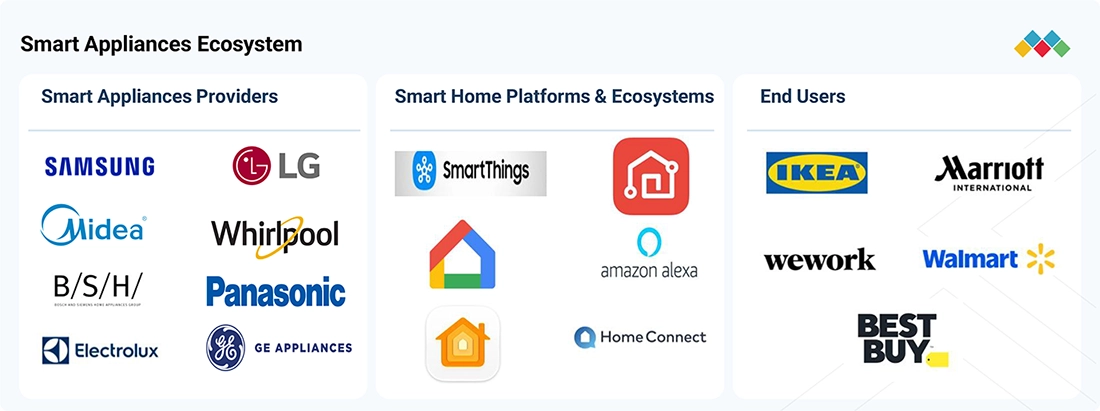
SMART APPLIANCES MARKET: COMMERCIAL USE CASES ACROSS INDUSTRIES
| COMPANY | USE CASE DESCRIPTION | BENEFITS |
|---|---|---|
 |
Samsung offers smart refrigerators, washing machines, air conditioners, and other connected appliances. Its SmartThings ecosystem enables users to connect compatible appliances, monitor their status, control functions remotely, and automate selected operations. | Enables centralized appliance management | Supports remote operation | Improves convenience | Provides energy monitoring features on compatible appliances |
 |
LG offers smart refrigerators, washing machines, dryers, and air conditioners with ThinQ connectivity, enabling users to monitor appliance status, control selected functions remotely, and access smart diagnosis features. | Improves convenience through remote control | Supports appliance monitoring and diagnostics | Helps users manage household appliances efficiently |
 |
Midea offers smart air conditioners, refrigerators, washing machines, and other connected appliances with mobile application controls and intelligent operating features. | Enables remote appliance control | Improves user convenience | Supports temperature and operating adjustments | Helps optimize appliance operation |
 |
Whirlpool offers connected kitchen and laundry appliances with smart features that allow users to monitor appliance status, receive notifications, and control selected functions through compatible applications. | Simplifies kitchen and laundry management | Provides appliance status notifications | Enables remote control | Improves day-to-day convenience |
 |
Panasonic offers connected appliances, including selected air conditioners, refrigerators, and washing machines, with smart functions that support remote operation, monitoring, and automated control where available. | Supports remote appliance management | Improves convenience | Enables automated operation of compatible appliances | Helps users monitor appliance performance |
Logos and trademarks shown above are the property of their respective owners. Their use here is for informational and illustrative purposes only.
Related Ecosystem
Electrical System And Components
- Natural Language Processing (NLP)
- Sensors
- Machine Learning
- Temperature Sensors
- Actuators
- ABB India Limited
- Siemens ag
- SCHNEIDER ELECTRIC SE
- Eaton Corporation plc
- General Electric Company
Electronics System And Components
- Sensors
- Temperature Sensors
- Pressure Sensors
- Actuators
- Image Sensors
- Lenovo
- Samsung
- Texas Instruments Incorporated
- HONEYWELL INTERNATIONAL INC.
- Teledyne Technologies Incorporated
Key Takeaways
- India's smart appliances market is projected to more than double from USD 2,889.6 million in 2025 to USD 6,131.8 million by 2030, driven by a 16.2% CAGR that exceeds global growth rates.
- India's expanding middle class and rising disposable incomes are accelerating consumer adoption of connected home devices across urban and semi-urban regions.
- Government smart city initiatives and declining IoT device costs are creating favorable conditions for market expansion in India through 2030.
- India's young, digitally-native population is driving demand for energy-efficient and convenience-focused smart appliances in the residential sector.
Smart Appliances Market Report Scope
| Report Metric | Details |
|---|---|
| Base Year | 2025 |
| Fastest Growing Segment | VACUUM CLEANING ROBOTS (Product) |
| Forecast Period | 2025-2030 |
| Growth Rate | CAGR of 11% from 2025 to 2030 |
| Largest Segment | WI-FI (Connectivity) |
| Market Size Base Year (Billions) | ~USD 42.3 (2025) |
| Revenue Forecast (Billions) | ~USD 71.28 (2030) |
| Segments Covered | Product, Vertical, Sales Channel, Connectivity |
India Smart Appliances Market Report Segmentation
4 segment dimensions are covered across the global market.
By Product
- Air Conditioners
- Air Purifiers
- Coffee Makers
- Cookers/Cooking Robots
- Dishwashers
- Microwaves
- Other Smart Appliances
- Ovens & Cooktops
- Refrigerators
- Vacuum Cleaning Robots
- Washing Machines & Dryers
- Water Heaters
By Vertical
- Commercial
- Residential
By Sales Channel
- Offline
- Online
By Connectivity
- Bluetooth
- Wi-Fi
- Wifi
Target Audience
- Electronics Manufacturers : Smart appliance and consumer electronics manufacturers need India market data to identify growth opportunities, plan production capacity, and develop region-specific product strategies for the high-growth market.
- Semiconductor & Component Suppliers : Chip manufacturers and component suppliers require India market insights to forecast demand for IoT processors, connectivity modules, and smart home semiconductors driving the 16.2% CAGR expansion.
- Investment & Private Equity Firms : Investors evaluating opportunities in India's electronics and smart home sectors need comprehensive market sizing, growth projections, and competitive landscape data to support funding and M&A decisions.
- Retail & E-commerce Platforms : Online retailers and distribution channels require India-specific market data to optimize product portfolios, forecast inventory needs, and capitalize on the growing smart appliances demand across regions.
- Market Strategists & Consultants : Business consultants and strategy teams need detailed India market analysis to advise clients on market entry, competitive positioning, and growth strategies in the rapidly expanding smart appliances sector.
Reasons to Buy this Report
- Market Size & Growth Validation : Access precise market valuation data for India (USD 2,889.6M in 2025) with 5-year forecasts to validate investment decisions and identify high-growth opportunities in the region's smart appliances sector.
- Competitive Positioning Strategy : Understand India-specific market dynamics, consumer preferences, and regional growth drivers to develop targeted go-to-market strategies and competitive positioning against local and international players.
- Investment & Expansion Planning : Leverage detailed India market insights to evaluate expansion opportunities, assess market entry strategies, and allocate resources effectively across different appliance categories and geographic segments.
- Consumer Trend Analysis : Gain insights into India's rising middle class consumption patterns, e-commerce adoption, and digital transformation trends driving smart appliance demand across urban and emerging markets.
- Risk Mitigation & Forecasting : Utilize India-specific CAGR data (16.2%) and market projections to forecast revenue potential, mitigate market entry risks, and make data-driven decisions for product development and marketing investments.
Frequently asked questions
What is the current size of India's smart appliances market in 2025?
India's smart appliances market is valued at USD 2,889.6 million in 2025, with strong growth momentum expected through the forecast period.
What is the projected market size for India's smart appliances by 2030?
India's smart appliances market is forecast to reach USD 6,131.8 million by 2030, representing more than a doubling of market value from 2025.
What is the CAGR for India's smart appliances market?
India's smart appliances market is expected to grow at a compound annual growth rate of 16.2% between 2025 and 2030, outpacing the global average of 11%.
What factors are driving growth in India's smart appliances market?
Key growth drivers in India include rising disposable incomes, urbanization, government smart city initiatives, declining IoT device costs, and increasing consumer awareness of energy efficiency.
How does India's smart appliances market compare to global growth?
India's 16.2% CAGR significantly exceeds the global smart appliances market CAGR of 11%, making India one of the fastest-growing markets in the sector.
RESEARCH METHODOLOGY
The study involved four major activities to estimate the current size of the smart appliances market. Extensive secondary research was conducted to gather information on the smart appliances market, related industries, and the broader smart home and connected appliance ecosystem. Primary research was then conducted with stakeholders across the value chain, including smart appliance manufacturers, technology providers, distributors, retailers, and end users across residential and commercial segments to validate market estimates and assumptions. Both top-down and bottom-up approaches were used to estimate the overall market size, followed by market breakdown and data triangulation to determine the size of individual segments and subsegments. Secondary and primary research were combined to provide a comprehensive analysis of the smart appliances market.
Secondary Research
Various secondary sources were referred to during the secondary research process to identify and collect information relevant to the smart appliances market. These sources included annual reports, press releases, investor presentations of key companies, product brochures, product and solution pages, technical documents, white papers, industry journals, certified publications, industry associations, company websites, trade directories, government databases, and smart home, connected devices, and consumer electronics industry sources. Secondary research was conducted to obtain key insights into the market's supply chain, value chain, competitive landscape, and segmentation across residential and commercial applications. It also helped analyze industry trends and the adoption of smart appliances, connected technologies, and IoT-enabled features across residential and commercial settings.
The collected data was further analyzed to estimate the overall market size and validate findings, which were subsequently refined through primary research with industry experts and key stakeholders.
Primary Research
Extensive primary research was conducted after gaining knowledge about the current scenario of the Smart Appliances market through secondary research. Several primary interviews were conducted with experts from the demand and supply sides across four major regions: North America, Europe, Asia Pacific, and RoW. This primary data was collected through questionnaires, emails, and telephonic interviews.
Breakdown of Primary Interviews
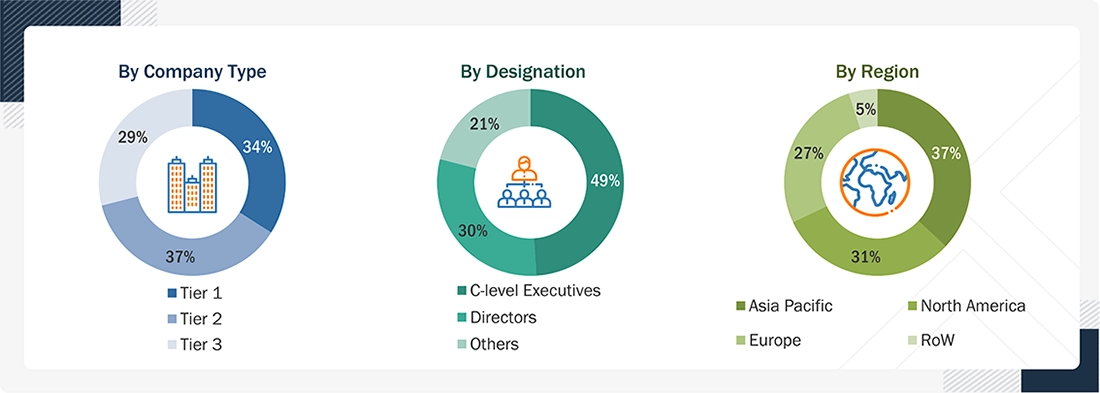
Note: The three tiers of companies are defined based on their total revenue in 2025: Tier 1 - revenue greater than or equal to USD 1 billion; Tier 2 - revenue between USD 100 million and USD 1 billion; and Tier 3 - revenue less than or equal to USD 100 million. Other designations include sales managers, marketing managers, and product managers.
To know about the assumptions considered for the study, download the pdf brochure
Market Size Estimation
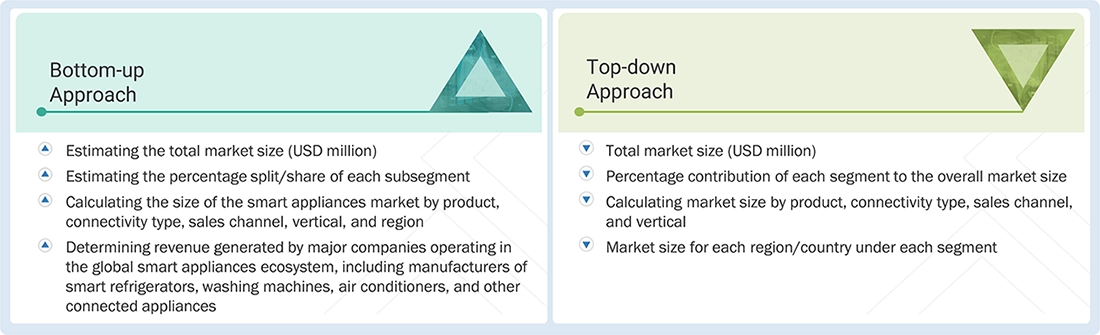
- Both top-down and bottom-up approaches were used to estimate and validate the total size of the smart appliances market. These approaches were also used extensively to estimate the size of various segments and subsegments in the market. The following research methodology was used to estimate the market size:
- Major players in the smart appliances industry and related smart home, connected device, and consumer electronics markets were identified through extensive secondary research.
- The industry value chain and market size (in terms of value) were determined through primary and secondary research processes.
- All percentage shares, splits, and segment-level breakdowns across residential and commercial applications were determined using secondary sources and validated through primary research.
Smart Appliances Market: Top-Down and Bottom-Up Approach
Data Triangulation
After arriving at the overall size of the smart appliances market through the market size estimation process described above, the total market was divided into relevant segments and subsegments. Data triangulation and market breakdown procedures were used, wherever applicable, to complete the overall market engineering process and derive statistics for all segments and subsegments. The data was triangulated by analyzing various factors and trends from both the demand and supply sides, including the adoption of smart appliances, technological advancements, connectivity features, and developments across residential and commercial applications. In addition, the market size was validated using both top-down and bottom-up approaches to ensure consistency across the overall market and individual segments.
Market Definition
A smart appliance is an electronic device equipped with connectivity, sensors, software, or intelligent control capabilities that enable automated functions, remote monitoring, and control. Smart appliances help users improve convenience, energy efficiency, operational performance, and resource management across residential and commercial settings. Smart appliance offerings include connected appliances and related technologies that enable remote access, automated operation, and integration with smart home or building management systems. Smart appliances are particularly important for applications that require efficient energy management, automated control, remote monitoring, and improved operational convenience. They support functions such as cleaning, cooking, food preservation, climate control, and other household and commercial operations. A typical smart appliance environment may integrate appliances with mobile applications, voice assistants, smart home platforms, Internet of Things (IoT) systems, and building management systems. The configuration and functionality of smart appliances vary depending on appliance type, connectivity capabilities, level of automation, application requirements, and end-user needs across residential and commercial segments.
Key Stakeholders
- Manufacturers and Suppliers
- Component Suppliers
- Software & Platform Providers
- Distributors & Retailers
- System Integrators & Service Providers
- Telecom & Connectivity Providers
- Regulatory & Standards Bodies
- End-user industries
- Research & Development Firms
Report Objectives
- To define, describe, and forecast the smart appliances market in terms of value across residential and commercial segments
- To forecast the market size, in terms of value, across four major regions—North America, Europe, Asia Pacific, and the Rest of the World
- To provide detailed information regarding the major factors influencing the growth of the smart appliances market, including drivers, restraints, opportunities, and challenges
- To analyze the micromarkets¹ for individual growth trends, prospects, and contributions to the overall market
- To provide a detailed overview of the value chain of the smart appliances market
- To analyze opportunities for various stakeholders by identifying high-growth segments of the market
- To profile key players and comprehensively analyze their market positions in terms of ranking and core competencies², along with detailing the competitive landscape of the market
- To analyze competitive developments, such as product launches and developments, partnerships, acquisitions, contracts, expansions, and research and development activities in the smart appliances market
Available customizations:
With the given market data, MarketsandMarkets offers customizations according to the company’s specific needs. The following customization options are available for the report:
Company Information
-
Detailed analysis and profiling of additional market players (up to 5)
Get the Full Smart Appliances Market Report
Full forecast, segment splits, and company analysis for all Smart Appliances Market.
- Canada Smart Appliances Market
- Mexico Smart Appliances Market
- US Smart Appliances Market
- France Smart Appliances Market
- Germany Smart Appliances Market
- Italy Smart Appliances Market
- Rest Of Europe Smart Appliances Market
- UK Smart Appliances Market
- China Smart Appliances Market
- Japan Smart Appliances Market
- Rest Of Asia Pacific Smart Appliances Market
- South Korea Smart Appliances Market
Need a Tailored Report?
Customize this report to your needs
Get 10% FREE Customization
Customize This Report
